
New U.S. military operations in Africa would most likely target jihadist groups in West Africa, the Democratic Republic of the Congo and Mozambique, but Washington could also conduct limited strikes in Sudan or Congo to force local belligerents to de-escalate fighting in a less-likely, higher-impact scenario. On Christmas Day 2025, U.S. President Donald Trump announced that the United States had struck Islamic State-linked militants in Nigeria's northwestern state of Sokoto, blaming the militants for having killed Christians for "many years, and even centuries." On Jan. 8, Trump said that while he would "love" for the recent U.S. military action in Nigeria to be a "one-time strike," it would be a "many-time strike" if more Christians were killed in the country. These comments came amid escalating attacks by jihadist groups, such as Islamic State West African Province (ISWAP), against Christian communities in Nigeria following the U.S. strikes in Sokoto. They also followed the United States' Jan. 3 forced removal of Venezuelan President Nicolas Maduro, and a growing willingness by the Trump administration to resort to military force abroad.
Potential Targets
Against this backdrop, RANE has assessed that the following five African geographies are the most likely to see new U.S. military action before the end of Trump's term in January 2029. This ranking explicitly excludes Somalia, where the United States has routinely targeted al Qaeda affiliate Al Shabaab since the late 2000s.
Nigeria (60% likelihood)
ISWAP's revenge attacks against Christian communities following recent U.S. strikes and Trump's domestic political considerations suggest that the United States will launch additional aerial or missile strikes against jihadist groups in Nigeria, which would likely escalate intercommunal tensions if they become recurrent. Following the United States' December 2025 strikes in Sokoto, Nigerian security officials said that Washington would step back from direct military action in Nigeria and instead focus on intelligence sharing and conducting intelligence, surveillance and reconnaissance flights to support Nigerian security forces. But while this pattern will likely dominate counter-terrorism cooperation between the United States and Nigeria for the foreseeable future, ISWAP's retaliatory attacks against Christian communities in the aftermath of the U.S. strikes create strong incentives for Trump to order new U.S. military action in the country. Domestic political considerations further heighten this prospect, as Trump could order strikes on Nigeria-based jihadist groups to change the media narrative at a time of weakness and/or mobilize his conservative Christian base ahead of the U.S. midterm elections. This suggests that the United States will likely launch new aerial or missile strikes against ISWAP or other jihadist groups in Nigeria, such as Lakurawa or Jama'atu Ahlis-Sunna Lidda'awati Wal-Jihad (JAS), also known as Boko Haram. Such strikes could occur in northeast Nigeria, which has been a jihadist stronghold for over a decade and is where ISWAP has conducted most of its revenge attacks against Christians following the U.S. strikes in Sokoto. Alternatively, the Trump administration may continue strikes in the northwest, given the strong momentum of jihadist groups in the area, including by Lakurawa, JAS and al Qaeda affiliate Jama'at Nusrat al-Islam wal-Muslimin (JNIM). Such operations would likely be limited to attacks against a handful of jihadist campsites and/or their logistics networks. The Trump administration would likely seek Nigerian authorities' formal consent before conducting any new military operations, but these demands could be given with little notice — effectively putting Abuja before a fait accompli or risk facing unilateral U.S. strikes. But even if U.S. military action is conducted with the Nigerian government's formal approval, further U.S. strikes will still risk exacerbating Muslim-Christian tensions if they become recurrent – especially as tensions between both communities rose following the December 2025 strikes. This would increase the potential for violent unrest in the run-up to Nigeria's 2027 general elections — a period that is already prone to identity-based violence due to the country's ethnic and religious divides.
- Following the U.S. strikes in Sokoto, ISWAP attacked at least three predominantly Christian settlements in the northeastern state of Adamawa. These attacks resulted in the burning of a church and over 150 houses, and reportedly killed at least a dozen people, with the actual death toll likely being much higher. In its media communication following these attacks, ISWAP explicitly referred to Christians as "hostile."
Mali and the Western Sahel (55% likelihood)
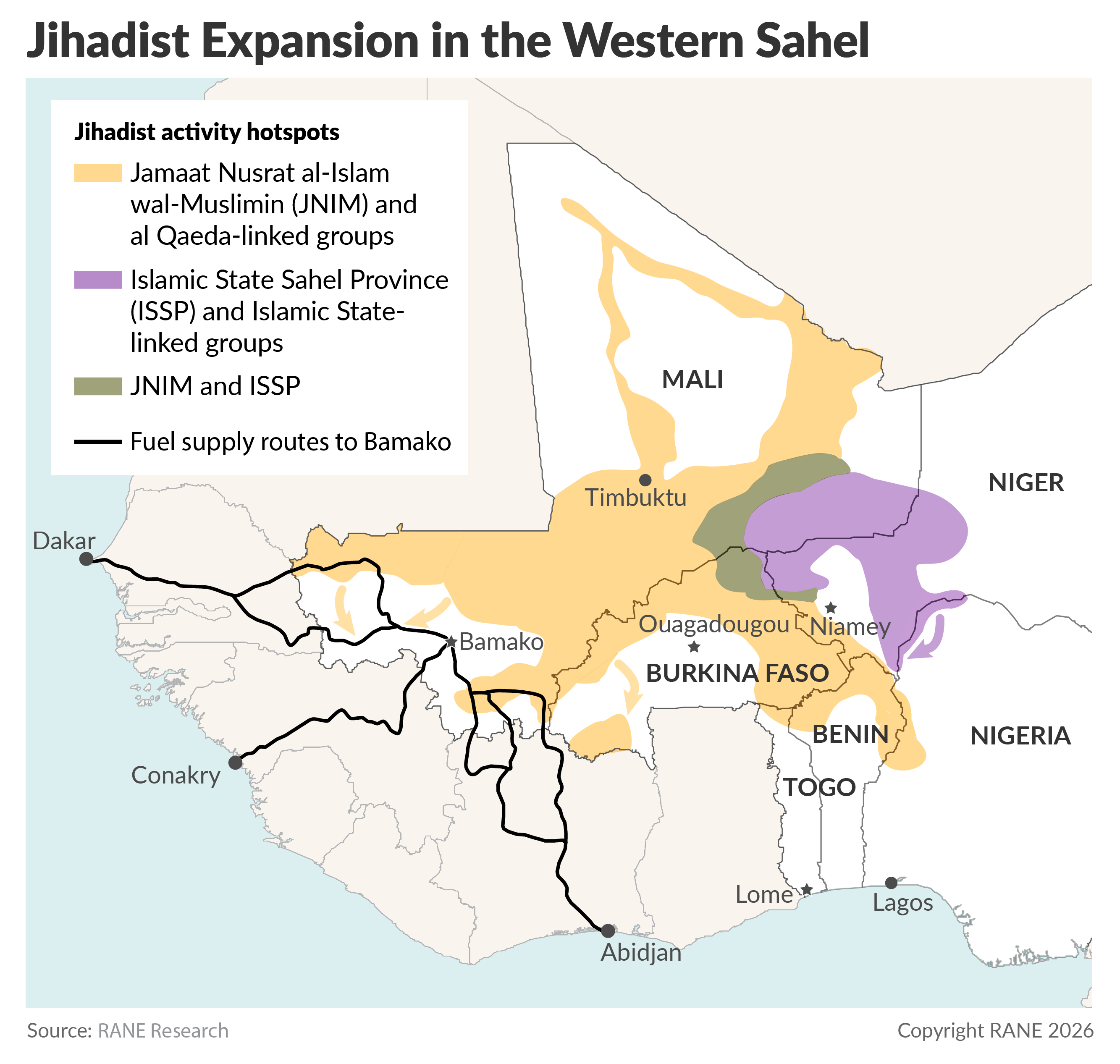
In the Western Sahel, the United States is most likely to take action in Mali given al Qaeda affiliate JNIM's advances near the capital, but the Trump administration could also conduct missile or aerial strikes in Burkina Faso and Niger, as well as the northern parts of Benin and Togo. The western Sahel's security environment has steadily worsened in recent years amid strong momentum by JNIM and Islamic State Sahel Province (ISSP) militants. In September 2025, JNIM initiated a fuel blockade on government-held areas in Mali, resulting in severe fuel shortages in the capital, Bamako. While fuel shortages have somewhat eased since mid-November 2025, the group remains a major security threat. JNIM's recent progress around Bamako reportedly prompted Cote d'Ivoire to lobby the Trump administration to dispatch intelligence, surveillance and reconnaissance (ISR) assets to its territory, in order to support the Malian junta's counterinsurgency operations along key axes of transport connecting Bamako to the Ivorian border — a pivotal transport corridor for fuel supplies. The Malian junta's emphasis on national sovereignty currently limits the prospects for U.S. ISR flights over the country, though this may change if fuel shortages in Bamako worsen, which appears likely in 2026. Moreover, JNIM advances toward Bamako, or indications that its momentum presents an imminent threat to the junta's stability, would increase the likelihood of the United States launching aerial or missile strikes against the jihadist militants to ease pressure on Malian security forces. This scenario would become especially likely if U.S. media outlets start reporting on an allegedly imminent jihadist takeover of the Malian capital. But while U.S. strikes in the western Sahel would most likely occur in Mali, the Trump administration's recent outreach to the juntas in Burkina Faso and Niger suggests these countries might also see U.S. attacks on jihadist targets. Meanwhile, JNIM activity in Benin and Togo means the Trump administration may direct strikes against jihadist groups in either country — particularly northern Benin, where JNIM is gaining ground and security forces are struggling after a recent coup attempt.
The Democratic Republic of the Congo (30% likelihood)
U.S. military action in Congo would most likely target the Islamic State-linked Allied Democratic Forces (ADF), but a low-likelihood, high-impact scenario could also see strikes against Rwanda-backed M23 rebels if the group makes significant advances into central and/or southern Congo. The ADF mostly operates in Congo's eastern North Kivu and Ituri provinces. The jihadist group has repeatedly attacked Christian communities in these areas, including burning churches and conducting targeted assaults on predominantly Christian settlements that often result in dozens of fatalities. Given Trump's emphasis on protecting Christian communities, this makes the ADF a high-ranking target for future U.S. strikes in Africa. While launching Tomahawk missile strikes from the Western Indian Ocean is technically feasible, the need to fly over Kenya and Uganda to reach ADF strongholds in eastern Congo suggests that the United States would likely favor aerial strikes. This option will be further facilitated by the Trump administration's growing ties with the Congolese government amid its recent brokering of a peace deal with Rwanda. However, the ADF's lower public profile in the United States and Europe compared with West African jihadist groups makes U.S. strikes in Congo relatively less likely than in Nigeria or Mali. Beyond the ADF, the Rwanda-backed M23 rebel group is another potential, though far less likely, target for U.S. military strikes in Congo. Currently, the United States appears highly unlikely to take direct military action against the group, given the Trump administration's recent role in brokering the Congo-Rwanda peace deal and the fact that M23 remains in Congo's outlying eastern region. However, this could change if M23 successfully launches a major offensive into central and/or southern Congo, which would risk broadly destabilizing the country — thereby undermining the Trump administration's plans to expand U.S. investments in the mineral-rich Katanga region. In this low-likelihood, high-impact scenario, Trump could order aerial strikes against the M23 to halt their advances, secure U.S. commercial interests in Katanga and force the rebel group — and, by extension, Rwanda — to reenter meaningful negotiations with the Congolese government.
Mozambique (25% likelihood)
The Trump administration could conduct military action against Islamic State Mozambique (ISM) in the northern Cabo Delgado province, with the stated goal of protecting Christians and U.S. commercial interests. Cabo Delgado first saw the emergence of an Islamist insurgency in 2017, which rallied the Islamic State in 2019. The group's expanding capabilities in the area ultimately forced U.S. multinational oil and gas company ExxonMobil and French multinational energy company TotalEnergies to declare force majeure on large-scale liquified natural gas projects in the province following a major jihadist offensive on the town of Palma in March and April 2021 that killed over 1,000 civilians. ISM's capabilities have since significantly weakened following a Rwandan military intervention that enabled both ExxonMobil and TotalEnergies to lift their force majeure in late 2025. However, the jihadist group remains a major security threat in Cabo Delgado and has recently expanded its operations in the neighboring Nyassa and Nampula provinces. Moreover, ISM militants have repeatedly and deliberately targeted Christian communities, including through the burning of churches and the beheading of Christian individuals. Given Trump's emphasis on protecting Christian communities, ISM thus appears as a high-profile target for new U.S. military operations in Africa. Nonetheless, the group is somewhat less prominent than other jihadists in Somalia and West Africa, making it somewhat less likely that Trump will order strikes against it. However, this prospect would become more likely if ISM conducts a high-profile attack on Christians that gains media coverage in conservative U.S. outlets, such as Fox News. Reports of successful ISM infiltration and/or attacks on ExxonMobil and TotalEnergies' shared project site in Cabo Delgado could also be a trigger for strikes, given Trump's emphasis on defending U.S. commercial interests.
- Although TotalEnergies is not a U.S. company, the Export-Import Bank of the United States re-approved a $4.7 billion loan to the French major's $20 billion Mozambique LNG project in March 2025, meaning that Washington now has a vested interest in the project's completion. This suggests that even if ExxonMobil does not make a positive final investment decision on its $30 billion Rovuma LNG, threats to TotalEnergies' project could act as a catalyst for U.S. intervention — even though Trump would likely emphasize the defense of Christian communities in such a scenario.
Sudan (15% likelihood)
In Sudan, the United States could take military action against either the Sudanese Armed Forces (SAF) or the Rapid Support Forces (RSF) in order to force belligerents into agreeing to deconfliction measures or a ceasefire, but this prospect remains constrained by the risk of severe friction with either Saudi Arabia or the United Arab Emirates. Since April 2023, Sudan has been embroiled in a brutal civil war between the SAF and RSF that has killed over 150,000 people. In September 2025, the Trump administration forwarded a peace plan in coordination with Egypt, Saudi Arabia and the United Arab Emirates. But while RSF has nominally accepted those proposals, SAF leader Abdel Fattah al-Burhan has repeatedly rejected them, maintaining a maximalist stance against the RSF. Against this backdrop, Trump could direct military action against the SAF, and especially allied Islamist militias such as the Al-Bara' bin Malik Battalion, in order to force al-Burhan to accept U.S.-backed proposals for a humanitarian truce. In a low-likelihood, high-impact scenario, the United States could also capture or kill al-Burhan, with the goal of replacing him with someone more willing to compromise (mirroring the Trump administration's current "regime-tweaking" strategy in Venezuela). However, such a move would risk sparking armed clashes between SAF factions amenable to U.S.-led mediation efforts and SAF-linked Islamist groups, most of whom strongly oppose any mediation with the RSF. In any case, the likelihood of any U.S. military action against the SAF remains relatively low, as it would risk alienating Saudi Arabia, which is increasingly supporting the SAF's fight against the UAE-backed RSF, as Riyadh tries to counter growing Emirati influence in northeast Africa. Meanwhile, the Trump administration could also conduct strikes against the RSF, given widespread allegations that its fighters are conducting genocidal activity against Black African tribes in Darfur and Kordofan. But this is also unlikely as it would risk alienating the United Arab Emirates, the paramilitary group's main foreign patron.
