
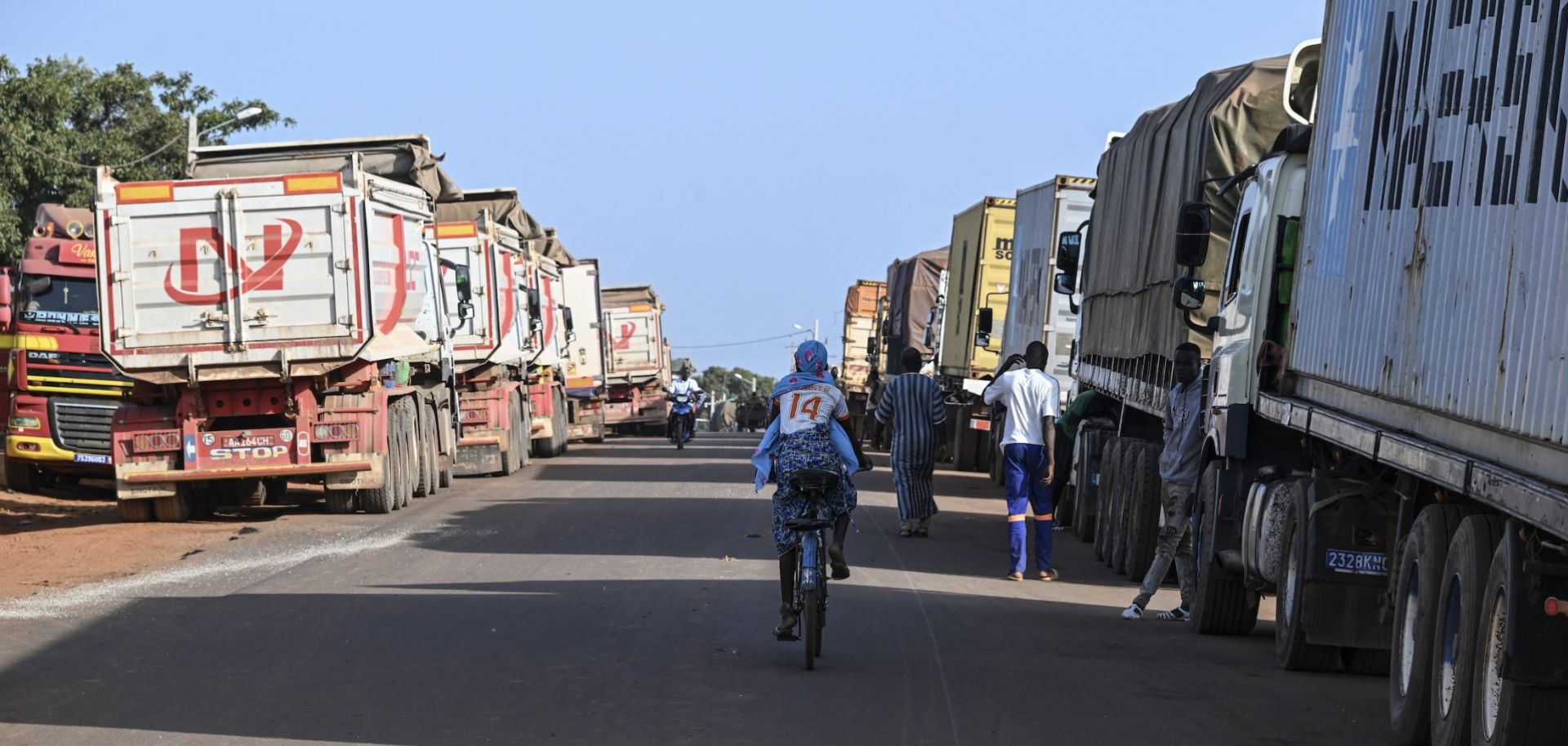
Jihadists' fuel blockade on Mali's capital is set to increase popular and elite pressure on the ruling junta, whose likely inability to use force to fully lift the blockade portends rising intra-junta tensions that risk fragmenting the country's security forces, a development that jihadists would likely exploit to advance toward the capital. On Oct. 28, the U.S. Embassy in Mali issued a security alert calling on all U.S. nationals to immediately leave the country amid a worsening fuel blockade by al Qaeda affiliate Jamaat Nusrat al-Islam wal-Muslimin (JNIM) in the capital Bamako and other major cities. The fuel blockade, which began in early September, has led to severe shortages of diesel and gasoline, bringing the economy to a standstill and causing fuel prices to increase by up to 500%. While Mali's junta has deployed security forces to escort fuel truck convoys importing petroleum products from neighboring countries, this has not prevented JNIM from torching hundreds of those convoys in recent weeks. In turn, Malian forces' failure to secure a steady supply of fuel to Bamako has heightened tensions within the junta. On Oct. 22, Malian President Assimi Goita sacked the Chief of Staff of the Army and two other members of his top brass — a move that followed an earlier purge on Oct. 8, when 11 high-ranking military figures were dismissed. Facing an increasingly desperate situation, Malian authorities have reportedly entered talks with JNIM to lift the blockade, but as of early November, these have yet to yield positive results.
- Following the U.S. embassy's Oct. 28 announcement, several other Western countries — including Germany, Italy and Australia — called on their citizens to immediately leave Mali. These announcements came after the junta's Oct. 26 decision to close schools and universities nationwide until Nov. 11 due to the ongoing fuel blockade.
- Mali does not produce crude oil on a commercial scale and lacks an oil refinery, making the landlocked country wholly dependent on imports to secure its supply of petroleum products. Estimates indicate that around 70% of Mali's trade transits through the Senegalese port of Dakar, but 2023 trade data shows that Mali imported 47% of its petroleum products from Senegal and 46% from Cote d'Ivoire.
- According to Radio France Internationale, local officials from Mali's central Mopti region began talks with JNIM as early as the beginning of October, at the initiative of Malian intelligence services. However, the talks have reportedly struggled to make progress due to disorganization and the presence of numerous intermediaries. Key JNIM demands reportedly include the release of prisoners, the officialization of negotiations, an end to army controls of bus stations and a requirement for women to wear a headscarf on public transport. Certain sources have claimed that JNIM also wants the Malian army to abandon the control of fuel sales in rural areas, but this has been disputed by a Malian security official.
JNIM's imposition of a fuel blockade on Bamako comes as the group has markedly expanded its reach into southern Mali and is seeking to maximize economic costs on the junta to undermine its legitimacy and ability to govern the country. Mali's security environment has steadily deteriorated since 2022-2023, after Goita effectively forced out French troops and U.N. peacekeepers from the country. While the junta's pivot toward Russia enabled it to secure the deployment of nearly 2,500 Russian paramilitary personnel, this force has been unable to compensate for the void left by the departure of French and U.N. forces. Furthermore, the Kremlin's use of violent counter-insurgency tactics, including the massacres of civilians, has further boosted recruitment for jihadist groups. Against this backdrop, JNIM has rapidly expanded its reach, launching deadly attacks on Bamako in September 2024, while consolidating its influence over the economy of rural areas of southern Mali, which is more populous and politically significant than the country's central and northern regions. Importantly, this has enabled the jihadist group to deepen ties with communities outside of the Tuareg and Fulani ethnic groups, which have served as the main recruitment pool for jihadist groups in Mali over the last 15 years. Despite this strong momentum, JNIM has so far refrained from launching major offensives to capture large urban centers, as the junta's military capabilities still give it an edge in waging conventional battles. To assert its influence, JNIM has instead imposed blockades to interrupt the movement of goods and people in a number of towns and cities, with the goal of forcing local power brokers to accept some of its key demands. This strategy has already been successful in several localities, leading to de-escalation agreements that have seen Malian security forces reduce their presence in certain areas. Since the spring, JNIM has also escalated its targeting of Mali's economic interests by attacking mining and industrial sites and kidnapping more non-Western nationals, with the goal of deterring foreign investments in the country.
- JNIM's expansion strategy in Mali has heavily emphasized increasing its influence over the country's economic networks, especially in rural areas. This has involved asserting control over logging activity and artisanal mining, as well as livestock breeding and trading — a key part of the local economy. The group's involvement in drug and weapon smuggling has also enabled JNIM to amass significant financial firepower and provide generous compensation to its fighters, further driving recruitment. Moreover, JNIM has demonstrated political and ideological pragmatism in its efforts to forge ties with local actors, facilitating its implantation in Mali and the wider western Sahel.
- In July, JNIM launched attacks against mining sites near the locality of Bafoulabe in southwestern Mali. The same month, the group also attacked a factory operated by the Indian cement company Diamond Cement in the Kayes region and kidnapped three Indian nationals. Moreover, JNIM has targeted at least six Chinese-operated industrial sites in recent months.
- In April, JNIM lifted a year-long blockade on the town of Boni in central Mali after security forces agreed to reduce their presence in the area. In many rural areas of the country, JNIM has also reached deals with local elites, in which the group agrees not to harm local communities so long as they pay taxes, adhere to sharia law and/or cease cooperating with Malian security forces.
Mali's junta is unlikely to forcefully lift the blockade on its own, which, combined with its close partners' limited willingness and/or ability to provide rapid military support, suggests that fuel shortages are likely to persist in the coming weeks. For the foreseeable future, Mali's junta is set to prioritize the deployment of troops to escort fuel convoys and protect the main communication axes connecting Bamako to Cote d'Ivoire, Senegal and Guinea. The junta may also seek to airlift fuel to Bamako with the support of Russia. But while these measures may somewhat ease the fuel blockade in Bamako, the junta will face major challenges in airlifting fuel supplies at scale. Meanwhile, the reallocation of security forces will likely further erode state authority in less strategic areas, paving the way for a further erosion of state authority. Moreover, securing hundreds of kilometers of road network running across JNIM's support zones will prove highly challenging for the junta, especially given its lack of significant air capabilities. This suggests that the junta is unlikely to forcefully lift JNIM's blockade by itself, portending persisting fuel shortages in the absence of a deal with JNIM, as jihadist militants will retain the ability to conduct surprise hit-and-run attacks in pre-selected areas. Against this backdrop, Mali's junta will become increasingly likely to request military assistance from both Russia and its allied juntas in Niger and Burkina Faso. But despite Mail's formation of a trilateral force with its two Sahelian allies, neither Niger nor Burkina Faso is likely to commit significant military resources to Mali, given that both nations are also facing a rapid expansion of jihadist activity within their borders. Meanwhile, Russia may be open to providing limited additional military assistance, such as deploying more air assets. However, it appears unlikely that Russia will be willing to press ahead with a large enough expansion of its military presence in Mali to break JNIM's fuel blockade. Meanwhile, such a mission would also prove challenging for Moscow from an operational standpoint, and Mali's financial capacity to fund a significant military buildup is also limited, further deterring Moscow from pursuing it.
- After a meeting between Goita and a Russian delegation, a Russian official announced on Oct. 24 that Moscow would deliver between 160,000 and 200,000 tonnes of petroleum and agricultural products to Mali. However, Russian authorities did not specify how the goods would be supplied to Bamako, nor the exact quantity of fuel product they planned on delivering.
The economic fallout from the ongoing fuel shortages raises the risk of unrest and will intensify pressure on Goita to strike a deal with JNIM to lift or ease the blockade, but disagreements within the junta regarding negotiations with the jihadist group will likely escalate intra-junta tensions and increase the likelihood of a military coup, which could reorient Mali's foreign policy. The persistence of widespread fuel shortages in Bamako and other major cities is set to take a growing toll on Mali's economy, driving up the cost of basic goods and heightening socioeconomic grievances. Together with security forces' inability to ensure basic state functions such as securing fuel supplies, Malians' growing economic hardship will further erode the junta's legitimacy, potentially leading to riots. The risk of unrest will increase the longer fuel shortages persist, thereby intensifying pressure on Goita to strike a deal with JNIM to lift the fuel blockade. However, the jihadist group has little incentive to compromise on its key demands, including a reduction in the presence of Malian security forces in certain areas. Although JNIM could be open to a narrower deal, where it allows a small number of preselected fuel convoys to enter the capital in exchange for limited concessions from the junta, this would not address the underlying fuel crisis. Regardless, disagreements over whether the junta should strike any sort of a deal with JNIM, as well as regarding what concessions should be made, are set to escalate tensions among Malian security forces. Meanwhile, parts of the county's top brass will likely become more open to expanding military cooperation with the Economic Community of West African States, or ECOWAS, the United Nations and/or the United States in the face of Russia's likely inability or refusal to press ahead with a major military buildup in Mali. Escalating disagreements on which strategy to adopt to end the fuel blockade will thus increase the likelihood of Goita being forcefully removed from power. While Goita's removal could be opportunistically driven, it may also pave the way for a more significant realignment of Mali's counter-terrorism strategy, either through a pivot toward ECOWAS and the United States, or through negotiating a more comprehensive deal with JNIM that meets some of the jihadist group's key governance demands, such as the implementation of sharia law.
- U.S.-Mali relations were tense under former U.S. President Joe Biden's administration due to the junta's refusal to transition the country back to civilian rule and human rights violations by Malian security forces. However, the current U.S. President Donald Trump's administration has since reengaged with the junta. On July 22, Mali's foreign minister met with a U.S. delegation and discussed plans to expand security and economic cooperation. In a Truth Social post on Nov. 1, Trump vowed to "wipe out Islamic terrorists" targeting Christians in Nigeria, suggesting the United States could be open to partnering with Mali's junta against JNIM.
JNIM's likely continuation and potential escalation of its "economic jihad" against the junta would undermine the cohesion of Malian security forces and could eventually result in mutinies or infighting between different factions of the military, which would significantly increase the likelihood of JNIM asserting its authority over Bamako. Barring major concessions by the junta, JNIM will likely sustain its fuel blockade on Bamako and Mali's other large cities. But the jihadist group is also growing more likely to escalate its "economic jihad," which could, for example, see JNIM expand its interdiction of trade to Bamako to non-fuel goods and/or the movement of people. These tactics portend a further attrition of the junta's morale and public legitimacy, which, together with likely disagreements within Mali's top brass on potential talks with JNIM, will degrade the cohesion of the country's security forces. In addition to raising the risk of a coup, growing intra-junta tensions will also increase the likelihood of mutinies from certain army units and no-shows from soldiers, which will erode security forces' chain of command and could ultimately result in clashes between different military factions. While JNIM's immediate objective may not be to capture Bamako, such a fragmentation of Mali's military would incentivize JNIM to launch a coordinated push toward the capital, which the group could assert control over within days, given the crumbling of state institutions implied in this scenario. Alternatively, JNIM could strike a power-sharing deal with some elements of Mali's military that grants it a pivotal say on government affairs. Were JNIM to ascend to power in Mali, it would send shockwaves globally and raise concerns about a potential rapid jihadist takeover of neighboring Niger and Burkina Faso. Facing these risks, juntas in both countries could pivot back toward ECOWAS and/or the United States, and tilt away from Russia in the face of Moscow's failure to defend its Malian ally. Meanwhile, JNIM would likely try to head off a Western or ECOWAS intervention against it by projecting moderation, which may involve cutting its ties to al Qaeda. However, this move would risk increasing tensions within JNIM, potentially causing local cells in Niger, Burkina Faso or Benin to splinter from the group. But even if JNIM formally severed ties with al Qaeda, fear of a jihadist spillover across the rest of West Africa would still likely prompt calls for an ECOWAS intervention to oust JNIM from the Malian capital.
- France — which held much sway over its former West African colonies, including Mali, until the start of the 2020s — would be unlikely to swiftly intervene militarily in Mali to force JNIM out of Bamako, given its recent departure from a policy of proactive military intervention in the region. However, France — along with the United States — would probably be open to militarily supporting an ECOWAS-led mission against JNIM.
