
The United States is pressuring Nigeria to take visible action against armed groups targeting Christian communities, but Abuja faces multiple constraints to curb the violence, and fresh instances of high-profile intercommunal attacks would increase the likelihood of U.S. airstrikes in Nigeria. On Oct. 31, U.S. President Donald Trump announced in a post on Truth Social that he was designating Nigeria as a Country of Particular Concern due to the killing of Christians in the country. The following day, Trump warned that his administration would ''immediately stop all aid and assistance'' to Nigeria if its government ''continue[d] to allow the killing of Christians,'' and said he had instructed the U.S. Department of Defense to prepare for ''possible action'' in the country. Trump later told reporters on board Air Force One that this could involve launching air strikes or deploying ground troops. In response to Trump's comments, a spokesperson for Nigerian President Bola Tinubu stressed Nigeria's interest in expanding cooperation with the United States, although he added that such assistance would need to respect Nigeria's sovereignty. Meanwhile, Republican Senator and Chairman of the U.S. Senate Foreign Relations Subcommittee on Africa and Global Health Policy Ted Cruz reiterated on Oct. 31 that he was forwarding legislation that would impose sanctions against Nigerian officials who ''implement or support blasphemy and sharia law.''
- The 1998 International Religious Freedom Act allows the U.S. government to designate countries it considers as severely violating religious freedom as ''Countries of Particular Concern'' (CPCs). Under U.S. law, this designation exposes Nigeria to restrictions on U.S. development and military aid, U.S. opposition to loans from international financial institutions, and targeted sanctions against Nigerian officials deemed responsible for religious freedom violations. Trump first designated Nigeria as a CPC at the end of his first term in December 2020, but this designation was quickly reversed after former U.S. President Joe Biden took office the following month.
- Since 2000, 12 of Nigeria's 36 states have implemented Sharia law. In the northeastern states of Gombe, Yobe and Borno, Sharia is only applied to personal and civil matters. However, in the other nine states, it extends to criminal law, making blasphemy a criminal offense.
Nigeria has a long history of intercommunal violence between Christian and Muslim communities, including in recent months, and Northern Nigeria's security environment has further degraded over the past year amid worsening jihadist and bandit attacks. High levels of mistrust between Nigeria's diverse ethnic groups have resulted in political competition and the allocation of resources being heavily influenced by ethnic interests at both national and local levels. The ensuing unequal distribution of power and resources has, in turn, fueled perceptions of injustice and resulted in recurring outbreaks of intercommunal violence since the country's independence from the United Kingdom in 1960. However, the frequency of intercommunal violence has markedly increased over the past two decades, largely due to escalating tensions between predominantly Muslim herders (primarily Fulanis) and predominantly Christian farmer communities over access to resources, which have been fuelled by Nigeria's rapid population growth. The past few months have seen several high-profile instances of intercommunal violence in Nigeria's Benue and Plateau states, located in the country's Middle Belt. These outbreaks coincide with a recent resurgence in jihadist activity in northern Nigeria, where Jama'at Ahl al-Sunna li al-Da'wa wa al-Jihad (also known as Boko Haram, or JAS) and its splinter group, Islamic State West Africa Province (ISWAP), have expanded the pace and range of their attacks against authorities following a lull in activity in the early 2020s. Meanwhile, rapidly expanding jihadist activity in the western Sahel region — which includes Mali, Niger and Burkina Faso — has also seen elements linked to al Qaeda affiliate Jamaat Nusrat al-Islam wal-Muslimin (JNIM) and the Islamic State Sahel Province (ISSP) begin operations in northwestern Nigeria over the past year. Further degrading northern Nigeria's security environment has been a fresh influx of weapons from the western Sahel and a lack of economic opportunities in northern states, which has fueled escalating attacks by bandit groups.
- Nigeria has between 350 and 400 ethnic groups based on linguistic classification. However, three main groups — the northern-based Hausa-Fulani, the southwestern-based Yorubas and the primarily southeastern-based Igbos — account for approximately 65% of the population, and have competed for state power since before the country's independence.
- Farmer-herder tensions and violence were particularly high in Nigeria during former President Muhammadu Buhari's tenure (2015-2023). Many Yorubas, Igbos and predominantly Christian communities accused Buhari, a Muslim northerner, of turning a blind eye to violence committed by Fulani herders against farmers, which sparked debate over Buhari's purported plans for the ''Fulanization'' of Nigeria. While Buhari rejected these accusations, a 2018 report from Amnesty International found that his administration was responsible for ''at least, wilful negligence, at worst; complicity'' regarding the worsening of farmer-herder violence.
- In May and June 2025, Nigeria's Benue state experienced significant communal violence after primarily Fulani gunmen started attacking predominantly Christian farmers. The clashes were fueled by a combination of ethnic, religious and political factors, as well as competition for resources. While the Nigerian government reported only 45 fatalities, local community leaders claimed that over 200 people were killed. According to the nonprofit Armed Conflict Location and Events Data, June 2025 was the deadliest month in Benue state since the clashes between local militias began in 2016.
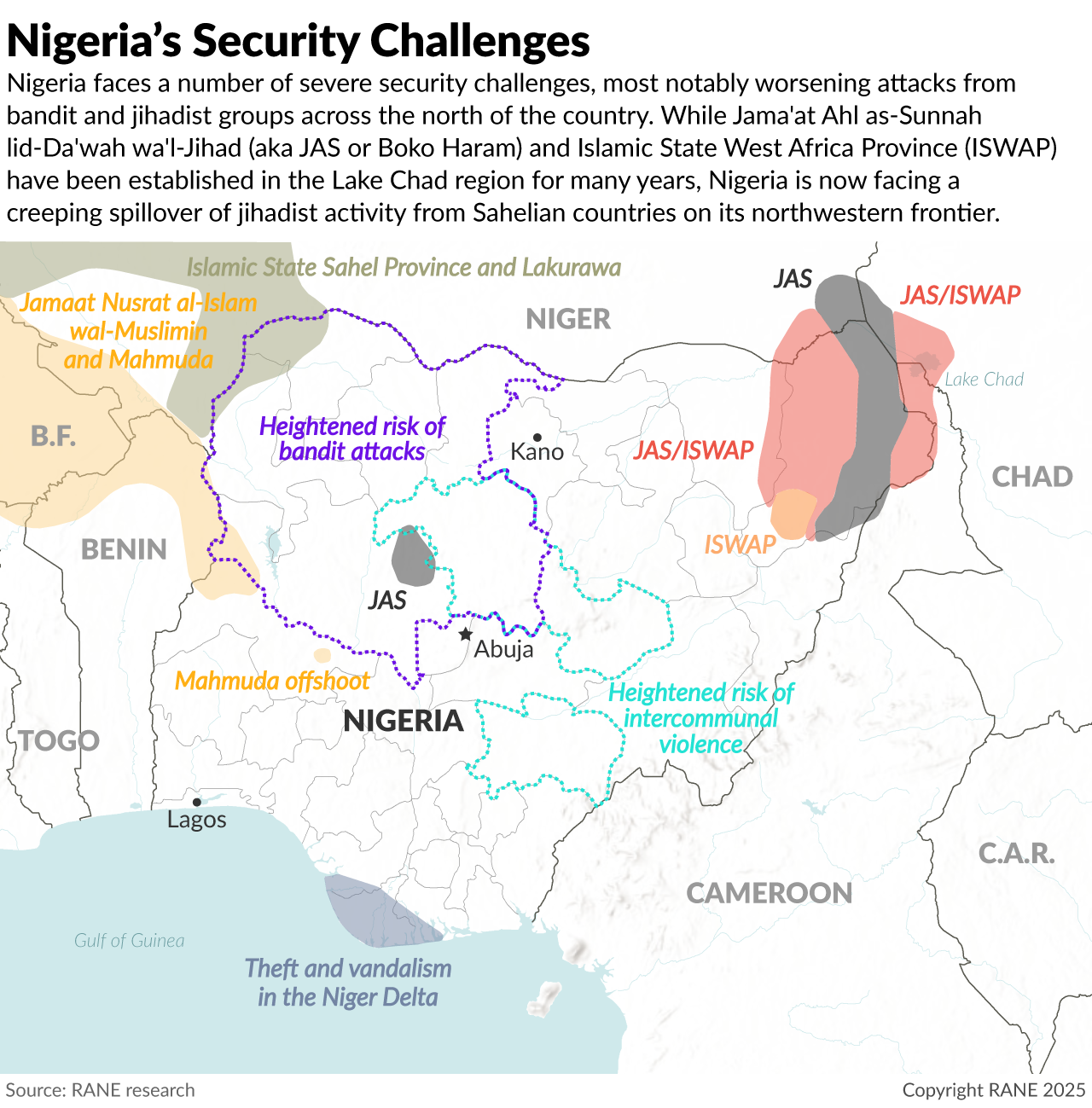
Despite Nigeria's likely willingness to cooperate with the United States against armed groups targeting Christian communities, the Trump administration may still deem Abuja's actions against these groups insufficient, potentially leading to cuts in U.S. aid and U.S. sanctions against Nigerian officials. Tinubu's openness to expanding security cooperation with the United States in the face of Trump's rhetorical threats indicates that Nigeria's federal government will likely be willing to take rapid and visible action against jihadist groups. However, Nigerian security forces are already stretched thin across the country amid a plethora of security challenges, which, in addition to those affecting Northern Nigeria, include ensuring the security of oil-rich Niger Delta and countering Igbo separatists in the southeast. This will constrain Abuja's ability to press ahead with a sustained surge in counter-insurgency operations against Boko Haram and/or other jihadist groups, as a prolonged redeployment of forces would likely create security vacuums elsewhere in the country that other armed groups would likely exploit. Moreover, Trump has not explicitly mentioned which armed groups targeting Christian communities should be prioritized for action, which means the White House could very well pressure the Nigerian government to also target Fulani herder militias. This would present Nigerian security forces with a similar dilemma, as sustained operations against Fulani militants would also lead to security vulnerabilities in other parts of the country. Furthermore, a deliberate focus by Nigeria's federal government on targeting Fulani militias would expose Tinubu to political backlash, as he would likely be accused by certain northern elites and politicians of siding against herders in the country's perennial farmer-herder conflict, rather than seeking to resolve it. Together, these security and political constraints suggest that there is a significant risk that the Nigerian government's actions against armed groups targeting Christian communities will be deemed insufficient by the Trump administration, which would increase the likelihood of U.S. sanctions on Nigerian officials, as well as cuts to U.S. assistance and development aid to the country.
- U.S. aid to Nigeria totaled around $1 billion in 2023. But this has sharply decreased following the Trump administration's cuts to development aid, with partial data for 2025 indicating that Nigeria has so far only received $250 million in U.S. assistance this year. To offset this reduction, the Nigerian government approved an additional $200 million in spending.
Nigeria could strike an expanded security partnership with the United States if the Trump administration perceives it as taking sufficient action, but bilateral relations will likely face short-term turbulence and could face a sustained downturn if the Trump administration presses for changes to Sharia and blasphemy laws in Nigeria's northern states. Tinubu's plans to expand security cooperation with the United States will likely focus on intelligence sharing and the acquisition of modern military equipment, especially intelligence, surveillance and reconnaissance capabilities. The Trump administration will likely be more willing to overlook concerns over Nigerian forces' human rights abuses, which have previously hindered U.S.-Nigeria security cooperation. However, Nigeria's new ''Country of Particular Concern'' designation suggests that the White House will link deeper defense ties to Abuja's taking what it considers as sufficient action against armed groups targeting Christian communities. While this will prove challenging for Nigeria to sustain due to the aforementioned manpower and political constraints, a well-publicized success — such as the killing of a high-profile jihadist commander — could be enough to initiate an expansion of security collaboration. In a currently less likely scenario, this could evolve into a broader U.S.-Nigeria security partnership, potentially extending to economic sectors such as oil and gas. However, Trump's sharp rhetoric suggests relations are more likely to remain tense in the coming weeks, which could lead to increased U.S. tariffs on Nigerian goods. Moreover, bilateral relations could face a sustained downturn if the Trump administration aligns with Ted Cruz's stance and pressures the Tinubu administration to oversee changes to Sharia and blasphemy laws in the country's northern states. In addition to being challenging for Nigeria's federal government to implement — given that this would primarily be a matter for Nigerian states to decide — Tinubu would likely oppose advocating for such changes to avoid significant backlash, including riots, in northern states, which are set to play a crucial role in his likely bid for a second term in Nigeria's next general elections, scheduled for in late 2026 or early 2027.
- In August, the U.S. State Department approved $346 million in weapons sales to Nigeria, although Congress must still approve the sale. Following Trump's Oct. 31 Truth Social posts, Media Aide to President Tinubu, Daniel Bwal, said that the U.S. president had ''assisted Nigeria a lot by authorizing the sale of arms to Nigeria.''
- While Nigeria's next elections are currently scheduled for early 2027, lawmakers introduced legislation in October that could see the country's next general election take place in November 2026.
Fresh instances of intercommunal violence that kill dozens of Christians would raise the likelihood of unilateral U.S. military action in Nigeria, most likely aerial strikes, which could prompt other African countries to strengthen defense ties with non-U.S. powers. Trump's comments have sparked fresh controversy in Nigeria regarding the nature of insecurity and intercommunal violence in the country. Amid already elevated levels of mistrust and long-standing grievances between different ethnic groups, this will likely worsen already high intercommunal tensions in the country, thereby increasing the risk of fresh violence. Meanwhile, the advancement of Nigeria's dry season will intensify competition between farmers and herders for water and grazing land in the coming months, further raising the risk of clashes. Trump's general foreign policy goals prioritize avoiding large-scale military entanglements abroad and refocusing military power to safeguard the U.S. homeland, which suggests the White House will favor pressuring the Nigerian government into curbing violence against Christians by itself. However, if there are fresh instances of high-profile intercommunal violence that result in dozens of fatalities among Christian communities, the United States would become more likely to take unilateral military action in Nigeria. This would most likely take the form of airstrikes or drone strikes, rather than the unilateral deployment of commando forces, which would risk severely escalating tensions with Nigeria. While the United States maintains access to military facilities in neighboring Chad and several other West African countries, N'Djamena and members of the Economic Community of West African States are unlikely to allow Washington to conduct unilateral airstrikes in Nigeria from their territory. However, the Trump administration could still launch such airstrikes from U.S. bases in southern Europe and, though less likely, Djibouti. In a more escalatory scenario, these airstrikes could also take place following the deployment of a U.S. aircraft carrier group to the Gulf of Guinea, though such a force would likely take time to amass and the U.S. military could face capability constraints due to other deployments in the Caribbean, Middle East and Indo-Pacific region. In addition to causing a severe downturn in bilateral ties between the United States and Nigeria, unilateral U.S. military action against the ''Giant of Africa'' would likely spark significant backlash from most African countries, many of which would probably double down on efforts to strengthen their defense ties with other outside powers, including China, Russia and Middle Eastern powers.
- The dry season in northern and central Nigeria usually begins in late October and lasts until early May, followed by a rainy season that peaks in July and August. This results in a cyclical increase in tensions between farmer and herder communities in the region.
