
The Nigerian government will likely continue prioritizing security crises based on the political and economic relevance of different regions, but myriad domestic constraints and limited regional cooperation will enable armed groups to continue to expand their range of operations and capabilities. In mid-August, the governor of northwestern Zamfara state publicly rejected the option of negotiating with armed bandits to curb their growing attacks, instead pledging to pursue them by force. His firm stance came days after reports emerged that some local government areas in neighboring Katsina state had struck peace deals with bandit groups, though the terms of these agreements remain unclear. The deals follow a recent surge in banditry characterized by killings of both civilians and security personnel, kidnappings for ransom and disruption to farming and herding — pivotal economic sectors in northern Nigeria. While initiatives such as peace agreements with bandits aim to address insecurity, they highlight the limits of Nigeria's overstretched security forces in managing multiple crises that include jihadist insurgencies, persistent intercommunal violence, militancy in the southern Niger Delta that continues to pose a threat to key energy projects, secessionism in the southeast and critical levels of crime across the country.
- Bandits have been active in Nigeria since at least the early 2010s, with their activities increasing in frequency and becoming more organized and deadly, particularly in the northwest and increasingly in the north-central regions.
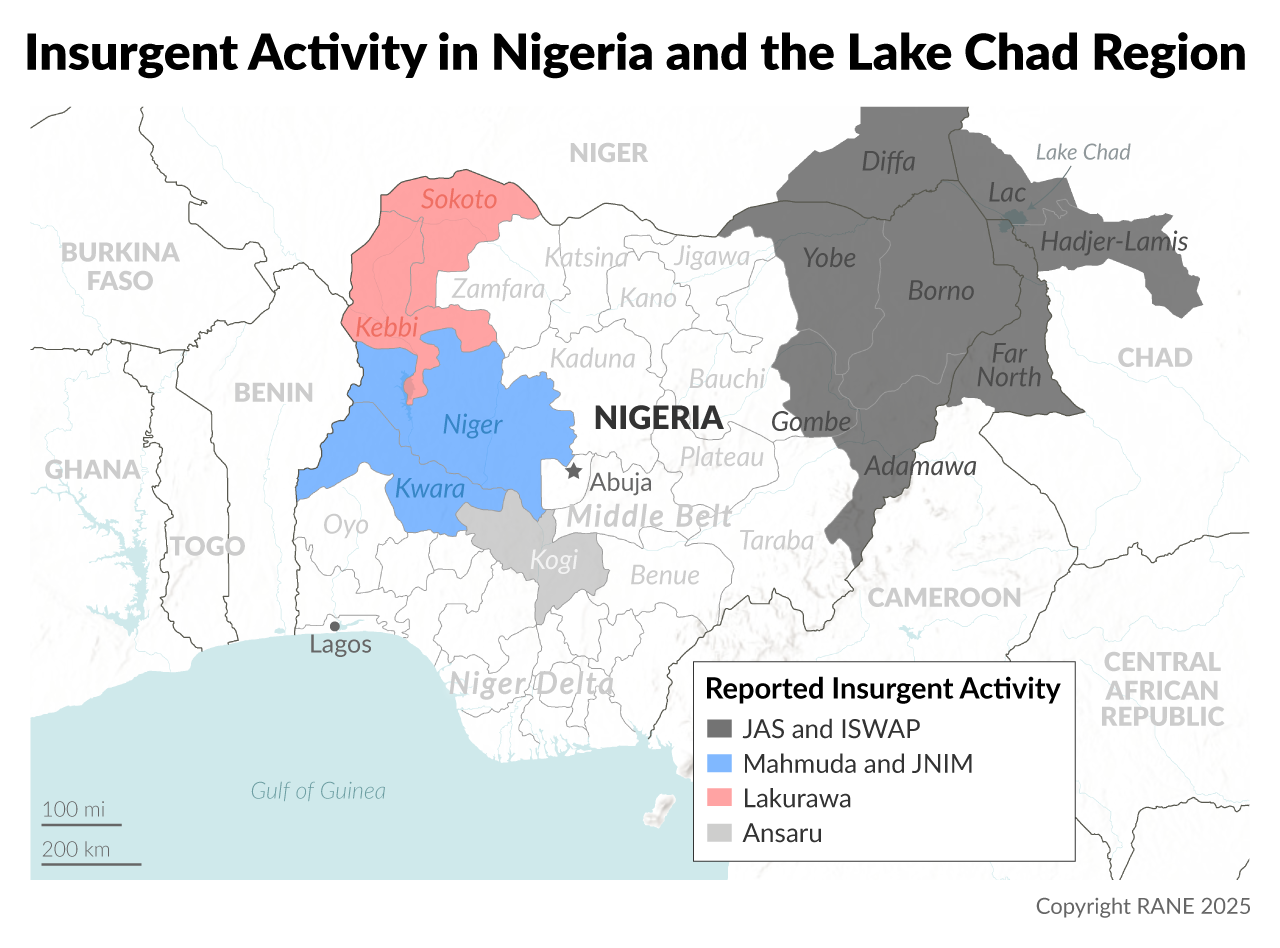
- Jama'at Ahl as-Sunnah lid-Da'wah wa'l-Jihad (JAS, popularly known as Boko Haram) and its offshoot, the Islamic State West Africa Province (ISWAP), remain the strongest and most active jihadist groups in Nigeria. They mainly operate in northeast Nigeria, as well as across the wider Lake Chad region — including Chad, Niger and Cameroon. In the northwest, the Islamic State-linked group Lakurawa reemerged in November 2024 and is active in Kebbi and Sokoto states, as well as in neighboring Niger.
- Over the past few years, reports have linked bandits to sporadic tactical collaboration with jihadist groups such as JAS and Ansaru, a breakaway faction of JAS.
- According to Nigeria's Human Rights Commission, at least 2,266 people were killed by bandits or insurgents in the first half of 2025, compared with 1,083 in the first half of 2024 and 2,194 for the full year.
The Nigerian government appears to be prioritizing security responses based on political and economic importance, but this selective approach has left many regions vulnerable, reinforcing local perceptions of marginalization. Due to limited resources and capabilities, the Nigerian government and security forces — led by the military, but often supported by intelligence services, police units and local militias — appear to prioritize crises based on political and economic relevance. Overall, this selective prioritization enables the government to strategically intervene in crises when violence escalates or political stakes are high, but also creates inconsistent security responses that leave some regions vulnerable and reinforce perceptions of marginalization, especially as violence continues at a low but consistent scale. The Niger Delta, where the country's oil and gas industry is concentrated, is central to Nigeria's economy. Its security is therefore a priority for the federal government. Instability in the region threatens vital energy infrastructure and exports, with militancy, oil theft and piracy being particular risks. Combating insurgencies in the northeast became a greater priority for the federal government under the presidency of Muhammadu Buhari, who was in office from 2015 to 2023. The fact that Buhari was from northern Katsina state also likely made him more attentive and responsive to northern security crises. This is in contrast to current President Bola Tinubu's response to the insurgency, which many northerners argue has worsened due to the federal government's perceived deprioritization of the north. Despite this criticism, Tinubu's government has effectively responded to the resurgence of Lakurawa in Sokoto and Kebbi states — a move aimed at avoiding a further erosion of support in the northwest, viewed as essential to Tinubu's reelection in 2027. Meanwhile, farmer-herder violence in the Middle Belt — home to some of Nigeria's key agricultural states — is driven by competition over land and water and intercommunal tensions. It has been intensified by population growth and climate change, resulting in periodic government intervention when violence flares, though focus has been inconsistent. At the same time, the Biafran separatist movement in southeastern Nigeria continues to push for the revival of the defunct state of Biafra, although these groups appear to have been deprioritized by security forces in recent years, given their weaker capabilities compared with jihadist and bandit groups.
- Nigeria has intensified its crackdown on oil theft in the Niger Delta, aiming to raise oil production to 3 million barrels per day in 2025 from the current 1.8 million. In addition to technical improvements, the operation, which has expanded to include armed drones, attack helicopters and enhanced intelligence, has helped boost output from 1.4 million barrels per day at its launch in late 2023. Large-scale theft used to cost Nigeria hundreds of thousands of barrels per day and billions in lost revenue, and it left production far below OPEC quotas.
- Beyond JAS, ISWAP and Lakurawa, al Qaeda's Sahel affiliate, Jamaat Nusrat al-Islam wal-Muslimin (JNIM), is reported to be active in Kainji Lake National Park, spanning Niger and Kwara states. In the Middle Belt, the Mahmuda group, with alleged JNIM ties, is also active in Niger and Kwara, while Ansaru, another JAS offshoot, has been reported in Kogi state.
- In August 2025, the United Nations reported that nearly 31 million Nigerians faced acute food insecurity. Contributing factors include conflict-driven agricultural losses compounded by flooding and inflation. For instance, Nigeria's corn production for the 2024 to 2025 season was projected in 2024 to fall from 12 million metric tons to 11 million due to security challenges, particularly disruptions in major farming regions, including the Middle Belt, according to The Wall Street Journal.
- As recently as June 2025, federal security forces were deployed to the Middle Belt, particularly Benue state, where over 100 people were killed in farmer-herder clashes, to de-escalate violence and suppress subsequent protests. The deployment indicates that the government will intervene when the situation becomes severe.
Northern and central Nigeria's security environment is likely to worsen over the coming year due to weak governance, growing militant recruitment and rising flow of weapons from neighboring Sahelian states, with an intensification of farmer-herder violence threatening to facilitate jihadist recruitment in Nigeria's Middle Belt. Northern and central Nigeria's security situation is likely to worsen in the coming months as intertwined socio-economic, political and environmental pressures continue to strengthen jihadist and bandit groups. High poverty and unemployment will likely sustain recruitment into jihadist and bandit groups, especially in northern and central Nigeria. In practice, jihadist groups' influence over both regions' rural areas is likely to grow as key smuggling and trade routes expand to accommodate an influx of weapons and fuel. These pressures intersect with structural drivers of insecurity, particularly farmer-herder tensions rooted in competition over land, water and grazing routes, which have long fueled intercommunal clashes. Arms trafficking from the Sahel — facilitated through Niger and Mali's porous borders and entrenched smuggling networks that channel weapons from Libya and other conflict zones — will continue to act as a catalyst by intensifying the lethality of these disputes and enabling bandit groups to expand their operations. The government is unlikely to implement economic development or reconciliation initiatives at scale, as these require consistent resources and sustained political will, leaving grievances over land and water unaddressed. Security operations in response to farmer-herder violence risk disproportionately targeting Fulani communities accused of attacking Christian farmers, which could heighten perceptions of government bias against northerners and facilitate recruitment by bandits and jihadists. Combined with displacement, social disruption and weak governance, these dynamics are likely to perpetuate cycles of radicalization and community vulnerability, leaving northern Nigeria and the Middle Belt increasingly exposed to attacks, territorial encroachment and disruption of key economic corridors.
- Across the Sahel — especially in Mali, Niger and Burkina Faso — militant groups, particularly JNIM, have exploited Fulani grievances, marginalization and cross-border mobility to recruit and expand influence, prompting security forces to target Fulani communities, thereby fueling resentment and further recruitment.
The Nigerian government is likely to continue prioritizing security crises based on politics and economic rationales, alongside the need to secure electoral support ahead of the 2027 general election. The Niger Delta is likely to be the highest priority. This reflects persistent challenges, such as personnel and equipment shortages and entrenched corruption. The fight against jihadist groups in the northeast, northwest and Middle Belt is likely to be second, due to their significant capabilities relative to bandits and other criminal actors. But even within these regions, further reprioritization may occur. The northeast could be deprioritized if jihadist groups in the Middle Belt develop the capacity to carry out large-scale attacks, prompting security forces to focus on protecting key economic corridors linking northern and southern Nigeria. This would especially be the case if further evidence of systemic cooperation between local bandit and jihadist groups emerges, as this would threaten to disrupt trade flows to Abuja and Lagos. In response, the government may lean more on its 2022 designation of bandits as terrorists to justify intensified military operations and surveillance. Local authorities may continue negotiating fragile peace deals with bandits, including ceasefires or financial arrangements, though unresolved grievances and sporadic violence are likely to persist. Ahead of the general election in 2027, the government is likely to place greater emphasis on the north because it represents the largest voting bloc, the Hausa-Fulani community forms the government's core political base and the region has historically dominated national politics. However, the Middle Belt could still attract attention, particularly to contain intercommunal violence that could suppress voter turnout. By contrast, other challenges — including protests, strikes and Biafran separatist activity — are likely to receive comparatively more limited engagement, with intervention by security forces occurring only when there is a risk of major disruptions to, for instance, supply chains and road networks.
Limited regional cooperation and ongoing internal challenges in mostly Niger and Chad will likely continue to constrain efforts to counter jihadist groups, increasing cross-border insecurity and potentially leaving gaps that exacerbate violence. It is unlikely that Nigeria's neighbors facing the most significant security challenges will substantially improve their internal security for the foreseeable future. Therefore, regional cooperation is likely to remain limited, enabling armed groups to continue exploiting security gaps to sustain their operations. Niger, in particular, is likely to continue facing a worsening insurgency driven by JNIM and the Islamic State Sahel Province (ISSP), while continuing coup-proofing measures that concentrate well-trained soldiers on guarding government institutions. Consequently, Nigeria's calls for regional collaboration to curb jihadist activity and arms trafficking across porous borders are unlikely to yield substantial results, as Abuja would still need to assume a leadership role despite its own internal challenges and mistrust among its neighbors. This situation has been further complicated by Niger, Mali and Burkina Faso's exit from the Economic Community of West African States. Chad, while having threatened to leave the Multinational Joint Task Force (MNJTF) established to combat JAS, has expressed interest in strengthening counterterrorism operations with Niger. Through bilateral coordination, including potential Chadian troop deployments to support Niger against JNIM and ISSP — similar to Chad's 2020 intervention in Niger under President Idriss Deby, who sent approximately 1,000 troops who have since returned to Chad — cross-border surveillance and operational coordination could improve. However, this approach risks creating security gaps within Chad, particularly regarding intercommunal violence, which the government currently deprioritizes due to its limited direct threat to the presidency. For Nigeria, the implications are twofold. On one hand, closer Niger-Chad security coordination could indirectly benefit Nigeria by constraining jihadist movements in the Lake Chad Basin, reducing the space available to groups like ISWAP and JAS to operate across borders. On the other hand, Chad's reduced commitment to the MNJTF and the possibility of security vacuums within Chad would weaken multilateral coordination, leaving Nigeria more exposed to cross-border infiltration and arms trafficking along its northeastern border.
- In November 2024, Chadian President Mahamat Idriss Deby threatened to pull the country out of the MNJTF, citing its failure to effectively counter insurgent groups in the Lake Chad region. Deby criticized the force for poor coordination among member states and its inability to meet objectives, noting that the MNJTF appeared stagnant despite being created to unify regional efforts against threats such as JAS and Islamic State affiliates.
- One opportunity that could pave the way for greater security cooperation lies in efforts between Nigeria and Benin to strengthen their bilateral relations — such as the August 2025 framework for deeper cooperation ties and trade ties. This could set the stage for deeper collaboration, particularly as the two countries share a border that jihadists are reportedly using to smuggle weapons into Nigeria. Even so, Benin is struggling with infiltration from Burkina Faso and Niger along its northern border, likely forcing the Beninese government to focus there, rather than on its eastern border with Nigeria.
