
A general view of the reception of Total E&P Uganda in Kampala, Uganda, on Jan. 22, 2020.
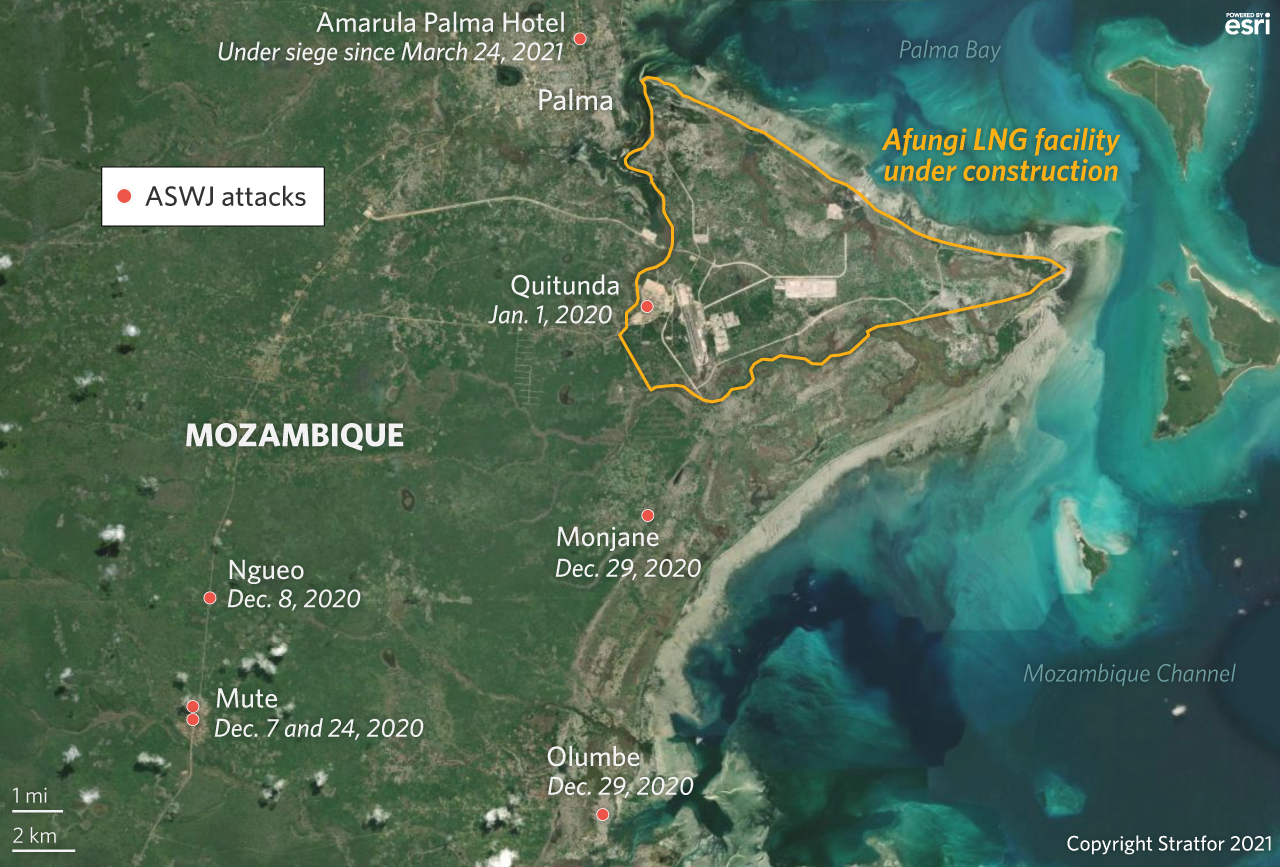
Jihadist militants' seizure of the town of Palma jeopardizes the viability of Mozambique's liquefied natural gas industry and with it, the country's financial future. Without a significant improvement in the security environment, future LNG investment plans will be delayed or suspended. The March 24-28 attack on Palma, about 10 kilometers (about 6 miles) from Total's LNG site, is the most significant, and perhaps best organized, attack by Ahlu Sunnah Wa-Jamo (ASWJ) to date. The attack was sophisticated, involved hundreds of militants and a great degree of operational planning similar to the August 2020 seizure of the nearby town of Mocimboa da Praia, which the group still controls. Palma’s proximity to Total's LNG project makes its seizure more significant. Just March 24, Total announced that it was resuming construction at the site after suspending activities in early January due to previous attacks nearby; it quickly resuspended operations in response to the attack.
- The Palma incident was a coordinated attack that, according to some estimates, led to roughly half of the town's 75,000 people fleeing; U.S. officials believe that between 40 and 50 foreigners died during the attack, which would make it ASWJ's deadliest attack on foreigners.
- ASWJ's parent organization, the Islamic State, claimed responsibility on March 28 — the first claim of an attack in Mozambique since early November, suggesting that the broader group is trying to secure a propaganda victory from it.
ASWJ appears to be focusing its operations near Total's LNG site. The cadence of attacks — especially if the group continues to hold Palma — in the region is likely to increase after Cabo Delgado's rainy season ends in April. Disrupting Mozambique's LNG industry would be a major propaganda boon for ASWJ and the Islamic State. In December 2020, the group carried out six attacks near the LNG site, culminating with a Dec. 31-Jan. 1 attack on a resettlement village adjacent to the site's airstrip. Until the March 24 assault in Palma, ASWJ had not carried out an attack in the same region of Cabo Delgado since the Jan. 1 attack. Mozambique says its counterinsurgency operations explain the lull, but the successful attack on Palma suggests that the group's operative capacity was not eroded significantly. A more likely contributor to the pause would be the region’s December-April rainy season, which peaked during the same timeframe. Cabo Delgado's infrastructure is undeveloped, the terrain is a dense forest and many roads are unpaved — all inhibiting mobility during the time of year when heavy rainfall occurs roughly nine out of every 10 days.
- In 2020, ASWJ's operations scaled up after March: It launched a significant attack in March 2020 on Mocimboa da Praia and scaled up its operations during the dry season, culminating with the seizure of the town five months later. ASWJ's range and attacks increased afterward, eventually leading to the attacks near Total's LNG site by December.
ASWJ's impact on Mozambique's LNG industry and the large number of foreign nationals reportedly killed in the Palma attack will increase pressure on Mozambican President Filipe Nyusi to accept more significant foreign support to counter the group's advance. Absent accepting such support, the security situation is unlikely to improve. Mozambique's (and Total's) current strategy appears insufficient to cope with the security crisis. Rivalries between police forces and the military, lax training and limited resources have combined to limit the government's ability to counter ASWJ. To address these concerns, Mozambique likely needs substantial foreign aid, training and potentially even a regional intervention in order to contain the rising threat from ASWJ. Although the Southern African Development Community has drafted up plans to deploy its standby brigade, Nyusi and Mozambique have not publicly supported such plans and Nyusi has not always shown up at SADC security meetings when other heads of states have, showcasing his lack of priority on the group. Nyusi has been reluctant to accept a multilateral intervention over sovereignty concerns, but now that the threat is affecting his government's — and more important, his party's — fortunes, Maputo may reassess that position.
Total and other investors in Mozambique's onshore LNG sector will struggle to move forward with their projects as long as ASWJ represents a major security threat, leading to delays in projects. Although Total made a financial investment decision to move forward with developing its Mozambique LNG project including critical onshore development of the LNG export facility, the string of attacks in January stalled progress for nearly three months. The most recent attack — coupled with further attacks likely during the dry season — will probably lead to lengthier delays, potentially postponing the planned 2024 start date by years. Militants could also use Palma as a launch pad for offshore attacks (something ASWJ has done elsewhere), increasing risks offshore, where oil and gas deposits are located.
Significant delays to project construction and the continuation of the security threat may damage the financial viability of future LNG investments, potentially leaving some investments stranded and cutting into the long-term financial revenue Maputo stands to receive from LNG projects. Total's sunk cost into the initial development of the LNG project likely means that it will hold out as long as possible on developing the project, but the same may not be true for ExxonMobil. Though ExxonMobil and Total are planning to use the same site for their LNG projects and plan to share some infrastructure, ExxonMobil has not made a final investment decision. ExxonMobil has delayed the decision several times for other reasons, most recently in 2020 due to COVID-19 CAPEX spending cuts, and is currently targeting a decision in early 2022. In order to make a final investment decision by then, ExxonMobil will likely want to see significant progress against the insurgency and improved security near the site. Further delays to ExxonMobil's project could affect whether it goes through as other LNG exporters, such as Qatar and Russia, move forward with their own projects and oil companies continue to adjust their investment plans to take climate change and emissions targets into account. Another yearslong delay in its investment decision could result in the project being stranded altogether.
- Mozambique's three LNG projects — ExxonMobil's, Total's and Eni's — are expected to generate about $95 billion in revenue for the government over the 25-year period in their contracts. About half of Mozambique's anticipated revenue is from ExxonMobil's project. By comparison, Mozambique's gross domestic product in 2019 was about $15 billion. (The Eni project, a small floating LNG project, is likely to remain unaffected by onshore security woes.)
