
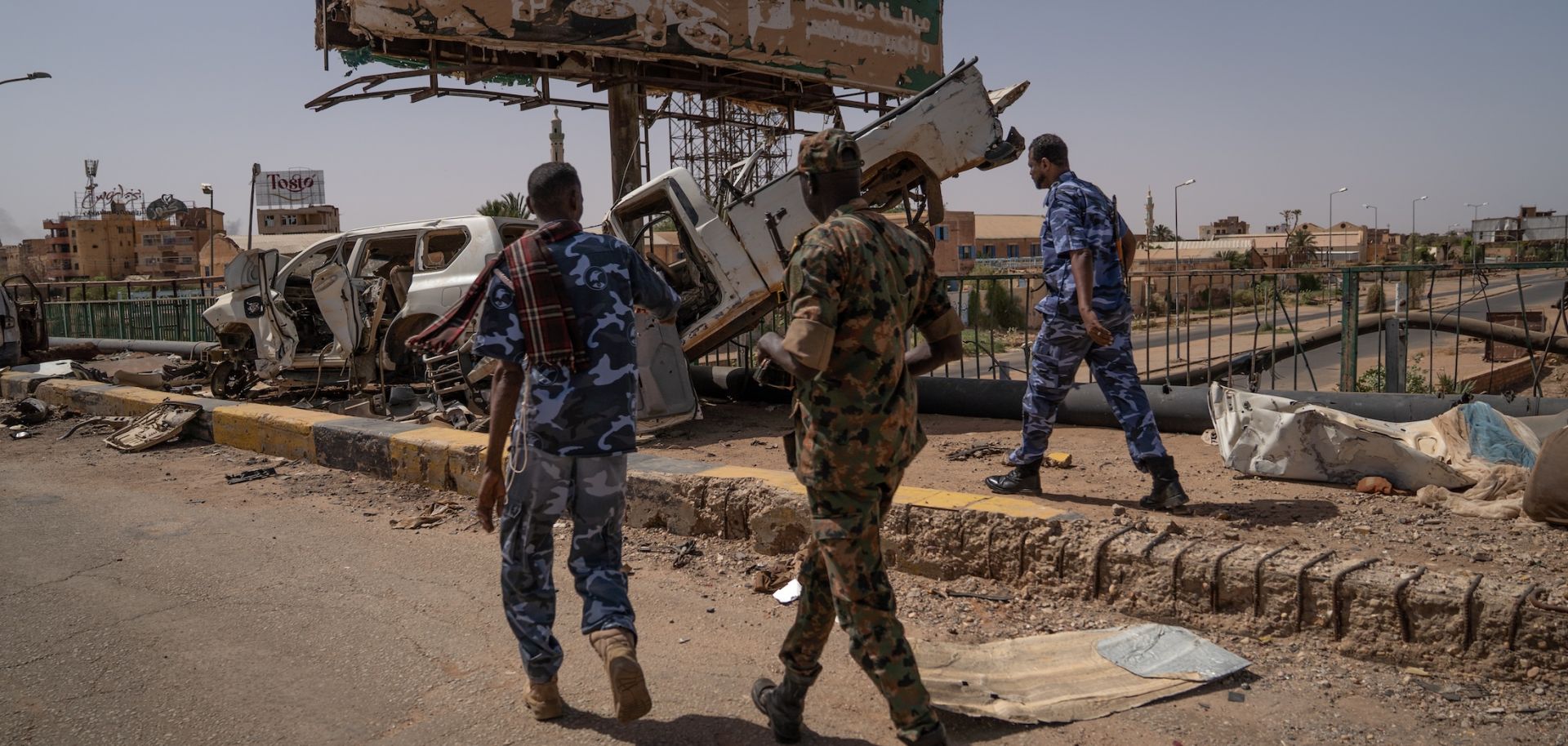
Although a de-escalation of Sudan's civil war is becoming more likely, the Sudanese Armed Forces is unlikely to agree to U.S.-led proposals beyond the ceasefire stage due to political considerations, with the ensuing deadlock likely entrenching Sudan's de facto partition and potentially leading to an eventual re-escalation in fighting. On Nov. 6, Sudan's paramilitary Rapid Support Forces, or RSF, announced that it had accepted proposals by the United States, Egypt, the United Arab Emirates and Saudi Arabia — a grouping known as the Quad — for a humanitarian truce in its more than two-year civil war against the Sudanese Armed Forces, or SAF. The announcement came shortly after the RSF seized the western city of el-Fasher on Oct. 26 following an over 18-month siege that killed and displaced tens of thousands of civilians. Numerous reports have since emerged of RSF fighters conducting widespread atrocities against civilians in el-Fasher, including ethnically-motivated killings. While SAF leader Abdel Fattah al-Burhan vowed "revenge" against the RSF and reiterated his intent to forcefully eliminate the paramilitary group in early November, unnamed high-level sources within Sudan's SAF-backed government told news outlet Sudan Tribune on Nov. 9 that Khartoum had submitted its own plans to the Quad for a truce. However, the Quad is reportedly pushing for its own proposals to be accepted, with diplomatic sources within the U.S.-led quartet indicating they were now considering measures to impose the truce "by force," although they did not provide further details.
- While exact estimates regarding the number of fatalities in Sudan's civil war are highly uncertain due to difficulties in accessing many parts of the country, the latest estimates suggest that at least 150,000 Sudanese have been killed since the start of the conflict in April 2023. The United Nations also estimates that around 4.2 million refugees have fled the country since the start of the war, and that an additional 7.2 million Sudanese have been internally displaced.
- A number of SAF commanders and fighters reportedly fled el-Fasher before the RSF takeover, potentially following an agreement with local RSF forces. According to sources quoted by news outlet Darfur24, SAF forces, having withdrawn from the city, relocated to the town of Kornoi, located around 200 kilometers (125 miles) northwest of el-Fasher.
The RSF's acceptance of the Quad's truce proposal comes as the Trump administration has ramped up mediation efforts to de-escalate the civil war in Sudan in recent months. The current civil war broke out in April 2023, driven by disagreements between al-Burhan and RSF leader Gen. Mohammed "Hemedti" Dagalo over the timeline for the RSF's integration into the SAF. While the RSF — which has been chiefly backed by the United Arab Emirates — held an edge early on in the conflict, the paramilitary group overextended its supply lines when launching an offensive into the eastern state of Sennar in mid-2024. This, in turn, enabled the SAF to regain the initiative and fully capture the capital Khartoum in late March 2025. Ahead of its withdrawal from Khartoum, the RSF shifted its war objectives toward consolidating control over western Sudan, which in practice meant redoubling efforts to capture el-Fasher. Hemedti also pushed for the formation of a government to administer RSF-held areas, which took office in April with plans to start issuing identity cards and printing currency. Meanwhile, al-Burhan also oversaw the establishment of a new civilian-led government to administer SAF-controlled areas in May. Importantly, al-Burhan ensured that key cabinet and administrative positions were granted to prominent Islamist groups, which are vital to his anti-RSF coalition. Against this backdrop, the Quad on Sept. 12 forwarded a peace plan to end Sudan's civil war. The initiative, led by U.S. President Donald Trump's senior adviser for Africa, Massad Boulos, aligns with the White House's purported efforts to advance peace initiatives globally. The plan notably involves proposals for a three-month humanitarian truce that would be followed by a permanent ceasefire. After the permanent ceasefire takes effect, the Quad's plan then foresees a nine-month "inclusive" transition process, which would culminate in the formation of a civilian-led government that is controlled by neither the SAF nor RSF and excludes groups associated with the Muslim Brotherhood.
- The RSF was formed in 2013 out of Arab militias known as Janjaweed, which Sudan's former President Omar al-Bashir used as an auxiliary force against rebel groups in Darfur during the 1990s and 2000s. Al-Bashir deliberately put the RSF under the command of Sudan's intelligence services, rather than the SAF, to counterbalance the Sudanese military's influence and to coup-proof his regime. But this strategy ultimately failed, as the RSF and SAF allied to oust al-Bashir in 2019 amid large-scale protests.
- Sudanese Islamists regroup a variety of actors, including the Broad Islamic Current, a political coalition that includes several Islamist parties, as well as former members of al-Bashir's now-dissolved National Congress Party and militias like the Al Baraa Ibn Malik Battalion, which fights alongside the SAF despite operating outside its formal structure.
The RSF's acceptance of the Quad's proposals raises the likelihood of a humanitarian truce, but any deal would be inherently fragile and challenging to implement, with clashes likely to persist in the central Kordofan region. Despite mounting international pressure to de-escalate the civil war, al-Burhan is likely concerned that agreeing to a truce following the RSF's capture of el-Fasher would signal weakness and erode his authority over the SAF. Moreover, agreeing to the Quad's proposed truce could jeopardize the SAF's partnership with key Islamist factions, the bulk of which have strongly rebuffed the Quad's peace plan as an unwarranted interference in Sudan's internal affairs. However, the RSF's acceptance of the Quad's truce proposal now enables the paramilitary group to portray the SAF as the sole obstacle to de-escalating Sudan's civil war, which will intensify diplomatic pressure on al-Burhan to agree to a truce. In practice, this will expose the SAF to ebbing diplomatic, economic and potentially military support from Egypt and Saudi Arabia, as well as additional U.S. sanctions. Given these risks, the SAF is growing more likely to nominally agree to a truce, either within or outside the Quad's proposed framework. However, any truce would be fragile, partly because many SAF and RSF units operate with significant autonomy from their central command, which suggests that some local commanders would likely still seek to exploit tactical opportunities as they arise. This would especially be the case in Kordofan, where both sides are pressing ahead with fresh troop deployments. But while localized clashes would likely persist at least sporadically, a truce would likely still reduce the intensity of fighting and aerial strikes, which could lead to a moderate improvement in humanitarian conditions, particularly in areas away from the frontlines.
- While a truce presents some political disadvantages for al-Burhan, it would give the SAF time to regroup its forces before potentially launching a major offensive in Kordofan.
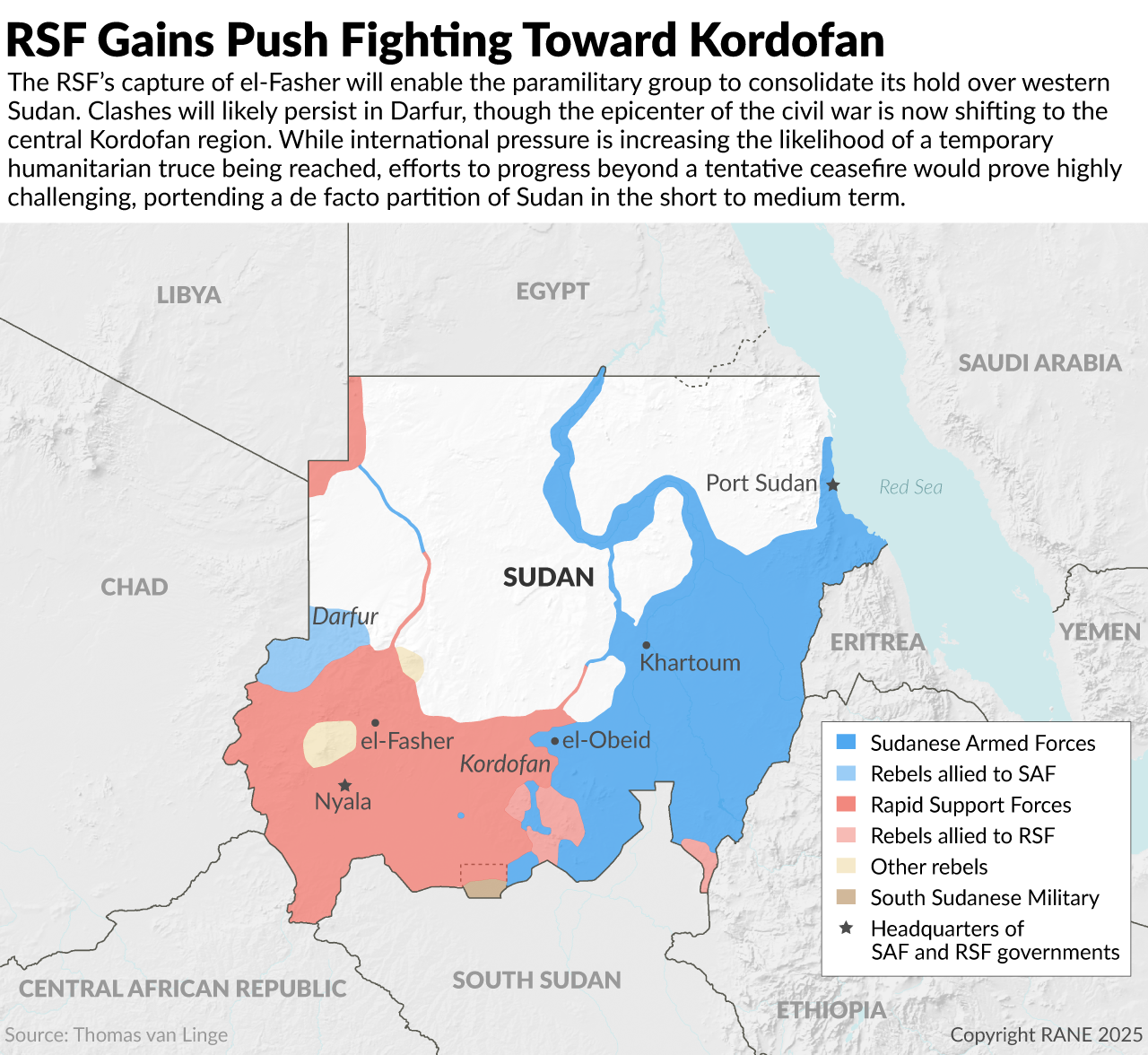
If al-Burhan continues rejecting truce proposals, the conflict's center of gravity will likely shift toward Kordofan, though mounting international pressure could still drive both sides to accept limited deconfliction measures. Should al-Burhan keep rejecting truce proposals over the coming months, the SAF would almost certainly sustain frequent offensive operations in Kordofan in order to regain the military initiative. Meanwhile, the RSF would likely seek to consolidate its hold over western Sudan by expanding its buffer zone into Kordofan and capturing Darfur's Tina-Kornoi area, which remains controlled by SAF allies. While this means that fighting in Darfur is unlikely to fully abate following the RSF's capture of el-Fasher, it suggests that the epicentre of the war will likely shift to Kordofan, regardless of whether a humanitarian truce is reached. In the absence of a truce, the RSF will likely face growing pressure from the United Arab Emirates to, at least temporarily, avert large-scale offensives. While Abu Dhabi has so far been willing to tolerate the reputational costs of supporting the paramilitary group, the capture of el-Fasher represents a major achievement with regard to Emirati war objectives in Sudan — namely, maintaining the RSF's cohesion and denying the SAF and its Islamist allies a decisive victory. This success is likely to shift Abu Dhabi's calculus and see it put a greater emphasis on mitigating further diplomatic and reputational risks linked to its support for the RSF by pushing for a temporary de-escalation, though the United Arab Emirates would still likely permit — if not encourage — smaller RSF offensives that help the paramilitary group consolidate control over Darfur and Kordofan. Al-Burhan, meanwhile, will still need to account for mounting international pressure to de-escalate the civil war. This suggests that even if the SAF does not accept any truce in the coming months, it will become increasingly likely to accept some limited deconfliction measures, such as local humanitarian corridors or a temporary air truce, to avoid fully alienating the United States, Egypt and Saudi Arabia.
- Clashes between the RSF and local armed groups in Darfur are also likely to persist, at least sporadically. The al-Nur faction of the Sudan Liberation Movement remains dominant in Darfur's Jebel Marrah mountains and primarily focuses on defending Black African communities in the area, especially the Fur. While the group is neither aligned with the SAF nor the RSF, it has frequently clashed with the RSF, given the paramilitary group's Arab supremacist roots.
Even if the Quad brokers a permanent ceasefire, its proposal for a civilian-led government excluding Islamists is unlikely to win SAF support, setting the stage for a diplomatic deadlock that would entrench Sudan's de facto partition and risk eventually leading to a renewed escalation in fighting. Although an SAF-RSF truce would likely face repeated violations, pressure from the Quad and other international actors could ultimately see both sides nominally agree to a permanent ceasefire, especially if the initial truce successfully reduces the intensity and frequency of clashes. Although a permanent ceasefire would mark an important milestone in de-escalating Sudan's civil war, it would also kick-start a transition process aimed at establishing a civilian-led government that is controlled by neither the SAF nor the RSF, should the Quad's peace plan serve as the guideline. This prospect would be especially unpalatable to the SAF, as it would mean voluntarily relinquishing control of Sudan's internationally recognized government. While some of the SAF's civilian affiliates could join the Quad's proposed transitional government, securing the SAF's acceptance of such a plan would prove challenging, as it would still involve al-Burhan losing direct control of government affairs and likely imply accepting the entry of RSF civilian affiliates or allies in government. Moreover, the planned exclusion of the Muslim Brotherhood and associated groups from government affairs means that al-Burhan's acceptance of the Quad's plan in its current form would likely heighten tensions with influential Islamist groups, including Islamist-friendly factions within the SAF itself. This suggests that the SAF would likely push for major changes to the Quad's proposed transition process, portending a months-long deadlock in advancing peace efforts beyond the ceasefire stage. Combined with a relative de-escalation of fighting, this would likely entrench Sudan's de facto partition between SAF-led and RSF-led governments in the east and west of the country, respectively, which could increase the political costs of a future reunification as each government's local patronage network strengthens. However, the absence of a diplomatic breakthrough and likely ongoing localized ceasefire violations could also eventually reignite high-intensity fighting as both sides seek to gain leverage at the negotiating table.
