
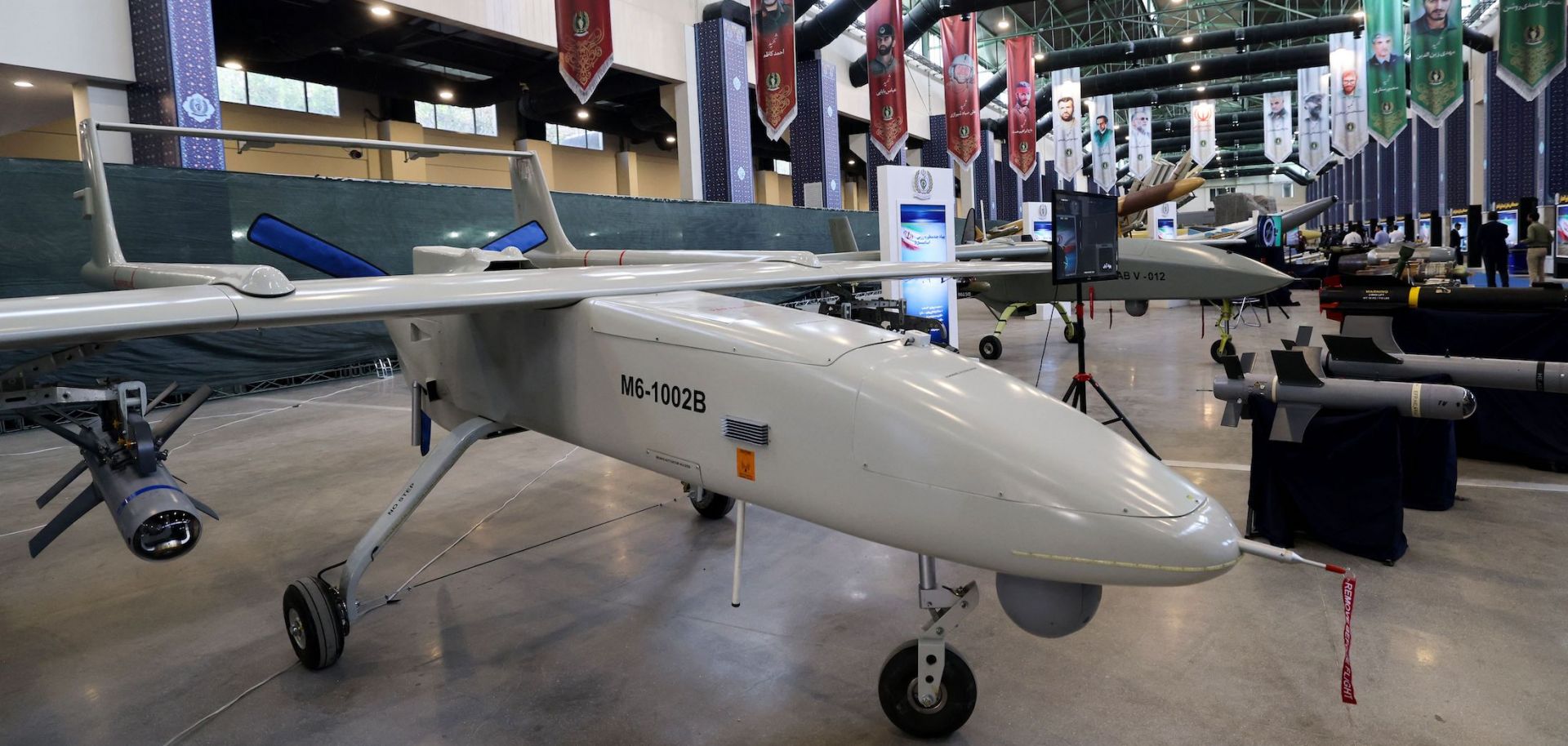
Through a sort of drone diplomacy, Tehran hopes to rekindle dormant ties with the Sudanese government to aid the latter in its ongoing civil war, at the very least making it harder for a strong anti-Iran government to take power after the conflict ends. Iran has supplied the Sudanese Armed Forces with Mohajer-6 combat drones as the SAF remains deadlocked in a nine-month civil war with the rival Rapid Support Forces, according to senior Western officials cited in multiple recent media articles. Satellite imagery dated Jan. 9 by Planet Labs showed at least one drone and an associated radio tower at the Wadi Sayyidna airbase located just north of the Sudanese capital of Khartoum. The drones' delivery comes as the SAF has lost several significant cities, including parts of Khartoum, to the RSF. Egypt has openly backed the SAF, but the RSF has made its gains due to suspected support from Iran's rival, the United Arab Emirates, which is believed to be supplying the Darfur-based RSF with drones and other equipment through Chad and Libya — something Emirati officials deny.
- In addition to sending drones to Russia for use in Ukraine in a bid to secure Russian military support on other technologies, Iran has also sent combat drones (and drone technology) to Yemen, where the Houthi militant organization has used them against commercial shipping, and to the Ethiopian government for use in the 2022-22 Tigray war.
- The Sudanese civil war broke out in April 2023 as long-standing tensions boiled over between SAF chief and chairman of the Transitional Sovereignty Council Abdul Fattah al-Burhan and RSF chief and deputy chairman of the council Mohamed Hamdan Dagalo, aka Hemedti. Burhan admitted in September 2023 that he relocated to the northeastern Port Sudan after fleeing Khartoum due to RSF gains in the capital. The RSF seized Nyala in October and Wad Madani in December, the next-largest cities in Sudan after the capital.
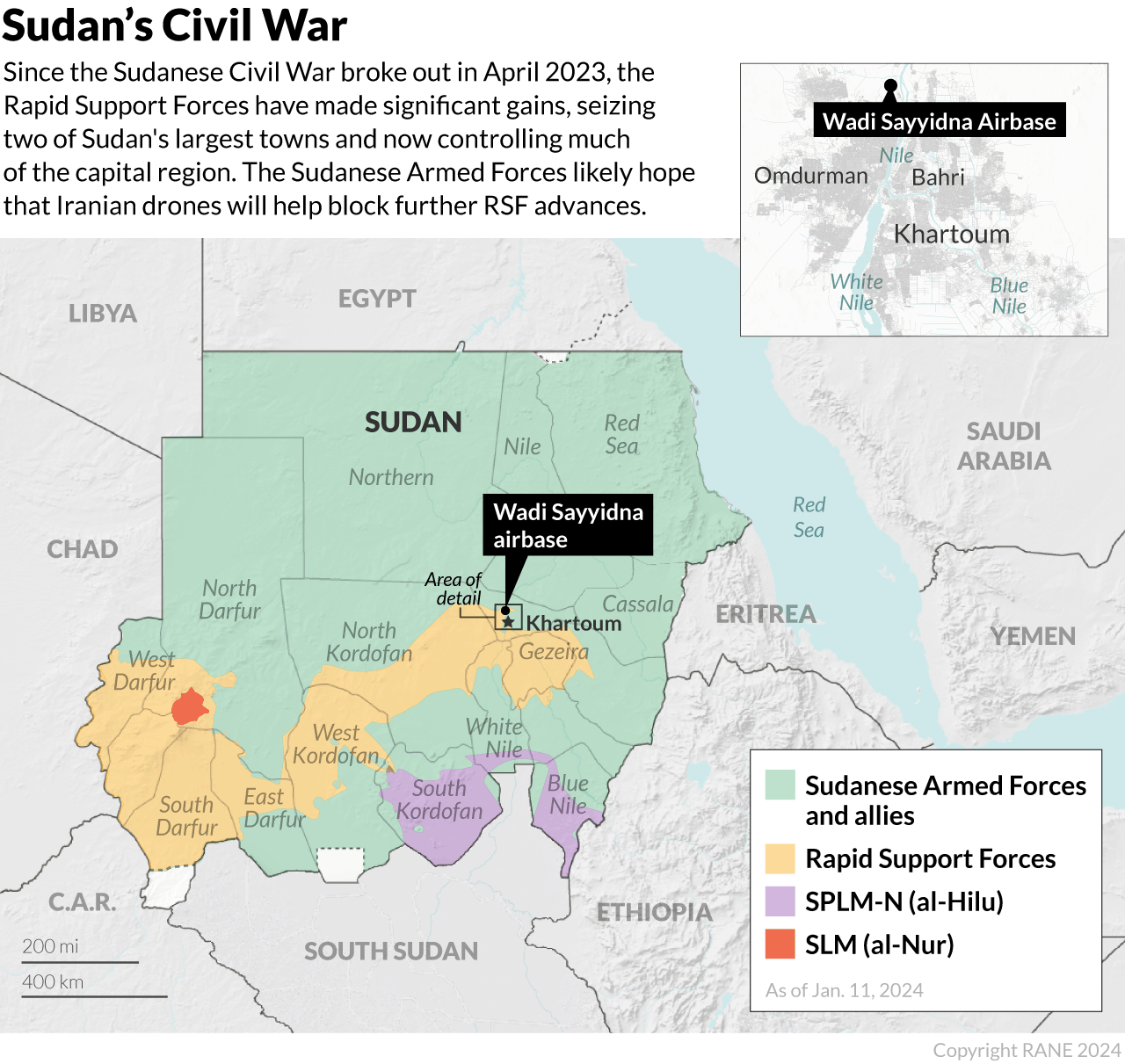
By sending the combat drones to the SAF as it seeks to fend off the RSF offensive, Tehran is trying to reestablish ties with the Sudanese government dormant since 2015 in an effort to outmaneuver its Gulf Arab rivals. Prior to 2015, Iran and Sudan, then under the control of President Omar al-Bashir, enjoyed close ties. Al-Bashir's government was closely aligned with Sudan's Sunni Islamist movement. This alienated regional Arab Sunni states, including Saudi Arabia, Egypt and the United Arab Emirates, which accused al-Bashir of harboring Muslim Brotherhood leaders. Sudan's economic crisis and 2018-9 revolution that saw al-Bashir removed from power led Sudan to reverse its political allegiances and enabled Riyadh, Cairo and Abu Dhabi to forge closer ties to Sudan's post al-Bashir leadership, curtailing Iran's previous influence. For Iran, the loss of ties to Khartoum was a major strategic blow, as Sudan had been Tehran's closest ally on the African continent. Tehran had used Sudan as part of a smuggling route including the Horn of Africa and Red Sea to supply Iranian proxies in Gaza, chiefly Hamas and Palestinian Islamic Jihad. Closer ties with Khartoum would help Tehran effectively encircle Israel (as well as Saudi Arabia and the Gulf Cooperation Council states) with governments friendly to Iran amid the regional escalation following the Oct. 7 Hamas attack on Israel. A potential deal to use Sudan's ports would also make it easier for Iran to resupply its naval vessels operating in the Red Sea and outmaneuver Gulf rivals like the United Arab Emirates. While Sudan's Islamists were largely purged following the 2018-9 revolution, Hemedti accuses Burhan of increasingly relying on their support. Many Islamists would be supportive of closer ties with Tehran, particularly as they accuse neighboring Arab states of supporting the RSF and not doing enough to support the SAF.
- From 2009-12, Sudan accused Israel multiple times of carrying out mysterious airstrikes on Sudan targeting Iranian arms being smuggled to the Gaza Strip for use by Palestinian militant groups. In 2012, Sudan claimed four Israeli jets were responsible for airstrikes that caused an explosion at a munitions depot in Khartoum.
- Sudan's Islamist movement, which achieved its greatest power under the influential cleric Hassan al-Turabi, has fewer ties to the Islamist Muslim Brotherhood movement. Initially, many analysts considered it a sort of Sunni version of the Shiite Islamic Revolution in Iran, suggesting ideological affinities between Sudan's Islamist movement and Iran despite the Sunni-Shiite divide.
- After the 2011 Arab Spring — and particularly after Mohammed Morsi was overthrown in Egypt in 2013 — Egypt, Saudi Arabia and the United Arab Emirates aggressively sought to eliminate the Muslim Brotherhood's influence regionally, viewing it as a threat to the region's monarchies and strong military governments. For this reason, these three countries helped support al-Bashir's overthrow and the new transitional government, seeing it as a way to diminish a regional Islamist faction. The United Arab Emirates has many reasons to support Hemedti, but Burhan's plan to rehabilitate Sudan's Islamists, which has been heavily criticized by Hemedti, is a key one. Hemedti has also proposed his own peace plan for the Sudanese civil war that bars Sudanese Islamist participation.
Ultimately, the SAF faces an uphill battle in winning the Sudanese civil war outright, but for Iran, merely extending the conflict and strengthening the SAF's hand in potential talks with the RSF will complicate Emirati efforts to bring about a new government in Sudan that would otherwise be staunchly anti-Islamist and anti-Iranian. Iranian combat drones may help offset drone deliveries to the RSF that the United Arab Emirates and Russia's Wagner Group have allegedly made, but Iran probably cannot send enough drones to Sudan given that uptick in U.S. efforts in the Red Sea and surrounding waters to interdict Iranian shipments of drones and drone technology to Yemen. Iran's own economic weakness meanwhile limits its ability to provide economic aid to help prop up the Sudanese economy, which has been significantly disrupted by the civil war and its attendant transportation bottlenecks. For its part, the United Arab Emirates has significant economic and military resources that it can use to help prop up the RSF over the long run, which will likely ensure that any post-civil war political settlement involves the RSF and Hemedti playing a key role in the government. This will make it difficult for Iran to reestablish as close of a relationship with Sudan in the future as it had a decade ago. But Iran's support of the SAF through drone deliveries may make it more difficult for the RSF to win by force, lengthening the civil war and giving the SAF more leverage in subsequent negotiations. Helping keep Sudan unstable also draws Emirati (and Saudi and Egyptian) attention away from other theaters more important to Tehran, such as Iraq, Syria and Yemen.
