
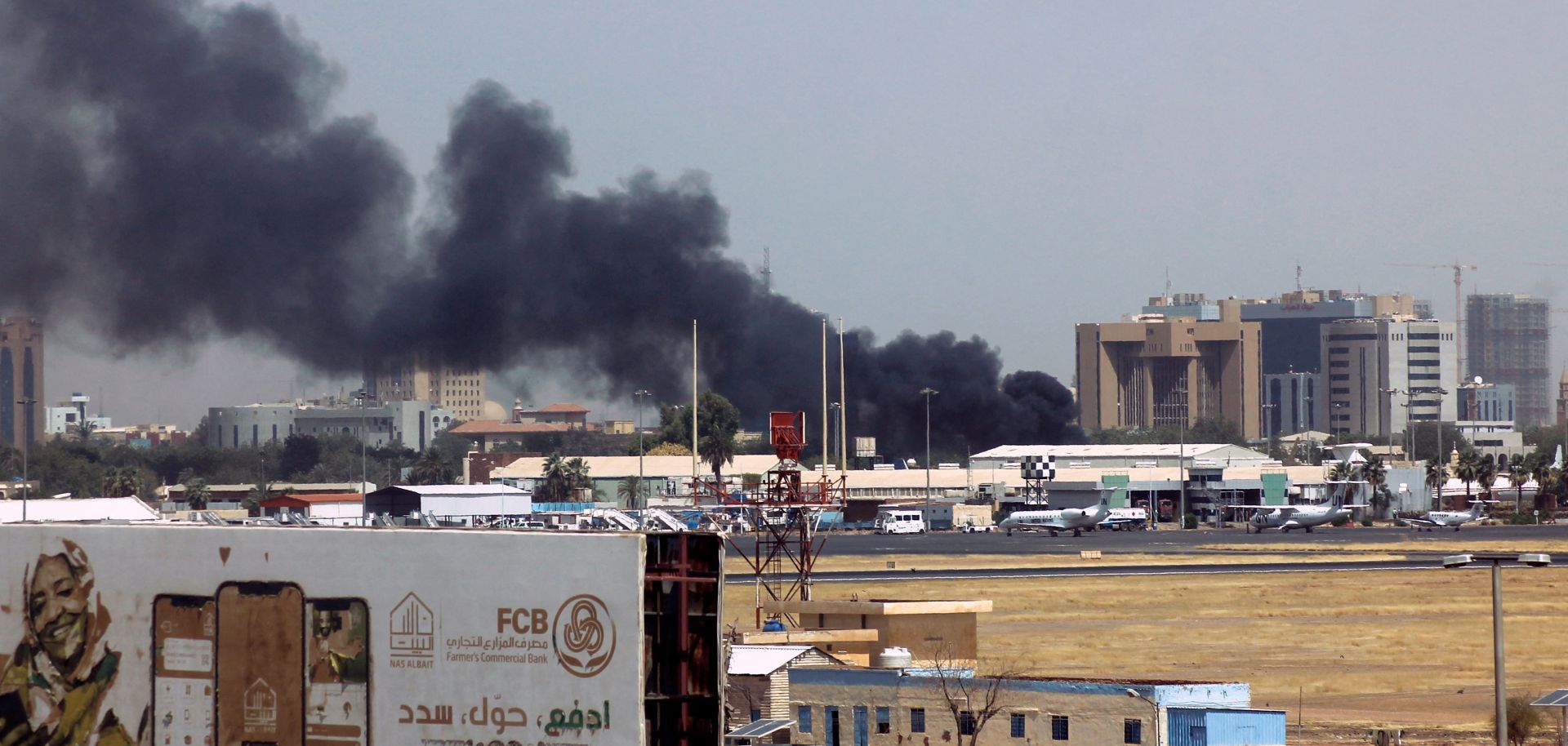
Heavy smoke billows above buildings near the Khartoum airport on April 15, 2023, amid clashes between the army and paramilitary troops.
Clashes between the Sudanese military and the paramilitary Rapid Support Forces (RSF) will likely persist despite international pressure for peace, and could escalate into a sustained nationwide conflict. As of April 17, ongoing clashes between the Sudanese military and RSF fighters in the capital Khartoum and surrounding areas had killed at least 97 people, according to reports on the ground. The RSF claimed that it took control of both the military intelligence building and the presidential palace, and had also stormed the residence of the head of the country's military, Abdel-Fattah Burhan, though these reports have not yet been confirmed. Residents in Khartoum have reported persistent gunfire and shelling across the capital, especially around the military headquarters near the city center. The Sudanese military said that it has conducted multiple airstrikes targeting RSF bases in the area. Some Sudanese social media accounts, however, have commented that the air force is also carrying out strikes on the military, seemingly on behalf of the RSF and suggesting the air force itself could be split into rival factions. The fighting erupted on April 15, just days after the military issued a warning ordering the departure of recently deployed RSF forces to the capital and other parts of the country — including the northern town of Merowe, where the RSF has reportedly seized the airport.
- The clashes come amid a stalled power-sharing agreement between Sudan's military, the RSF and a faction of the civilian coalition Forces for Freedom and Change that is intended to ultimately return the country to civilian rule following two separate coups in 2019 and 2021. The signing of the agreement had been postponed reportedly due to disputes between the military and the RSF over the latter's dissolution and integration into the armed forces and federal and local law enforcement.
- The RSF originated from the Arab janjaweed militia that has been involved in over two decades of ethnic conflict in Sudan's western Darfur region. The paramilitary group is led by the deputy chairman of the ruling Transitional Military Council, Mohamed Hamdan Dagalo (also called Hemeti). The Sudanese military is headed by Abdel-Fattah Burhan, who is also president of the transition council and has served as the country's de facto ruler since the 2019 revolution.
International partners will likely attempt to broker peace rather than wage proxy battles, despite regional competition for influence. Sudan's location on the Red Sea makes it a strategic point of interest for regional and international powers, leading to concern among some international observers that the current fighting in Khartoum will devolve into a proxy war. However, Egypt, Saudi Arabia and the United Arab Emirates — the three regional players with the most involvement in Sudan — have all called for peace since the clashes began on April 15. While Egypt appears most closely aligned with Burhan and the Sudanese military, all three countries have commercial operations in Sudan and little interest in a regional conflict. Regional players will likely avoid choosing sides as long as fighting appears more or less evenly matched, and all three countries will likely prioritize Sudanese stability and strong relations with the next government. Parties responsible for brokering the transitional agreements — including the European Union, United Kingdom and the United States — have also condemned violence in Sudan and called for renewed talks between the military, RSF and civilian coalitions. Such calls, however, will likely continue to be largely ignored, as the West likely lacks sufficient political and/or economic leverage to compel action.
Despite international pressure for peace, the clashes in Khartoum will likely persist given that the two sides appear relatively evenly matched, raising the risk of a sustained civil conflict that shatters Sudan's transition to civilian rule and induces a new humanitarian crisis. In a statement posted to Facebook on April 15, the army said there would be ''no negotiations or dialogue until the dissolution of the paramilitary RSF.'' Meanwhile, on Twitter, RSF leader Dagalo referred to Burhan as a criminal and said that the RSF was fighting ''to ensure the democratic progress, for which [the people] have so long yearned.'' These statements suggest that fighting in Khartoum will likely persist at the very least, whereas flare-ups in Darfur, Omdurman and Port Sudan risk engulfing the country in a sustained civil war. The two sides are relatively evenly matched in terms of personnel, and recent military defections to the RSF and speculation that contingents of the air force are fighting on Degalo's behalf appear to negate some of the military's intelligence and airpower advantage, making a sustained conflict more likely. Sudan's western Darfur region is at particular risk of intense conflict, given the region's historical connection to the RSF (the paramilitary group emerged out of the Arab janjaweed, one of the key forces in the 2003 Darfur war). Darfur has also seen recent spikes in tribal clashes over the past week, along with increased army and RSF recruitment efforts. Further geographic expansion of the fighting will likely provide opportunities for additional armed groups to become involved in clashes, and could result in a protracted conflict in parts of the country, even if fighting subsides in Khartoum. This could have drastic humanitarian implications for Sudan, which is already facing ongoing droughts and food shortages. A cessation of conflict in its current state would be highly unlikely to salvage the transitional agreement, but a sustained conflict between the military and RSF would make negotiations over power-sharing and security reform in the immediate future highly unlikely.
- The RSF is estimated to have approximately 100,000 troops, while the number of military personnel is estimated at around 124,000.
