
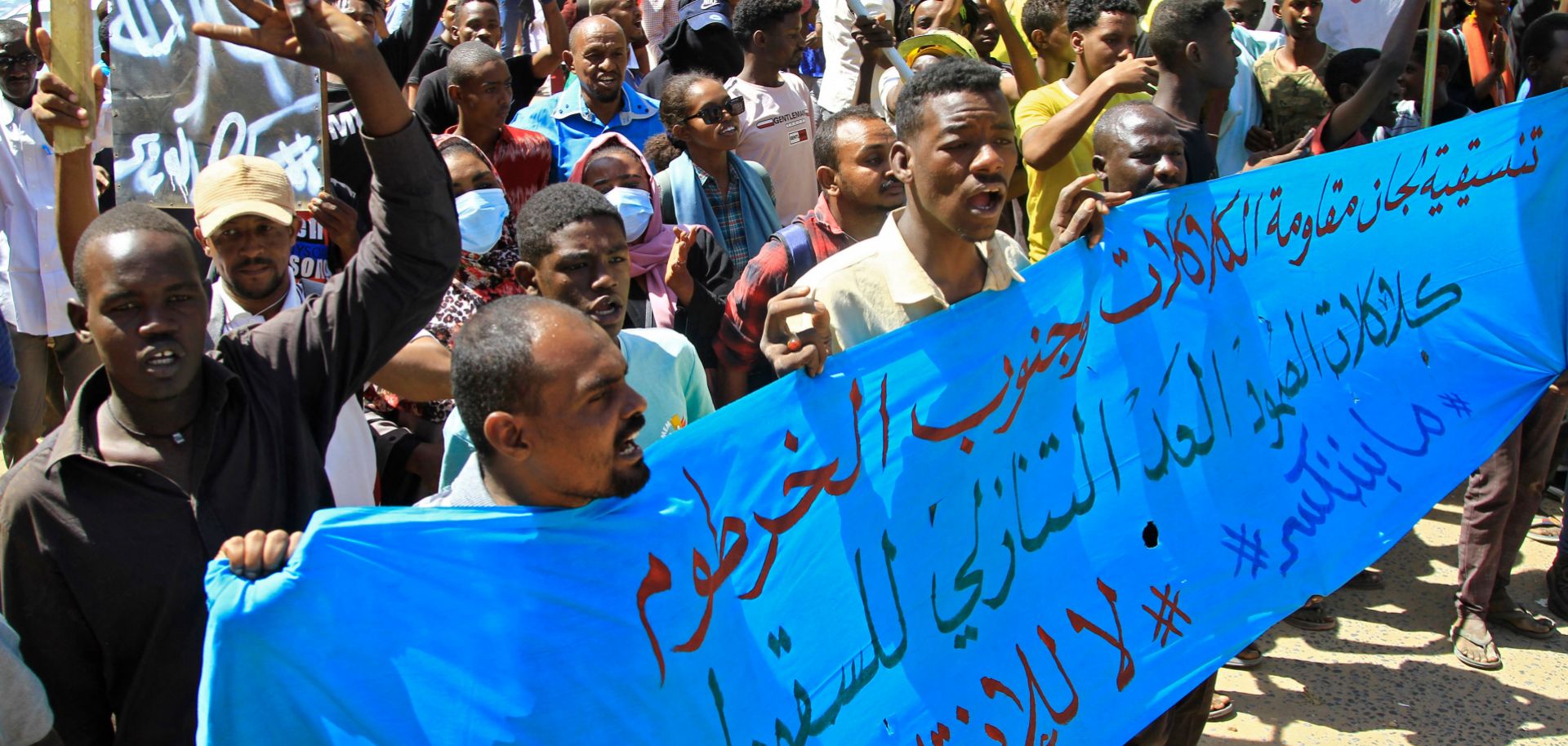
Demonstrators march in a protest in the area south of Sudan's capital Khartoum on Oct. 25, 2022, on the first anniversary of the military coup.
The Sudanese military and civilian political coalitions appear to be nearing a draft constitution deal, but civilian resistance groups' refusal to make concessions to the military may mean that violent unrest and political volatility persist even if an agreement is reached. Thousands of Sudanese took to the streets on Oct. 25, marking the one-year anniversary of the military coup that installed Abdel Fattah al-Burhan as the country's transitional president. Despite an intermittent nationwide internet blackout, videos on social media showed protesters marching to the presidential palace and confronting security forces. Since the military took power, civilian resistance committees have staged weekly protests demanding a return to democratic rule, to which security forces have responded with tear gas, arrests, beatings and live fire. Under increasing international pressure to account for security abuses, Burhan announced in July that the military would cede power if civilian political groups and resistance forces reach an agreement on a new technocratic government, but progress has been intermittent and the military retains government control.
- In his coup in October 2021, Burhan dissolved the ruling Sovereignty Council, which had overseen a power-sharing arrangement between civilians and the military, claiming that he did so to avert a civil war.
- According to the Sudanese Doctors' Committee, 119 protesters have died since the military took control of the government one year ago.
- Established during the 2019 revolution against former President Omar al Bashir, resistance committees have community-based structures and initiatives organized by neighborhoods, and have proved an extraordinarily resilient and effective method of consolidating and sustaining resistance to the military junta.
The one-year coup anniversary comes as the military and civilian groups are reportedly nearing an agreement on a draft constitution that could improve Sudan's near-term economic outlook. The United States, the United Kingdom, the United Arab Emirates and Saudi Arabia are facilitating talks between the military, the Rapid Support Forces (a Sudanese paramilitary group led by Mohamed Hamdan Dagalo) and the Forces of Freedom and Change (a coalition of civilian politicians). The parties involved are apparently working off of a draft constitution presented by the Sudanese Bar Association that would create a new government with participation from rebel groups, the Forces of Freedom and Change (FFC) and other political parties and separate protest groups. Under this arrangement, the state security apparatus would undergo reforms and a civilian council would immediately appoint a civilian prime minister, who would lead the country to elections in 2024 and eventually head the Security Defense Council. Reportedly, the military would still have some guarantees of independence and freedom from prosecution for crimes committed over the last year and during the 2019 revolution. The draft would also require the military to absorb the RSF, according to an Oct. 17 report by Bloomberg. A deal along these lines would likely unfreeze billions of dollars in Western aid and foreign investment in agricultural projects and infrastructure that were suspended when Burhan seized the government in 2021, giving a huge boost to Sudan's ailing economy and mitigating the worsening cost-of-living crisis.
- Before Burhan's coup, Sudan was already one of the poorest countries in the world, but has since faced a worsening economic and cost of living crisis. About one-third of the population suffers from hunger (a 50% increase since 2021, according to the World Food Program), and the cost of food staples has increased 137% since October of last year. Sudan's macroeconomic situation has also deteriorated since last year's coup, as the country's progress under an IMF program, foreign investment and aid have all come to a halt.
Even if the military and civilian political coalitions reach a deal, civilian resistance committees are unlikely to accept concessions to the military, meaning some level of violent unrest is likely to continue, threatening the transition to civilian rule. While Sudanese resistance committees have opposed all military involvement in governance since the 2019 revolution, security forces' recent violence against civilian protesters has made some members even less willing to entertain military leaders' demands. Burhan, Dagalo and other members of the security establishment are unlikely to cede power without assurances that the new civilian government will not attempt to prosecute them for alleged crimes committed during the reign of al Bashir and over the course of the junta's rule. Civilian politicians in the FFC will thus likely agree to such concessions to ensure they can ink a deal — meaning that resistance committees may reject the draft constitution proposed by the FFC, the military and the RSF and continue to stage protests advocating for a return to civilian rule and prosecution of military crimes. In the short term, this would likely continue to result in clashes between protesters and security forces in cities like Khartoum and Omdurman, as well as further violence in peripheral states as security forces focus on clamping down on dissent in urban centers. In the medium term, resistance committees' demands that the military be excluded from Sudan's next government may backfire, as leaders like Burhan are unlikely to willingly cede all power to civilian coalitions. As such, continued violent unrest would likely offer favorable circumstances for opportunistic military leaders to use civilian political disunity as justification for future power grabs. While another coup is far from guaranteed, internal fracturing and competition within the security establishment — particularly between members of the military and the RSF — will likely remain a threat to free and fair elections in 2024.
- Amid further unrest in more populous urban areas, Sudanese states like Blue Nile (which suffered 220 deaths during inter-communal violence over the weekend of Oct. 22-23), will likely experience further atrocities resulting from long-standing ethnic and land grievances.
- Following the October 2021 coup, the civilian prime minister Abdullah Hamdok resigned, citing an unwillingness to be complicit in the military's regime and an inability to spur the transition back to civilian rule. Resistance committees are attempting to avoid a repeat of this by banishing the military from politics, but political groups are less extreme in their demands and at this point appear willing to support some form of power-sharing, weakening resistance committees' position.
