
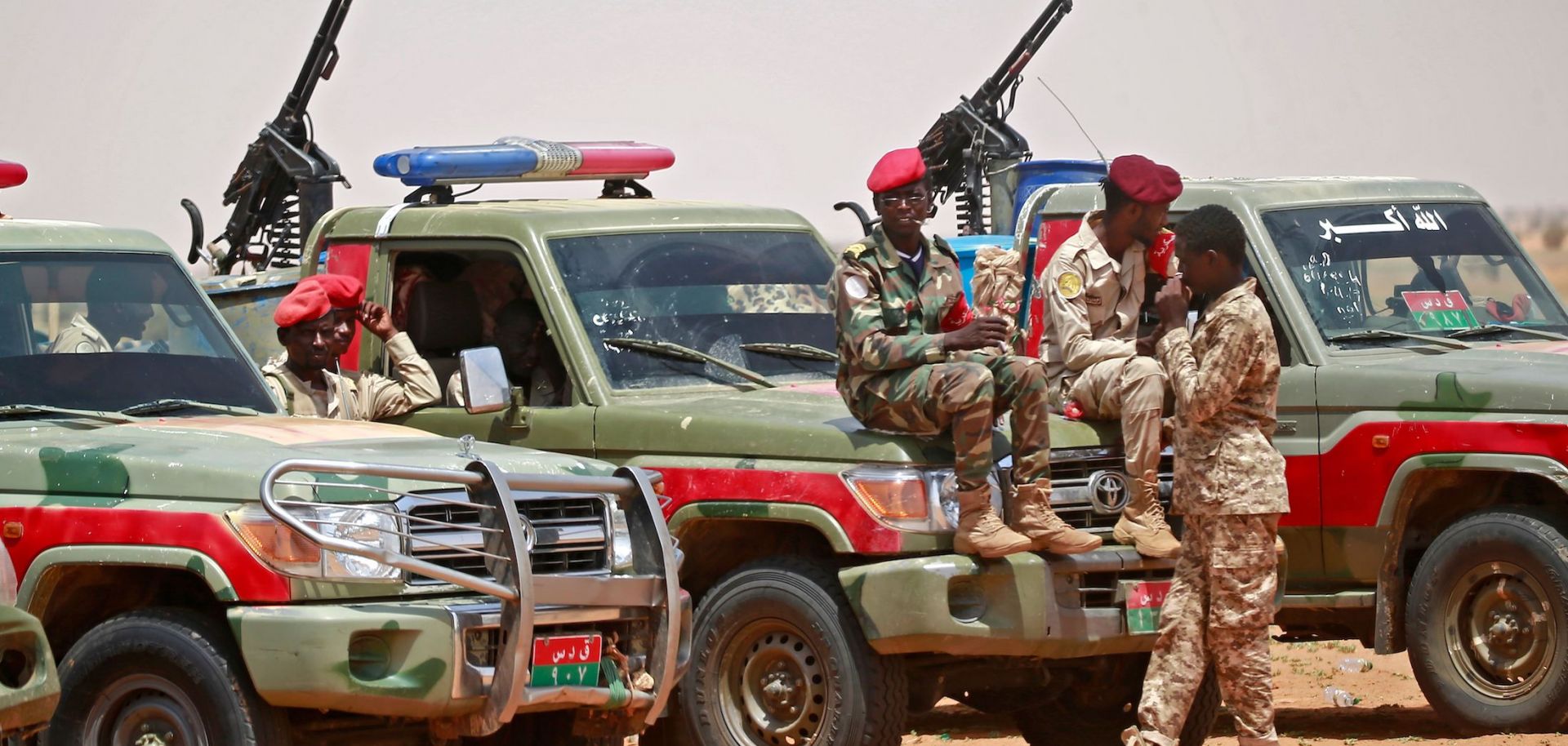
Members of Sudan's Rapid Support Forces (RSF) paramilitary group are seen in a desert area about 100 kilometers north of Khartoum on Sept. 25, 2019.
In Sudan, troop movements and army warnings indicate heightened tensions that risk escalating into violence and derailing the country's already delayed transition to civilian rule. On April 13, the Sudanese army issued a warning after the paramilitary group Rapid Support Forces (RSF) deployed troops to the capital of Khartoum and the northern town of Merowe. The RSF claims that the deployments are a part of its normal duties to provide ''security and stability and [fight] human trafficking and illegal migration,'' but the army has said that the troop movements occurred without its approval or coordination and represented a ''clear violation of law.'' While the number of RSF troops deployed to Khartoum and Merowe is unclear, one media outlet reported that around 100 military transport vehicles belonging to the RSF were deployed near the city's airport.
- The RSF originated from the Arab janjaweed militia that has been involved in over two decades of ethnic conflict in Sudan's western Darfur region and is currently led by deputy chairman of the ruling Transitional Military Council, Mohamed Hamdan Dagalo. The RSF is estimated to have approximately 100,000 troops, bases and deployments throughout the country. The Sudanese military is headed by Abdel Fattah al-Burhan, who is also president of the transition council and de facto ruler. The two leaders have been in varying states of conflict for decades, each backed by different international powers. The number of military personnel is estimated at around 124,000.
The escalation in tensions between the RSF and the military comes amid stalled negotiations over Sudan's transition to civilian rule following the 2021 military coup. The RSF, the military and the Forces of Freedom and Change (FFC) civilian coalition signed a preliminary framework agreement in December 2022, but left major sticking points to be decided during the second round of negotiations, which was originally supposed to conclude in March. Those sticking points include a date for when the transition period will begin, security sector reform, immunity for crimes committed during the 2019 revolution and subsequent transitional years, and integration of the RSF into the military. However, the signing of the second internationally-backed agreement has been postponed twice over the past month, reportedly due largely to an ongoing disagreement between the RSF and the military. The disagreement appears to be related to security sector reform, as well as the extent of and timeline for the RSF's integration into Sudan's armed forces, which are key stipulations of civilian coalitions like the FFC. Animosity between the RSF and the military has long fueled conflict in Sudan, with leaders like Dagalo and Burhan competing for national influence and power.
- In 2019, a massive pro-democracy movement led to a coup against Sudan's former authoritarian leader Omar al-Bashir, who had reigned over the country for nearly three decades. Following the coup, military leadership dissolved the government and assumed control of the country through the Transitional Military Council, eventually agreeing to a power-sharing structure with civilian leaders. But, in October 2021, the military overthrew the transitional civilian government and has ruled the country ever since.
Elevated tensions risk erupting into violent conflict and giving the military plausible cover for more lengthy delays in returning Sudan to civilian rule. The military has stated it is trying ''to find peaceful solutions'' to avoid further escalation, but it has also placed its troops in the capital on high alert and bolstered its deployed forces. The newly deployed RSF fighters appear to intend to stay in Khartoum and Merowe; some media sources reported that upon arriving in Merowe, the RSF troops were ordered by the army to leave the area, which they refused to do. The army has since reportedly demanded that if the RSF does not withdraw within 24 hours, its personnel will be ''forced'' to remove them. But as of April 14, the standoff is still ongoing. These developments raise the risk of violent confrontation, including in Khartoum (which continues to see civilian protests against military rule) that could spark clashes in other parts of the country. According to Bloomberg, both the RSF and the army have in recent weeks increased recruitment efforts in Sudan's turbulent Darfur region, which remains a hot spot for ethnic violence often involving the RSF. As a result, should armed clashes occur, both the military and the RSF may attempt to mobilize forces in other regions across the country, although a sustained national conflict is a low-likelihood scenario given high international involvement in the transition process. No matter the intensity of any fighting, tensions will likely prevent the transitional agreement from being signed in the coming days, and the military could use the heightened risk of violence as evidence that Sudan is not ''ready'' to transition — potentially further delaying the process for weeks or months. The pro-democracy civilian resistance committees that have led anti-military protests in Khartoum (and elsewhere) since the October 2021 coup did not support the deal to begin with and oppose negotiating with the army outright. But these civilian groups would very likely still protest any additional delays to Sudan's political transition, portending continued instability and unrest in the capital city.
- The United States, United Kingdom, Saudi Arabia and the United Arab Emirates began facilitating closed-door talks between civilian and military leaders in Sudan in the months since the 2021 coup.
- The 2021 coup and the subsequent delays in Sudan's return to civilian rule have so far cost the country billions of dollars in external support pledged to aid its political transition, causing the Sudanese economy to continue to spiral and living conditions in the country to further deteriorate.
