
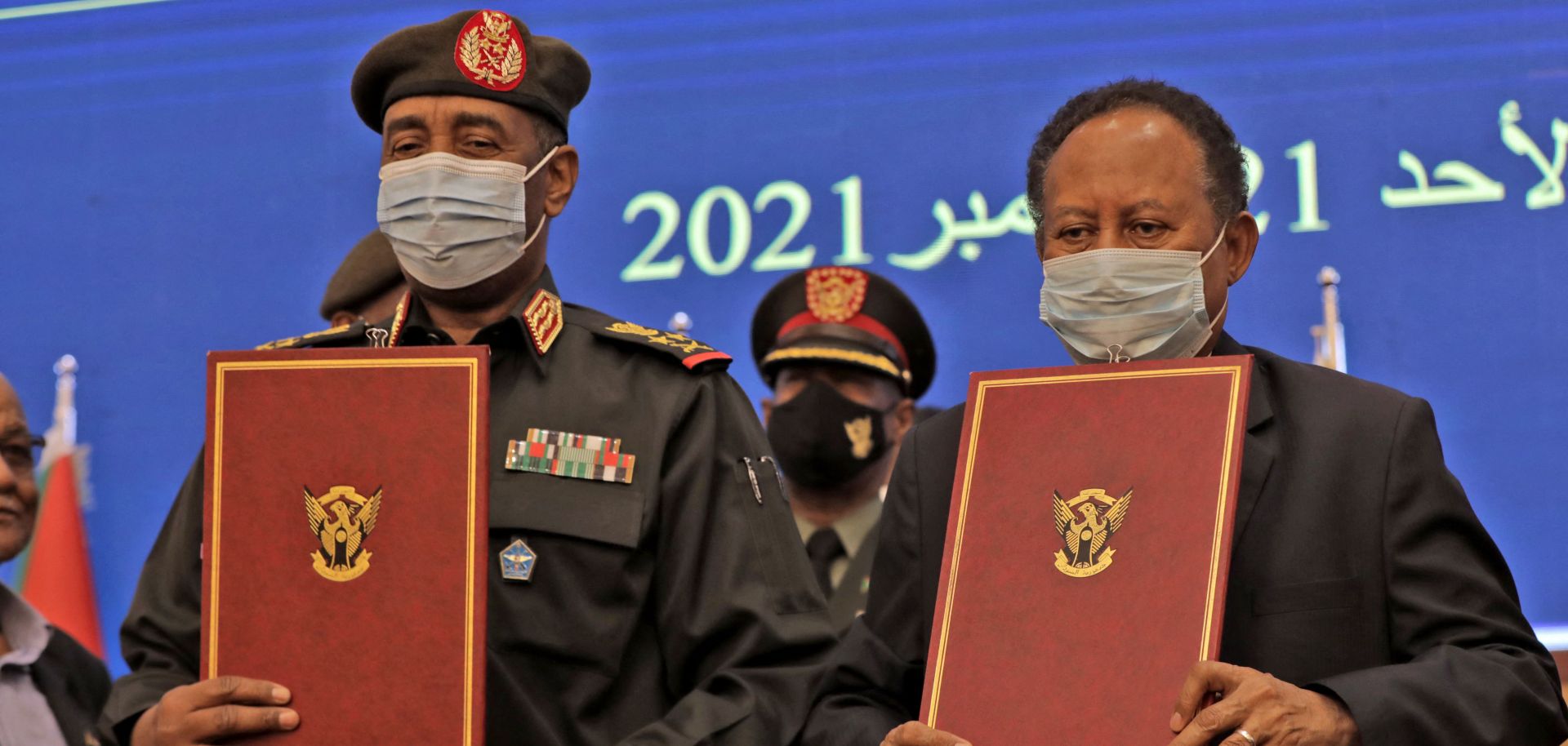
Sudan’s military chief (left) and prime minister show documents during a deal-signing ceremony in Khartoum on Nov. 21, 2021.
The reinstatement of Sudan’s civilian prime minister will not be enough to satisfy the pro-democracy protest movement, which will continue to destabilize the already fragile country. On Nov. 21, Sudanese Prime Minister Abdallah Hamdok was released from house arrest and subsequently reinstated to his post as part of a deal with Sudan’s military chief and leader of the Oct. 25 coup, General Abdel-Fattah Burhan. Under the deal, Hamdok will lead a technocratic civilian cabinet that will continue facilitating Sudan’s democratic transition as planned, including organizing elections before July 2023. Hamdok publicly stated that his cooperation with Burhan was aimed at preventing additional casualties amid ongoing protests in Khartoum and Omdurman, which have resulted in 41 civilian deaths since last month's coup. Despite this, however, pro-democracy protesters from the Sudanese Professionals Association (SPA) have condemned the agreement, calling the prime minister a traitor and a sellout.
- Burhan initially claimed that the deal with Hamdok would be inclusive. However, the Forces of Freedom and Change (FFC) — the civilian alliance that held a power-sharing agreement with the military before the coup — was not represented beyond Hamdok.
- Hamdok was arrested on Oct. 25 as part of a military takeover of Sudan’s joint civilian and military government, which was established in 2019 after the ousting of former authoritarian leader Omar al-Bashir.
Hamdok’s return will reduce Western pressure on Burhan following the coup, though ongoing protests will continue to undermine Sudan’s domestic stability. In a joint statement issued on Nov. 21, the United States, European Union, the United Kingdom, Norway, Switzerland and Canada expressed support for Hamdok’s reinstatement and called for the release of the remaining civilian cabinet members who were detained in the wake of last month’s military takeover, which Burhan has pledged to do in the coming days. But the leaders behind Sudan’s pro-democracy movement — the FFC, the Sudanese Congress Party (a member of the FFC) and the SPA — have said that they would not recognize any deal with the military as they have no assurances that security forces will not attempt to seize power again, claiming the Burhan-led military establishment has lost all credibility since staging last month’s coup. The emergent consensus among the protest organizers is that a return to the pre-coup status quo is not enough, and that the military needs to step down from national leadership altogether. Burhan, however, has little incentive to relinquish power ahead of 2023 elections — all but ensuring that civil society groups will continue to protest.
- The Nov. 21 deal between Hamdok and Burhan comes days after U.S. Secretary of State Antony Blinken wrapped up his tour of Kenya, Nigeria and Senegal, during which he discussed the Sudan crisis with several African leaders and called for the return of the transitional coalition government.
Looking ahead, a key question in determining Sudan’s future is whether pro-democracy groups will be pacified with anything other than full abnegation of military authority. Burhan will continue to face staunch domestic opposition in the form of widespread and relatively peaceful protests, as groups like the SPA previously showed their persistence during the demonstrations leading up to al-Bashir’s 2019 ousting. As domestic pressure persists, security forces will likely crack down on demonstrators as they did in response to protests on Nov. 17, adding to civilian casualties. The ability of Sudan’s newly reinstated prime minister to mitigate this violence will likely also be limited, as the authority granted to Hamdok under his new deal with Buhran remains uncertain. If groups like the SPA accept basic measures toward organizing elections and establishing democratic institutions on the timeline set forth by the military, violent unrest may be staved off. However, pro-democracy groups’ recent public statements and past behavior suggest they’re much more likely to stay on their current path, raising the risk of more bloody and destabilizing clashes on the streets.
- The SPA is credited with organizing and leading many of the demonstrations that led to the eventual downfall of al-Bashir. Despite blackouts and disruptions by security forces, the SPA continues to be highly effective in demonstrating against the current military government.
