
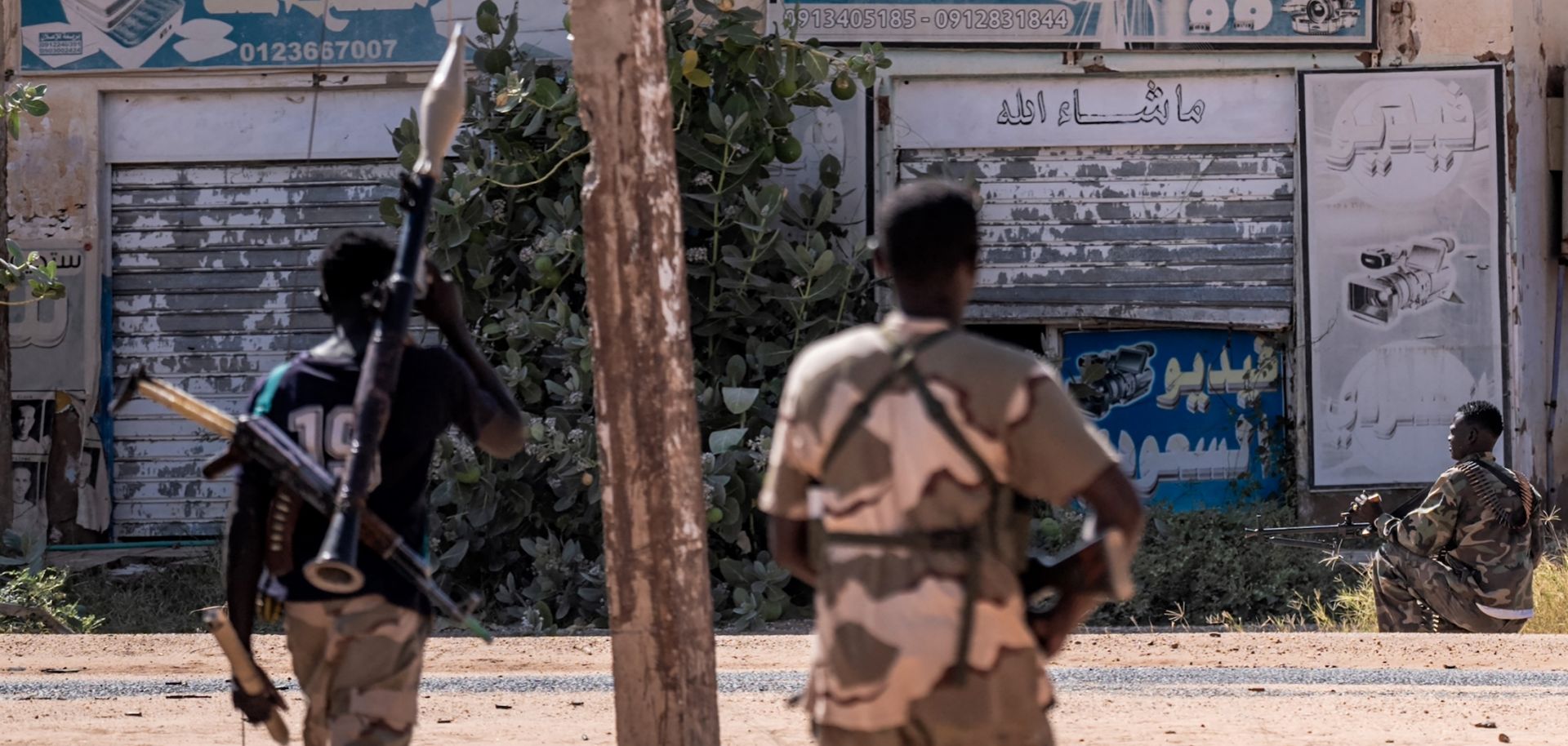
Efforts to resolve Sudan's conflict are hindered by competing international interests, making a peace deal unlikely and risking destabilization in neighboring South Sudan and Chad through ethnic violence and arms proliferation, while creating a power vacuum that could enable jihadist groups to exploit deteriorating socio-economic conditions. On Oct. 25, the Rapid Support Forces paramilitary group, or RSF, was accused of killing at least 124 people in a village in the east-central state of Gezira amid the group's ongoing conflict with the Sudanese Armed Forces, or SAF. The violent raid occurred after a high-ranking RSF officer surrendered to the SAF, which prompted the RSF to retaliate by killing and detaining civilians in his home area, displacing thousands of civilians in the process. These events are part of the larger civil war in Sudan that broke out on April 15, 2023, primarily driven by power struggles between two rival military factions: the SAF, led by Abdel Fattah al-Burhan, and the RSF, commanded by Mohamed Hamdan Dagalo, also known as Hemedti. The conflict emerged from tensions following the military coup in October 2021, where both factions initially united to oust the civilian government. However, their relations gradually deteriorated as they competed for control over Sudan's political future and resources. The two groups also sparred over the RSF's integration into the regular Sudanese military — a key aspect of a proposed transition to civilian rule that faced delays and disagreements over timelines and command structures. Tensions ultimately erupted when the RSF launched a coordinated assault on SAF positions, primarily targeting locations in Khartoum. The conflict then rapidly spread across the country, fueled by repeated breakdowns in peace negotiations.
- As of Oct. 14, the Armed Conflict Location & Event Data Project (ACLED), a publicly available database that tracks political violence and protest events across the world, recorded 8,109 events of political violence and more than 24,850 reported fatalities in Sudan since the war between SAF and RSF began in April 2023.
- The RSF, formed in 2013, originated from the local Arab militias known as the Janjaweed, active in the Darfur conflict from 2003 to 2010. Over time, former president Omar al-Bashir expanded the RSF's role to include involvement in various conflicts such as those in Yemen and Libya, border security, and the protection of key resources, including Sudan's gold reserves. The group also played a pivotal role in the 2019 ousting of al-Bashir.
Since April, the SAF and RSF have shifted territorial control in Sudan amid failed peace initiatives by various regional and international stakeholders, as external players pursue their interests in a complex proxy war. Over the past seven months, both the RSF and SAF have engaged in territorial maneuvers, capturing and losing control of key areas in the ongoing war. While the RSF launched a large-scale offensive in eastern Sudan in June and July that achieved some success, as of early November 2024, the SAF held significant portions of the country's east, including strategic areas along the Nile River and key cities in Sennar state like Dinder and El Souki, as well as Port Sudan and other critical locations in Red Sea state. Meanwhile, the RSF retains strongholds in the Darfur region, including major cities like El Geneina and Nyala; the paramilitary group is also trying to seize El Fasher, the SAF's last stronghold in the area, where fighting is ongoing. The area surrounding Sudan's capital of Khartoum remains divided, with intense urban combat persisting. The SAF and RSF both rely on alliances with ethnic and religious militias, as well as politically-motivated armed groups. The SAF aligns with Islamist and ethnic militias, including groups tied to the toppled regime of former President al-Bashir, while the RSF primarily recruits from Arab tribes in Darfur and beyond, and incorporates local ethnic militias for territorial control. The conflict is further exacerbated by the ongoing proxy war as external powers pursue their strategic interests through local actors, with Russia and Iran supporting the SAF, the United Arab Emirates backing the RSF, and the United States, Egypt and Saudi Arabia engaged in mediation efforts. Various stakeholders have undertaken multiple peace initiatives to end the war, though these have had mixed outcomes and have yet to yield a lasting cease-fire.
- In May 2023, Saudi Arabia and the United States facilitated cease-fire talks between the SAF and the RSF in the Saudi port city of Jeddah, but the talks repeatedly failed to produce a deal, with Sudanese civilians and civil society organizations excluded from the process. In October 2023, Saudi Arabia and the United Arab Emirates mediated another round of talks focused on humanitarian issues, although the SAF's absence limited progress. In August 2024, the United States, in collaboration with Saudi Arabia, facilitated peace talks in Geneva aimed at addressing Sudan's humanitarian crisis. The RSF participated in these discussions, while the SAF declined to attend, citing conditions such as the RSF's withdrawal from occupied areas as prerequisites for their participation; consequently, the talks concluded without a tangible agreement.
A cease-fire will remain elusive due to the SAF and RSF's conflicting agendas and deep-seated hostilities, reinforced by influential proxy actors sustaining the conflict. Stalled peace talks and the SAF and RSF's entrenched rivalry, combined with regional divisions and competing international interests, will continue to impede efforts to resolve the conflict, making a lasting cease-fire unlikely in the near term. While the SAF initially appeared willing to participate in peace negotiations, this was likely driven by expectations of stronger Russian and Iranian support, which the Sudanese army hoped to use as a bargaining tool to strengthen their position in talks with the paramilitary group. But this additional support never materialized, and as a result, the SAF's commitment to reaching a diplomatic resolution has waned, as without that negotiating leverage, a truce would likely involve making more concessions to the RSF. Meanwhile, competing frameworks for peace talks, with different countries and regional bodies leading different talks, have further hindered genuine progress toward a resolution as well. The likelihood of a prolonged stalemate is therefore high, as mediation efforts struggle to gain traction due to each side's reluctance to compromise on cease-fire terms and uphold agreed-upon truce conditions. If these dynamics persist, violence in Sudan could escalate and leave different factions — including SAF and RSF with their allies — in control of different parts of the country. This would worsen the proxy war and further radicalize various Sudanese groups, increasing the risk of spillover violence in neighboring countries.
- The RSF participated in the last round of negotiations in Geneva, though the SAF did not attend, citing concerns that the talks aimed to ''whitewash'' the RSF. The SAF also denounced the United Arab Emirates' presence at the talks, accusing the Gulf state of supporting the RSF. Additionally, Sudanese authorities objected to the SAF being invited to the Geneva talks instead of Sudan's Sovereign Council, a body installed to rule over the country until elections.
- Regional organizations like the African Union and Intergovernmental Authority on Development (IGAD) have emphasized including local communities in peace talks, despite facing constraints due to the complex dynamics of the conflict. If the international community succeeds in pressing for ''all-inclusive'' talks that involve other Sudanese political representatives in addition to the RSF and SAF, a pathway to temporary cease-fires and limited power-sharing may become viable. Nonetheless, without addressing the influence of external actors and aligning divergent civilian and military interests, the road to stable governance in Sudan will likely be a protracted one.
As peace talks fail, the risk of violence spilling into South Sudan remains high, with cross-border recruitment, ethnic tensions and arms proliferation threatening to destabilize the country and spark clashes between the SAF and RSF-affiliated militias along its northern border. In the absence of progress toward a lasting cease-fire, the risk of violence spilling southward into ethnic communities in neighboring South Sudan remains high, as tensions there partly align along SAF and RSF divisions. South Sudan's President Salva Kiir has sought to distance himself from the war in Sudan by focusing instead on securing the transportation of crude oil through the Petrodar pipeline that connects oil fields in South Sudan's Upper Nile state to Sudan's Port Sudan. But the conflict nonetheless risks expanding into South Sudan through cross-border recruitment, ethnic tensions and arms proliferation. Hostilities have already intensified near the two countries' shared border, including in Sudan's South Kordofan and White Nile states. Both the RSF and SAF have reportedly targeted South Sudanese communities for recruitment, especially the Nuer and Dinka ethnic groups, which risks aggravating existing ethnic rivalries within South Sudan. Additionally, South Sudan's deployment of troops to its northern border to counter potential RSF incursions could lead to direct clashes. The flow of arms across the Sudanese border, as well as external support to warring Sudanese factions, could further destabilize South Sudan, amplifying the risk of local militias and rebel groups gaining access to weapons and potentially escalating local conflicts in the country.
- In January 2024, South Sudan's government accused the RSF of recruiting South Sudanese rebels to target the SAF, prompting South Sudan to deploy troops and heavy weaponry along the border to protect key areas, especially oil regions, from potential RSF attacks. Two months later, a former South Sudanese military officer was accused of forcibly recruiting South Sudanese citizens to support the SAF; the report indicated that the recruitment drive has targeted South Sudan's main ethnic groups, the Nuer and Dinka.
In neighboring Chad, the president's support of the RSF also risks bringing the conflict into his country by prompting Chad's ethnic Zaghawa community to take up arms. Though he claims to be neutral in the Sudan conflict, Chad's President Mahamat Idriss Deby de facto supports the RSF, as demonstrated by his decision to allow supply movements across the Chadian border for the armed group, backed by arms and funding from the United Arab Emirates. This has caused tensions within Chad's ethnic Zaghawa community, which has been targeted by RSF's attacks in Darfur, as Deby himself belongs to the ethnic group. If Deby maintains his support for the RSF — which is likely, given his close ties with the United Arab Emirates — there is a risk that armed Chadian Zaghawa fighters may join the conflict against the RSF, leading to clashes on both sides of the border. This would risk the spillover of violence into Chad as the RSF and its allies clash with Chadian Zaghawas. It could also further diminish Deby's support from his ethnic community, undermining his legitimacy. The Chadian Zaghawa community, feeling threatened, could mobilize militias to defend themselves as well, potentially leading to clashes with Chadian security forces.
- On Oct. 17, the RSF launched an assault on a Joint Force outpost in Jebel Oum, located in West Darfur's Jebel Moon locality, marking another escalation along the Chad-Sudan border.
- In October, Deby dismissed a slew of top security officials who had reportedly opposed his support for the RSF.
More broadly, the ongoing conflict in Sudan is creating a fertile environment for jihadist activity, with deteriorating socio-economic conditions fueling radicalization and facilitating cross-border movements among extremists. As the fighting between the SAF and RSF continues, the significant power vacuum risks enabling various jihadist groups to establish footholds and operational bases to potentially finance their activities, driven by the lack of state authority and control. The SAF could indirectly facilitate this situation due to the Sudanese army's own links with Islamist militias. In addition, the alignment between the SAF and the Muslim Brotherhood also poses a risk of Sudan becoming a nexus for jihadist activities. If Islamist factions within SAF continue to gain influence, they may be able to shift the army toward a more militant, ideologically driven structure, potentially attracting foreign jihadist groups seeking new footholds in exchange for support in fighting the RSF. Furthermore, the fragmentation of Sudanese security forces has discarded the country's ability to counter external threats, which could enable jihadists to carry out their operations, such as recruitment and smuggling, with relative impunity. Meanwhile, deteriorating socio-economic conditions in Sudan — marked by rising unemployment, displacement, and lack of basic services — have created conditions ripe for radicalization among disillusioned individuals seeking purpose and support. This could enable groups like Somalia's al-Shabaab to use Sudan's strategic location to expand recruitment training and operational capabilities for financing, or through a local franchise. By leveraging illicit networks for financing — e.g. through smuggling, extortion and illegal trade — these jihadists could enhance their capacity to launch attacks and consolidate more territories across the Horn of Africa and West Africa.
- Former Sudanese President al-Bashir provided Osama bin Laden and al Qaeda with a safe haven in the early 1990s, creating a foundation for the network that ultimately enabled the planning and coordination of the 9/11 attacks on the United States.
- The Muslim Brotherhood in Sudan, once influential under al-Bashir, has resurfaced amid recent conflicts, with the group supporting the SAF since the civil war broke out in 2023.
