
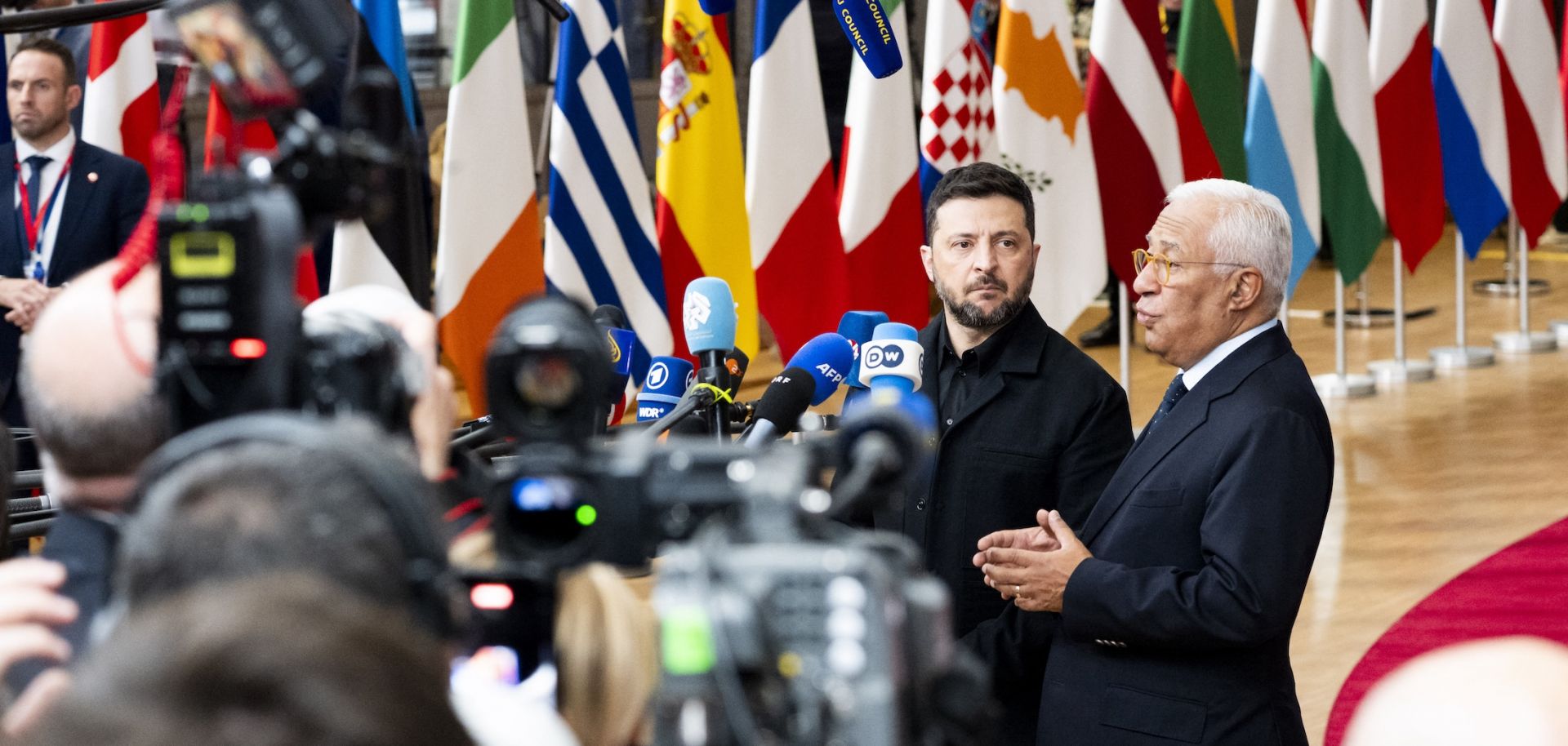
During the latest European Council summit on Oct. 23, the leaders of the European Union's 27 member states debated the situation in Ukraine, efforts to enhance the bloc's defense capabilities and initiatives to make the EU economy more competitive and resilient in the face of growing economic nationalism and geopolitical volatility. As part of these discussions, the leaders explored ways to increase economic pressure on Russia, enhance protection against Russian aggression, and manage relations with an increasingly assertive China, especially as Beijing is tightening export controls on strategic minerals critical to Europe's economic development.
These debates reflect a major shift in the global order in recent years. China and Russia have deepened cooperation in energy, trade, security and technology while becoming more hostile to Europe. These parallel (but not fully coordinated) challenges threaten Europe's import reliability, industrial competitiveness and defense policies. China's export restrictions, domestic subsidies and a generally more assertive positioning on global affairs are a direct threat to the European Union's economy, while Russia's increasingly aggressive actions are challenging the bloc's security. Complicating things further, the United States is increasingly pressuring the European Union to reform its rules on issues from the digital market rules to taxation to make them more accommodative to U.S. interests while frequently casting doubt on its commitment to the bloc's security.
Confronted with these risks, Europe is attempting to derisk its trade dependencies and strengthen its security policies without triggering economic disruption, political fragmentation or a worsening security environment. How the European Union responds will shape its industrial sovereignty, defense capacity and global autonomy for years to come.
China and Russia: From Pragmatic Alliance to Strategic Leverage
The current alignment between China and Russia is driven by a combination of ideology and strategic necessity. Both countries share a common desire to challenge the Western-led international order that constrains their geopolitical ambitions, even if Moscow is more willing than Beijing to disrupt that order through conventional and unconventional warfare. The war in Ukraine has cemented their economic partnership. Under Western sanctions, Russia has turned eastward to China as a key buyer of energy and raw materials, which China (often under preferential terms) uses to fuel its industrial, technological and defense sectors.
This partnership grants both countries strategic leverage over Europe. China's strong trade ties already provide influence, and Beijing is now signaling it could use export controls (especially on rare earth elements, magnetic materials and advanced semiconductor components) as bargaining tools to deter or retaliate against European trade restrictions (for example, on electric vehicles). If strictly implemented, these controls would severely damage the European Union's industrial base and economic development prospects. And while Russian energy exports to Europe (and the leverage that they once gave the Kremlin) have decreased significantly since the start of the war in Ukraine, Moscow currently relies on hybrid warfare (from cyberattacks and disinformation campaigns to espionage and sabotage of critical infrastructure) to deter the EU from intensifying economic or military pressure. These dynamics give China and Russia leverage over Europe — and, indirectly, over each other. Russia's pivot magnifies China's economic reach, while China's export dominance enables control over supply chains that Europe cannot easily diversify from in the short term.
Recent trade data illustrates Europe's exposure to China. In 2024, the European Union imported 12,900 tonnes of rare earth elements, a 29.3% drop from 2023, but still relying on China for 46.3% of those imports. Russia supplied 28.4%. Germany was particularly exposed: in 2024, 65.5% of its rare earth imports came from China. This level of exposure means that any disruption in Beijing can ripple across multiple European sectors — from high-end electronics to EV motors. In May 2025, for instance, Chinese magnet shipments to Europe plunged by around 75% year-on-year, delivering immediate shock to firms reliant on these inputs. Industrial dependency is not limited to raw materials. Many European firms rely on axes of the Chinese supply chain, including rare earth refining, magnet production, advanced ceramics and key semiconductor components. Many companies around the world source intermediate parts that pass through China, meaning that a licensing hold or export control in China can affect global production. In many cases, just a few supply-chain tiers separate European manufacturers from Chinese suppliers.
Compared to China's, Russia's trade leverage is more modest, but still significant: countries like Hungary and Slovakia still receive more than 90% of their oil from Russia, which explains why Budapest and Bratislava constantly threaten to veto EU sanctions against Moscow. Russia's leverage these days is based more on fear than on trade, as the Kremlin devotes significant resources to generate panic, uncertainty, discontent and division in Europe.
Europe's Strategic Dilemma: Derisking vs. Overreach
Faced with these structural vulnerabilities, the European Union has developed several strategies to deal with China and Russia. On China, the EU has adopted a posture of "managed de-risking," aiming to reduce strategic dependencies and protect key sectors of its economy while preserving economic openness — a tricky balancing act. The Critical Raw Materials Act and the European Chips Act are designed to incentivize upstream investment, recycling and strategic stockpiles. But policy implementation has been uneven, and funding challenges persist. Some states (especially in Central and Eastern Europe) continue to court Chinese investment. Others are pushing more aggressively for alignment with U.S. export controls and joint industrial subsidies. The result is a patchwork of national variations that weakens the European Union's ability to present a unified strategy.
The European Union's challenges are most evident in stressed sectors like automotive manufacturing. European automakers, hit by supply shocks in magnets and rare earths, have lobbied for subsidies and protective measures to offset higher costs. However, if Brussels moves too aggressively with trade restrictions or subsidies, it risks Chinese retaliation and deeper fragmentation of global value chains.
On Russia, the European Union's biggest achievements have been sharply reducing imports of Russian oil and gas while increasing support for Ukraine. Progress in other areas has been more modest. While the EU has approved successive rounds of sanctions, the bloc is still struggling to approve drastic measures such as seizing the roughly 200 billion euros ($232 billion) in Russian assets held in European banks, out of fear of the damage that this would do to the eurozone's credibility and the potential for Russian retaliation. Moreover, while the sanctions have eroded Russia's fiscal and industrial resilience, they have not impacted Russia's war strategy in a meaningful way or made Moscow more willing to be flexible in its maximalist demands for winding down the war. And while the European Union is advancing plans to strengthen its military capabilities (such as establishing a new Strategic Compass to boost its defense capabilities, facilitating massive joint investment through new financial tools like the ReArm Europe Plan and the SAFE loan instrument and creating industrial programs like the European Defence Fund to foster common procurement and boost the defense industry's capacity and interoperability), conflicting national interests, insufficient financing and bureaucratic hurdles mean that it will take years for these plans to yield results.
The Scenarios for 2026
Against this backdrop, several scenarios are possible for EU relations with China and Russia in 2026. The most likely is economic realism and strategic caution regarding China and a confrontational stance on Russia. Tensions between Brussels and Beijing are likely to persist over export controls, rare earth licensing and human rights issues. Both sides could implement additional trade restrictions against each other in the coming months, but they will seek to avoid a full-blown escalation that would severely impact both economies. Despite calls for strategic autonomy, the European Union and China remain mutually dependent. China is Europe's largest trading partner, with bilateral trade exceeding 800 billion euros in 2024. European firms continue to rely on Chinese supply chains for intermediate goods. For its part, the European Union is China's second-largest trading partner after the United States. Its large, affluent market remains vital to China's export-driven economy. As the U.S.-China trade war continues, the European Union has also become an increasingly important outlet for Chinese goods redirected from the American market due to tariffs. The European Union's own trade tensions with the United States will make Brussels reluctant to enter a severe escalation with Beijing.
As a result, European leaders will seek to keep strategic confrontation with China within tolerable margins. The United States will likely push the European Union for more aggressive containment of China but Europe's deeper economic exposure will make Brussels reluctant to follow Washington's push for broad economic decoupling, creating trans-Atlantic policy divergence that limits coordinated escalation. China, for its part, is likely to continue using export controls selectively to maintain leverage without triggering full decoupling with Europe. China's focus on economic stabilization amid slowing growth, its outsized current reliance on exports for economic growth and comparatively greater friction with the United States will temper its assertiveness, especially with the European Union.
In the meantime, the European Union's relationship with Russia will remain very tense. Even if ongoing mediation efforts yield a ceasefire in Ukraine, as long as there is not a comprehensive peace agreement that Ukraine fully supports, the European Union will be reluctant to lift sanctions against Russia. Even in the case of a peace agreement, Brussels will seek to maintain many of the sanctions to ensure Moscow's compliance. One of the European Union's main challenges if there is progress on the peace process will be to resist U.S. pressure to lift sanctions as a part of a bigger bargain with Russia. Moscow, for its part, is likely to continue with its hybrid warfare against Europe, as generating divisions and fears within NATO member states remains one of Moscow's key strategic goals. In this scenario, Moscow's economic directioning toward China would continue, with exports of energy, fertilizers and other products continuing to primarily flow eastward.
In a second scenario, relations between China and the European Union could deteriorate significantly and produce an escalation of their trade war. If subsidy disputes remain unresolved, and particularly if European concerns about a flood of Chinese imports deepen and both sides weaponize trade instruments, escalation would become self-reinforcing. The European Union would impose severe restrictions on select Chinese products and services while drastically limiting Chinese investment in the bloc, while Beijing would impose stringent regulatory barriers on key European sectors such as vehicles or luxury brands while further tightening exports of critical raw materials. A sharper confrontation between the United States and China over Taiwan or the South China Sea could also force the European Union to align more explicitly with the United States and trigger Chinese retaliation. A dramatic escalation in Chinese support for Russia's war efforts would produce a similar outcome. No matter what triggers this escalation of the trade dispute, the result would be severe disruptions to EU industrial output, particularly in the EV, semiconductor and aerospace sectors.
An intense EU-China trade war would create both opportunities and risks for Russia. On the one hand, a weaker Chinese economy could over time make the country less willing or able to consume Russian products and therefore negatively impact the Russian economy. On the other hand, a weaker Chinese economy would give China less ability to dictate terms to Russia over trade and create opportunities for Moscow to expand its influence on regions where China is currently very active, such as Central Asia (though Moscow's financial resources to do this would be constrained if Chinese demand for Russian energy weakens).
In a third scenario, a severe worsening of Russia's position in Ukraine could convince the Kremlin to become more aggressive against both Ukraine and the European Union. Significant reversals on the ground (such as losing large amounts of land in the Donbas region, the control of which Moscow has established as one of the key goals of the war), a drastic increase in European military support for Ukraine (such as providing Kyiv with long-range missiles and encouraging Ukraine to hit politically sensitive targets in large urban centers such as Moscow or St. Petersburg) or a severe escalation of sanctions (such as confiscating the Russian assets held in European banks, imposing a total export ban on all industrial equipment, software and technology, even for civilian use or banning all Russian goods and services from the EU market) would almost certainly result in a more aggressive Russian hybrid warfare campaign against Europe, including more blatant incursions in its airspace and open threats of invasion of areas such as the Baltic region.
China's initial reaction to such a situation would likely be diplomatic ambiguity, not open condemnation or endorsement of Moscow's more aggressive actions. If the European Union, United States and G-7 respond with unified, secondary sanctions targeting Chinese firms and financial institutions, Chinese banks would quietly begin reducing transactions with Russian entities to avoid being cut off from the dollar and euro systems. State-owned enterprises might scale back purchases of Russian oil or technology if they see exposure to Western penalties. China would not abandon its strategic alliance with Russia immediately, but Beijing might quietly press Moscow to de-escalate. If Russia escalated only within Ukraine, China's reaction would probably be more muted. In the case of a direct Russian attack against a NATO country, Beijing might publicly call on both sides for restraint while maintaining backchannel engagement with Moscow.
Finally, a scenario where EU-Russia relations improve markedly is highly unlikely in 2026, as this would require an end to the war that is heavily favorable to Ukraine. Such an outcome would involve Russia's total or near-total exit from the territories it has conquered since the invasion in 2022, coupled with Moscow's acceptance of strong NATO-like security guarantees for Kyiv. This would result in a fast lifting of EU sanctions and an intensification of bilateral trade and investment, coupled with a visible de-escalation of Russia's hybrid warfare campaign. But the Kremlin is currently so far from making the necessary concessions to obtain sanctions relief that such a situation is very unlikely in the short to medium term.
This scenario would eventually result in a recalibration of Russia-China ties. With sanctions lifted, Russia would regain access to European energy markets (though they are unlikely ever to reach prewar levels), Western capital and technology, sharply reducing its economic vulnerability and reliance on China. This would give Moscow more autonomy and could bargain harder with Beijing on energy prices, infrastructure projects and political alignment. This could, in turn, lead China to seek to de-escalate trade tensions with the European Union, out of fear of a political, economic and strategic rapprochement between the West and Russia that could negatively impact China's interests. Such developments would weaken, but not end, the Sino-Russian alignment.
A Tough Road Ahead for the European Union
Ultimately, Europe's ability to navigate the intertwined challenges posed by China, Russia and shifting U.S. priorities will determine its geopolitical relevance in the coming years. The European Union faces an unprecedented test. It must defend its economic model, sustain long-term support for Ukraine and preserve strategic autonomy while finding a balance between greater protectionism and managing its trade interdependence with Beijing, defense dependence on Washington and security threats from Moscow.
Success will require coherence between national and EU-level strategies, credible industrial and defense investment and sustained political will to translate "de-risking" from a slogan into structural resilience. The evolving China-Russia partnership has exposed the vulnerabilities of Europe's economy and security structures, but it has also catalyzed the development of a more strategic, security-conscious Union. Whether Europe can turn this moment of pressure into lasting strength will depend on its ability to balance realism with unity – safeguarding its prosperity without compromising its global influence.
