
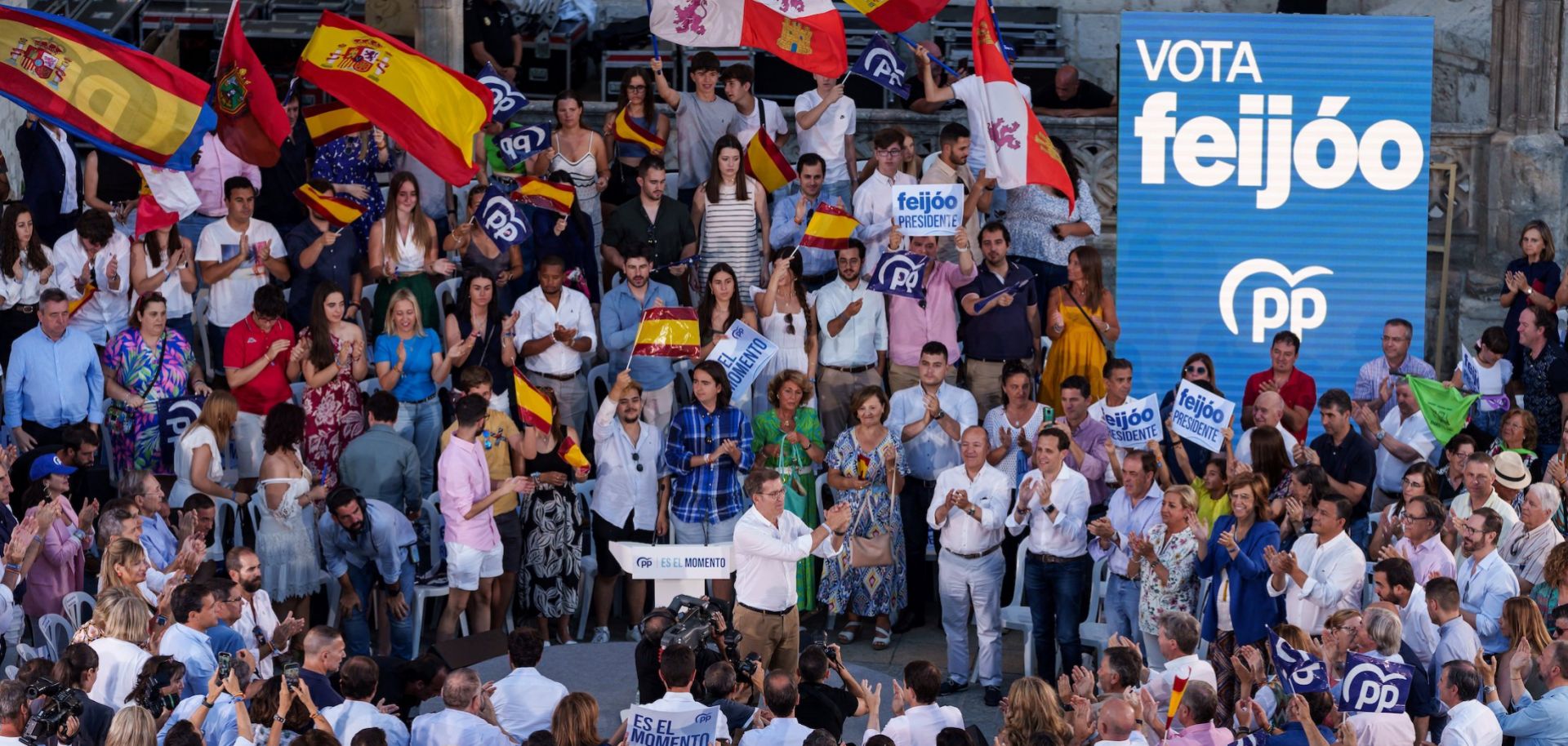
If Spain's July 23 general election yields a governing coalition of conservative and right-wing forces as polls suggest, the risk of social unrest, Catalan secessionism and tense EU relations over climate policies will increase, while a generalized tax reduction will be unlikely. Spain will hold a general election on July 23 that could mark the end of center-left Prime Minister Pedro Sanchez's government. According to a 40dB opinion poll for El Pais newspaper published on July 17, the main opposition party, the center-right People's Party (PP), will win the election with 32.9% of the vote, followed by Sanchez's Socialist Party (PSOE) with 28.7%, the left-wing Sumar with 13.7% and the right-wing Vox with 13.5%. According to the survey, PP will obtain 131-139 seats in Spain's lower house, while Vox will obtain 37-40 seats, which means a coalition between them may control the 176 seats that are necessary for a majority. Polls also suggest that a left-wing coalition between the PSOE and Sumar is virtually impossible.
- Pedro Sanchez has been Spain's prime minister since June 2018, when he defeated then-Prime Minister Mariano Rajoy (PP) in a no-confidence vote in parliament. Under Sanchez's leadership, the PSOE won the two general elections that took place in 2019. In May 2023, Sanchez called for an early general election for July 23 (some six months earlier than legally mandated) after the PSOE and its coalition partner, the left-wing Unidas Podemos (UP), performed poorly in regional and municipal elections.
If polls are correct, the PP will not be able to form a government alone and will need support from Vox, which will significantly increase the right-wing party's influence on policy. The PP's primary objective after the general election is to lead a majority government, but polls show that this is virtually impossible. This means that the PP will need to negotiate with Vox to appoint PP leader Alberto Nunez Feijoo as prime minister. This could happen in two ways. Vox could provide parliamentary support to a PP minority government, but this would mean wasting an opportunity to enter a Spanish government for the first time and take Cabinet positions in areas that the party cares about (such as immigration). Alternatively and more likely, Vox could enter a formal coalition with the PP and demand Cabinet positions, which would significantly increase its visibility and resources. In fact, this is what Vox did in the Valencian Community (Spain's fourth most populous autonomous region), where the PP agreed to give Vox several positions in the regional government in exchange for its support in appointing a government. In either scenario, the PP would need Vox's votes in parliament to pass legislation and block potential no-confidence motions from the center-left and left-wing opposition, which means that one way or another Vox's influence on Spanish policy will increase after July 23.
- If the PP and Vox do not breach the 176-seat threshold needed to appoint a government, the two parties will need support from small, regional parties to appoint Feijoo as prime minister. Catalonia's regional parties will almost certainly not support the PP-Vox coalition due to deep ideological differences, but parties from other regions may agree to abstain during Feijoo's vote of investiture in exchange for concessions to their regions.
- Should the PP and Vox fail to obtain this support, another general election later in 2023 cannot be ruled out. In fact, Spain has held several early general elections during the past decade because parties failed to reach deals to appoint governments.
Despite their campaign promises, the PP and Vox are unlikely to drastically reduce Spain's tax burden and take the fiscal deficit to zero. The PP and Vox are campaigning on a promise to cut taxes, reduce bureaucracy and deregulate Spain's labor market in order to boost investment, consumption and employment. They have also promised to reduce Spain's fiscal deficit (which was 4.8% of GDP in 2022, above the European Union's target of 3%) through spending cuts. However, neither of them has provided exact details about how they will achieve these goals. Unless the next administration in Madrid is willing to take on significant amounts of debt (which would be problematic since Spain's debt-to-GDP ratio is at around 113%, one of the highest in the eurozone), the promised tax cuts would need to be compensated with spending cuts. But while both the PP and Vox have promised to reduce ''politically-motivated'' bureaucratic spending, they have not announced any concrete spending cuts that would compensate for their promised tax cuts. This means that while high-profile, specific tax cuts are likely and mild tax reforms are possible (such as updating the income tax brackets to account for inflation), a generalized reduction of taxes is unlikely, especially as neither the PP nor Vox is willing to cut spending on critical areas such as pensions, health care, education or defense.
- In a June 22 interview, the PP's economic vice-secretary, Juan Bravo, admitted that rather than cutting taxes, a PP-led government will not increase them further. Then in a July 7 interview, Bravo said a PP-led government would ''cut taxes only if the budget allows for it.'' However, the PP has promised to eliminate a tax on large fortunes that the PSOE implemented in 2023.
- Vox's proposals to cut taxes are much more aggressive than those of the PP. For example, Vox proposes to replace Spain's progressive income tax with a flat tax of 15% for incomes below 70,000 euros ($78,400) a year and 25% for incomes above that threshold. The party is also proposing to reduce Spain's corporate tax rate from 25% to 15%. Vox is simultaneously proposing to increase public spending on areas such as healthcare, pensions, infrastructure and education.
If the PP leads Spain's next government, especially if Vox is a formal member, some sectors of Spanish society will increase their protests, and tensions with Catalonia will reignite. The PP's conservative views on social issues (such as LGBTQ+ rights and immigration) mean that different sectors of Spanish society are likely to express their discontent if the party leads the next Spanish government. Additionally, the PP's opposition to Catalonia's independence and the party's actions to suppress the region's 2017 illegal independence referendum means that tensions between Spain's central government and Catalonia's regional government will increase if Feijoo becomes prime minister. Social and regional tensions will be particularly high if Vox formally enters the Spanish government. Vox is critical of what it refers to as ''gender ideology'' and has promised to abolish Spain's abortion law and the Ministry of Equality (which promotes policies to reduce gender inequality). Vox has also promised to eliminate state support for trade unions and to reduce their influence during wage negotiations. The party also wants to abolish Spain's autonomous communities to re-centralize the Spanish state. Even if this latter policy is virtually impossible because it requires changing the Spanish constitution (for which Vox will not have enough support in parliament), the anti-Catalan rhetoric will be enough to reignite tensions between Madrid and the region.
- Tensions between Catalan separatists and the Spanish central government decreased significantly under Sanchez, especially after the prime minister pardoned the Catalan leaders who had been jailed after the 2017 illegal declaration of independence. Catalonia is unlikely to declare independence again in the short to medium term because of political, economic and logistical constraints, but pro-independence rallies and demonstrations would likely increase under a PP government, especially if Vox is a member. The Catalan government would also likely selectively challenge and criticize Madrid for domestic political reasons.
- Former Prime Minister Mariano Rajoy ordered security forces to crack down on the organizers of Catalan's 2017 referendum and then ordered the removal of the Catalan regional authorities who organized it.
While a Spanish government that includes Vox would not threaten Spain's membership in the European Union, it would increase the risk of clashes between Madrid and Brussels over issues such as climate change and immigration. The PP supports Spain's membership in the European Union and the eurozone, which means that under a Feijoo premiership, Madrid would remain committed to both organizations. And while Vox is critical of some of the most federalist dimensions of the European Union, the party is not campaigning on a promise to exit the bloc as some right-wing parties in other parts of Europe are. This means that even if Vox formally becomes a member of the next Spanish government, the chances of Spain exiting the European Union or the eurozone are virtually zero. Still, Vox (and to a much lesser extent, the PP) are critical of some aspects of the European Union's climate policy, especially those that negatively impact Spanish agricultural producers; for example, the two parties defend irrigation systems that the European Union criticizes because of their environmental impact. This means a PP-Vox coalition would likely push for a slower implementation of the European Union's green agenda, while Madrid may ignore or violate some existing EU guidelines on the issue. Should Madrid repeatedly ignore Brussels' request to implement EU climate policy, the bloc could impose financial sanctions on Spain. Another area where Madrid and Brussels could clash, especially if Vox is a part of the next Spanish government, is immigration, as Madrid would likely pressure the European Union to do more to prevent migrants from entering the continental bloc. A PP-Vox government could even accelerate the expulsion of irregular migrants to Spain before they can apply for asylum, in contravention of EU rules.
- In its electoral platform, Vox says Spain should fight against climate change at its own pace without damaging the Spanish economy. The party is also critical of the European Union and says Spain should not be subject to ''the ideological prejudices of the lobbies that currently direct Brussels policy'' on climate change.
- According to the PP's electoral program, ''We will work to rationalize targets and make the timetable for implementing the European Green Deal and the European 'Farm to Fork' strategy more flexible, pushing for measures that are achievable and without setting unattainable targets.''
- A PP-Vox government's stance on migration would also likely generate disputes between Spain and Morocco, as Vox accuses Rabat of using migrants as leverage to obtain political and economic concessions from Madrid and the broader European Union. While some of Vox's anti-Morocco proposals would be impossible to carry out, the rhetoric alone would likely raise tensions.
- In April 2022, Sanchez announced Spain's support for Morocco's proposal to grant autonomy to the Western Sahara region, which is home to a separatist movement, the Polisario Front. This was a drastic reversal in Spanish foreign policy that irritated Algeria, a significant exporter of natural gas to Spain and a supporter of the Polisario. While Vox's electoral program does not explicitly mention Western Sahara, it proposes to ''reverse the recent actions in foreign policy of the [Spanish] government that harm the national interest in energy matters,'' which suggests that if Vox is a part of the new Spanish government, Madrid could go back to its pre-2022 position on the issue.
