
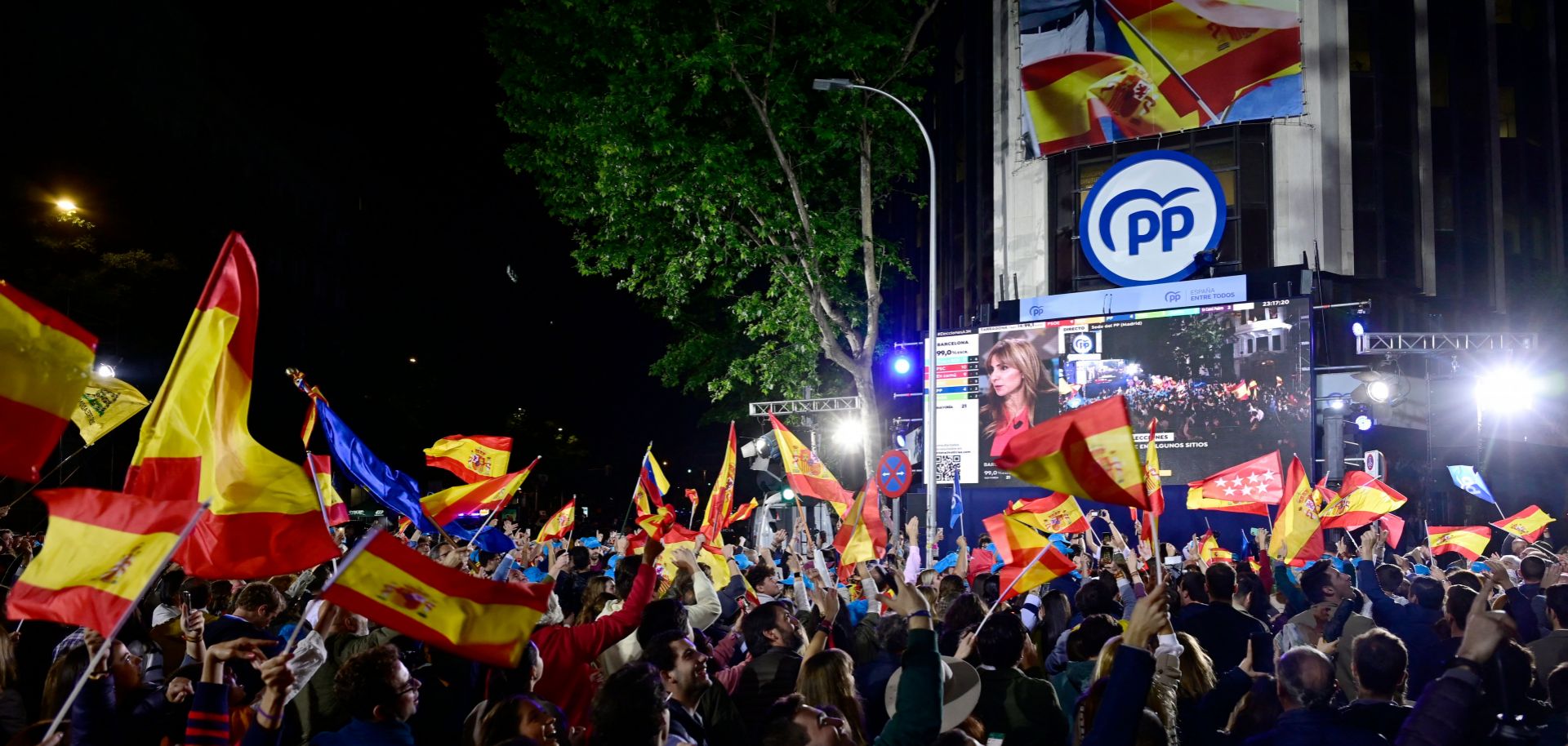
Supporters of Spain's center-right Popular Party (PP) gather outside the PP's headquarters in Madrid on May 28, 2023, to celebrate the party's strong performance in recent regional elections. (JAVIER SORIANO/AFP via Getty Images)
In Spain, an early general election will open the door to a right-wing government that could dismantle current fiscal policies, increase the risk of social unrest and disrupt Spain's upcoming presidency of the European Union. On May 29, Spanish Prime Minister Pedro Sanchez announced that Spain will hold an early general election on July 23, some five months earlier than originally planned. Sanchez made the announcement hours after his center-left Socialist Party (PSOE) performed poorly in regional and municipal elections on May 28, which saw the center-right People's Party (PP) and the far-right Vox party make significant gains. To complicate matters further for the prime minister, the left-wing Unidas Podemos party (UP), the junior member of Sanchez's coalition government, performed extremely poorly in the regional and municipal elections.
- On May 28, Spain held regional elections in 12 of its 17 autonomous communities and municipal elections across the country. The PP obtained roughly 32% of the votes across the country (up from 23% in 2019), while PSOE obtained around 28% (down from 29% in 2019). Vox, meanwhile, received around 7% of the vote, up from 3.5% in 2019. Notably, the PP won in autonomous communities that were previously governed by the PSOE, including the Valencian Community, Aragon, La Rioja and the Balearic Islands. In many regions, however, the PP will need support from Vox to appoint governments.
- The UP, which has been a member of the Spanish coalition government since late 2019, had a particularly poor performance, as it did not even enter the regional parliaments of large autonomous communities such as the Madrid Community and the Valencian Community. The party also lost the municipal elections in cities where it was previously in power, most notably in Barcelona, Spain's second-largest city.
By calling the early election, Sanchez is hoping to stabilize his government and mobilize left-wing and moderate voters who are worried about the rise of the center-right and the far-right. There are multiple reasons behind Sanchez's decision to hold an early general election. To begin with, he wants to prevent his authority from deteriorating further. Holding the election as originally planned in December would have meant months of a weakened and disjointed government that could have further strengthened the opposition. Such a long period before the general election would also have increased the risk of members of the PSOE questioning Sanchez's leadership of the party. Notably, an election in July also means holding the vote very shortly after the PP's negotiations with Vox to appoint regional and municipal governments. Sanchez believes that high-profile PP-Vox negotiations across the country (which in many cases will result in coalition deals) will mobilize left-wing voters who stayed at home during the May 28 elections while also convincing moderate voters to support the PSOE in the general election to prevent the PP and Vox from taking over the national government. Still, this is a risky move because the electoral momentum in Spain seems to have turned against the center-left and the left and in favor of the center-right and the far-right.
- In the coming days, PP-Vox alliances are likely in those autonomous regions and municipalities where the PP cannot appoint a government alone. But the negotiations will not be easy, as both parties are competing for a similar electorate in the general election and will want to remain separate in the eyes of voters. The PP wants to be perceived as relatively moderate and fears that alliances with Vox could alienate its more centrist voters. Vox, in turn, wants to preserve its anti-establishment credentials, which could be tarnished by the alliances with the more mainstream PP. This means that even if the PP and Vox reach deals at the municipal and regional levels, their alliances will be only tactical and subject to collapse depending on the evolution of the campaign for the general elections.
If a PP-Vox coalition emerges from the general election, it will seek to dismantle many of the PSOE's recent tax hikes and anti-government protests are likely to increase. If the PP wins the general election, its priority will be to govern alone. However, polls suggest that it will not win enough seats in parliament to do so, which means that the PP will need to either reach a formal coalition deal with Vox, or a deal according to which Vox will support the PP from parliament. Either way, a PP-Vox pact will likely result in a push to abolish some of the tax hikes that Sanchez's government approved in recent years, including a windfall tax on banks and energy companies and a tax on people with wealth greater than 3 million euros. While financial markets would probably react positively to these developments, the tax cuts would also force the next Spanish government to either cut spending or take on additional debt, which could result in some market volatility if investors don't believe Madrid's fiscal policies are sustainable. Vox's nationalist rhetoric and its conservative positions on social issues would also likely spur more anti-government demonstrations among groups ranging from LGBTQ minorities to pro-independence supporters in Catalonia. Vox and the PP's hawkish stances on immigration mean the election of a right-wing government could strain Spain's ties with Morocco as well, as the PP and, in particular, Vox leaders have accused Rabat of using migration as leverage to obtain economic and political concessions from Madrid (in fact, Vox's electoral platform calls for deploying the military to the Spanish exclaves in Morocco to protect them).
The electoral campaign and the negotiations to appoint a government will reduce Spain's bandwidth to handle its upcoming presidency of the European Union, which will probably slow the bloc's policymaking process. Spain's general election will take place shortly after the country takes over the rotating EU presidency on July 1. This means that the Spanish government will be primarily focused on internal issues during the first month of its presidency (due to the electoral campaign) and at least during the month following it (because of the formation of the new government if the PP wins), which will reduce Madrid's bandwidth to deal with EU issues. A new PP-led government would also scrape or change many of the policy goals that the current PSOE government has set for Spain's six-month EU presidency — especially if the PP comes to power via a deal that gives Vox some influence over policy. As a result, the policymaking process in the European Union could slow down significantly if Madrid fails to meet its presidency obligations, which range from introducing topics in the bloc's policy agenda to brokering deals between member states over controversial issues.
- The current Spanish government has said that reforming the European Union''s fiscal rules will be one of the priorities of its rotating presidency. This is unlikely to change if July 23 election yields a new right-wing government, as the PP (and Vox) would still be interested in introducing more flexible fiscal deficit and sovereign debt rules in the European Union. A PP-led government would also likely maintain its predecessor's push for EU energy market reforms that would decouple natural gas prices from electricity prices and increase energy interconnections between member states.
- Other policy areas, however, could see significant disruptions, especially if Vox formally enters the next coalition government. Vox has heavily criticized Brussels' ambitious push to reduce the bloc's carbon emissions, which could result in clashes with Madrid over climate change policies. The PSOE's pledge to deepen EU-Latin America relations during Spain's presidency of the bloc would also be affected if Vox enters the next Spanish government. Vox's electoral manifesto calls for deeper ties between Spain and Latin America, but those ties prioritize political alliances against the region's left-wing governments. This means that Spain's relations with the left-wing governments in Brazil and Mexico would likely worsen under a right-wing government in Madrid. Vox would also push back against the European Union's ongoing negotiations with the South American bloc Mercosur (which includes Brazil, Argentina, Uruguay and Paraguay) over a free trade agreement, especially if it opens EU markets up to competitive agricultural exports from the likes of Brazil and Argentina.
