
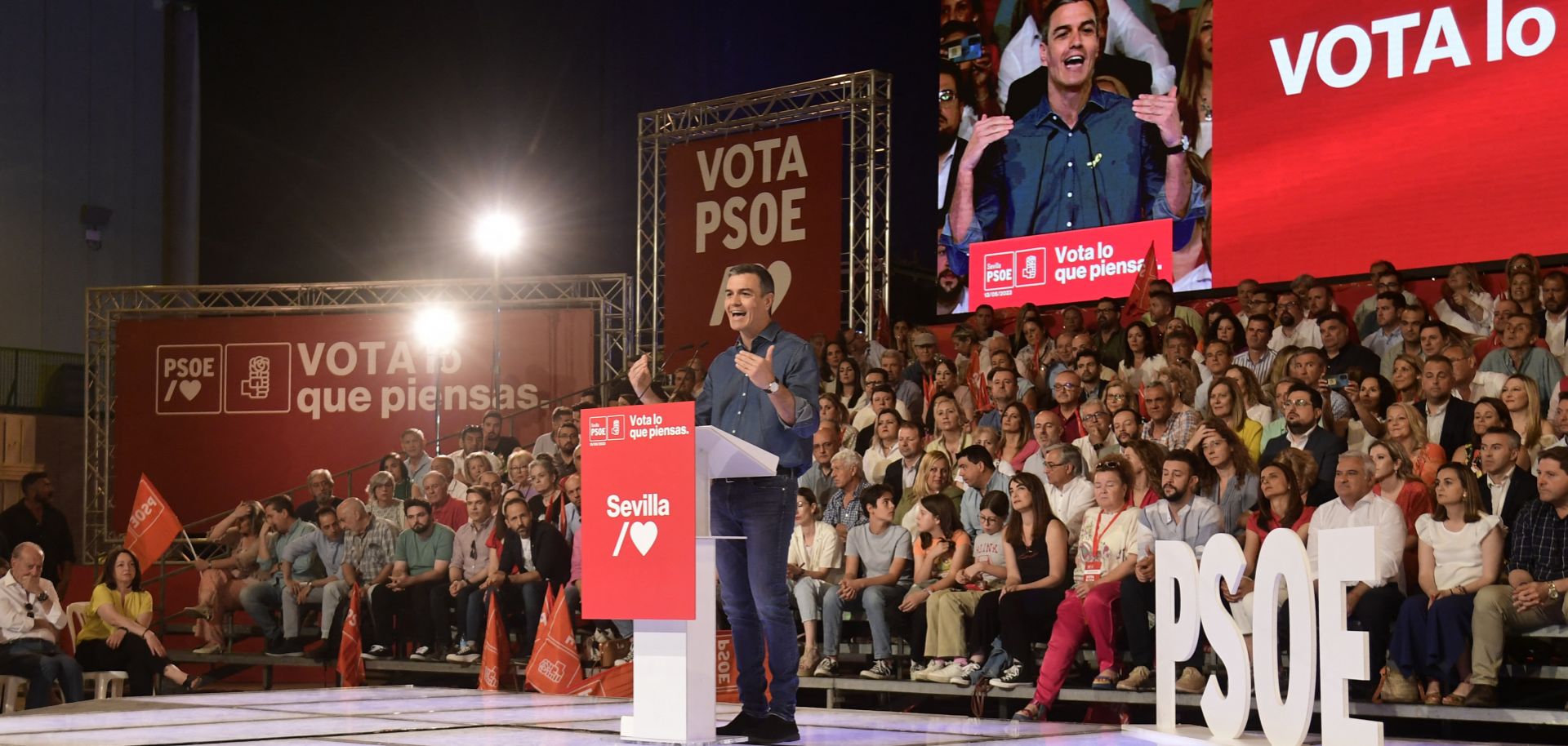
Spanish Prime Minister Pedro Sanchez speaks at a campaign rally in Seville for his Socialist Party (PSOE) on May 13, 2023, ahead of the country's May 28 regional and municipal elections.
In Spain, upcoming regional and municipal elections will result in fragmented legislatures and increase the far-right's political influence that will preview similar developments in the general election later in the year and point to future governance challenges. On May 28, Spain will hold regional elections in 12 of its 17 autonomous communities, its two autonomous cities, as well as municipal elections across the country. These elections will offer a preview of the electoral mood in the country ahead of the general elections, which will take place at some point between late November and early December.
- Since 2019, Spain has been governed by a coalition between Prime Minister Pedro Sanchez's center-left Socialist Party (PSOE) and the left-wing Unidas Podemos party (UP). The next general election must take place before Dec. 10.
- According to recent opinion polls, the center-right People's Party (PP), the main opposition party, will win the general election with 28-33% of the votes, followed by the PSOE with 22-26% and the far-right Vox party with 13-16%.
A weak performance by the ruling PSOE in the regional elections would likely lead the ruling party to implement populist measures to shore up support ahead of the general elections. Nine of the 12 autonomous communities that will go to the polls on May 28 are currently governed by the PSOE, in many cases in coalitions with smaller parties. According to opinion polls, the PSOE could lose in some of the autonomous communities currently under its control, without entering the government in any of the autonomous communities where it is currently not in power. If the PSOE performs poorly in the upcoming regional elections, the Spanish government will likely increase public spending on welfare payments and subsidies for low-income households, as well as increase taxes for wealthy individuals and large corporations during the second half of the year, in a bid to boost its popularity ahead of the general election. In addition, a bad performance in the regional ballot would likely increase tensions between the PSOE and its governing partner, the UP, which has also been struggling to grow in opinion polls. As the two parties seek to differentiate from each other in the eyes of voters ahead of the general election, the policymaking process could become more disjointed and cooperation within the coalition could become harder.
- According to opinion polls, the PSOE could lose the election to the PP in the autonomous communities of Aragon, Valencian Community, La Rioja and the Balearic Islands — all of which are currently governed by the PSOE and their allies. The PP, meanwhile, is projected to win the elections in the autonomous communities where it is currently in power (the Community of Madrid and Murcia).
The regional elections could also increase Vox's political influence and open the door to the far-right party entering the central government at the end of the year, which would increase tensions with the European Union, stoke social tensions in Spain and trigger a renewed push for Catalan secessionism. With the exception of the Community of Madrid (where the PP may win enough votes to govern alone), in all the autonomous communities where the PP stands a chance of forming a government, it will probably need support from the far-right Vox party to do so. Vox is currently part of a regional government in only one autonomous community, Castile and Leon, where it reached a coalition deal with the PP in May 2022. This means that Vox's influence in Spanish politics will likely grow after the regional elections. The multiplication of PP-Vox alliances across Spanish autonomous communities would also open the door to a similar alliance at the national level after the general election, especially if PP is unable to form a government alone. A PP-Vox central government would increase tensions between Spain and the European Commission on issues such as immigration, the fight against climate change and the federalization of the European Union. But the main impact would be domestic, as Vox's very conservative social views could see the Spanish government dismantle some of the more progressive social measures adopted by Sanchez's government (for example on issues like gender parity and the rights of sexual minorities), which would, in turn, spur protests by the affected groups. Moreover, Vox wants the Spanish central government to take back policy areas that have been devolved to regional governments. This means that a PP-Vox central government would almost certainly reignite the secessionist movement in Catalonia, which has significantly eased since the PSOE-UP government took office.
- Vox's electoral platform calls for the ''immediate return'' to the central government of the policy areas that are currently under the control of the autonomous communities, including education, healthcare and security. It also calls for the ''immediate suspension'' of the autonomy of the regional governments that are threatening Spain's territorial unity, which is an indirect reference to Catalonia's push for independence. Re-centralizing the Spanish state would require changing the country's constitution, which is very improbable because a prospective PP-Vox government would not have the majority in parliament needed to push through constitutional amendments. However, the mere fact that Vox is in power would be enough for secessionist forces in Catalonia to restart their push for independence.
- Vox's electoral platform is also critical of the ''radical environmentalism'' promoted by the European Union and argues that Spain cannot be taken hostage by ''the ideological prejudices of the lobbies in Brussels.'' According to the party, Spain should fight against climate change at its own pace and without endangering jobs in the country. Vox also calls for a review of all of Spain's free trade agreements in order to protect the country's industrial interests, and argues that national laws should take precedence over EU legislation on issues that impact Spain's ''national interest.'' All of these points of view would drive a rift between Madrid and Brussels if Vox is included in the next central government coalition.
Regardless of the outcome, the regional elections will confirm the fragmentation and polarization of Spanish politics, which could make it harder for future governments at all levels to implement policy. No matter who wins in each territory on May 28, the regional and municipal elections will produce fragmented legislatures where coalitions of two or more parties will be needed to form governments. A very similar scenario is probable after the general election. In addition, the ongoing polarization of Spanish politics reduces the possibility of cooperation between the PSOE and the PP and makes ''grand coalitions'' between them virtually impossible, as both parties are forced to look to their left and to their right to reach government alliances. This combination of fragmentation and polarization means that it will become increasingly difficult for political parties to reach pacts and form governments at the municipal, regional and national levels. It also means that when those governments are formed, many will be fragile and subject to internal disputes that complicate policymaking. This will result in a pervasive political risk in Spain that will force households and businesses to operate in a context of policy uncertainty, relatively frequent early regional and national elections, and complex governance as lawmakers struggle to reach enough consensus to implement structural economic and institutional reforms.
- Between the 1980s and the early 2010s, Spain was effectively a two-party system, with the PSOE and the PP jointly obtaining around 80% of the vote in general elections and governing the country alone. However, the economic crisis of the early 2010s resulted in a fragmentation of the Spanish electorate and the emergence of new right- and left-wing parties, which challenged the supremacy of the PSOE and the PP and forced them to move away from the political center. While the PSOE and the PP are still able to reach agreements on specific reforms, it remains highly unlikely that Spain's two largest parties would ever form a ''grand coalition'' (which is frequent in countries like Germany and Italy).
