
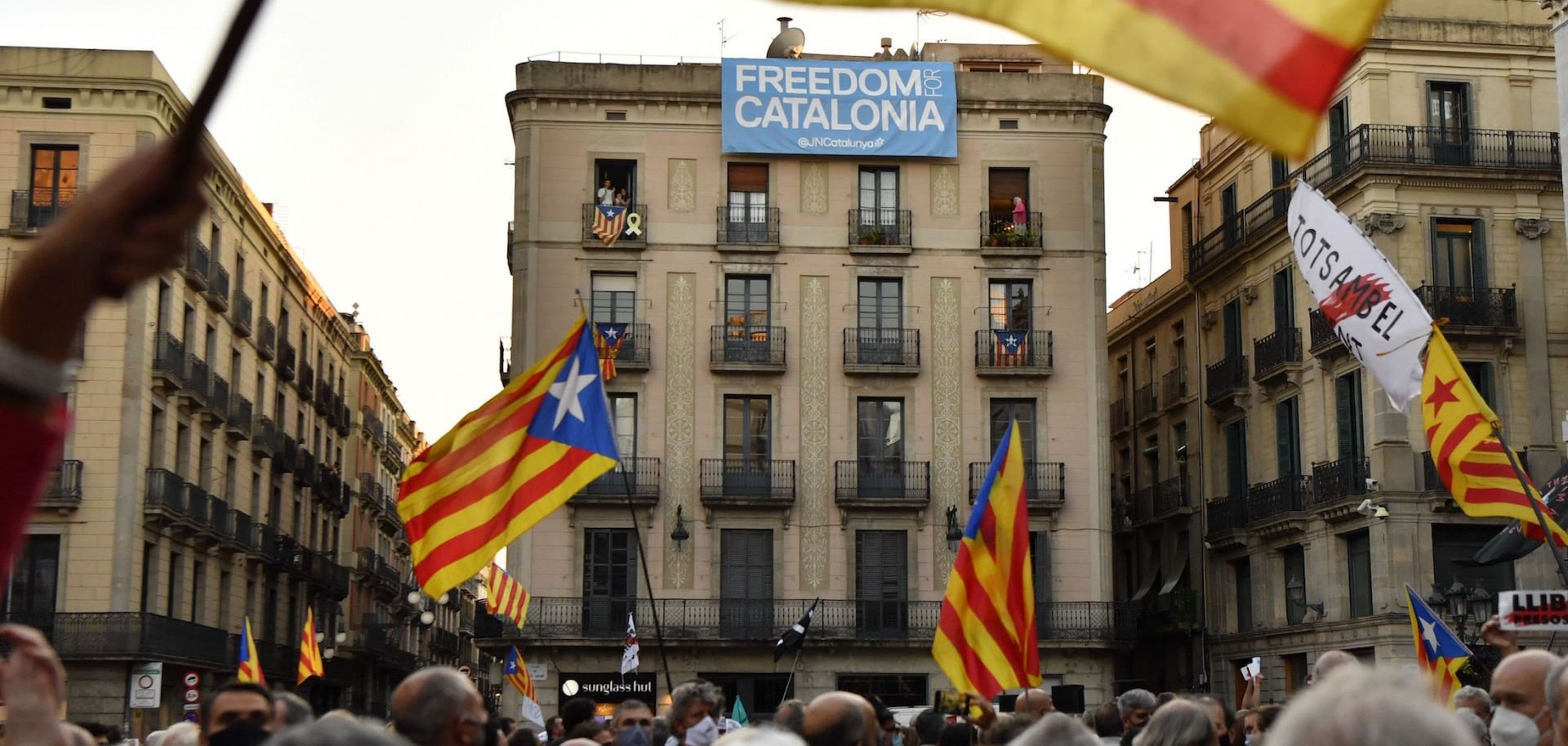
A pro-Catalan independence rally on Sept. 28, 2020, in the Spanish city of Barcelona.
While the next Catalan government is unlikely to unilaterally secede from Spain in the short- to medium-term, the issue of Catalan independence will continue to raise long-term questions about Spain's territorial integrity and generate political and economic risk in the region and in Spain as a whole. Catalonia's political parties are currently holding negotiations to appoint the region's next government after the Feb. 14 legislative election. Pro-independence parties are likely to retain power because they control enough seats in the regional parliament to appoint a government. While the pro-independence camp is internally divided, a compromise is probable because it wants to avoid a new election.
- The unionist Catalan Socialist Party (PSC) won 33 of the 135 seats in the Catalan parliament. While its leader, Salvador Illa, has said he will try to become the region's next president, unionist parties do not control a majority of seats.
- The pro-independence Republican Left of Catalonia (ERC) also won 33 seats, and is currently negotiating a government with the pro-independence Together for Catalonia (JxC), which won 32 seats.
- The main question is whether ERC and JxC will form a government with the far-left, pro-independence Popular Unity Candidacy (CUP) or the left-wing, unionist In Common We Can (ECP). The CUP supports taking unilateral measures to achieve independence, while ECP wants a legally binding referendum approved by the Spanish government.
The next Catalan government will continue to promote independence, but will also seek pragmatic relations with the central government in Madrid. The new Catalan government will try to avoid the unilateral measures that led to the arrest of pro-independence leaders in 2017 and will opt for cooperation with Madrid on issues such as the handling of the COVID-19 pandemic and the implementation of economic relief measures. ERC, and to a lesser extent JxC, are also interested in obtaining an amnesty for the secessionist leaders who were arrested after the illegal declaration of independence in 2017. They also want to influence the central government's decisions on measures to cope with the economic crisis in Spain as well as in the absorption of billions of euros in EU funds. As a result, the new Catalan government is likely to selectively challenge the central government in Madrid, for internal political reasons, but is unlikely to take any drastic measures to obtain independence unilaterally.
- Catalonia held an illegal independence referendum and unilaterally declared independence in October of 2017. As a reaction, the Spanish central government took direct control of the Catalan government. Some independence leaders were arrested while others fled the country.
- Spain currently has a minority center-left government, led by Prime Minister Pedro Sanchez. ERC and to a lesser extent JxC have supported Sanchez's government in some initiatives, such as the budget for 2021. This gives the pro-independence parties some degree of influence over the central government's decisions.
- The Spanish government is working on a reform of the criminal code that could eliminate some of the crimes that were used to jail Catalonia's secessionist leaders. It is also considering pardoning the leaders who are in jail. Pro-independence forces want an amnesty instead.
The election of a pro-secession majority confirms the centrality of independence in Catalan politics. As a result, the issue will continue to generate political and economic uncertainty, both in Spain and in Catalonia. Pro-independence forces will control 74 seats in the Catalan Parliament, four more than in the previous regional election in 2017. In the meantime, 51% of Catalan voters supported pro-independence parties in the Feb. 14 election (though this only represents around a quarter of all possible voters, as voter turnout was a record low because of the COVID-19 pandemic). These results suggest that the secessionist movement is still strong in Catalonia and will continue to shape regional and national politics for years to come. The Spanish central government is unlikely to authorize a legally binding referendum in the foreseeable future meaning political clashes between Madrid and Barcelona and sporadic acts of regional disobedience and challenges to the central government are likely to persist. As a result, households and businesses will continue to make spending and investment decisions amid uncertainty about the region's long-term status.
- On Feb. 14, ERC leader Pere Aragones called for the Spanish government to authorize a legal independence referendum in Catalonia.
- On Feb. 16, Spain's deputy Prime Minister, Carmen Calvo, said that the Spanish Constitution does not allow for an independence referendum in Catalonia. Calvo did say, however, that her government wants to keep dialogue channels open with the Catalan government.
- In 2017, hundreds of companies moved their legal seats from Catalonia to other parts of Spain as a reaction to the independence push in the region. Some reports suggest that foreign direct investment in Catalonia has also taken a hit in recent years because of the region's political turbulence.
