

Demonstrators hold a Catalonian flag ahead of a political meeting in Perpignan, France, on Feb. 29, 2020.
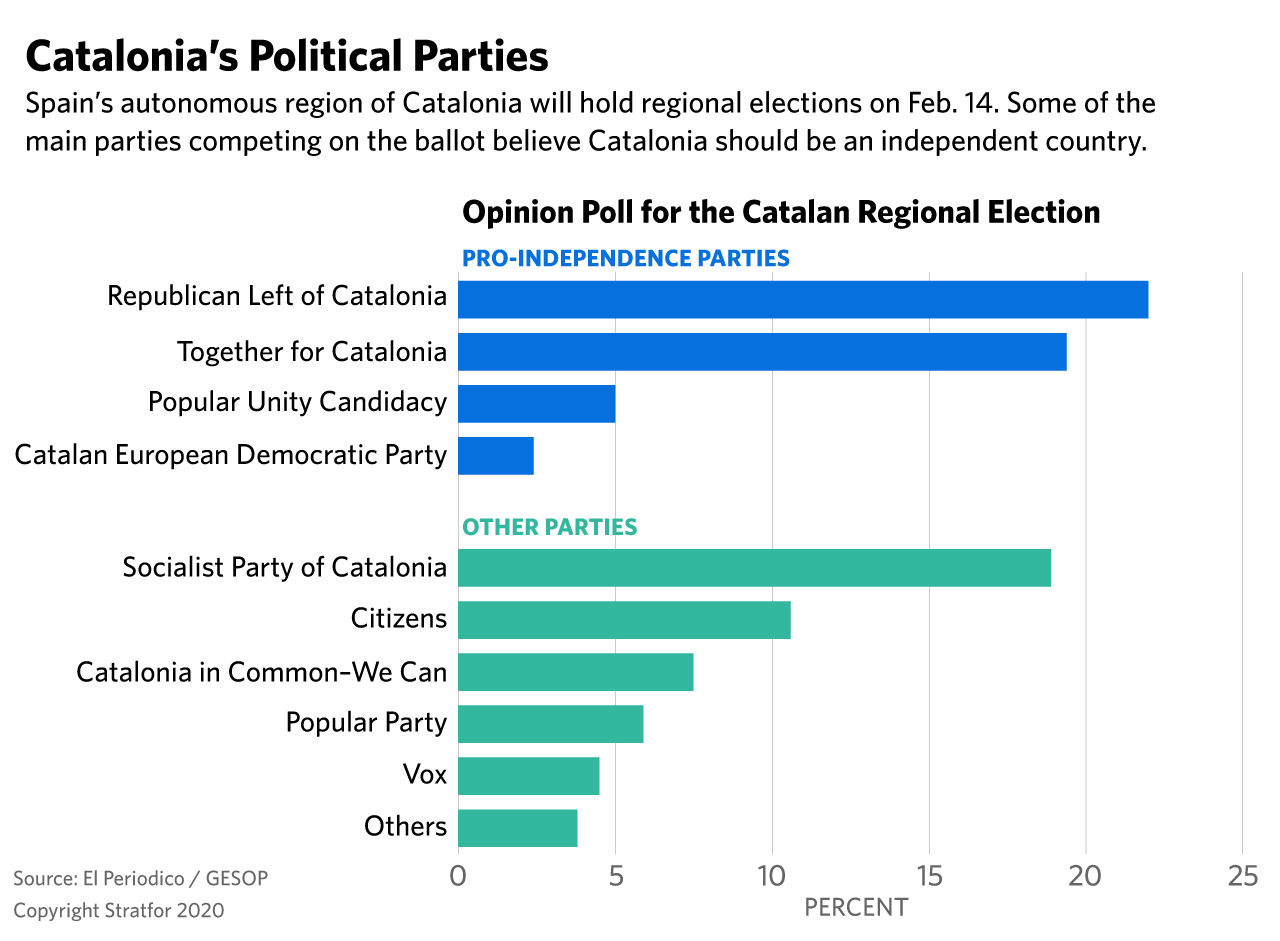
Pro-independence forces in Spain’s Catalonia region will likely remain in power after February regional elections, but they are unlikely to achieve their secessionist goals in the near-to-medium term. Nonetheless, Catalonia’s persistent push for independence will risk eventually undermining its own political and economic stability, as well as that of Spain’s. It could also stoke a nationalist backlash in other parts of the country. Catalonia will hold an early regional election on Feb. 14, though the vote could be postponed depending on the evolution of Spain’s COVID-19 epidemic. Opinion polls suggest that secessionist forces, which include the Republican Left of Catalonia (ERC) and Together for Catalonia (JxCat) will win enough seats in the Catalan parliament to form a government. Both parties were involved in the illegal referendum and the 2017 unilateral declaration of independence, and some of their leaders are in jail while others have fled the country to avoid arrest.
- In early December, the Barcelona-based El Periodico newspaper released a GESOP poll in which 22 percent of respondents said they planned to vote for the ERC. JxCat came in second at 19.4 percent, followed by the two unionist parties — the Socialist Party of Catalonia (PSC) and Ciutadans (Cs) — with 18.9 percent and 10.6 percent, respectively.
- Some polls suggest pro-independence parties in Catalonia may, for the first time, receive more than 50 percent of the popular vote in the next election. If this happens, the secessionist parties — who already have a majority of seats in the Catalan parliament — will use it to legitimize their demands for a legally binding independence referendum. But a larger popular mandate in Catalonia is unlikely to change Madrid’s opposition to such a vote.
Instead of making unilateral moves toward succession, the next Catalan government will likely focus on selectively challenging the authority of the Spanish central government, as it seeks to continue cooperating with Madrid in areas where it proves beneficial. The desire to secure extra national funding for the region, along with extra help in managing the spread of COVID-19, will compel Catalonia’s pro-independence parties to maintain a working relationship with Madrid. These parties will also want to avoid a repetition of the events of 2017, which resulted in the Spanish central government dismissing the Catalan regional government and taking direct control of the region. These tactical reasons to cooperate with Madrid — along with internal divisions within the pro-independence camp — will, in turn, reduce the probability of unilateral action to secede from Spain.
- The COVID-19 pandemic has temporarily made Catalan independence a secondary issue for many voters. Similarly, the regional government’s immediate priority is to address the health and economic repercussions of the pandemic.
- In recent months, the ERC and, to a lesser extent, JxCat have cooperated with the Spanish central government on certain issues. In early December, both parties voted in favor of the 2021 budget proposed by Spanish Prime Minister Pedro Sanchez’s government, which included roughly 2.3 billion euros in investment and fiscal transfers for Catalonia.
- On Nov. 10, the Spanish parliament reformed a national law requiring that Spanish be the main language taught in schools throughout the country. This was a longstanding demand of Catalan and Basque nationalists that was made possible by the region’s cooperation with the central government.
- ERC and JxCat are also interested in cooperating with the Spanish government to ensure the early release of the pro-independence leaders who are in prison. Madrid is currently considering pardoning the jailed leaders and modifying the country’s sedition laws that were used to detain them.
- Small secessionist parties, like the left-wing Popular Unity Candidacy (CUP) are likely to continue demanding unilateral action and defend a confrontational strategy vis-a-vis Madrid, but their impact on actual policy will be modest.
Conservative parties in Spain will accuse the central government of being too lenient with Catalonia, which will likely exacerbate the country’s political polarization by opening the door to protests and the potential radicalization of some Spanish voters. Center-right Spanish political parties, including the Popular Party (PP) and Ciudadanos (Cs), will escalate their criticism of Sanchez’s government, accusing it of putting the country’s territorial unity at risk. In particular, Spain’s far-right Vox party will likely organize anti-government protests, trying to capitalize on growing nationalist sentiments across the country. Spain’s growing political polarization could pave the way for a center-right central government following the country’s next general election, which is scheduled for late 2023 but could happen sooner if the current minority government collapses before then. A more right-wing Spanish government would worsen Madrid’s relationship with Catalonia, increasing the probability of renewed unilateral action in the region.
- As of late November, Spain’s Socialist Party was polling at roughly 28.8 percent, followed by PP at 18 percent. Recent polls also put Vox’s popularity at around 17 percent, an improvement from the 15.1 percent of the vote it received in the general election of November of 2019.
- In late November, a group of 73 retired army officials sent a letter to Spanish King Felipe VI warning that the Spanish central government’s cooperation with secessionist parties was putting the country’s territorial integrity at risk. While this position does not necessarily represent the views of the active army officials, it coincides with the position of some nationalist political parties like Vox.
- Spain’s central government only controls 155 of the 350 seats in the Congress of Deputies. While Sanchez managed to obtain 188 votes in favor of his budget, this majority could evaporate if nationalist parties in Catalonia and the Basque country stop cooperating with the central government.
Questions about Spain’s territorial integrity will continue to generate political and economic risk in the country, exacerbating the financial fallout from the COVID-19 crisis. The ongoing pandemic poses the most immediate threat to the Spanish economy, with domestic consumption and investment likely to remain depressed for at least several more months. In the longer term, the Spanish central government will also have to deal with worsening fiscal deficit and rising debt levels, which could raise questions in financial markets about the sustainability of Madrid’s fiscal policies. The risk of households and companies defaulting on their bank loans will remain high during 2021, as will the risk of companies going bankrupt — especially those that are small- and medium-sized). In a longer-term, the question of Spain’s territorial integrity will be of concern for both domestic and foreign actors in the country’s economy, influencing their investment and spending decisions.
- The European Commission expects the Spanish economy to contract by 12.4 percent in 2020, followed by a 5.4 percent expansion in 2021. This means that Spain’s overall economic growth is expected to remain below pre-pandemic levels throughout the next year.
- Spain’s unemployment rate also reached 16.2 percent in the third quarter of 2020, up from 13.9 percent in the same quarter of 2019. Catalonia’s unemployment rate, meanwhile, reached 13.2 percent in the third quarter of 2020, up from 10.8 percent in the same quarter of 2019.
- Spain’s sovereign debt is expected to reach around 120 percent of GDP in 2020, from 95 percent of GDP in 2019.
- Uncertainty about Catalonia’s future appears to have also contributed to a decrease in foreign direct investment (FDI) in the region, which decreased by roughly 5 billion euros between 2016 and 2019, according to Catalonia’s Statistics Institute. During that same period, FDI in the community of Madrid increased by nearly 3 billion euros.
