
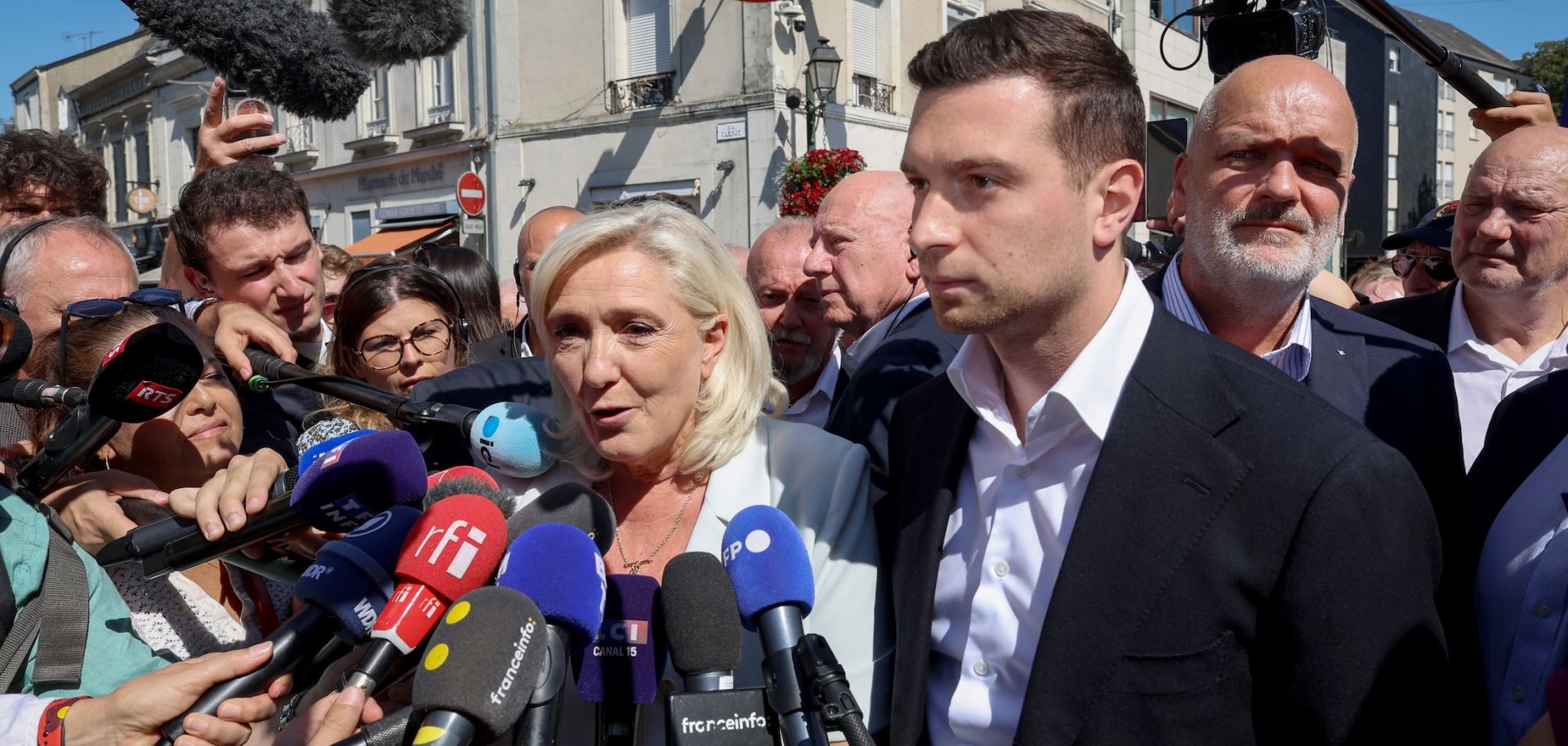
Le Pen's return to France's 2027 presidential race reinforces the National Rally as the election frontrunner, increasing the likelihood of a foreign policy shift toward greater confrontation with the European Union, reduced support for Ukraine and weaker NATO integration, although institutional, fiscal and political constraints would likely moderate implementation. French far-right National Rally leader Marine Le Pen announced on July 7 that she will run in the 2027 presidential election, hours after the Paris Court of Appeal upheld her conviction for embezzling European Parliament funds while clearing her to stand. The court found that Le Pen and her party used EU funds earmarked for parliamentary assistants to pay staff working on unrelated party activities. Judges sentenced her to three years in prison — two suspended and one to serve at home under electronic monitoring — alongside a 45-month ban on seeking office. Because judges suspended 30 months of the ban and Le Pen has already served the remaining 15 since her first-instance conviction in March 2025, the ruling restores her eligibility to run next year. Speaking on broadcaster TF1 in the evening, Le Pen said she would appeal to the Cour de Cassation, France's highest criminal court. The appeal, she added, suspends the requirement to wear an electronic tag until a final ruling. Le Pen also said she would run on a joint ticket with National Rally President Jordan Bardella, naming him her preferred candidate for prime minister.

- A lower court had found Le Pen guilty in March 2025 of misusing EU funds by paying National Rally staff with European Parliament assistant allowances. That verdict's immediate five-year ban, imposed despite her pending appeal, initially excluded her from the 2027 race. This marked a rare departure from French judicial practice — where sentences typically remain suspended during appeals — and drew accusations of judicial overreach and interference in the democratic process.
- Standing aside, however, would have surrendered her best-ever shot at the presidency and risked alienating a base that expects her to stay in the race, leaving the appeal route as the only path to reconciling her stated red lines with her eventual decision to run.
- As recently as July 1, Le Pen reiterated that she could not effectively campaign if she had to secure judicial permission for every rally while wearing an electronic monitoring bracelet. However, stepping aside would have meant relinquishing her best shot yet at the presidency and potentially alienating a supporter base that expects her to stay in the race. The appeal route was thus left as the only path to reconciling her stated red lines with her eventual decision to run.
- Le Pen ran for president in 2012, 2017 and 2022, reaching the runoff in her last two attempts before losing to Emmanuel Macron, as centrist and left-wing voters coalesced behind her opponent under the so-called republican front, the tactical-voting pattern that has kept the far right from taking power in France since 1945. However, polls now suggest that this barrier has weakened considerably, giving the National Rally its strongest prospects yet in the 2027 elections.
Le Pen's appeal, the National Rally's succession planning and favorable polling together ensure that her legal conviction is unlikely to derail the party's presidential bid. Because the appeal suspends the electronic monitoring order until the high court rules, Le Pen will be able to campaign without the tag she herself framed as disqualifying, while presenting the proceedings as a judicial witch hunt. Even an adverse ruling would carry limited practical consequences, as France's lengthy enforcement process would likely run past the April vote, while any monitoring imposed in time would likely remain light enough to spare the campaign major disruption and could even feed her narrative of judicial persecution. A victory in the presidential election, meanwhile, would suspend the sentence for the duration of her term. Should the court confirm the sentence and impose monitoring conditions too restrictive to campaign under, or should the whole legal saga backfire politically, Bardella stands ready to inherit the candidacy at short notice, a fallback the party had already begun preparing. The joint ticket lets the pair campaign together while positioning Bardella for the premiership should Le Pen be elected. But regardless of who ultimately runs as its candidate, the National Rally remains the clear frontrunner in the presidential race. Polls give either candidate over 30% in the first round, roughly double any rival, with Bardella polling slightly ahead of Le Pen. The runoff looks less certain, as a fragmented political landscape makes it unclear who would face the National Rally in the second round. However, the tactical voting that has historically blocked the far right from taking power has weakened amid the National Rally's normalization and the parallel rise of far-left leader Jean-Luc Melenchon, whose radical platform has pushed many centrist and center-right voters to prefer the National Rally over the left. Polls currently place former center-right Prime Minister Edouard Philippe second behind either National Rally candidate and closely trailed by Melenchon, with some surveys suggesting Philippe could prevail in a runoff while a National Rally nominee would beat Melenchon comfortably.
- Philippe leads a fragmented centrist camp, where a late May survey by the Jean-Jaures Foundation found only 35% of Macron's 2022 voters would back another centrist candidate, with the rest leaning toward the right, the left or abstention, and faces a rival bid from Gabriel Attal, another former prime minister. The conservative Republicans party field several contenders, including party leader Bruno Retailleau, but without a realistic path to the runoff. Meanwhile, the left has so far failed to unite behind a single candidate, leaving Melenchon ahead of Raphael Glucksmann, the leader of the small center-left party Place Publique. Former Socialist President Francois Hollande could also join the race, especially if no moderate left-wing contender gains traction in the coming months.
- A June 25 Ifop poll for the first round of the presidential race put Bardella at 36-37% and Le Pen at 32%, depending on which of the two runs, with Philippe at 19-21% as the sole centrist candidate but 14% if Attal also stands, Melenchon steady at 12-15%, Glucksmann at 9-11% and Retailleau at 8-11%.
A National Rally presidency — especially under Le Pen — would put France on a collision course with the European Union on several policy areas, curb support for Ukraine, ease pressure on Russia and loosen France's NATO and European defense commitments, and likely lead to an early legislative election to secure a parliamentary majority. A National Rally president would take a markedly more confrontational stance toward the European Union on trade, energy, migration, industrial policy and enlargement, and test single market rules through French preference in public procurement and potential restrictions on free movement. Much of this agenda would require legislative backing that the National Rally would initially lack in the current hung parliament, meaning the new president would likely dissolve the National Assembly early on to seek a majority (a high bar, however, that would likely leave the National Rally dependent on coalition partners such as the center-right Republicans, whose support would come at the price of diluting the agenda, especially on economic policy). Shifts on defense and foreign policy, which the French constitution places under direct presidential control, would proceed regardless of a legislative majority. The National Rally has long opposed a common European defense, viewing it as a limit on France's national sovereignty. It favors higher French military spending over pooled EU capabilities, joint procurement and shared command structures, and also maintains a commitment to leaving NATO's integrated military command. Furthermore, if the National Rally wins the presidency, its insistence on maintaining a strictly national deterrent could lead it to scrap or heavily condition plans to extend France's nuclear umbrella to European partners, effectively stalling the initiative. The party would likely also curb aid to Ukraine and likely abandon French leadership of the coalition preparing postwar security guarantees for Kyiv. This reduced support for Ukraine would be more likely under Le Pen, who carries a legacy of accommodation toward Russia that Bardella has sought to distance himself from. The two also diverge on economic policy, where Le Pen's statist, redistributive platform contrasts with Bardella's more economically liberal, pro-business profile. These differences span tax policy, where Bardella prioritizes cutting production taxes and easing burdens on companies, while Le Pen centers relief on household purchasing power. Additionally, Le Pen still pledges to reverse Macron's controversial pensions reform, while Bardella has walked back that promise to reassure investors of fiscal restraint.
However, the most radical stances of any National Rally president would be tempered by the need to maintain a degree of fiscal discipline and market confidence amid strained public finances and elevated borrowing costs, and by external pressures binding France to European cooperation; resistance from unions and the left would also sustain a constant risk of social unrest throughout the term. As it rose in the polls and power came within reach, the National Rally has moderated its platform in recent years on issues like exiting the euro and the European Union, while adjusting its rhetoric and policies to court the business community and enhance its market credibility, particularly under Bardella. The party also cut ties with Moscow after Russia's 2022 invasion of Ukraine and, in 2024, cut ties with Germany's more radical far-right party, Alternative fur Deutschland. Additionally, the National Rally has remained deliberately vague on issues such as its promise to exit NATO's integrated command and the repeal of Macron's pension reform, leaving room for U-turns and compromise once in office. Material constraints would reinforce this moderating effect. Economic pressures — namely, a public deficit near 6% of GDP, debt at 118% and climbing and wary bond markets — would necessitate fiscal discipline. Additionally, to secure a parliamentary majority, the National Rally would likely eventually have to form a coalition with the more moderate, fiscally conservative Republicans, who would then have the final say on economic matters. Combined, these factors would deter some of the costliest clashes with the European Union, likely restraining any National Rally president from taking steps such as withholding budget contributions (as Bardella has threatened) or openly breaching EU single market rules. More fundamentally, compounding external pressures — including Russia's assertiveness along NATO's eastern flank, the U.S. drawdown from Europe, global trade tensions and rising economic headwinds — raise the cost of unilateral action for France, thereby binding even a sovereigntist president to European defense arrangements, joint rearmament programs and the collective trade leverage that shields French purchasing power and industry. Meanwhile, resistance from unions and left-wing groups — some of which have already said they would contest a far-right victory — would likely trigger mass protests in the immediate aftermath of the election, including potential riots in the banlieues. There would also be a greater risk of large demonstrations, strikes and violent unrest throughout the new president's tenure, posing persistent security risks and adding friction to an already weak economy.
- The actual extent to which a National Rally president would moderate their agenda once in office remains uncertain. For instance, Italian Prime Minister Giorgia Meloni's far-right coalition significantly tempered its platform after assuming power in 2022. But France currently wields much greater strategic and economic leverage than Italy did four years ago. Furthermore, Europe's recent rightward shift has since lowered the bar for what is politically acceptable and weakened the mainstream pressures that would have more substantially tamed a far-right government just a few years ago.