
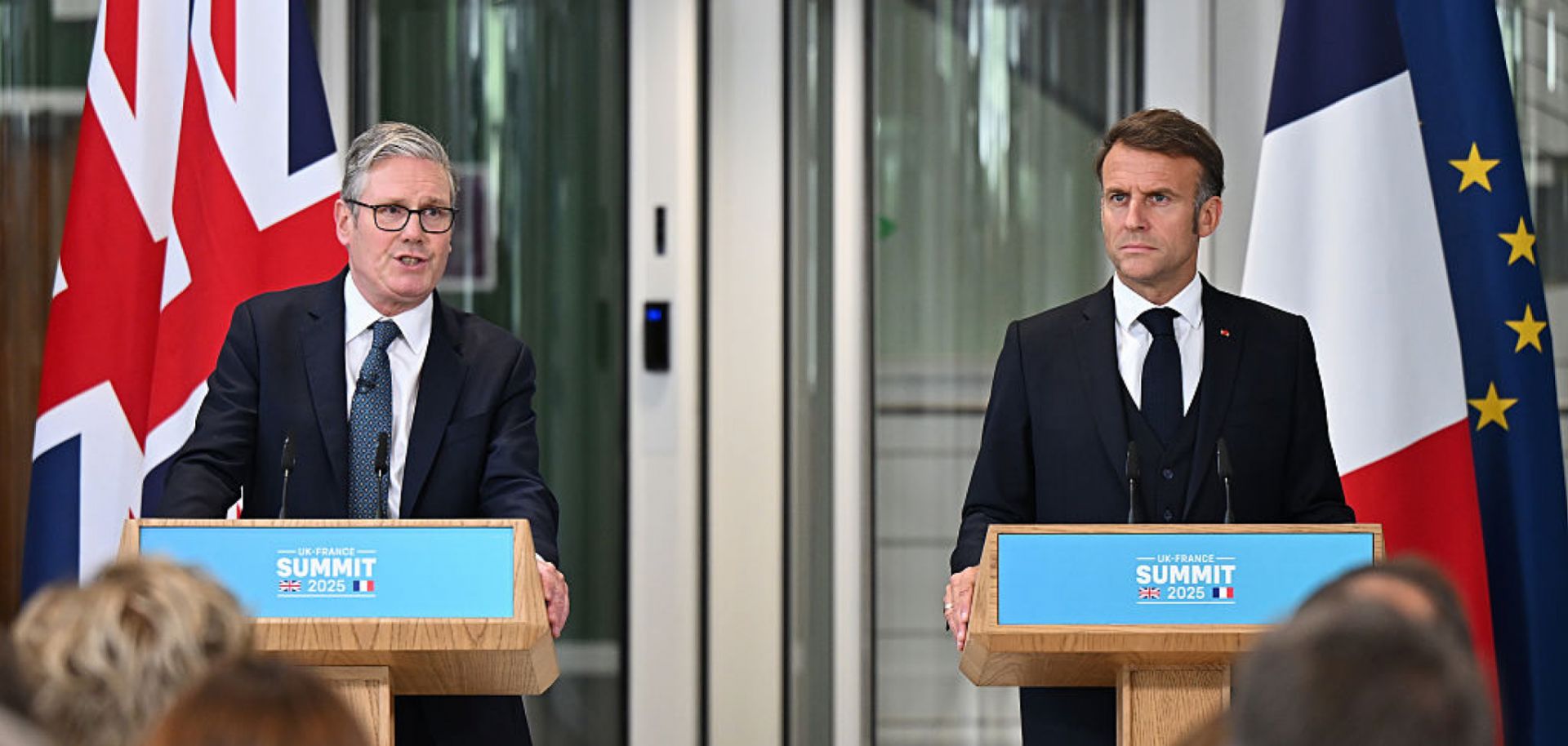
France and the United Kingdom have signed a series of agreements that will deepen bilateral defense cooperation across nuclear policy, industrial development and support for Ukraine, reflecting growing European momentum to accelerate strategic autonomy and positioning London and Paris as central actors in shaping the Continent's future security architecture. However, entrenched European divisions and material constraints will hinder progress toward a fully integrated European nuclear posture. French President Emmanuel Macron and U.K. Prime Minister Keir Starmer announced on July 10 a series of deals expanding bilateral strategic cooperation on nuclear deterrence, defense industry ties and support for Ukraine. As part of the defense package, France and the United Kingdom formalized plans to coordinate their nuclear arsenals in response to extreme security threats in Europe and update the 2010 Lancaster House treaties to include operational force integration in new domains such as space and cyber. The two leaders also confirmed additional joint orders of conventionally armed Storm Shadow cruise missiles for Ukraine and committed to accelerating the development of a next-generation replacement. Macron and Starmer then joined a virtual meeting of the so-called ''Coalition of the Willing,'' a group of countries committed to supporting Ukraine in its fight against Russia and, in the event of a ceasefire, with a peacekeeping deployment in and around the country to provide Kyiv with post-conflict security guarantees. During the meeting, participating states announced the establishment of a joint operational command center for Ukraine support.
- In addition, Macron and Starmer signed a new reciprocal migration deal allowing weekly returns of up to 50 migrants between the United Kingdom and France. The agreement includes a ''One In, One Out'' screening system and a French commitment to host EU-funded migrant processing hubs. The deal is unlikely to significantly shift migration flows in the short term, given that in 2024, an average of 700 migrants entered the United Kingdom each week after crossing the Channel in small boats. But it nonetheless marks a politically important step toward reviving post-Brexit cooperation on asylum and border management, which had been stalled for years. For Starmer, the deal also offers a concrete deliverable amid rising anti-immigration sentiment in the United Kingdom, and distances his ruling Labour Party from the previous government's failed Rwanda deportation plan. And for Macron, it justifies seeking more U.K. support for French enforcement along the Channel.
- Signed in 2010, the Lancaster House Treaties are two bilateral defense and security agreements designed to strengthen strategic alignment and interoperability between France and the United Kingdom and establish frameworks for military cooperation, including joint expeditionary forces, nuclear stockpile stewardship and the collaborative development of defense equipment and capabilities.
The agreements underscore efforts by France and the United Kingdom — and across Europe, more broadly — to deepen defense cooperation and reinforce strategic alignment amid heightened tensions on the Continent and concerns over the reliability of long-term U.S. commitments to NATO. The decision to enhance political coordination on nuclear deterrence, while falling short of full operational integration, confirms Paris and London's intent to lay the groundwork for a more autonomous European nuclear posture. The coordination will not involve merging nuclear arsenals, but is intended to ensure political alignment in the event of an extreme threat to Europe, reinforcing the strategic messaging of unity between the continent's two nuclear powers. The update to the Lancaster House treaties also reflects a maturing defense partnership between France and the United Kingdom, now extended to new operational domains such as space and cyber. A pillar of this deepening cooperation is the establishment of a defense industrial ''Entente Industrielle,'' which aims to pool resources and accelerate joint development of advanced weapon systems. This includes co-developing a replacement for the Storm Shadow/SCALP missile, expanding anti-drone capabilities and co-producing new air-to-air missiles for the two countries' respective armed forces. In parallel, both France and the United Kingdom reaffirmed their frontline role in supporting Ukraine through continued weapons deliveries and enhanced coordination under the Coalition of the Willing, which has now established a dedicated operational command center. The defense alignment consolidates London and Paris as the leading European military actors at a time of strategic flux and institutional fragmentation across the Continent.
- The France-U.K. defense industrial cooperation agreement comes amid a broader push to establish a more integrated and resilient European defense industrial base. This push is underpinned by recent EU initiatives, such as the 800 billion euro ReArm Europe plan and the European Defence Industrial Programme, that are aimed at incentivizing joint arms procurement, development and production across the bloc to address inefficiencies and duplication in Europe's fragmented defense sector. Although the United Kingdom remains formally outside these EU programs following its exit from the bloc, London's participation in select initiatives is central to scaling production capacity, enhancing interoperability and securing supply chains across the Continent. The May 2025 EU-U.K. agreement on security and defense cooperation provides a structured basis for such collaboration, including provisions for coordinated industrial development, shared threat assessments and joint capability planning. As one of Europe's largest defense producers, the United Kingdom's involvement is key to the bloc's long-term rearmament and strategic autonomy agenda, and the deepening U.K.-France partnership may serve as a testbed for broader EU-U.K. defense industrial coordination.
Despite the July 10 agreements, the creation of a genuine European nuclear posture remains a largely aspirational goal at this stage due to significant political and material constraints. Although the new France-U.K. agreements signal growing interest in aligning nuclear deterrence policy, it remains a narrowly defined step that does not alter the independent posture or operational command of either country's nuclear arsenal. The concept of a pan-European nuclear deterrent continues to face fundamental political and technical barriers. France has long positioned its nuclear forces as a pillar of national sovereignty. It will thus remain reluctant to share decision-making authority, even if France offers to extend its nuclear umbrella to the whole Continent — including in a scenario where Europe faces ''extreme threats'' (to paraphrase language in the recent agreement with the United Kingdom). The United Kingdom, for its part, while supportive of closer alignment with France on the creation of a European-only nuclear deterrent, faces structural constraints that limit its ability to act independently from the United States. The United Kingdom's nuclear deterrent depends on U.S.-supplied Trident II D5 missiles from a shared pool with the U.S. Navy, jointly developed warhead designs, and logistics and maintenance support from U.S. facilities. These dependencies mean that the United Kingdom cannot fully decouple its nuclear posture from U.S. oversight and technical assistance, making integration into a European framework both legally and operationally difficult. Other European countries also remain politically divided on the matter. Those that feel more directly threatened by Russia (particularly Northern and Eastern European countries) support discussions for stronger intra-European nuclear guarantees, but they are deeply skeptical of any shift away from NATO's U.S.-led nuclear umbrella. Against this backdrop, at least for now, the concept of a European nuclear deterrent remains largely aspirational, constrained by sovereignty concerns, different national security priorities and material constraints. A fully integrated European nuclear deterrent is unlikely to gain significant political traction without a sustained and credible reduction in U.S. security guarantees and/or a major external shock, such as a rapid escalation in Russian aggression. While these conditions are currently plausible enough to fuel debate, they are not yet sufficient to trigger decisive, concrete action.
