
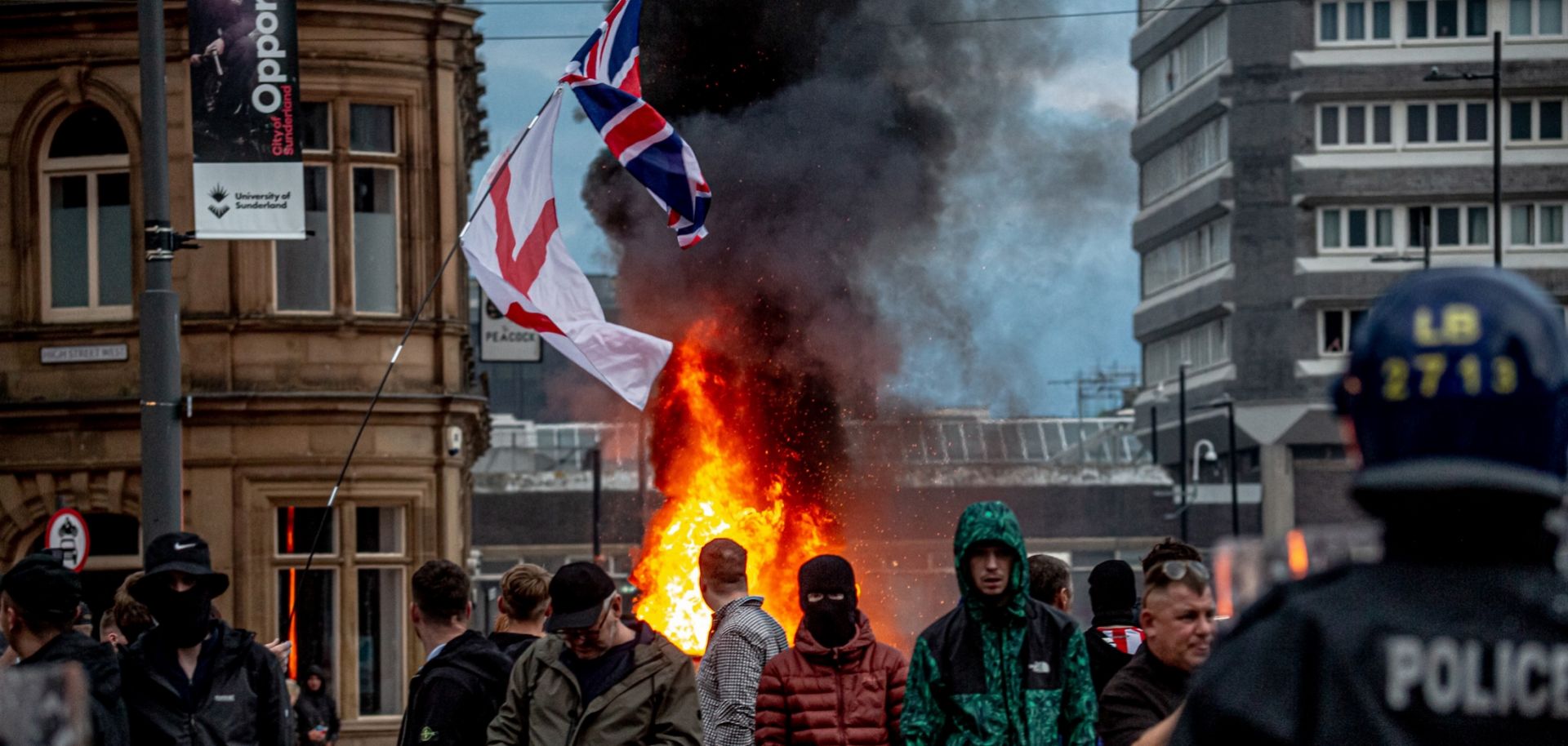
Widespread, violent rioting across the United Kingdom underscores the growing threat of far-right extremism amid rising anti-immigration sentiment, political polarization and disinformation campaigns, but the unrest is unlikely to significantly destabilize the new Labour government. Violent far-right demonstrations have been taking place for over a week in multiple towns and cities across the United Kingdom. Violence first broke out on July 30 in Southport, Merseyside, as far-right groups rioted in front of a mosque amid speculation on social media that a 17-year-old male arrested in connection to a mass stabbing attack that killed three young girls and seriously injured five others in the town was a Muslim migrant. Despite investigators dismissing rumors about the identity of the attacker, riots spread across the country over the following days, including in London, Manchester, Liverpool, Sunderland, Blackpool, Bristol, Hull, Leeds, Middlesbrough and Belfast, resulting in clashes with the police and significant property damage. U.K. Prime Minister Keir Starmer conveyed an emergency meeting on Aug. 5 with ministers, police chiefs and intelligence officers to coordinate a response to the unrest and announced the creation of a new national police unit to face the rioters, along with severe punishment for individuals arrested in connection to the violence.
- The riots resulted in violent clashes between demonstrators and police forces as well as counter-protesters. They also resulted in significant property damage with rioters setting fire to vehicles and buildings associated with migrants such as community centers and hotels hosting asylum seekers.
- British authorities have linked the groups behind the riots to the officially defunct far-right, anti-Muslim organization English Defense League.
- As of Aug. 6, nearly 400 people had been arrested since the riots began.
The riots come amid growing anti-immigration sentiment and the proliferation of far-right ideologies in the United Kingdom, with the risks of unrest and intercommunal violence set to increase in the coming years alongside rising immigration levels and far-right grievances amplified by disinformation. Anti-immigrant protests had already been on the rise in the United Kingdom, driven by the growing popularity of far-right parties and nativist ideologies in the country. This trend is set to expand in the coming years as migration levels remain elevated, adding to growing popular frustration with the terrorist attacks, perceived upticks in crime and lack of economic opportunities that far-right political groups blame on migrants. These grievances are further amplified by online disinformation, which allows for the spread of false narratives that both radicalize individuals and mobilize them following events such as the mass stabbing in Southport, where riots erupted over false information regarding the identity of the attacker. This threat is further magnified by foreign disinformation campaigns seeking to spread false narratives about migration to sow tensions in Europe. Against this backdrop, similar demonstrations will become more common and more likely to escalate into riots and violence in Europe in the years ahead.
- Recent figures from the advocacy group Hope Not Hate show that the number of far-right demonstrations in the United Kingdom increased more than 13-fold in 2023 from the previous year.
- Besides elevated migration levels, among the motives behind the recent rioting, there is a perceived lack of assimilation of migrants across certain parts of England, which is driving nativist grievances and inter-communal tensions between migrant and local communities, particularly in more economically deprived areas.
- Support for the far right has been growing steadily in recent years in the United Kingdom, where Nigel Farage's Reform UK party won 14% of the vote in the July 4 general election (mostly at the expense of the traditional center-right Conservative Party) and secured 5 seats in the House of Common (after its predecessor, the Brexit Party, failed to obtain any seat in the 2019 elections).
- Projections for the size of the United Kingdom's population from the Office for National Statistics published in February 2024 show the country's population rising by nearly 10% (to about 73.7 million by 2036), with net migration expected to account for more than 90% of that increase. Moreover, though likely not to the same level seen during the 2014-16 migration crisis, illegal migration is set to remain elevated over the coming years, and increase if security and economic conditions deteriorate in departure countries in the Middle East, North Africa and South Asia.
- Russia has recently been intensifying its destabilization campaign in Europe to opportunistically exploit divisive issues such as migration in a bid to disrupt Western military and political support for Ukraine.
- U.K. Home Secretary Yvette Cooper warned on Aug. 5 that ''hostile states'' are ''almost certainly'' amplifying disinformation surrounding the recent rioting in the United Kingdom.
The rioting represents the first real test for Starmer's premiership, but the unrest is unlikely to significantly impact his new government's stability or to result in any immediate, substantial change to U.K. migration policies. In the short term, further demonstrations will likely take place in medium-to-large urban centers across the United Kingdom, likely resulting in further violence, vandalism, looting and localized transport disruptions. Planned or spontaneous counter-protests by rival political activists will also significantly increase the chance for clashes between antagonizing groups. Still, as the protest movement loses steam and the government continues to crack down on the rioters, the unrest will eventually likely come under control over the coming days. Politically, the stability of the newly elected Labour government is unlikely to be meaningfully affected by the riots, which all mainstream political forces across the ideological spectrum have widely condemned and are unlikely to evolve into a more widespread, protracted and articulate protest movement. Moreover, while Labour has already pledged to curb illegal crossings through the English Channel, seeking to address a key concern among U.K. voters, the government is unlikely to announce stricter migration policies (or any other adjustment to its policy agenda) directly in response to the riots, which it does not intend to legitimize.
- U.K. authorities are set to carry out several more arrests as investigations on the riots of the past few days proceed while deploying a more robust security presence to defend probable targets like mosques and asylum centers across the country.
- Other European governments have recently sought to absorb some far-right proposals into their own platform in a bid to stem the rise of far-right parties. The United Kingdom's new Labour government, however, is unlikely to engage with any of the grievances behind the recent riots, which Prime Minister Starmer has defined as ''far-right thuggery.''
