
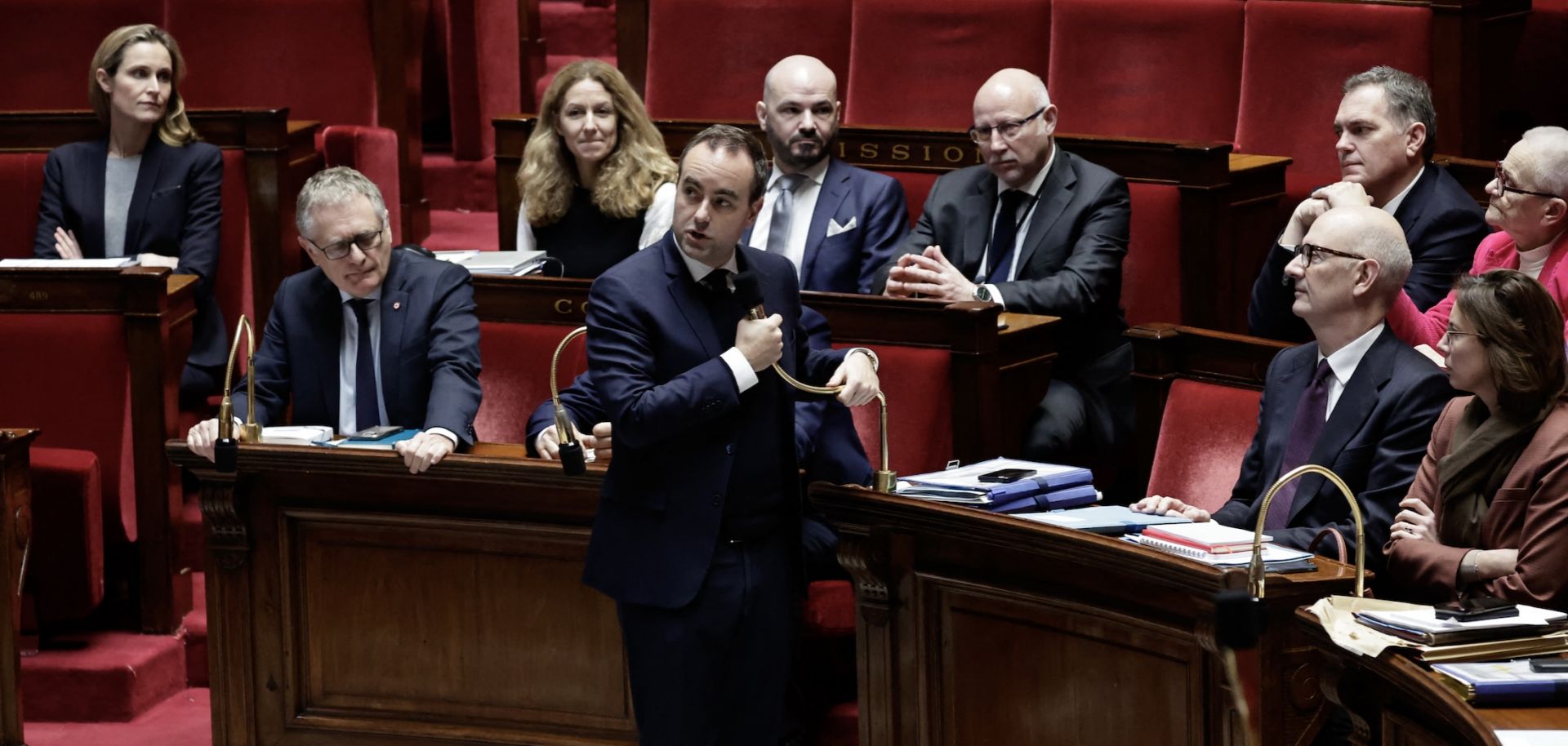
The likely adoption of France's 2026 budget will enable the minority government to remain in office until at least the next budget cycle, but entrenched political fragmentation will still limit room for substantive policy action and sustain the risk of a government collapse later in the year, which will keep France's fiscal trajectory uncertain and sustain market pressure on French sovereign debt into 2027 and beyond. France's minority government survived two consecutive no-confidence votes in the National Assembly on Jan. 23 after Prime Minister Sebastien Lecornu used Article 49.3 of the constitution to push through the revenue section of the 2026 budget without a parliamentary vote. A motion tabled by the hard-left France Unbowed (LFI), supported by the Greens and Communists, secured only 269 votes, falling short of the 288 needed to bring down the government, while a second motion brought by the far-right National Rally (RN) secured only 142 votes and was also rejected. Shortly after, Lecornu again invoked Article 49.3 to force through the expenditure section of the budget. This prompted additional no-confidence motions from LFI and RN, though these motions also failed on Jan. 27, attracting even fewer votes. The government is now expected to invoke Article 49.3 one final time to secure passage of the full budget package, which will likely trigger a final round of unsuccessful no-confidence motions.

- Article 49.3 of the French Constitution allows the government to adopt legislation without a parliamentary vote unless a no-confidence motion is filed within 24 hours and secures an absolute majority in the National Assembly, in which case the bill is rejected and the government is forced to resign.
- Lecornu survived the no-confidence votes after securing the abstention of the opposition center-left Socialist Party following last-minute budgetary concessions that included higher social spending, indexation of income tax brackets to inflation, expanded support for low-income workers, the preservation of subsidised student meals and protected funding for selected public services, while shelving more contentious savings measures that would have directly affected households, alongside earlier promises to suspend President Emmanuel Macron's controversial 2023 pensions reform.
- France entered 2026 operating under a rollover of the 2025 budget after the National Assembly failed to agree on and pass a full fiscal plan last December, despite reaching an agreement on social security funding. Facing market pressure and with statutory budget deadlines looming, Lecornu had to eventually turn to Article 49.3, reversing an earlier pledge not to do so.
The adoption of the 2026 budget would end months of uncertainty, but significant concessions will dilute fiscal consolidation efforts and shift much of the burden onto the business sector, leaving France exposed to persistent debt, growth and market risks heading into the next budget cycle. The outcome of the Jan. 23 votes indicates Lecornu has likely secured sufficient backing from the Socialists to withstand further no-confidence motions on the full budget, paving the way for its adoption in early February. But while the passage of the 2026 budget after months of legislative deadlock will likely reduce risk premia linked to political paralysis, underlying fiscal pressures are likely to persist. For one, the budget targets a fiscal deficit of about 5% of GDP in 2026, which is a slight reduction from 2025 but still above earlier government commitments. Additionally, this figure remains far from the European Union's 3% threshold, which will keep France under the bloc's excessive deficit procedure. The government's strategy for this slow consolidation also relies heavily on tax measures that shift much of the adjustment burden onto large companies — including extending a temporary corporate surtax of roughly 8 billion euros (roughly $9.5 billion) and delaying planned business tax cuts — which risks hindering investment, hiring and overall economic growth. France's fiscal outlook is further hindered by still rising public debt levels, only modest growth prospects and the continued absence of structural reforms in this and previous budgets, with the 2027 budget cycle likely to prove similarly contentious and prone to renewed market stress around French sovereign debt in case of another stalemate.
- France's economy is projected to grow at close to 1% in 2026, up slightly from 0.8% in 2025, before gradually gaining momentum again in 2027, according to the Banque de France. However, this outlook remains fragile amid the risk of renewed U.S. tariff threats, lingering doubts over the government's ability to meet its 2026 fiscal targets, and uncertainty over the budget's impact on growth.
- France's public finances remain under significant pressure. Government debt continues to rise, reaching an estimated 117% of GDP at the end of 2025. This is well above the eurozone average of 88%, exceeded only by Greece and Italy, though their debt levels are on a downward trajectory. Should France's fiscal deficit remain at or above 5% over the next four years, government debt would rise to 125% of GDP or above by 2030.
- In 2025, Fitch Ratings and S&P both cut France's long-term rating from AA- to A+ in 2025, citing persistently high deficits, a rising debt trajectory and weakened fiscal credibility amid legislative deadlock. Moody's Ratings kept France at Aa3 but revised its outlook to negative, warning that political fragmentation and limited reform capacity could further deteriorate the country's public finances. All three credit-rating agencies also expressed concern over the limited prospects for fiscal consolidation ahead of, and potentially beyond, France's 2027 presidential elections.
Passing the budget would help temporarily stabilize Lecornu's government, but entrenched political fragmentation and a packed electoral schedule will likely intensify political paralysis by the next budget cycle, sustaining the risk of early legislative or presidential elections. Clearing this major hurdle would likely ensure the government's survival for at least another eight to nine months, until the start of the next budget cycle. The concessions made to the Socialists to pass the budget, combined with a general sense of "political fatigue" among French voters after prolonged institutional deadlock, would also significantly lower the immediate risk of protests linked to Lecornu's repeated use of Article 49.3. However, a crowded electoral schedule will still severely restrict the government's capacity to govern. With municipal elections in March, senatorial elections in September and presidential elections approaching in April 2027, opposition parties will have little incentive to align themselves with Lecornu's policy agenda. This may not necessarily lead to a government collapse, as these parties may seek to avoid another parliamentary dissolution that would disrupt their electoral campaigns. However, the risk of renewed deadlock and political instability will likely resurface during the next budget cycle in the fall. Failure to pass the 2027 budget could once again force Macron to consider calling an early legislative election later this year, which is otherwise not due until 2029. In an extreme scenario, Macron might even bring forward the presidential election in the hopes of breaking the impasse. However, a new president would inherit the same hung parliament, giving them a strong incentive to call a snap legislative election in pursuit of a clearer governing mandate.
Snap legislative elections would likely only prolong uncertainty about France's fiscal trajectory, given the substantial policy divergences between more centrist and radical parties on both the left and right. A snap legislative election — whether called by Macron following a renewed budget stalemate or by a new president seeking a stronger governing mandate — would most likely result in another fragmented parliament. This would prolong policy uncertainty and keep Paris focused on short-term crisis management over structural reforms. It would also reinforce a pattern of diluted fiscal compromises that leave deficit and debt dynamics largely unchanged, sustaining pressure on French sovereign assets amid chronic political dysfunction. However, there is a chance that the far-right National Rally could secure a parliamentary majority, especially if the center-right Republican Party partially or fully abandons its position against collaborating with the far right. Such a shift could be catalyzed by the current government's repeated reliance on Socialist support to pass the 2025 and 2026 budgets or, if the legislative election is held after the presidential elections, by the National Rally winning the presidency. But while this outcome would provide clearer political direction for France, it would not necessarily yield a more stable fiscal trajectory. The Republicans would push for spending restraint and tighter welfare rules, in contrast to the National Rally's platform, which is fiscally interventionist and protective of social spending. This difference would limit the potential for structural fiscal consolidation under a coalition government between the two parties — though to what degree would depend on whether Jordan Bardella's more pragmatic economic line prevails over Marine Le Pen's influence within the National Rally, as Bardella might be more open to fiscal consolidation than Le Pen. Furthermore, while political coherence might improve, a right-wing government would raise the risk of social conflict with unions and left-wing opposition parties. Another, lower-probability scenario would see the left-wing bloc emerge narrowly ahead and attempt to govern as a minority government with ad hoc centrist support. But deep ideological divisions over fiscal policy, taxation and structural reform would likely generate even greater internal tensions, policy volatility and political instability than under the current configuration. Taken together, these potential outcomes of an early legislative election suggest a medium- to long-term outlook in which France remains largely exposed to persistent fiscal drift, hindering economic growth while keeping French sovereign debt vulnerable to renewed market pressure.
- October 2025 polling suggests that the far-right bloc — composed of the National Rally, Eric Ciotti's Union of the Right for the Republic (a splinter of the Republican Party) and the smaller Reconquete party — would secure a significant portion of the vote in a snap legislative election. Specifically, the National Rally and the Union of the Right for the Republic would collectively receive 35% of the vote, potentially rising to 39% when Reconquete is included. By contrast, Macron's centrist camp is polling at only 14% (roughly eight points below its first-round result in the 2024 legislative elections), while the center-right Republicans are polling at around 11%. The left-wing New Popular Front coalition (which includes France Unbowed, the Socialists, the Greens and the Communists) is collectively polling at around 24%, though it is unclear if these parties would run again under this coalition in the next legislative election.
- Polling suggests that Republican voters are increasingly open to cooperation with the far right: 41% said they favor an alliance with the National Rally, while only 30% said they prefer an alliance with the centrist bloc, highlighting mounting pressure on Republican leadership to reconsider the cordon sanitaire.
- The March 15 municipal elections will serve as an early test for whether left-wing voters will punish the Socialists for breaking ranks with the broader left-wing bloc.
- Current polling suggests the 2027 presidential election would be won by the National Rally, although party leader Marine Le Pen's candidacy remains uncertain pending a ruling in the coming months on her EU funds embezzlement appeal. Should the ruling uphold a five-year ban on Le Pen from public office, Jordan Bardella would likely replace her as party leader and the National Rally's presidential candidate, as his polling performance and personal popularity currently rival or surpass Le Pen's.