
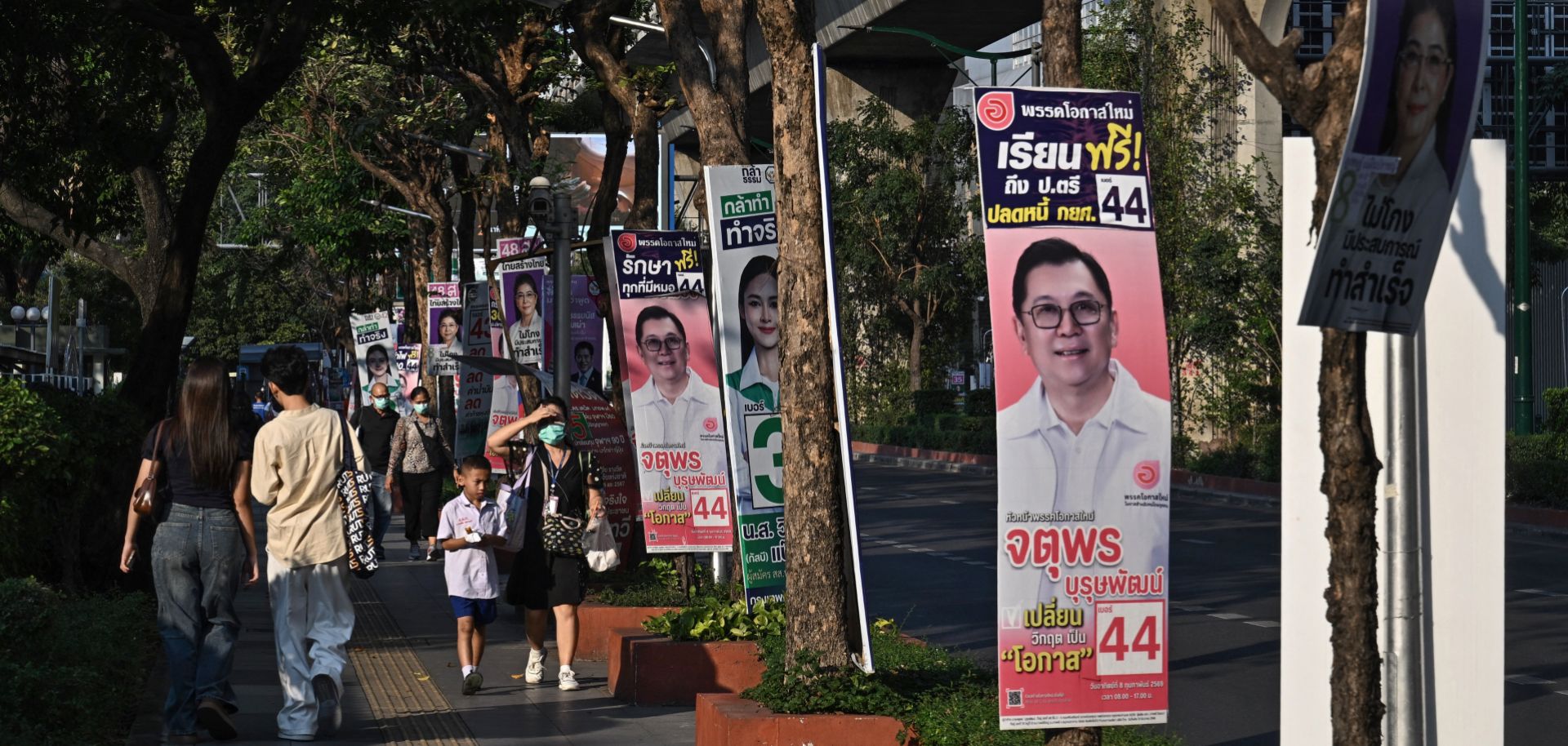
Thailand's general election and constitutional referendum are unlikely to deliver a decisive political reset and will instead risk extending a familiar cycle of contested governance, constrained reform and policy caution amid heightened security pressures and economic underperformance. On Feb. 8, Thailand will hold a general election for the 500-seat House of Representatives and a national referendum on whether to initiate the drafting of a new constitution to replace the 2017 charter. Under Thailand's parallel voting system, 400 members of parliament will be elected from constituencies and 100 from party lists. Forming a government will require the support of at least 251 lawmakers to select a prime minister. The election is being contested primarily by three major political blocs: a progressive and reformist camp led by the People's Party, center-right forces aligned with the governing Bhumjaithai Party and the established political network of the center-left Pheu Thai Party, which advocates redistributive economic policies and welfare expansion. Key campaign issues include economic policy, governance and constitutional reforms, and national security issues following the large-scale cross-border clashes with Cambodia in 2025 and the subsequent failed ceasefires.
- The constitutional referendum will ask voters whether they approve beginning a process to draft a new constitution; it does not include a draft text or specify the form of any future charter. Ballot options will include approval, disapproval or abstention.
- The Bhumjaithai Party leads the current minority government after parliament elected its leader, Anutin Charnvirakul, as prime minister in September 2025. This transfer of executive power from a Pheu Thai-led government followed a court-ordered removal, rather than a general election.
The votes will be held amid prolonged institutional instability in Thailand, in which electoral competition has consistently collided with entrenched non-electoral power centers. Since the 2014 military coup, Thailand's political system has been governed by constitutional arrangements that were drafted by military-appointed officials and designed to prevent decisive electoral majorities from translating into unconstrained executive authority. The 2017 constitution formalized this approach by expanding the authority of unelected oversight bodies and courts, embedding procedural barriers to amendments and enabling legal mechanisms that have frequently intervened in election outcomes. As a result, elections since 2019 have largely functioned as opening moves in a broader contest shaped by judicial review, administrative enforcement and elite bargaining. This pattern has been reinforced by repeated party dissolutions and leadership disqualifications, producing cycles in which reformist and populist movements reconstitute themselves under new banners while institutional constraints remain intact. Such dynamics have contributed to voter polarization, episodic mass mobilization and recurring legitimacy disputes, particularly when electoral outcomes conflict with the preferences of the military or the monarchy establishment. Institutional tensions have been further shaped by the 2025 Thailand-Cambodia border conflict, the most serious interstate fighting involving Thailand in more than a decade, which featured sustained combat operations, airstrikes, heavy artillery, mass civilian displacement and repeated ceasefire failures. The conflict elevated national security as a dominant political issue and reinforced the military's domestic prominence at a moment when constitutional reform advocates sought to curtail its political role.
- Judicial and institutional interventions have repeatedly altered the political outcomes of Thai elections since 2019. In February 2020, the Constitutional Court dissolved the People's Party's predecessor, Future Forward Party, after it emerged as a major force in the 2019 election, banning its leadership and forcing lawmakers to regroup under successor parties. In the 2023 election, Future Forward's successor, the Move Forward Party, won the largest number of seats and formed a broad coalition with multiple parties. But the party failed to secure enough parliamentary votes for prime minister, largely because the military-appointed Senate withheld support. Move Forward subsequently exited the coalition and the Pheu Thai Party formed a government without it. In August 2024, the Constitutional Court similarly dissolved Move Forward. Later that month, the court dismissed Prime Minister Srettha Thavisin of the Pheu Thai Party over an ethics violation related to a cabinet appointment, triggering another change in government without an intervening election. In August 2025, the Constitutional Court again removed a sitting prime minister, Paetongtarn Shinawatra, on ethical grounds.
- Thailand and Cambodia signed their most recent ceasefire in December 2025, though subsequent incidents have been reported, including mutual accusations of ceasefire violations, continued forward deployment of troops near contested areas and Cambodian claims that Thai forces remain positioned in civilian zones, delaying the return of displaced residents.
- Thailand and Cambodia signed their most recent ceasefire in December 2025, though they have since accused each other of violations. Both countries have continued forward troop deployments near contested areas, while Cambodia claims that Thai forces remain positioned in civilian zones, delaying the return of displaced residents. While large-scale combat has not resumed, both governments have issued public warnings and lodged complaints over alleged breaches, indicating the ceasefire remains fragile and contested.
The legislative election is unlikely to yield a clear mandate, leading instead to an extended period of coalition bargaining shaped by institutional constraints rather than vote share alone. While the People's Party is entering the contest with strong poll numbers, reformist momentum and national visibility, Thailand's electoral system and recent political history make it difficult for any single bloc to translate plurality support into durable executive control. As in previous cycles, coalition arithmetic will thus likely matter more than headline results, with smaller parties poised to play an outsized role in determining the composition and durability of the next government. This sets the stage for prolonged coalition negotiations and several months of policy paralysis, delaying budget execution, complicating fiscal planning and reinforcing investor caution amid Thailand's already subdued economic growth and high household debt levels. Those negotiations are likely to eventually yield a coalition that is either led by the reformist People's Party or centered on Bhumjaithai or Pheu Thai. A People's Party-led coalition would probably struggle to maintain parliamentary backing due to legal scrutiny, procedural challenges and pressure from conservatives to moderate its agenda (e.g., constitutional reform, limits on unelected institutions and changes to the law criminalizing criticism of the monarchy). Conversely, a coalition led by Bhumjaithai or Pheu Thai would offer greater short-term continuity but could face legitimacy challenges if perceived as sidelining the strongest electoral performers (as occurred in 2023). Regardless of its composition, the next Thai government will likely initially prioritize short-term economic management, stimulus measures and policy continuity over structural reform. Thailand's foreign policy will also remain cautious and pragmatic to preserve trade access and maintain its balancing act between the United States and China. Additionally, the fragile Thailand-Cambodia ceasefire and the heightened salience of border stability will ensure the military's continued influence over political decisions. The main risk is thus post-election friction, including delays in government formation, fragile coalitions and renewed institutional intervention that reshapes outcomes after votes are cast. Ultimately, the election is more likely to produce a negotiated, constrained government rather than a decisive political reset, extending Thailand's pattern of contested governance and reinforcing policy caution.
- Thailand's economy is forecast to grow between 1.6% and 2.0% in 2026, with risks from a strong baht, high household debt, U.S. tariffs, and political instability weighing on business confidence and export competitiveness. At the same time, major global investors and funds have reduced exposure to Thai assets and markets ahead of the election, citing uncertainty over policy direction, which has contributed to weak performance in stocks and bonds.
- Economically, Thailand lags behind regional peers like Vietnam, which has sustained high growth and attracted stronger manufacturing and foreign direct investment inflows. This widening gap has fueled concerns that Thailand's prolonged political uncertainty and stalled reforms could further weaken its relative economic standing and drive manufacturing to other Asian countries.
Policy Agendas of Major Political Blocs
Thailand's main political blocs have vastly different visions shaped by their relationship to the post-2014 political order. The People's Party supports an explicitly reformist agenda centered on curbing the power of unelected institutions, reducing military influence in politics, amending the lese majeste law, expanding civil liberties and decentralizing governance — positions that the ruling establishment views as a challenge to core institutional pillars tied to the monarchy and military. The Pheu Thai Party supports redistributive economic policies, welfare expansion and technocratic governance, favoring incremental constitutional reform and compromise to maintain governing space. While it supports constitutional reform in principle, Pheu Thai favors incremental change and compromise within existing structures. Bhumjaithai occupies a conservative-populist stance that emphasizes stability and security (including maintaining institutional continuity under the current constitution and existing civil-military relations), along with more flexible, sector-specific economic policies. This stance positions the party as a potential stabilizing force for establishment actors, though it also draws criticism from reformists.
The constitutional referendum's practical impact will depend primarily on how the next government and oversight institutions interpret and operationalize the result, making rapid or sweeping changes to the current charter unlikely. Reformist parties, spearheaded by the People's Party and aligned constituencies, seek constitutional change on the grounds that the current framework prioritizes institutional control over electoral outcomes, producing repeated gaps between voter preferences and political leadership. In the current security environment — where national stability and military strength have regained political salience following the clashes with Cambodia — constitutional reform efforts are likely to be limited, with reformist actors prioritizing symbolic and procedural advances over maximalist change. A "yes" vote would initiate the process of drafting a new constitution, but the scope and composition of the drafting body would be determined through subsequent legislative and judicial procedures — thereby leaving substantial discretion to parliament, courts and administrative authorities. Consequently, even a clear approval would not guarantee rapid or sweeping constitutional change. The most likely short-term outcome is a qualified mandate: either a modest "yes" majority or an outcome complicated by abstentions. Reformists would cite this as authorization to reopen constitutional rules, while conservative and institutional actors would emphasize procedural limits embedded in existing law. This dynamic would likely shift the constitutional contest to disputes over process, including who controls drafting mechanisms, whether additional referendums are required to authorize or ratify potential subsequent stages and how courts adjudicate attendant challenges. A "no" result, while less likely, would not remove constitutional reform from the political agenda but would strengthen arguments for postponement and reinforce the status quo, narrowing reformist leverage within coalition negotiations. A low-turnout or ambiguous result would produce a similar effect by diluting claims of popular authorization and leaving more room for institutional interpretation. The referendum will influence the direction of the constitutional debate, shaping coalition bargaining and reform sequencing. But it is unlikely to deliver a definitive outcome due to the structural constraints in Thailand's post-2014 political order.
