
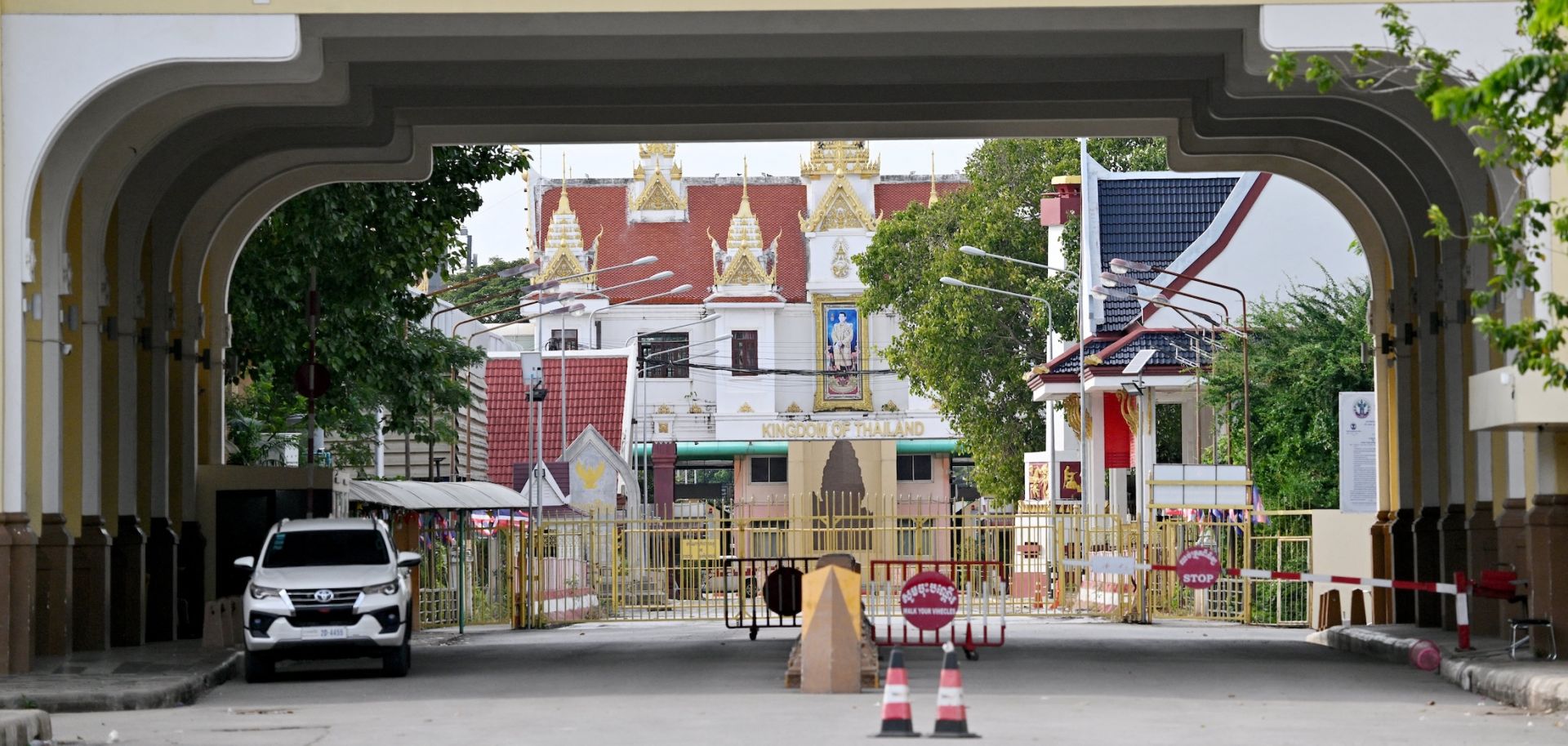
The latest Thailand-Cambodia ceasefire arrests a rapidly escalating border conflict driven by failed earlier truces, but its durability remains uncertain as early allegations of violations and unresolved boundary disputes leave the door open for another truce breakdown and return to larger fighting in the coming years. On Dec. 29, Chinese Foreign Minister Wang Yi hosted the Cambodian and Thai foreign ministers in Yuxi city in China's Yunnan province, where Wang framed China as a friend to both countries that is intent on preventing a relapse into conflict. The summit occurred two days after Thailand and Cambodia signed a renewed ceasefire effective noon local time on Dec. 27, halting a roughly three-week conflict that featured artillery exchanges and Thai airstrikes, and that left more than 100 dead and more than half a million civilians displaced across both sides of the border. The ceasefire commits both sides to an immediate halt in military movements and to no airspace violations for military purposes (a pointed clause, given Thailand's recent use of air power). The agreement also pairs de-escalation with practical stabilization measures, including facilitating civilian returns, restarting border management mechanisms and launching joint humanitarian demining amid Thailand's repeated accusations that newly laid Cambodian landmines have caused severe Thai military casualties. A key confidence test is Thailand's pledge to repatriate 18 Cambodian soldiers captured in July clashes after 72 hours of an incident-free ceasefire, an issue Cambodia has treated as a core demand. However, early compliance signals were mixed as on Dec. 29 — after the Yuxi talks had concluded — Thai military officials accused Cambodia of flying more than 250 drones over multiple border positions and highlighted new landmine casualties even after the new ceasefire was signed, incidents reminiscent of the kind that previously unraveled earlier July and October truces.
- The Dec. 27 truce was signed at a border checkpoint by the countries' defense ministers following three days of lower-level military talks. The ceasefire's call to restart border management mechanisms refers primarily to reactivating the General Border Committee, which Thailand suspended in mid-December, and to reviving the work of the Joint Boundary Commission, whose technical activities were effectively frozen as security conditions deteriorated.
- U.S. Secretary of State Marco Rubio publicly welcomed the ceasefire announcement and urged both parties to fully honor the ceasefire and prior accords, while U.N. Secretary-General Antonio Guterres called it a positive step and explicitly credited Malaysia, China and the United States for their mediating roles. Additionally, Malaysian Prime Minister Anwar Ibrahim, who is also the 2025 Association of Southeast Asian Nations (ASEAN) chair, hailed the truce as a necessary restraint to protect civilians.
- With respect to casualty figures, Thai military sources claim Cambodian military casualties at estimates ranging from several hundred to more than 2,000, but these figures are not independently verified nor acknowledged by Cambodia.
- In Yuxi, Thailand and Cambodia both publicly emphasized sustaining the "hard-won" truce and rebuilding trust "step-by-step." China paired its mediation efforts with humanitarian outreach, including a reported roughly $2.8 million (20 million yuan) emergency aid package provided to both governments to support displaced civilians and reconstruction needs in affected areas. China also framed ceasefire stabilization alongside expanded cooperation against transnational crime, especially telecom fraud networks that thrive in insecure border zones and have become a priority security concern for Beijing, given widespread victimization of Chinese nationals. China's framing also further elevates combating telecom and online fraud networks operating across insecure border areas as a key regional security priority.
The ceasefire caps a year-long cycle of escalation and failed de-escalation along the Thai-Cambodian border that repeatedly exposed the fragility of existing dispute management mechanisms, as China, Malaysia and the United States each took different approaches to try to wind down the fighting. Tensions intensified sharply in July, when localized incidents escalated into the most significant period of sustained cross-border fighting since the 2008-2011 period, prompting Thailand to employ air power for the first time in the decades-long dispute and triggering mass civilian displacement. A U.S.- and Malaysia-brokered ceasefire halted major combat at the time but failed to address core drivers of instability, including unresolved territorial claims, contested patrol zones and mutual accusations of landmine deployment. Follow-on agreements reached in October sought to reinforce the July truce through expanded political commitments and technical mechanisms, but these arrangements proved vulnerable to breakdown amid continued border incidents, deep mistrust between Thai and Cambodian military commands, and harsh rhetoric and accusations from both sides. By early December, the erosion of those accords culminated in a renewed escalation marked by heavier fighting, rising casualties and large-scale evacuations, underscoring the absence of durable verification or enforcement capacity. Throughout 2025, the conflict also became a test case for competing diplomatic tracks. Malaysia, as the 2025 ASEAN chair, positioned itself as the primary facilitator, reinforcing ASEAN's preference for quiet regional mediation. Meanwhile, the United States periodically exerted pressure on both Thailand and Cambodia — most visibly via heightened tariff threats during earlier ceasefire efforts in July — without assuming a sustained mediation role. China, by contrast, incrementally expanded its involvement as fighting intensified, framing its engagement as both a regional responsibility and a stabilizing force amid broader great power competition in Southeast Asia.
- China's decision to host trilateral talks in Yunnan province (which borders mainland Southeast Asia), rather than in relatively faraway Beijing, signaled an effort to localize its mediation posture and link border stability to wider concerns, such as transnational crime.
- Thailand may have agreed to the Dec. 27 ceasefire after assessing that its sustained military pressure (including air operations beyond Cambodia's realistic ability to counter) had largely achieved Bangkok's deterrence objectives, namely by restoring escalation dominance and demonstrating resolve while stopping short of territorial expansion. Given it was Cambodia that primarily drove escalation from February through July, Thailand's revived deterrence posture has allowed Bangkok to shift toward de-escalation from a position of strength, limiting domestic political exposure to accusations of weakness while reducing the humanitarian and economic costs of continued fighting.
The latest truce will likely suppress major combat in the short term but remains highly vulnerable to tactical violations and political conditionality, with its durability hinging on early confidence-building measures, which could open the door to further bouts of multiday cross-border conflict in the future. The agreement represents a containment mechanism, but it does not remove the incentives for calibrated provocation or gray zone methods that test the other side's restraint while avoiding open war. Therefore, in practice, the ceasefire is most likely to prevent a return to large-scale kinetic engagements while remaining highly vulnerable to localized incidents that could rapidly increase political pressure and undermine implementation, particularly during the initial 72-hour observation period and Thailand's pending decision on releasing 18 Cambodian soldiers detained since July. Early indicators already point to the truce's fragility. Thai military reporting of Cambodian drone incursions and fresh landmine casualties after the Yuxi talks illustrate how easily both sides can generate supposed evidence of non-compliance that justifies delaying concessions or hardening posture. In operational terms, the agreement's "freeze" language (i.e., halting troop movements, discouraging reinforcement along contested zones and restricting use of air power) reduces the probability of rapid massing and air escalation, but it does not eliminate day-to-day friction in contested zones where drones, patrols, mines and ambiguous attribution can function as coercive signaling below the threshold of open conflict. The most important short-term indicators will therefore depend on whether Thailand proceeds with repatriating the 18 soldiers on schedule, whether both sides operationalize any meaningful monitoring or incident management channels (like the General Border Committee), and whether the ceasefire yields visible civilian returns without new high-profile casualties. If any one of those steps stalls, Thailand and Cambodia are unlikely to immediately return to full-scale conflict. Instead, the more probable scenario is an extended period where the ceasefire remains politically intact but weakens on the ground, until this operational deterioration eventually results in a return to more significant fighting — precisely the pattern that preceded the re-eruption of border clashes in early December following the failed July and October accords. In the coming weeks and months, the most likely trajectory is a fragile stabilization marked by sustained heavy-weapons restraint but punctuated by drone incidents, mine-related casualties, border checkpoint disruptions and information operations aimed at shaping blame and creating leverage. Over the longer term, Thailand and Cambodia's underlying dispute — stemming from overlapping territorial claims, unclear boundary alignment inherited from colonial-era maps, and persistent disagreement over patrol rights and control of specific border features along the roughly 500-mile frontier — will remain unresolved. This will, in turn, sustain the risk of future bouts of prolonged cross-border fighting, absent a credible demarcation process and enforceable rules of engagement in contested areas.
- Thailand's upcoming snap election in February remains a background risk factor, heightening domestic political sensitivity to perceived concessions to Cambodia. But the ballot alone is unlikely to drive renewed escalation with Cambodia, absent a significant new incident. This is because the government of Thai Prime Minister Anutin Charnvirakul, who assumed office in September, has already demonstrated military resolve and deterrence over the past three weeks, reducing the political incentive to escalate further. In the weeks leading up to the election, Anutin is likely to frame recent military operations as evidence of decisive leadership and national resolve, pivoting the political narrative toward competence, stability and effective crisis management rather than continued confrontation.
- The ceasefire's aftermath is also a contest over who sets the mediation narrative and the post-conflict agenda, with Beijing bundling ceasefire consolidation alongside transnational crime cooperation and humanitarian assistance. China's approach, therefore, offers a plausible off-ramp framework that is politically easier than immediate boundary concessions because cracking down on scams and facilitating humanitarian steps is far less sovereignty-sensitive than demarcation. The United States' pressure on Cambodia and Thailand contributed to earlier ceasefire dynamics, and U.S. officials publicly welcomed the Dec. 27 deal. However, China's diplomatic intervention incrementally weakens U.S. influence over the conflict's diplomatic endgame unless Washington remains engaged in monitoring and demining support.
