
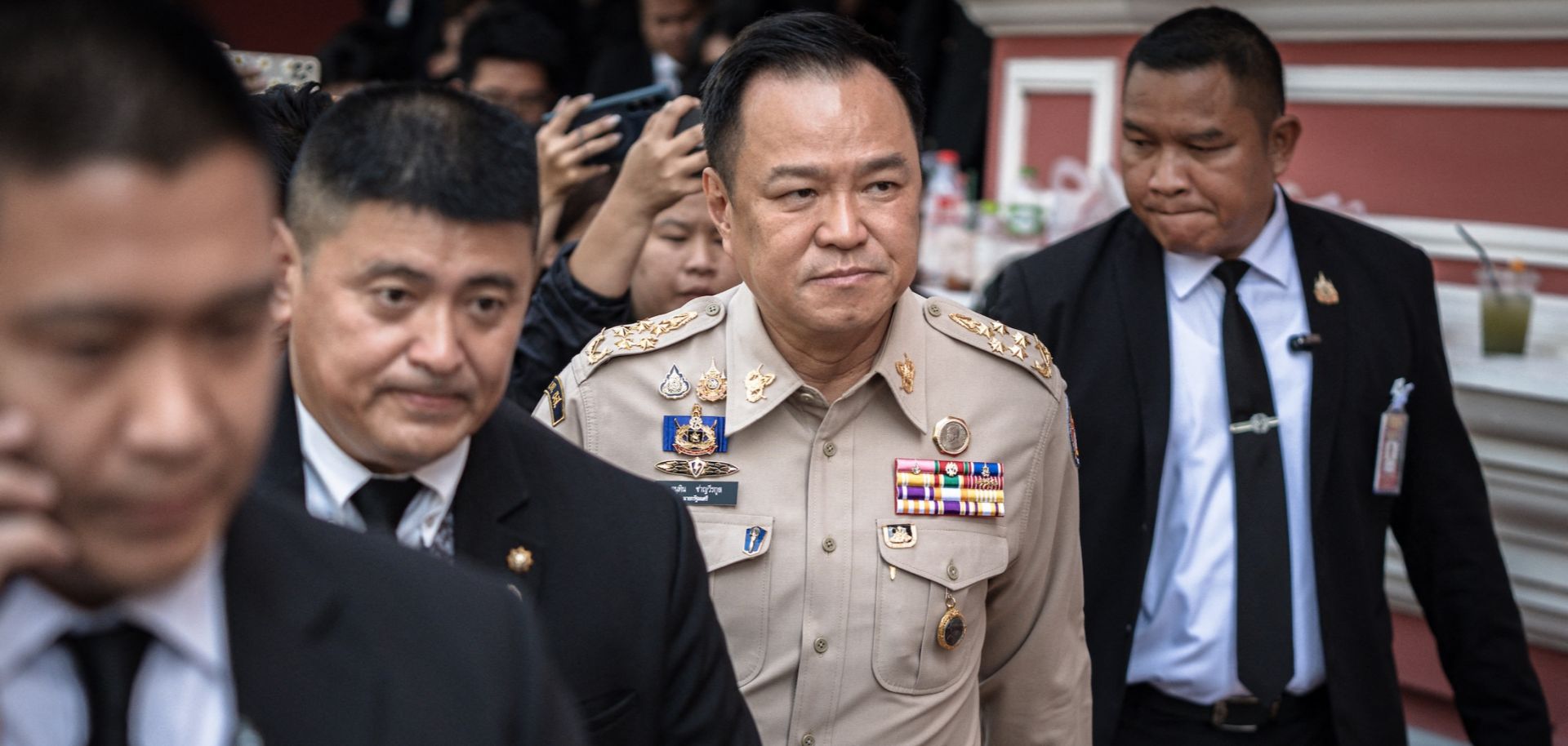
An armed clash on the Thai-Cambodian border raises the risk of escalations that unwind the two countries' recent peace accord, though a return to full-scale war is less likely due to U.S. economic and security leverage. A deadly firefight erupted Nov. 12 along the Thailand-Cambodia frontier near Nong Ya Kaeo village in Thailand's Sa Kaeo province and Prey Chan village in Cambodia's Banteay Meanchey province. According to the Royal Thai Army, Cambodian soldiers opened fire into Thai territory, prompting Thai forces to return warning shots in an exchange that lasted some 10 minutes. While no Thai casualties were reported, Cambodia accused Thai troops of deliberately shooting unarmed civilians, saying they killed one villager and injured three others on the Cambodian side of the border; Thailand has not denied the allegations. Cambodia condemned the incident as a "brutal and inhumane" act and filed formal protests with the Thai Embassy in Phnom Penh and the Association of Southeast Asian Nations. The Thai Foreign Ministry has meanwhile described Cambodia of using human shields. The skirmish came just after a Nov. 10 landmine explosion in Sisaket province injured four Thai soldiers, leading Bangkok to unilaterally suspend implementation of a U.S.-brokered peace accord signed Oct. 26 in Kuala Lumpur, Malaysia, at the annual ASEAN leaders' summit. According to Thai authorities, forensic evidence indicates the mine was planted after the accord, but Cambodia says the blast occurred in a legacy minefield. The Thai army subsequently closed all border crossings in Sa Kaeo, increased patrols and expanded mine clearance operations. On Nov. 12, Thai Prime Minister Anutin Charnvirakul ruled out renewed peace talks with Cambodia until Thailand's demands are met. He also stated that Thailand is "unafraid of U.S. tariff threats" — a reference to the Trump administration's threat to impose severe tariffs on both countries to achieve the ceasefire — indicating U.S. trade pressure will not factor into Bangkok's decision-making regarding its dispute with Cambodia.
- The Nov. 12 clash occurred in a lightly forested, semirural stretch where the boundary line is poorly demarcated and patrolled by both sides within overlapping security zones that had been designated for joint demining.
- Thailand's demands include a formal Cambodian apology for the allegedly newly laid landmines, acceptance of joint forensic and mine-clearing verification, withdrawal of Cambodian forces from contested border zones, and the release of detained Thai nationals.
The recent developments mark the sharpest breakdown in the U.S.-brokered ceasefire that paused the two Southeast Asian countries' five-day border war in July, threatening to undo months of peace efforts. This year has seen multiple flashpoints in two countries' long-standing border dispute. In February, Cambodian troops and villagers at the Ta Moan Thom temple complex sang the Cambodian national anthem inside the disputed zone, provoking Thai troop intervention and a formal protest from Bangkok, but no violence. Matters escalated in May, when a cross-border shootout left one Cambodian soldier dead and several wounded after patrols clashed near another contested sector, breaking months of uneasy calm. These confrontations reignited nationalist sentiment on both sides and eroded the fragile communication channels established under earlier border coordination frameworks. Tensions escalated even more midyear as Thai forces tightened border controls and issued eviction orders against Cambodian nationals living in what Bangkok termed "encroached" areas of Sa Kaeo province, orders that Phnom Penh rejected as unilateral and provocative. The dispute turned kinetic in late July when competing claims over territories near the Preah Vihear Temple site ignited five days of combat, leaving more than 40 people dead and 300,000 displaced. That crisis ended with a July 28 ceasefire brokered by the United States and Malaysia under threat of U.S. trade sanctions. The truce was codified as the Kuala Lumpur Peace Accord on Oct. 26 overseen by U.S. President Donald Trump and Malaysian Prime Minister Anwar Ibrahim, whose government holds the rotating ASEAN chairmanship for 2025. The deal committed both countries to withdraw heavy weapons, exchange prisoners, conduct joint humanitarian demining and accept ASEAN Observer Team verification. Implementation, however, quickly faltered. Thailand delayed releasing 18 Cambodian prisoners of war while Cambodia accused Thai troops of reinforcing forward positions and forcibly removing villagers.
- The border clash is the latest escalation in a century-old dispute rooted in the 1907 Franco-Siamese map that demarcated the frontier between modern Cambodia and Thailand, a boundary Bangkok still regards as skewed toward Phnom Penh. Although the International Court of Justice ruled in 1962 that the Preah Vihear Temple area belonged to Cambodia, long stretches of the border remain undemarcated and intermittently volatile.
- In June, then-Thai Prime Minister Paetongtarn Shinawatra took a conciliatory line toward Cambodia, holding a private phone call with former Cambodian leader Hun Sen to reaffirm peaceful demarcation and discourage further troop deployments. Hen Sen then leaked the call in an apparent attempt to destabilize the Thai government, a gambit that proved successful as Thai generals and nationalist coalition partners subsequently accused Paetongtarn of appeasing Phnom Penh and undermining Thailand's sovereignty, sparking domestic backlash. Within two months, the Constitutional Court forced Paetongtarn's resignation, clearing the path for her deputy, Anutin, to assemble a new coalition with explicit military support. The political shift restored some military influence in civilian decision-making. Anutin then authorized tighter border enforcement, endorsed the army's plan to evict Cambodian residents from so-called encroached zones in Sa Kaeo province and reframed the issue primarily as one of sovereignty rather than diplomacy.
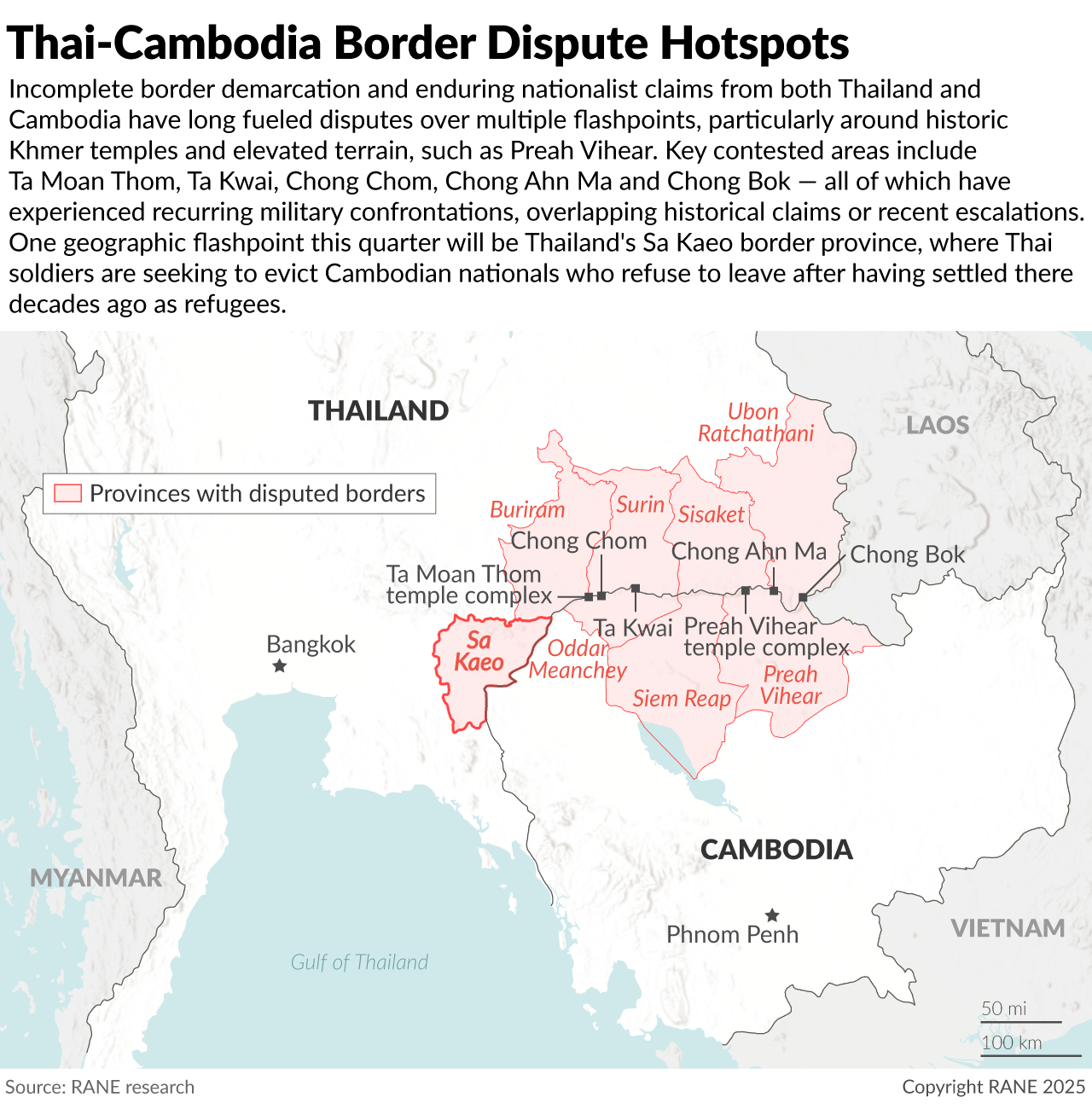
Periodic border flare-ups, short of full-scale war, are likely to persist through early 2026, leaving external mediation tied to trade incentives as the most realistic path to stabilizing the frontier and salvaging the Kuala Lumpur Peace Accord. The situation along the Thai-Cambodian frontier is poised to remain volatile through the coming months as both governments double down on incompatible objectives. In Bangkok, Anutin's assertive posture with military and popular support makes de-escalation politically costly. The army's closure of Sa Kaeo border crossings and continuing mine clearance expansion suggest Thailand intends to impose facts on the ground before entertaining mediation. Cambodia, by contrast, seeks to frame Thailand as the aggressor, leveraging diplomatic sympathy from the United States, ASEAN, the United Nations and rights bodies to preserve international legitimacy while buying time to consolidate defenses. Neither side appears ready to resume the suspended Kuala Lumpur Peace Accord, leaving the ceasefire architecture effectively hollow. The most immediate risk is that recurring small-unit skirmishes or accidental mine detonations could trigger retaliatory fire and localized escalation. Even though the partial drawdown of heavy weapons under the accord has been paused, no clear evidence of large-scale remobilization has emerged. Thailand's current posture aims to maintain tactical dominance without crossing into open war, while Cambodia's relative restraint may not hold if additional civilian casualties occur. Economically, Thailand faces far greater vulnerability to external pressure than Cambodia. The United States could respond to further escalation by raising baseline tariffs from 19% toward 40% (the upper tier of current U.S. tariff levels), suspending bilateral trade carve-outs or delaying participation in digital trade and semiconductor supply chain frameworks that Bangkok views as critical to export diversification. By contrast, Cambodia's continued endorsement of the peace accord leaves it relatively insulated from tariffs, especially amid recent rapprochement with the United States. A sustained impasse would therefore amplify Thailand's economic costs while eroding investor confidence in its political stability, but Bangkok is unlikely to yield quickly to trade pressure. Instead, Anutin's government is likely to harden its "sovereignty first" narrative and intensify ongoing export outreach toward alternative partners such as China, India and the Gulf states. Anutin will also use retaliatory rhetoric against Washington to rally domestic support ahead of a March 2026 election — which could change the current dynamic depending on its outcome — while judging that the long-standing U.S.-Thailand alliance will limit Washington's willingness to impose punitive measures maximally. Thailand could offer limited, symbolic concessions, such as inviting ASEAN or Malaysian observers for selective mine clearance verification, to defuse diplomatic isolation, but it will resist U.S. pressure perceived as infringing on national autonomy.
- U.S.-Thai trade negotiations remain in a holding pattern following an Oct. 26 reciprocal trade framework, with both sides still haggling over sectoral carve-outs from Washington's 19% baseline tariff. U.S.-Cambodia trade terms, also inked Oct. 26, were likewise set at a 19% baseline reciprocal tariff for Cambodian exports and allow for zero-tariff carve-outs of certain goods, with Cambodia committing to open its market and eliminate import quotas on U.S. goods.
- In early November, Cambodia's National Assembly formally nominated Trump for the Nobel Peace Prize in recognition of his mediation of the July ceasefire and the Oct. 26 Kuala Lumpur Peace Accord, an overture that has further endeared Phnom Penh to Washington and positioned Cambodia as less likely than Thailand to face U.S. trade reprisals. On Nov. 6, Washington lifted its arms embargo on Cambodia, and the two countries agreed to resume annual Angkor Sentinel military exercises after an eight-year suspension following Phnom Penh's renewed engagement with Washington and acquiescence to the Kuala Lumpur Peace Accord. The decision signals a symbolic recalibration of U.S. security alignment in mainland Southeast Asia that implicitly rewards Cambodia's compliance with the peace accord, thereby widening a strategic opening for Cambodia to rebalance modestly toward the United States after years of exclusive dependence on China.
- The United States also could pressure Thailand by leveraging security cooperation as a lever for compliance, such as by suspending future arms sales and halting joint training exercises such as Cobra Gold and other bilateral programs. Nonetheless, a full-blown rupture is unlikely given that, historically, sharp downturns in the U.S.-Thailand alliance (such as Thailand's 2014 military coup) have resulted only in temporary security downgrades rather than long-term strategic abandonment.
- While the most likely scenario is recurring but contained flare-ups through early 2026, a more escalatory scenario remains plausible. Mass casualty incidents, additional civilian deaths on either side, Thai preelection nationalist political incentives or military miscommunication or misinterpretation of the other's intentions could propel both sides back into a cycle of heavy fighting akin to July's five-day armed conflict. Swift reciprocal mobilization, renewed use of heavy weapons or frontline units taking their own initiative would mark indicators toward a more escalatory confrontation.
