
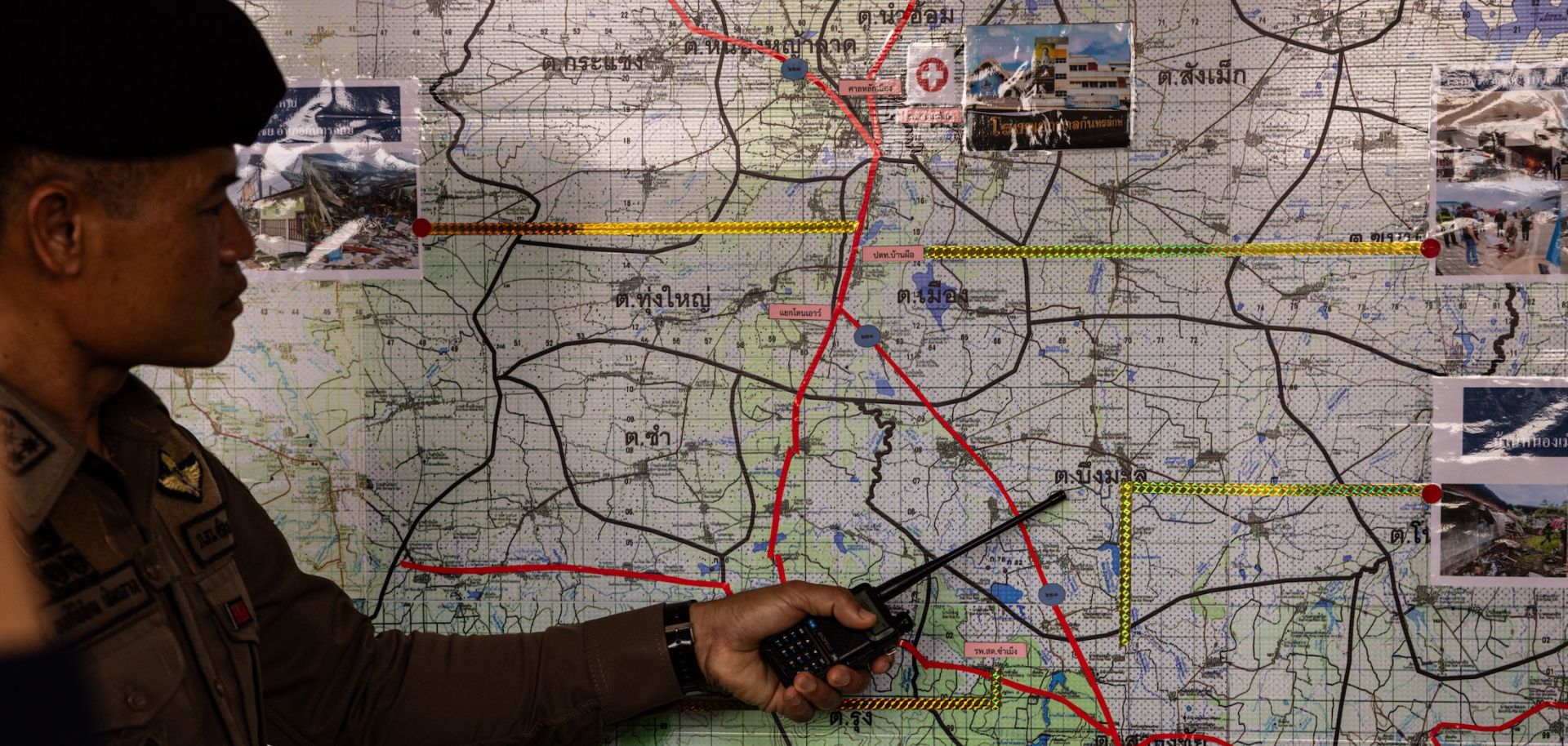
The latest round of clashes between Cambodian and Thai forces may yet surpass the scale of their July conflict, and though a return to the ceasefire is likely in the coming days, there will be a high risk of further flare-ups in the months ahead, especially in the lead-up to Thailand's expected elections in March. On Dec. 7, Thai and Cambodian military forces commenced another round of clashes in disputed territories along the two countries' shared border, with fighting still ongoing as of Dec. 9 and involving significant firepower. This includes widespread small arms and artillery fire from both sides, Thailand's use of airstrikes and tanks to strike Cambodian military targets and civilian targets allegedly used by the military (e.g., casinos and scam centers), and Cambodia's use of suicide and bomb-dropping drones against Thai forces. The latest round of fighting has expanded to nearly all border provinces, with the Thai navy supporting a campaign launched early on Dec. 9 to take Cambodian-held territory in Trat province. Clashes are now affecting every Thai province bordering Cambodia except Chanthaburi, and every Cambodian border province except Pailin (which is opposite Chanthaburi). Thus far, Thailand claims three of its soldiers have died and 29 people have been injured, while Cambodia claims nine dead and 20 injured, all civilians. Varying reports also suggest both countries have evacuated between tens and hundreds of thousands of citizens from areas near the fighting. Government leaders from Thailand and Cambodia have blamed each other for starting these clashes and suggested they will continue fighting.
- Thai defense ministry spokesperson Surasant Kongsiri and Prime Minister Anutin Charnvirakul have separately stated that this round of fighting will not stop, and that talks to resume the ceasefire will not commence until Cambodia ceases its attacks. Anutin also noted that he had "no concern" that the fighting would negatively impact U.S.-Thailand trade negotiations and asserted that "This is a matter between Thailand and its neighbor," while Thai Foreign Minister Sihasak Phuangketkeow said on Dec. 9 "We don't think tariffs should be used to pressure Thailand to get back" to the ceasefire, adding "You have to separate the issue of Thai-Cambodia relations from the issue of the trade talks."
- In a post on Facebook, Hun Sen — Cambodia's President of the Senate, former long-time prime minister and father of current Prime Minister Hun Manet — said "Cambodia is compelled to counterattack to defend our territory," and he called Cambodia's defensive position advantageous against an "invading enemy."
- As of Dec. 9, U.S. President Donald Trump has yet to publicly comment on the clashes.
The recent violence follows a flurry of ceasefire violations and U.S. interventions to limit conflict, with both Thailand and Cambodia politically motivated to continue fighting in some capacity. This latest round of fighting is the most significant in terms of fatalities, length and geographic expansion since five days of intense fighting in late July, which killed dozens and forced roughly 300,000 civilians to evacuate from border areas before a ceasefire was reached on July 28. That ceasefire was largely prompted by Trump's threat to suspend trade talks with both countries to lower U.S. tariffs, raised earlier this year, if they did not stop the fighting. Since then, there have intermittently been signs of both ceasefire implementation and new border clashes. These include both sides pulling back heavy artillery from the disputed areas in early September, a firefight in the eastern border provinces on Sept. 27, a signing ceremony with Trump on Oct. 26 on the sidelines of the ASEAN Summit to formalize the ceasefire, Thailand's Nov. 10 announcement following a landmine incident that it was suspending ceasefire implementation, a clash in the western border provinces on Nov. 12, and Trump calling the leaders of both countries on the phone on Nov. 14, presumably to remind them of his tariff threat. This fragility illustrates both the intractability of Thailand and Cambodia's underlying territorial disputes, and the fact that leaders from both countries are politically incentivized to maintain some level of fighting as they seek to stoke nationalist sentiment and thereby consolidate their rule.
- Thailand's superior military has long sought to settle the border dispute with Cambodia. Moreover, the military is politically empowered following the August resignation of former Prime Minister Paetongtarn Shinawatra — amid a scandal related to a phone call leak from Hun Sen — and her eventual replacement with the relatively pro-military Anutin. In addition, Anutin will likely dissolve the parliament in January for early general elections in March, in which his party and those aligned with the military are hoping to gain seats over progressive parties (like Shinawatra's) that have called for restraint at the border.
- Cambodian Prime Minister Hun Manet, who took office in August 2023, has a background in the military. He is also still relatively new to the job compared with his father, who ruled the country for nearly four decades, and Hun is still trying to establish his own leadership bona fides. Moreover, the July border clashes demonstrated that such actions can stoke political instability in Thailand, thereby giving Cambodia another incentive to make border provocations, despite its clear military disadvantage.
Fighting will likely continue in the coming days and could surpass the July clashes in scale, and though a return to the ceasefire amid U.S. pressure is likely, so are renewed clashes in the coming months; beyond that, peace at the border will depend largely on Washington's appetite for continued engagement. The scale of fighting and statements from both sides suggest clashes will likely continue for a few more days amid U.S. quietude. The Thai military is motivated to strengthen and reclaim border positions disputed in the July fighting, and to weaken the Cambodian military's future fighting capability. Cambodia, meanwhile, is incentivized to lay mines and conduct isolated strikes, as it tries to make it harder for Thai forces to hold disputed areas, combat the perception of its military inferiority, and legitimize Hun Manet's leadership in the context of a decades-long border dispute. In this context, the current flare-up could last longer and kill more people than the July clashes. That said, the Trump administration's original intervention in July — along with Trump insisting on the October signing ceremony to mark the ceasefire and his mid-November phone calls with the leaders of both Thailand and Cambodia — suggest the U.S. president is still motivated to preserve the truce, if not to avoid supply chain disruptions between two U.S. trade partners than to maintain his own oft-stated legacy of solving many wars in his first year in office. Thus, if the fighting continues and approaches the intensity of the July clashes, Trump will likely again threaten to impose tariffs, and the Thais and Cambodians are likely to acquiesce, resulting in an uneasy return to the July ceasefire. But even then, the current escalation (and the multiple smaller flare-ups in recent months) will stoke distrust that makes each side even less likely to fully implement the reduction in border forces outlined in the July ceasefire. This lingering militarization will sustain a high risk of future clashes, particularly ahead of likely Thai elections in March, when the government will have clear political reasons to take a hard line on Cambodia. Beyond those elections, the increasingly politically empowered Thai military will remain motivated to strengthen its existing positions or even expand territorial holdings at the border, especially as revanchism and territorial aggression are increasingly normalized on the global stage following Russia's 2022 invasion of Ukraine. However, as long as Washington is engaged to maintain the ceasefire, the Thai military will be prevented from achieving these goals, but it will keep recurrent violent flare-ups on the table in the coming year.
- If U.S. intervention to stem the border dispute wanes, the most obvious avenue for the Thai military to expand the conflict would be airstrikes deeper into Cambodian territory to significantly weaken its military and reduce the chances of future Cambodian border provocations, like the one that allegedly triggered the July clashes. Though less likely, Thai troops could also invade Cambodian border province territory beyond the currently disputed areas, either as a means to geographically insulate such disputed territories from the Cambodian military or to permanently take back larger portions of territory that Thailand (then called Siam) ceded to French Indochina in the early 20th century. However, this would likely entail the beginning of a full-blown war with Cambodia and is thus a far less likely scenario.
