
The lifting of force majeure on two major liquefied natural gas projects in Mozambique's Cabo Delgado province is a major milestone in Maputo's quest to tap its natural gas riches, but persistent security threats by Islamic State Mozambique Province, as well as the potential for fresh anti-government protests, create a lingering risk of new disruptions to construction works. On Jan. 29, the CEO of French multinational energy company TotalEnergies, Patrick Pouyanne, announced the formal resumption of construction works on its $20 billion Mozambique LNG project, located in the northern Cabo Delgado province. This came after the French major lifted its force majeure on the project in October 2025, which it had imposed in April 2021 following a large-scale offensive by Islamic State Mozambique Province, or ISMP, militants on the neighboring town of Palma that resulted in over 1,000 fatalities. Soon after TotalEnergies' October decision, U.S. multinational oil and gas company ExxonMobil announced that it had lifted force majeure on its proposed $30 billion Rovuma LNG project, which it had imposed for similar reasons, as the project is planned to be co-sited with Mozambique LNG. Despite this newfound momentum, TotalEnergies' request to the Mozambican government for a $4.5 billion increase in the project's costs sparked controversy. While Pouyanne stressed that this sum represented money already spent during the force majeure and that the total project cost remained at $20.5 billion, Mozambican authorities announced the launch of an audit into the cost increases in mid-November.
- TotalEnergies owns a 26.5% operating stake in Mozambique LNG. Other stakeholders include Japanese energy company Mitsui, Mozambique's state-owned energy company ENH, India's Bharat Petroleum and state-owned Oil India, as well as Thailand's state-owned energy company PTTEP. Mozambique LNG aims to tap into the Golfinho and Atum offshore gas fields, located in Mozambique's Area 1 concession. The project will have an initial capacity of 13 million tons per annum (MTPA) of LNG exports, which could be expanded to up to 43 MTPA.
- Rovuma LNG is looking to tap into Mozambique's offshore Area 4 concession and is being developed by Mozambique Rovuma Venture, a joint venture between ExxonMobil, Italy's Eni and China's state-owned energy company China National Petroleum Corp., or CNPC. Once completed, the project is expected to produce 18 MTPA. While Rovuma LNG is separate from Mozambique LNG, both projects share common infrastructure, including a materials off-loading facility and an LNG export jetty.
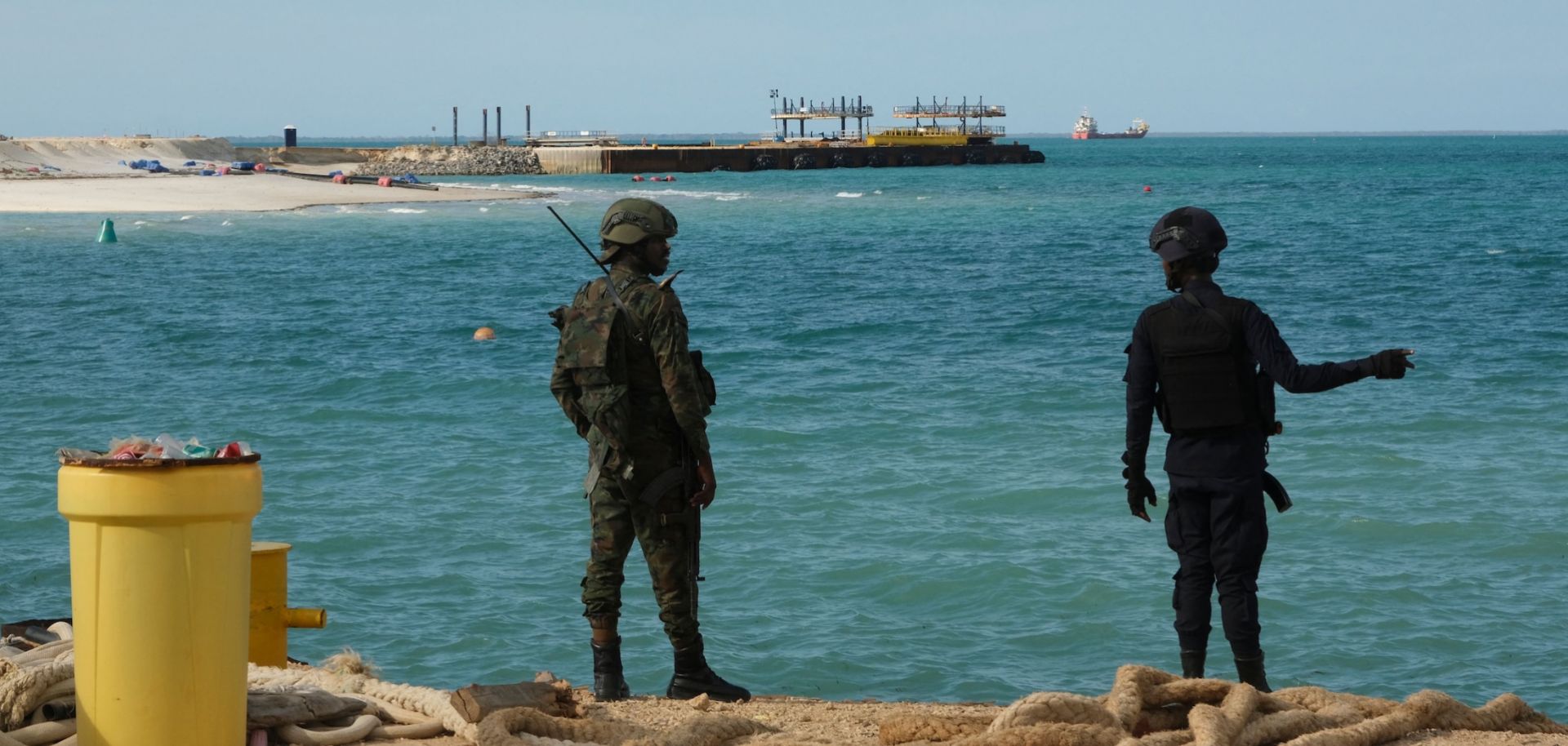
TotalEnergies and ExxonMobil's lifting of force majeure comes as Rwanda's troop deployment to Cabo Delgado has improved the project site's security environment, even though ISMP remains a major security threat in northern Mozambique. ISMP's 2021 attack on Palma prompted the Southern African Development Community, or SADC, to deploy a 1,500-strong force to Cabo Delgado in July 2021. Rwanda deployed 1,000 troops to the region that same month, a figure that quickly rose to around 2,000. These foreign troop deployments enabled the swift recapture of ISMP-controlled towns in the province, prompting the jihadist group to shift to guerrilla warfare. While the SADC terminated its mission in 2024 amid funding shortfalls, Rwanda doubled its presence to over 4,000 troops to fill the gap in manpower. While this foreign military presence has improved the security environment near the Afungi peninsula, where both LNG projects are located, ISMP has proven resilient in recent years, expanding its operations outward from Cabo Delgado into the neighboring provinces of Niassa and Nampula. The group has put a growing emphasis on revenue-generating activities over the past year, including by expanding kidnapping for ransom and precious metal smuggling operations. ISMP also conducted its first known high-profile maritime attack off the Mozambican coast in May 2025, and while equally complex naval operations by the group have not been reported since, jihadist militants continue to target local fishermen. Moreover, the group has increasingly resorted to small mobile units to infiltrate Cabo Delgado's urban areas, including around Palma in August 2025.
- Although the SADC terminated its mission in 2024, Tanzania retains an estimated 340 troops in Cabo Delgado's Nangade district to counter ISMP's cross-border movements into southern Tanzania.
- Key to Mozambique LNG's resumption was the Export-Import Bank of the United States' approval of $4.7 billion in financing to the project in March 2025. The loan was initially approved in September 2019 but needed to be reapproved following years-long delays linked to the force majeure — something that former President Joe Biden's administration resisted.
- United Nations estimates from July 2025 suggest that ISMP currently has around 300-400 fighters, down from an estimated 3,000 at its peak in 2020-21. However, such estimates are prone to a large margin of error, meaning that the jihadist group could have many more fighters.
Improved security on the Afungi peninsula mitigates the risk of ISMP disrupting Mozambique LNG's construction in the short term and raises the likelihood of a positive final investment decision for Rovuma LNG, but security measures linked to ISMP's continued activity will undermine the windfall for the local economy, which will facilitate ISMP recruitment. TotalEnergies has tightened Mozambique LNG's security protocol ahead of the formal resumption of construction works, with measures reportedly including fencing off the site perimeter, expanding camera surveillance and restricting the movement of construction workers to the neighboring town of Palma. Together with marked improvements in the security environment near the Afungi peninsula since 2021, this suggests that the risk of a high-profile attack on the project site is limited in the short term. Meanwhile, supplies and construction materials are due to be routed only by sea or air, which significantly lowers the risk of disruption to construction works. In addition to benefiting TotalEnergies, this improved security outlook raises the likelihood of ExxonMobil and its partners making a positive final investment decision on the Rovuma LNG project in 2026. However, the ExxonMobil-led consortium will be far more risk-averse than its French counterpart, given its much lower sunken costs, meaning that it could still abandon or delay the project should it consider long-term security risks to be too high. This is especially the case given that ExxonMobil may favor allocating its capital to other projects, such as in Guyana or the Permian Basin, which could delay Rovuma LNG should the U.S. major decide to sell its stake in the project, either in whole or in part. Meanwhile, ISMP's persisting attacks will hinder Cabo Delgado's economic development, and TotalEnergies' "bunkerization" of the Afungi peninsula will significantly reduce Mozambique LNG's windfall for the local economy. This is likely to drive resentment among parts of the local population, which ISMP will likely tap into by positioning itself as the defender of local communities against foreign multinationals and Maputo elites. The group thus appears set to enjoy a steady flow of recruits in the coming years, which could eventually result in a meaningful expansion of its manpower.
Rwandan security forces will likely remain in Cabo Delgado for the next few years, which will mitigate any surge in ISMP activity, but the jihadist group will likely seek to target the Afungi peninsula in the medium term, creating a significant risk of new disruptions to construction works. The Rwandan government has steadily expanded its financial interests in the Mozambican economy and Mozambique LNG since it first deployed troops to Cabo Delgado in 2021, which together with payments from the Mozambican government gives it a vested interest in the successful completion of the project. Moreover, the troop deployment in Cabo Delgado is an important bargaining chip for Kigali in its relationship with the United States and European countries, providing it some latitude to sustain an assertive policy in the eastern Democratic Republic of the Congo, where it backs the M23 rebel group. Taken together, these trends suggest that Rwanda is unlikely to proceed with a major troop drawdown from Cabo Delgado in the next few years, which will help contain any surge in ISMP attacks for the foreseeable future. Despite this, the jihadist group's recent emphasis on revenue-generating activity portends a steady increase in its financial firepower, which will likely enable it to acquire more drones — and potentially speedboats — in the medium term. Importantly, ISMP could use these capabilities to target Mozambique LNG, a move that aligns with the group's broader objective of undermining state control in northern Mozambique. For instance, a small number of ISMP militants could infiltrate the area near the project site's security perimeter and target construction works using grenade-equipped drones or loitering munitions. Such an attack could cause week-long disruptions to construction work and set back the project by months if ISMP drones successfully target a critical part of the site, such as the liquefaction trains. ISMP could also launch a naval interdiction campaign to hijack the shipment of supplies to the site. However, disruptions to maritime shipments currently appear unlikely to be systemic, as this would require a major expansion of the jihadist group's naval capabilities, of which there is little indication to date.
- Mozambique reportedly makes estimated payments of $2 million to $4 million a month to Rwanda to cover parts of the costs of its troop deployment.
- In December 2022, the European Union forwarded $20 million to Rwanda to support its troop deployment to Cabo Delgado, with a further $20 million approved in November 2024. However, several EU member states have opposed financing the mission due to Rwanda's support for the M23, making EU financing unreliable and prone to delays. Moreover, some estimates suggest the annual cost of the mission stood at around $250 million when Rwanda had 2,000 troops there, and the figure is likely to be meaningfully higher now given the surge in personnel. Other estimates indicate a somewhat lower cost of over $10 million a month.
- Between 2021 and 2025, ISMP struggled to generate revenue compared with most other Islamic State affiliates in Africa given its lack of territorial control, effectively preventing it from collecting taxes from local communities. However, ACLED data shows a steep increase in kidnapping for ransom — which represented 12% of all violent events conducted by ISMP in 2025, up from 2% in 2024 — as well as the smuggling of gold and precious stones — with the number of ISMP-related incidents near mining sites rising from four in 2024 to 27 in 2025.
Mozambique's economy will likely continue to struggle in the short term, as the windfall from Mozambique LNG and Rovuma LNG is unlikely to meaningfully materialize at a macroeconomic level prior to the early 2030s, and the likely implementation of fiscal consolidation measures in the medium term will threaten to trigger fresh unrest. Despite persisting security challenges, TotalEnergies' resumption of works on the Afungi peninsula represents a major milestone in Mozambique's quest to tap into its natural gas resources. Following its expected start of operations in 2029, Mozambique LNG's natural gas exports are slated to generate billions of dollars in revenue for the Mozambican government through taxes and royalties. However, delays in the completion of the project — together with rising costs — mean the economic windfall will not meaningfully materialize before the early 2030s, as initial profits will largely be directed toward TotalEnergies and other investors to recoup upfront costs. Meanwhile, the import of construction materials for Mozambique LNG is negatively weighing on Mozambique's balance of payments at a time when the country is facing liquidity shortages and challenges with its debt repayments. Against this backdrop, Chapo's administration has entered negotiations with the International Monetary Fund for a new support program, which appears likely to be finalized in 2026. Although this will help put the economy on a sounder footing in the medium term, Chapo will likely need to press ahead with a range of fiscal consolidation measures — such as curbs on public sector wages — and potentially devalue the Mozambican metical to secure IMF disbursements. These measures would threaten to trigger strike action from public sector unions, which would likely enjoy the support of opposition leader Venancio Mondlane. Given widespread grievances against the ruling Liberation Front of Mozambique party, better known as Frelimo, following the perceived rigging of the 2024 general election, these demonstrations could escalate into a new wave of nationwide unrest in a less likely, higher-impact scenario. In this scenario, security forces would likely violently repress opposition protests, but the unrest could still temporarily interfere with the supply of construction materials to the Afungi peninsula. Moreover, they could force Maputo to redeploy military personnel outside Cabo Delgado, which would create an environment more conducive to ISMP attacks — including against Mozambique LNG.
- Mozambique's debt-to-GDP ratio stands at close to 100%. In an interview published Jan. 15, Chapo said he was looking to secure a new IMF program by March, hinting that his government would then consider pressing ahead with debt restructuring.
- The cost increases to Mozambique LNG are likely to extend the project's cost recovery period, potentially by up to 20%, which would further delay Maputo's ability to access profit gas and tax revenues.
