
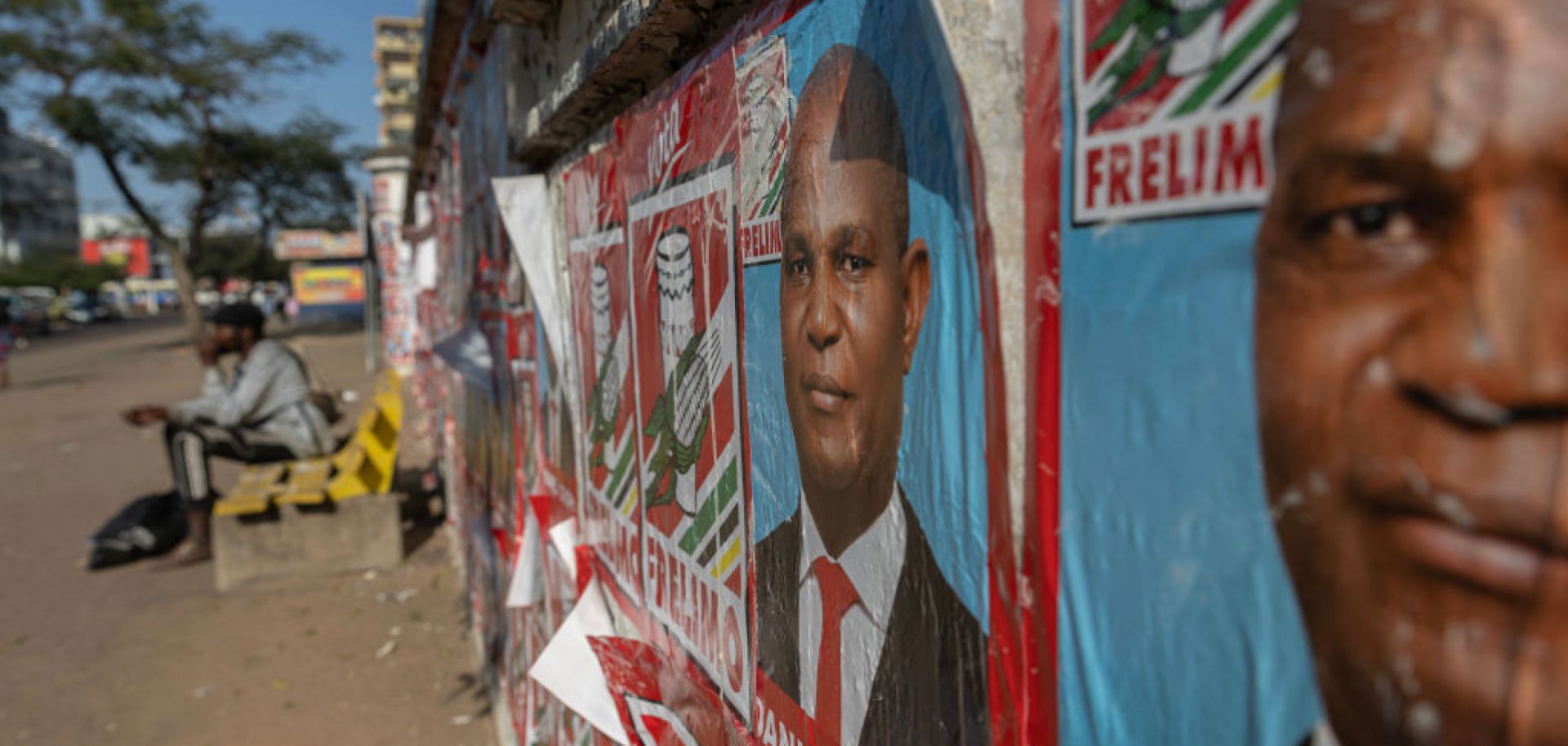
Mozambique's ruling Frelimo party will likely remain in power in the upcoming general election and maintain close ties with Rwanda, the European Union and China, as well as ensure broad continuity in the liquified natural gas sector, but the probable electoral manipulation will likely trigger anti-government protests. On Oct. 9, Mozambique will hold a general election during which the public will elect a new president, as President Filipe Nyusi will not run for reelection. If no candidate garners more than 50% of the vote in the first round, the two candidates with the largest shares will participate in a runoff election. In addition, the public will elect the Assembly of the Republic's 250 lawmakers using a proportional representation system. Former governor of the southern Inhambane province Daniel Chapo will run for president under the ruling Frelimo party against independent candidate Venacio Mondlane (supported by the Democratic Alliance Coalition, or CAD, and Podemos parties), Ossufo Momade of the Renamo party, and Lutero Simango of the Mozambique Democratic Movement.
The election comes as Frelimo faces mounting accusations of authoritarianism and as the renegotiation of mining and LNG contracts has taken center stage in the electoral campaign season. Mozambique has faced mounting political tensions since the October 2023 local elections in which Frelimo won 60 of the country's 65 municipalities amid widespread allegations of electoral fraud that prompted Renamo to hold weeks-long protests. Since then, the National Election Commission has barred CAD candidates from running in the upcoming legislative elections due to the party's alleged inability to meet legal requirements, prompting fresh accusations of foul play. To revitalize its image, Frelimo appointed in May the relatively unknown Chapo as its presidential candidate, who leveraged his humble background and relatively young age to connect with the public. Meanwhile, Renamo has also faced internal divisions due to discontent with Momade, whom some party members — including Mondlane — have accused of being co-opted by Frelimo. Mondlane was ultimately expelled from Renamo in May after announcing his intent to run for the presidency, but his savvy use of social media and calls to renegotiate mining and hydrocarbon contracts have helped his campaign gain enough public traction to pose a credible electoral threat to Frelimo. Despite legal challenges facing his campaign, Mondlane's momentum has put the question of renegotiating mining and hydrocarbon contracts at the center of public debate, leading Chapo to express his openness to contract renegotiation on a case-by-case basis even though this was not part of the manifesto that Frelimo approved in July. Debates regarding the response to an insurgency from Islamic State Mozambique Province, or ISM, militants in northern Mozambique have also been central to the electoral campaign.
- The National Election Commission first announced that Frelimo won 64 of the country's 65 municipalities, but the Constitutional Council overturned the results in Chiure, Quelimane, Alto Molocue and Vilankulos, where Renamo was ultimately declared the winner.
- Civil society groups have reported that the government has increasingly targeted journalists and human rights activists in recent years, and Mozambique's score in The Economist's Democracy Index fell from 5.3 in 2006 to 3.5 in 2023, with 10 being a perfect democracy.
- Mozambique has an estimated 100 trillion cubic feet of proven natural gas reserves, making it the third-largest holder of natural gas reserves in Africa after Nigeria and Algeria. The bulk of these reserves is located in the Rovuma deepwater basin, which is located off the coast of the country's northern Cabo Delgado province and has drawn strong interest from international oil and gas companies, including TotalEnergies, ExxonMobil and Eni. Eni began LNG production on its Coral South project in November 2022, enabling Mozambique to triple its natural gas export revenue between 2022 and 2023 to $1.7 billion.
Frelimo is likely to secure both the presidency and a parliamentary majority, but this is poised to trigger anti-Frelimo demonstrations that will heighten the risk of ISM attacks in Cabo Delgado and Nampula provinces and could prompt elements within Renamo to rescind their participation in a 2019 peace deal. Frelimo has monopolized political power in Mozambique since the country's independence from Portugal in 1975 and established firm command over state and electoral institutions, including the National Election Commission and the Constitutional Council. Alongside division within the opposition, voter apathy and CAD's inability to run in the legislative elections, control of the state apparatus will likely deliver Frelimo an outright parliamentary majority and the presidency. Nonetheless, Frelimo's victory will likely involve some level of electoral manipulation, which portends demonstrations as both Mondlane and Momade have vowed to hold protests in the event of electoral fraud. Given the precedent of the 2023 demonstrations, protests would likely last several weeks and could be disruptive, especially in opposition strongholds in central Mozambique. While Momade appears committed to the 2019 Maputo Accord, which ended the party's armed insurgency, certain factions within the party could rescind their commitment to the peace deal in a low-likelihood, high-impact scenario. Should this happen, armed Renamo militants would likely launch sporadic attacks on government facilities and security forces, principally in central Mozambique. Even if Renamo ultimately remains committed to the peace deal, anti-Frelimo demonstrations would likely stretch security forces thin, creating openings for ISM militants to launch new attacks in the northern Cabo Delgado and Nampula provinces, potentially prompting international energy companies to further delay the resumption of works and final investment decisions on LNG projects by several months.
- Frelimo and Renamo fought a brutal civil war between 1977 and 1992 that ended with the country's formal transition to a multi-party political system. Nonetheless, Frelimo retained control over the country's politics, prompting Renamo to resume military action against the Frelimo-led government in 2013. This insurgency came to an end in 2019 through the Maputo Accord, and Momade has urged former Renamo fighters to remain committed to the current electoral process despite expressing concern over a "lack of compliance" with certain aspects of the peace deal in August.
If he is elected, Chapo will likely look to gradually deconcentrate economic activity from Maputo, but he is unlikely to launch a comprehensive push to renegotiate contracts for existing LNG projects, as this would likely further delay their start of production, which would deny the government access to a critical source of revenue. Chapo's domestic and foreign policy will be shaped by the extent of post-election turmoil. In a baseline scenario where unrest peters out by early 2025, Chapo will likely look to advance political and economic decentralization efforts, which would help ease tensions with Renamo. These efforts could include transferring the headquarters of Mozambique's parliament to the central Zambezia province, which Chapo publicly committed to do on the campaign trail. However, the implementation of policies to deconcentrate wealth from Maputo is likely to remain slow at first due to resistance from within Frelimo, which holds a strong support base in southern Mozambique. As for domestic security, Chapo's lack of personal links to Cabo Delgado suggests he may depart from President Nyusi's military-focused response to ISM by instead emphasizing tackling the socioeconomic drivers behind the insurgency, namely the lack of economic opportunity and basic services in the province, as well as the marginalization of local Muslim communities. On the energy front, Chapo appears unlikely to strong-arm oil and gas companies into contract renegotiations, despite his election rhetoric, as this would likely prompt TotalEnergies to further delay the resumption of construction on its Mozambique LNG terminal, while ExxonMobil and Eni would likely delay final investment decisions on their Rovuma LNG and Coral North projects. More delays would deny the Mozambican government access to a crucial source of revenue that could help it advance development initiatives in northern and central Mozambique, thus making such a move unlikely. However, Chapo may seek to secure symbolic concessions from energy companies to shore up his political capital, such as expanding their commitment to local development initiatives.
- Outgoing President Nyusi is an ethnic Makonde, a primarily Christian group located in northern Mozambique that has faced deep-seated tensions with the Mwani ethnic group, which is predominantly Muslim and from which ISM has heavily recruited. Nyusi's administration has turned a blind eye to the activities of predominantly Makonde militias in Cabo Delgado that have abused Mwani civilians, but Chapo's lack of personal ties to the region suggests that he might prove less willing to tolerate such actions.
- LNG projects off the coast of Cabo Delgado are primarily located in the Rovuma Basin's Offshore Area 1 and Offshore Area 4, with TotalEnergies and its partners operating in the former while Eni and ExxonMobile operate in the latter. Chapo's proposal to renegotiate LNG projects on a case-by-case basis would be complicated by the fact that Mozambique granted contracts for entire concessions, rather than specific projects.
- Further constraining Chapo's ability to renegotiate agreements for LNG projects is a 2014 law that established a special regime for projects in the Rovuma Basin's Area 1 and Area 4.
As president, Chapo would likely maintain close relations with Rwanda and the European Union given their importance in countering ISM, but severe Western condemnation regarding the conduct of the election could prompt Chapo to accelerate cooperation with China and Russia. Rwanda now plays a pivotal role in countering ISM in northern Mozambique, notably through the deployment of 4,000-5,000 troops to the region. While the opacity of Rwanda's military presence has caused public discontent, Mozambican security forces' persistent capabilities gap will likely compel Chapo, should he win, to retain close security ties with Kigali, at least over the next few years. Chapo would also likely maintain security cooperation with the European Union, which helps strengthen the Mozambican military's preparedness in the medium and long term. While the European Union and its member states would likely express concern in the event of widespread allegations of electoral fraud and police brutality surrounding the election, the bloc would be unlikely to scale down security cooperation given its strategic interest in ensuring the development of Cabo Delgado's natural gas reserves, which will ease tightness in global LNG markets and help the bloc further reduce its energy reliance on Russia. However, severe Western criticism following the election could prompt Chapo to accelerate cooperation with both Russia and China, with which Frelimo holds long-standing ties. While neither Chapo nor Russia will likely be willing to see the Wagner Group/Africa Corps deploy to Cabo Delgado given the setbacks the group faced against ISM in 2019, Western criticism could prompt Chapo to reinforce economic cooperation and weapons purchases from Moscow. The Kremlin would likely welcome stronger cooperation with Maputo, as this would help it mitigate the impact of Western sanctions on the Russian economy. Similarly, reports that China is seeking to secure military port access in Mozambique — together with Chinese companies' economic interest in the country's mining and logging sector — suggest that Beijing would likely prove willing to reinforce counterterrorism and economic cooperation with Chapo's administration.
- The European Union launched a military training mission in Mozambique in 2021 and upgraded the mission to a European Military Assistance Mission in Mozambique in September 2024. The new mission provides for the delivery of advisory, mentoring and specialized training to the Mozambican military's Quick Reaction Force units, and it is currently scheduled to end by June 2026.
- Bloomberg reported on Sept. 6 that China was seeking port access rights in Mozambique, with Tanzania, Gabon and Equatorial Guinea also quoted as potential targets.
Mondlane's victory would increase the likelihood of a comprehensive push to renegotiate existing LNG contracts, but Frelimo would likely retain significant control over policy-making given CAD's inability to run in the parliamentary elections. While Frelimo is likely to resort to some electoral manipulation, it may prove unwilling to press ahead with widespread fraud over concern for the country's stability, meaning that Mondlane could win in a low-likelihood, high-impact scenario. Mondlane's election would raise the likelihood of a comprehensive push to renegotiate LNG contracts compared with Chapo's election. However, CAD's inability to run in the legislative elections would mitigate Frelimo's loss of power, leaving Mondlane to struggle to pass legislation, including on contract negotiation. While Mondlane could look to override the parliament and issue decrees to review LNG contracts, he would face similar economic challenges as Frelimo, and strong-arming foreign companies would hurt investor confidence in Mozambique and could result in international litigation, as the contracts likely include stabilization clauses. However, international oil and gas companies could be willing to make some concessions in an effort to avoid a potentially year-long litigation process that prevents the development of LNG projects in Cabo Delgado for the foreseeable future. But even in this case, companies like TotalEnergies, ExxonMobil and Eni would likely expect to pass some of the costs of concessions on to contracting parties developing the projects.
