
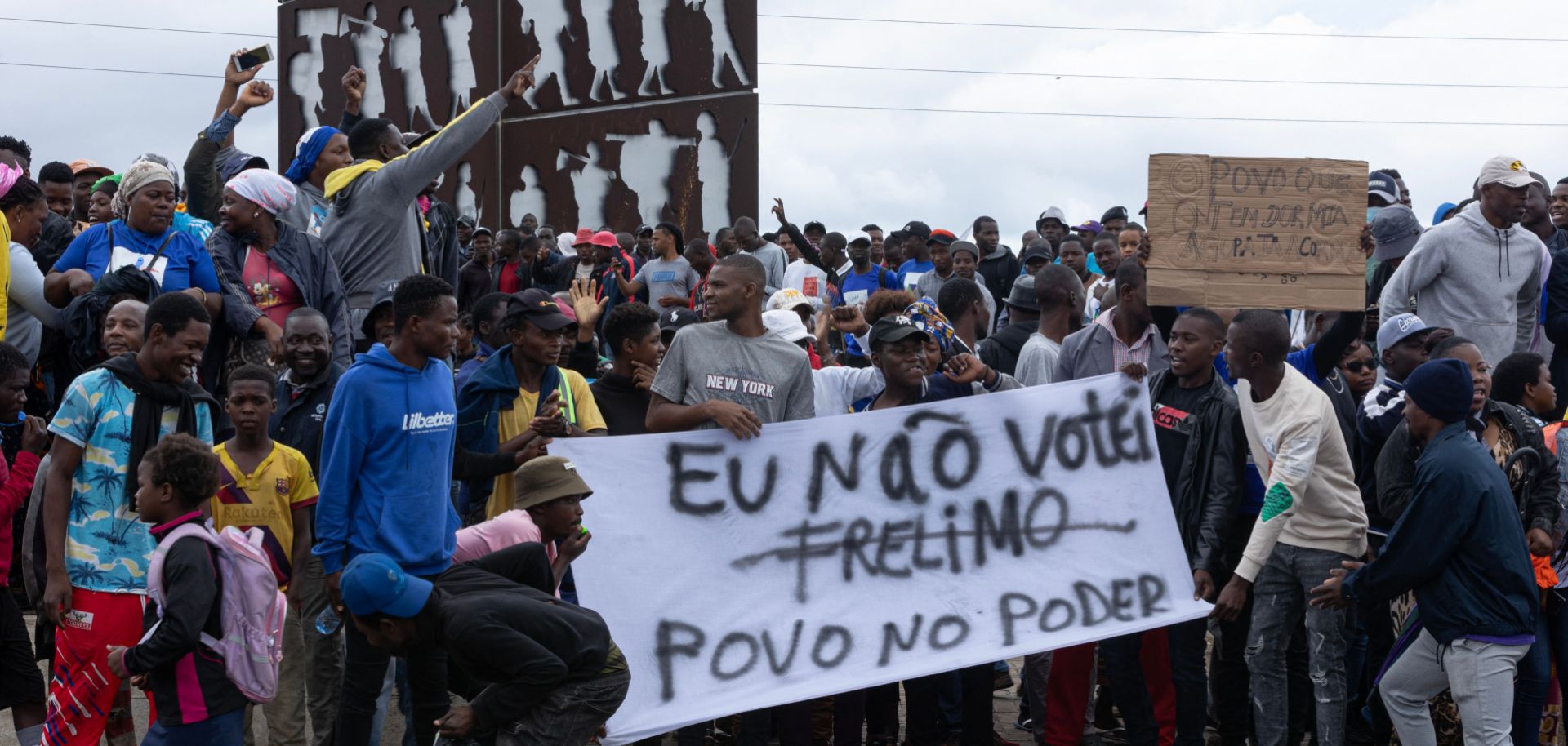
Despite recent opposition protests in Mozambique, the ruling party will likely maintain its dominance in the 2024 general elections and beyond, bolstered by a huge influx of revenue from an eventual restart of construction on a major liquified natural gas project. However, the revenue windfall will also generate uncertainty over the ruling party's objectives in Mozambique's northern provinces. In recent weeks, supporters of the opposition Mozambican National Resistance Movement party, better known as Renamo, have staged repeated protests across the country after the National Election Commission voted on Oct. 18 to confirm the ruling Frelimo party's victory in 64 of 65 municipalities in the Oct. 11 municipal elections. Nine civilians and one police officer were injured in northern Nampula province, while police used tear gas and made mass arrests to disrupt protesters who used burning barricades in the capital Maputo and smaller cities Nacala and Quelimane. Renamo members and supporters say Frelimo engaged in electoral fraud — which would be consistent with the ruling party's past electoral interference — citing early vote counts that showed Renamo winning healthy leads in several municipalities. Embassies of the United States, the European Union, the United Kingdom, Norway, Switzerland and Canada issued statements expressing concern over election irregularities. While protests died down in early November, Renamo may call for additional demonstrations in the weeks ahead as it seeks to put popular pressure on the Constitutional Council to rule in its favor on its appeal to have the results of the election overturned. While the council is the last method of recourse for Renamo, it has a history of ''rubber stamping'' Frelimo election victories, meaning a recount is unlikely.
- Renamo candidates claim to have won elections in the four most important urban municipalities — Maputo, Matola, Quelimane and Nampula — as well as Nacala, Angoche, Mozambique Island, Chiure, Cuamba, Moatize, Vilanculos and Marracuene.
The opposition protests come after security forces beat back an insurgency in the country's northern provinces in order to resume construction of a lucrative gas project, but the project's future remains uncertain, and government services still remain largely absent from the region. French oil major TotalEnergies declared a force majeure on the construction of its Afungi LNG project in April 2021 after insurgents linked to the Islamic State attacked the compound. After the attack, Mozambique enlisted the help of security forces from the Southern African Development Community (SADC) and Rwanda — whose troops are far better trained and equipped than local ones — to combat insurgents. According to the Armed Conflict Location and Event Data Project (ACLED), the number of Islamic State Mozambique Province fighters has decreased from over 2,500 to about 280 since SADC and Rwandan forces intervened in July 2022, leading international media to speculate that construction on the LNG site will restart by the end of 2024. But TotalEnergies representatives have not yet announced a date, and Islamic State Mozambique Province's increasing improvised explosive device (IED) attacks on roads used by security forces could continue to delay operations. Many locals in Mocimboa da Praia hope the LNG project will provide new job opportunities and greater security in the province, given the federal government provides little (if any) services outside the country's south. Corruption, mismanagement and relatively weak political constituencies (Frelimo's support base is in the south) have forced Mozambicans living in central or northern parts of the country to largely subsist on local governance structures and community-driven services, which in many cases explains their support for opposition parties like Renamo and frustration over the ruling Frelimo party's alleged election fraud.
- ACLED data shows that Islamic State Mozambique Province insurgents launched an unprecedented six IED attacks between Sept. 11 and Oct. 1 — a notable uptick in what until now has only been an occasional method of attack. The IED attacks have largely targeted the road between Mbau and Limala in Mocimboa da Praia and the road between Quiterajo and Mucojo in Macomia, both of which are vital routes for security forces. Cabo Ligado, a conflict-mapping project supported by ACLED, reported in October that Islamic State Mozambique Province now has four bomb-makers operating in the province, which would explain the new use of remote-detonated bombs.
- Mozambique is already heavily dependent on extractive industries, with the state attracting revenue from mining royalties and the Coral South floating LNG platform that began producing gas in November 2022. The government expects the TotalEnergies project to generate $35 billion to $63.6 billion in revenue over the project's lifetime, bringing Mozambique to ''middle-income status'' by the mid-2030s.
In the short term, the opposition's response to the municipal election suggests that unrest will also plague Mozambique's 2024 general elections in light of Frelimo's presumed continued dominance. The municipal elections offer a preview of the country's October 2024 general elections, which will very likely see repeat tactics by both sides. Frelimo will probably wield its influence over state institutions, like the electoral commission and the judiciary, to ensure a favorable electoral outcome. Together with Renamo's lack of unity, these strategies will very likely enable the ruling party to remain in power for the next five years. For their part, Renamo and other opposition parties will very likely protest alleged electoral abuses, triggering repressive and harsh crackdowns by security forces that prompt condemnations from Western states, but not to the extent of jeopardizing the future of oil and gas contracts. Renamo will very likely campaign on linking Frelimo to Islamic State Mozambique Province and accusing the ruling party of creating the insurgency to maintain power and prevent the population from sharing in northern provinces' resources as it has in past years. This message will enrage Renamo's base and inspire protests but is unlikely to compel a majority of voters to support the opposition party given mounting voter apathy. Frelimo has not yet announced its presidential candidate, but it may not matter because the outcome of the municipal elections and the presumed rejection of Renamo's Constitutional Court appeal — which could happen at any time before the end of 2023 — will likely add to already high voter apathy. Young Mozambicans, in particular, appear to view the results of the upcoming general election as predetermined, which will likely see many stay home on election day, thus paving the way for Frelimo's victory.
- Following the end of Mozambique's civil war in 1992, voter apathy has severely constrained opposition party support in the country. According to the Abdul Latif Jameel Poverty Action Lab, voter turnout fell from 90% in 1994 to just 36% in 2004 and has not rebounded since. Allegations of Frelimo's electoral interference, low political accountability and widespread perceptions that elected representatives are unconcerned with voter interests appear to drive the lack of political participation.
In the long term, an influx of revenue from the LNG project will enable Frelimo to spend more and thus further strengthen its grip on power, but it will also create uncertainty over how the ruling party will address insecurity and whether opposition groups will be able to capitalize on the north's new economic importance. Despite domestic resistance to the ruling party demonstrated by the most recent bout of protests, Frelimo's integration with Mozambican institutions, willingness to use force and repressive tactics, and the absence of a cohesive and strong opposition movement that poses a legitimate political threat means that the ruling party has a good chance of remaining in power even after 2030. A huge increase in revenue resulting from the planned 2028 start of TotalEnergies' project will enable the Frelimo-led government to raise official budgets and unofficial payouts of key political players to further enhance its power. The operational, infrastructure and employment opportunities created by the LNG project will spur greater economic growth and more secure livelihoods in Cabo Delgado, but royalties revenue will flow to the central government, keeping wealth concentrated in Frelimo strongholds in the south. Against this backdrop, there are several outstanding questions about how a Frelimo government will rank spending priorities, and whether Renamo and other opposition groups will be able to maintain or increase levels of support against a presumably stronger ruling party. It is unclear whether Frelimo — flush with new revenue and with political networks relatively assured — will attempt to address insecurity in Mozambique's northern provinces, or insulate coastal energy projects while leaving inland provinces to be plagued (and possibly governed) by insurgencies. If the government chooses the latter, the risk of violence beyond the ongoing Islamic State Mozambique Province insurgency will rise, given the region's history of conflict, especially as long-term grievances between ethnic Makondes aligned with Frelimo and ethnic Mwanis supportive of opposition groups have the potential to escalate. By contrast, if the ruling party markedly increases development spending via anti-poverty measures and investment in education, healthcare and infrastructure in the central and northern parts of the country, this would not only reduce vulnerabilities to conflict but also likely increase goodwill toward the ruling party over the long term. Therefore, Frelimo's policies in the north will likely influence the extent to which opposition parties can drum up support and pose a legitimate alternative to Frelimo in the years to come.
