
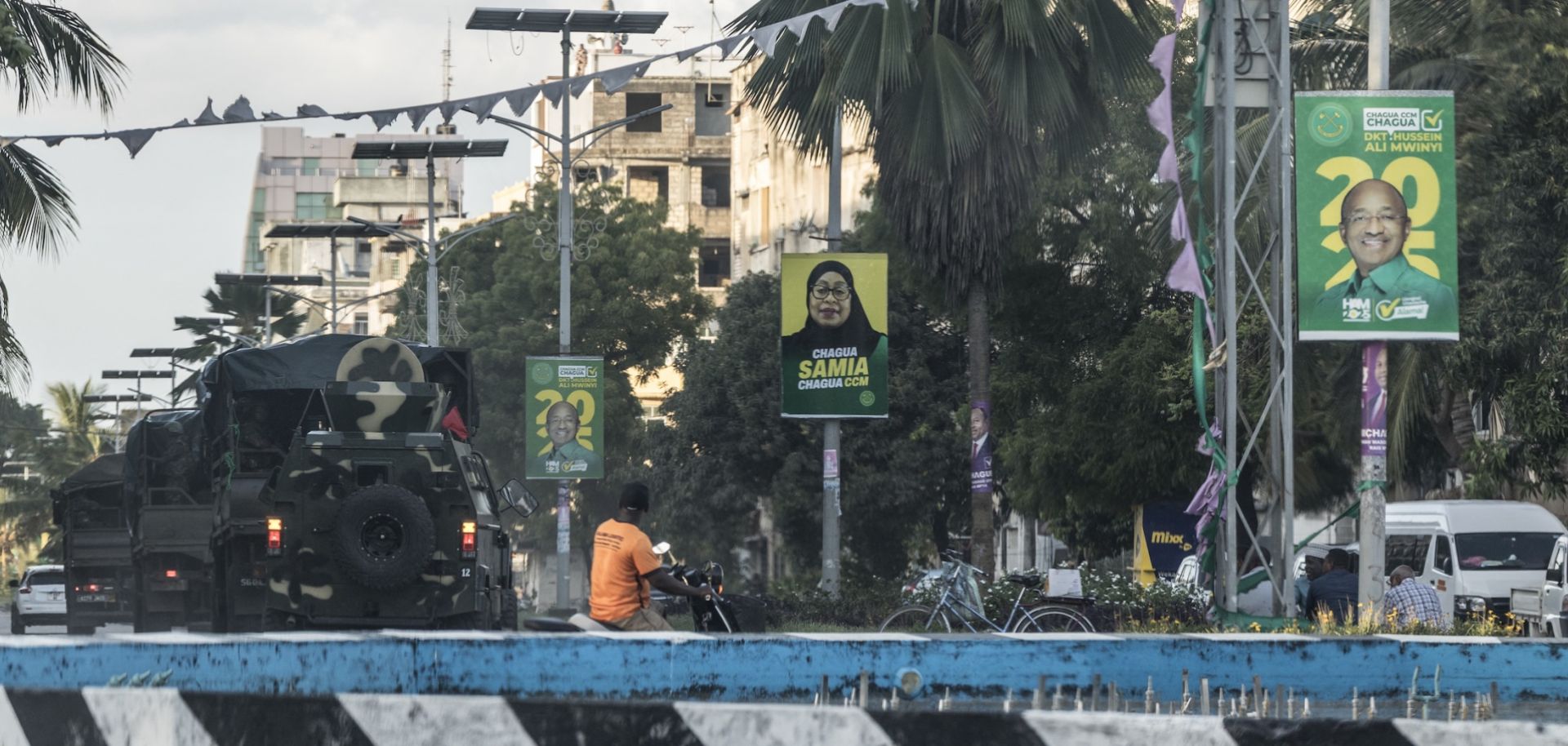
Tanzania's president will likely maintain a repressive approach to opposition groups in the wake of widespread post-election protests that, even with small concessions to political opponents, will sustain a risk of further bouts of large-scale unrest in the future, weighing on the economy and opening security gaps that jihadist groups may try to exploit. At the beginning of December 2025, Tanzanian authorities launched a nationwide crackdown aimed at preempting planned Independence Day protests on Dec. 9. Although the protests ultimately did not materialize due to the heavy security deployment and widespread arrests, the episode nonetheless underscored the mounting pressure facing President Samia Suluhu Hassan and her government amid growing public demands for political change. The already tense political climate has been significantly exacerbated by the controversial Oct. 29 general election, which triggered rare nationwide protests denouncing the polls as unjust and a violent response by security forces. Protesters openly denounced the electoral process, in which the two leading opposition figures and parties were barred from participation, alongside authorities' use of repressive tactics, including abductions, aimed at intimidating the opposition. The election, denounced by foreign electoral observers as not free or fair, ultimately delivered an official result granting Hassan 97.66% of the vote. In the aftermath, reports indicated that hundreds of people were killed, with opposition and rights groups' estimates suggesting the death toll may have approached 3,000, and alleging hundreds were detained and thousands forcibly disappeared — all claims the government has denied.
- Following the outbreak of post-election unrest, the government restricted internet connectivity for approximately six days, imposed a curfew in the country's largest city and economic hub of Dar es Salaam and rerouted cargo from the port of Dar es Salaam to Kenya's port of Mombasa, disrupting trade flows and leaving travelers stranded.
- Election observer missions from the Southern African Development Community and the African Union both stated that Tanzania's election was not free or fair, citing intimidation, restrictions on political freedoms and electoral irregularities.
Tanzania has been dominated by the Chama Cha Mapinduzi party, or CCM, and its predecessors since independence, and although Hassan initially eased some of the previous administration's authoritarian measures, she has since reversed course to consolidate power and support from key party factions. The CCM and its two predecessor parties have dominated Tanzanian politics since the end of colonial rule in the early 1960s. Although Tanzania reintroduced a multiparty system in 1992, the ruling CCM has retained power by leveraging state resources and retaining its sway over national institutions such as the security forces, electoral bodies and civil service — while political opposition has been tolerated only insofar as it does not threaten CCM control. Political space modestly expanded under former President Jakaya Kikwete, who served from 2005 to 2015. However, his successor, President John Magufuli, who served until he died in 2021 and earned the nickname "the bulldozer," in part for his crackdown on dissent, subsequently tightened political control across both the mainland and the semiautonomous island of Zanzibar. After succeeding Magufuli in March 2021, Hassan initially reversed many of Magufuli's authoritarian restrictions. However, her reform efforts quickly generated significant pushback not only from Magufuli loyalists and hardliners who favored the continuation of restrictive policies, but also from Kikwete, widely regarded as Hassan's key political backer, and his supporters, who retain substantial influence within the party. These factions feared that far-reaching reforms — including changes to the electoral commission, potential constitutional amendments and stronger checks on presidential power — could ultimately undermine CCM's dominance. To maintain party support and secure her position, Hassan abandoned her reform agenda and adopted measures reminiscent of Magufuli's crackdown. This resulted in her systematically curtailing opposition participation and restricting political campaigning in the lead-up to the October 2025 election, effectively shaping the electoral field in CCM's favor. Key opposition figures, including Chadema party leader Tundu Lissu, whom Hassan allowed to return to Tanzania from a two-year exile in 2023, were jailed and currently face treason charges, while ACT-Wazalendo party leader Luhaga Mpina was barred from running in the October election.
- As a woman and a politician from Zanzibar, an opposition stronghold, many did not anticipate Hassan's ascension to the presidency. Historically, Tanzania's political leadership has been overwhelmingly male, with women underrepresented in top government positions, and socially, there were lingering cultural biases that questioned a woman's ability to lead.
- When she came into power, Hassan initially allowed previously banned media outlets to resume operations, signaled greater tolerance toward opposition parties, and released or pardoned select political detainees. At the same time, she emphasized constitutionalism and rules-based governance, restoring a more conciliatory tone to national politics.
- In addition to appointing Kikwete's son to a ministerial post, Hassan has placed several CCM loyalists and some of her close family members in government positions. For instance, her daughter, Wanu Hafidh Ameir, was named deputy minister of education, while her husband, Mohamed Mchengerwa, was appointed minister of health.
In the immediate term, Hassan will likely maintain a hard-line, repressive approach while using patronage to try to consolidate CCM support and curb unrest, though potential economic pressures, intra-party tensions and fears of renewed instability could weaken investor confidence. In the coming months, Hassan will likely maintain a firm, hard-line posture toward dissent, characterized by heavy security deployments, preemptive arrests and other measures in an attempt to further curtail opposition activity and constrain civil society. While the risk of a repeat of the days-long, large-scale postelection unrest in late 2025 is unlikely, partly due to heavy repression, the risk of periodic protests and sporadic violent incidents will remain elevated for the foreseeable future. To thwart any larger unrest, the government will likely intermittently disrupt internet connectivity to restrict mobilization during periods of heightened tensions, while continuing to block access to social media platforms protesters use to coordinate. Amid fresh memories of the postelection violence from late 2025, such measures will likely temporarily harm the tourism industry, though the government will try to limit this as it is a major contributor to Tanzania's economy, accounting for almost a fifth of the country's gross domestic product; meanwhile, any heavy-handed restrictions on movement or other security measures could again lead to at least temporary delays at the Dar es Salaam port, a key logistics hub for neighboring countries. Collectively, Hassan's administration is likely to frame these actions as necessary to neutralize threats to the ruling party's dominance, enabling Hassan to safeguard her position. Alongside repression of opposition supporters, she is also likely to sustain concessions to key party figures from both the Magufuli and Kikwete factions through senior appointments, access to lucrative tenders (particularly in development projects), and broader patronage networks to secure continued elite support. Still, she may struggle to meet all factions' expectations due to internal party disagreements or slower-than-expected economic growth, which could fuel intra-party tensions, create openings for elite competition and undermine the cohesion of her presidency. In this environment, uncertainty over future political stability and fears of popular unrest may also weigh on near-term foreign investment, potentially slowing economic growth.
- A potential trigger for unrest could be the formal sentencing of opposition leader Lissu, but due to fear of a strong public reaction, the government will likely prolong his court appearances and rulings to weaken opposition momentum and prevent immediate unrest that might follow a formal sentencing.
- The Dar es Salaam port is a key regional trade hub, serving Tanzania and landlocked neighbors like Rwanda, Burundi, Uganda and the Democratic Republic of the Congo, facilitating imports and exports across East and Central Africa.
- Tanzania's tourism sector attracts millions of visitors annually to iconic destinations such as Serengeti National Park, Mount Kilimanjaro and Zanzibar's beaches. Tanzanian government data indicate that foreign direct investment commitments fell by 25% in the fourth quarter of 2025 compared with the third one, illustrating at least temporary economic risks in the wake of the contested election, while other data (such as hotel bookings) also show significant drop-offs.
If unrest re-escalates, the CCM will likely face mounting pressure to initiate national dialogue with opposition parties and civil society groups, but the government would likely only implement low-risk measures, meaning unrest could resume. In a scenario in which repression fails to check renewed unrest — and perhaps backfires by triggering an escalation, especially if security forces continue to kill many civilians during mobilization periods — the CCM and Hassan would likely face mounting pressure to initiate a national dialogue that includes opposition leaders and civil society groups. Were the government to agree, the goal would be to create the appearance of inclusivity to appease protesters and foreign donors by discussing recommendations for a range of reforms. These would likely encompass constitutional reforms, such as curbing executive overreach, clarifying union governance, strengthening civil and political rights, and reforming land and citizenship regulations. Electoral reforms would likely focus on modernizing voter registration, improving polling transparency and vote counting, strengthening the independence of the electoral commission, allowing limited observer oversight and, most importantly, establishing mechanisms to appeal or contest election results. While CCM may publicly commit to implementing these reforms, only low-risk measures, such as limited electoral administration changes, would likely be enacted promptly. More substantive reforms, particularly those affecting executive powers or union arrangements, would likely be delayed or ruled out entirely. Given that significant concessions to the opposition are unlikely, the country would likely remain at the cusp of large-scale and disruptive protests, which could be triggered by high-profile events like elections or seemingly minor events, such as political arrests, economic shocks or social grievances. This would remain the case even in a low-likelihood, high-risk scenario in which Hassan is ousted in a CCM-led coup, as her successor would also be from CCM. Any president following Hassan would face similar challenges, particularly demands for change, which could increase the risk of renewed bouts of popular unrest, especially during election periods and among young voters.
- Constitutional and electoral reforms have long been proposed by commissions, civil society groups and opposition parties, but the CCM has consistently discarded them.
- The potential release of Lissu could also serve as a government concession; however, he may face restrictions on organizing and mobilizing as a condition of his release, further weakening the opposition.
- Despite the low probability of tangible reforms being implemented, there is a chance that Hassan could push for more significant reforms in 2030, the last year of her term, to consolidate her legacy. However, this could cost her credibility within the party, a price that may be too high unless she has no political ambitions beyond the presidency.
Any resumption of prolonged unrest and growing anti-government sentiments would leave security gaps elsewhere in the country, especially in the south, opening the door for jihadist groups to plot more attacks and increase recruitment. As the government continues to focus on regime security and domestic stability, well-trained security forces and other resources such as intelligence collection will likely be concentrated in protest-prone areas such as Dar es Salaam, Arusha, Mwanza and Mbeya, reducing monitoring in other regions. This will create security gaps in areas like the south, which has previously been hit by jihadist attacks carried out by fighters from Islamic State Mozambique Province across the border. Although the group faces ongoing counterterrorism pressure, compared with prior years Islamic State Mozambique Province could be better positioned to take advantage of any security gaps to launch attacks in southern Tanzania, a risk that may increase as the group is likely to face heightened pressure from security forces in Mozambique in the coming year, pushing militants to seek alternative ways to demonstrate their disruptive capacity. Even if Islamic State Mozambique Province is unable to conduct fresh attacks in Tanzania, other jihadist groups that have already recruited Tanzanians from Mtwara, Zanzibar and other areas with Muslim populations, such as Islamic State Somalia Province and al Qaeda-affiliate al Shabaab, will likely exploit security gaps and heightened anti-government sentiment and youth unemployment to expand recruitment. Furthermore, this would provide an opportunity for Islamic State Somalia Province, which has lost many fighters in intense counterterrorism operations by Puntland security forces, supported by U.S. airstrikes, to try to rebuild its networks and consolidate influence.
- Islamic State Mozambique Province has carried out several attacks in Mtwara in recent years. In October 2020, militants attacked Kitaya village, killing around 20 civilians, and later that month attacked Michenjele village, killing five people. In 2021, multiple cross-border incursions occurred, including raids on Mahurunga and Kiwengulo villages, resulting in at least six civilian deaths, with homes and public facilities looted or burned. However, since these attacks, Tanzania has significantly improved its counterterrorism response in the southern region and launched a number of development projects to deter young people from being recruited due to economic incentives offered by jihadists.
- Tanzania also retains a few hundred troops in Mozambique in northeastern Cabo Delgado's Nangade district. Tanzanians are not the only foreign troops based in northern Mozambique. About 5,000 Rwandan troops are assisting the government in pushing back Islamic State Mozambique Province, which is likely aiming to take advantage of the expected resumption of TotalEnergies' large liquefied natural gas project in Cabo Delgado in 2026 to conduct new attacks.
