
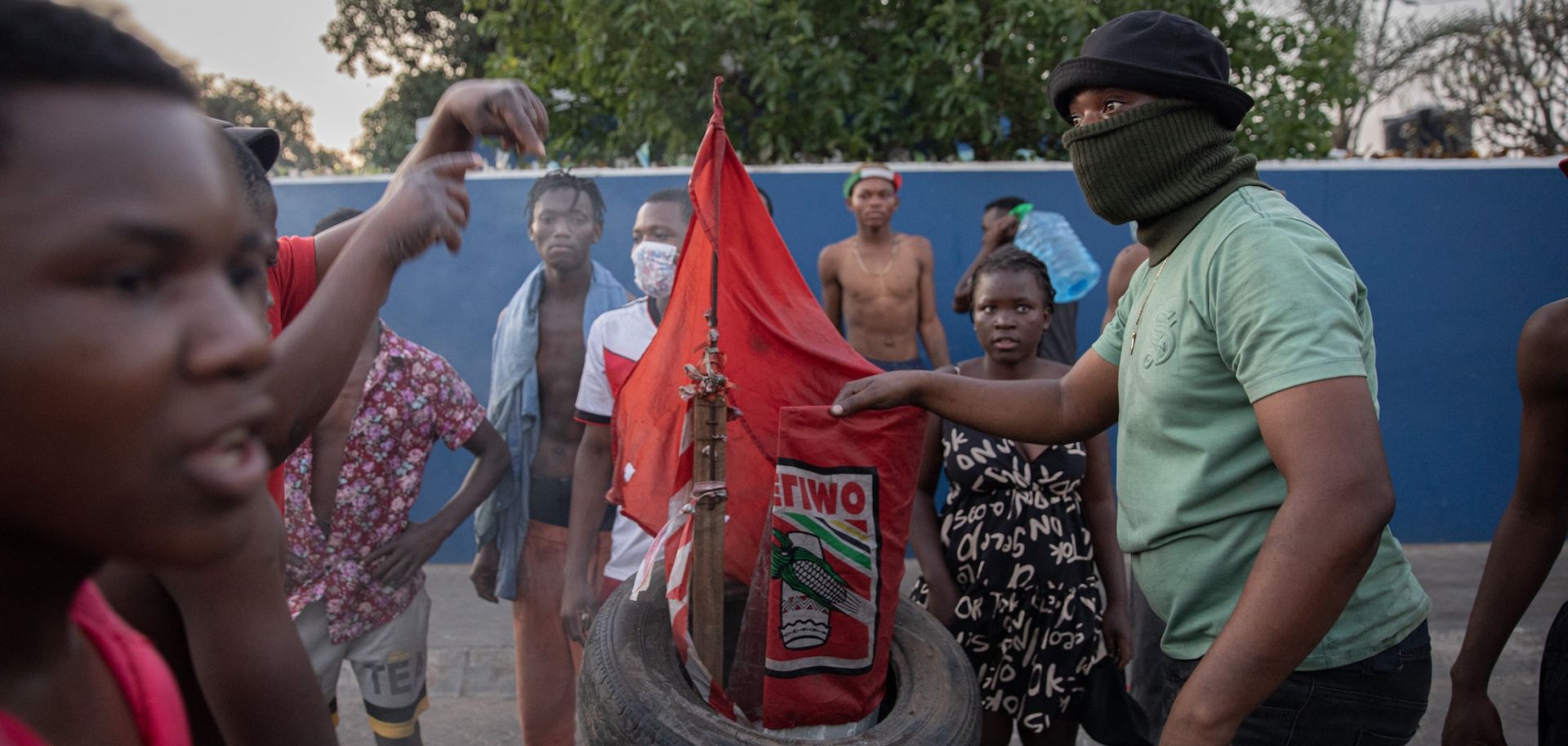
Mozambique's President-elect Daniel Chapo will face an uphill battle in ending the country's post-election crisis, portending sustained disruptions to economic activity and regional trade that will increase incentives for Chapo to compromise with opposition leader Venancio Mondlane, but such an agreement would risk triggering infighting within the ruling Frelimo party. On Dec. 23, Mozambique's Constitutional Council confirmed that ruling Frelimo party candidate Daniel Chapo won the presidential race in the country's disputed Oct. 9 general election, defeating opposition candidate Venancio Mondlane. Following the ruling, Chapo announced plans to hold a reconciliation and dialogue initiative after his inauguration on Jan. 15. Despite this, the Constitutional Council's announcement triggered a fresh round of unrest, with Mondlane's supporters quickly retaking to the streets to heed his earlier call for mass demonstrations if the council endorsed what Mondlane and many Western election observers described as rigged elections. The intensified protests have been met with increasingly heavy crackdowns by law enforcement, the army and vigilante groups linked to Frelimo, resulting in clashes that have so far killed over 280 people since the unrest began in late October after the National Election Commission announced provisional election results. However, on Dec. 29, Mondlane called for a five-day pause in protests and then postponed announcements for fresh demonstrations on Jan. 2, suggesting that mediation talks between Frelimo and the opposition could be making progress, even though Mondlane stressed that the move was linked to ''technical reasons and other setbacks.''
- The Constitutional Council ruled that Chapo won 65.17% of the vote, slightly less than the more than the 70% announced by the National Election Commission, and increased Mondlane's vote share from approximately 20% to 24.17%. In addition, the council ruled that Frelimo had secured 171 of 250 seats in the concurrent legislative elections — slightly less than the 195 seats provisionally announced by the National Election Commission. The court also awarded 43 seats to the Mondlane-affiliated Podemos party, as well as 28 seats for the Renamo party, the country's historic opposition party.
- Election observers from the African Union and the Southern African Development Community, or SADC, have said that Mozambique's October 2024 general elections were held in line with Mozambican election law. However, observers from the European Union and the United States, as well as civil society groups, have pointed to significant irregularities in the tabulation of election results, suggesting that Frelimo likely resorted to widespread electoral manipulation.
- Frelimo has governed Mozambique since the country's independence from Portugal in 1975. Following independence, Mozambique quickly slipped into a brutal civil war pitting Frelimo against Renamo. While the civil war ended in 1992 with the country's formal transition to a multi-party system, Frelimo has maintained its grip over the country, including through frequent violations of democratic norms and electoral manipulation.
Amid a standoff between Frelimo and the opposition, post-election unrest could persist for at least several more weeks, which would likely further undermine investor sentiment and compound the country's fiscal challenges while sustaining disruptions to regional trade. The intensification of protests following the Constitutional Council's ruling — which led to at least 130 deaths in just a few days — provides Mondlane significant leverage to insist on the need for structural reforms to Mozambique's political institutions. Despite the mounting cost of the unrest, these demands will prove politically challenging for Frelimo to accept, which suggests Mozambique's post-election protests could persist for at least the next several weeks and potentially months. This would likely further dampen the country's economic growth, heighten inflation and threaten food and fuel shortages, as Mondlane's supporters continue blocking major logistics nodes, including the Port of Maputo. Foreign companies, including those in the oil and gas sector, will likely also pause new investments in Mozambique until the security environment improves — especially given the continued threat of attacks by Islamic State militants in the northern Cabo Delgado province. Moreover, the continuation of the unrest exposes the Mozambican government to mounting liquidity challenges in servicing its domestic debt due to revenue shortfalls brought on by the downturn in economic activity. While Maputo is currently in talks with the International Monetary Fund to secure a new support program, this will not be a silver bullet for Chapo and his Frelimo party, as the IMF will likely condition that support on the government pressing ahead with unpopular fiscal consolidation measures and may also demand that progress be made toward a political settlement with Mondlane. Mozambique's ongoing post-election crisis risks harming the economies of neighboring countries as well. The unrest and associated supply chain disruptions will likely force many companies in landlocked Zimbabwe and Malawi to rely on longer trade routes through South Africa and Tanzania, resulting in extended transit times and higher transportation costs. Similarly, businesses in South Africa's northeastern Gauteng province — the country's commercial hub — will likely face repeated disruptions to import and export routes through the Port of Maputo and onshore trucking routes so long as mass protests persist.
- On Nov. 12, chairperson of the Mozambican Confederation of Business Associations Agostinho Vuma said that Mozambique's post-election unrest had cost the country an estimated $390 million, with the total cost of the unrest potentially exceeding $1 billion as of early 2025, which would represent over 5% of the country's GDP.
- In May 2022, the IMF approved a $456 million support program for Mozambique that will expire in early 2025.
- Mozambique's local currency debt has more than doubled since 2020, after the country was effectively shut off from international capital markets in 2016 due to a corruption scandal, with many domestic bonds due to mature in 2025 and 2026.
- In early December, South Africa's Road Freight Association said that disruptions to trade with Mozambique were costing South Africa 10 million rand, or $550,000, per day.
The growing economic costs of the unrest increase the incentives for Chapo to reach a compromise with Mondlane, but influential factions within Frelimo will constrain the new president's ability to do so. While sustained political gridlock would risk resulting in opposition protests morphing into a low-intensity insurgency, an agreement between Chapo and Mondlane would threaten to trigger infighting within the ruling party. Chapo will face severe constraints in meeting Mondlane's demands for wholesale political reform due to pressure from influential factions within Frelimo that effectively control the state apparatus. This suggests Chapo's proposed national dialogue will likely take at least a few weeks to de-escalate the crisis. If talks between Frelimo and Mondlane stall, the unrest could last for months. However, the potential that turnout at opposition demonstrations may gradually decline will act as a driver for Mondlane to reach an agreement with Frelimo in the next few months, as the eventual petering out of protests will reduce his leverage and risk ending his political relevance. Together with Frelimo being confronted with a deteriorating economic outlook, both sides could reach an agreement that could, for example, involve the inclusion of Mondlane's Podemos party in a government of national unity and pledges to advance electoral and constitutional reforms. However, any deal seen as undermining the political power and/or economic interests of influential factions within Frelimo, such as outgoing President Filipe Nyusi and his allies, will risk triggering infighting within the party and could ultimately prompt a palace coup attempt against Chapo in a low-likelihood, high-impact scenario. Given these risks, Chapo may refuse to make significant concessions to Mondlane for the foreseeable future, despite the mounting economic toll of the unrest. In this scenario, the likely growing brutality of Mozambican security forces in cracking down on demonstrators — combined with the ongoing political gridlock and the public's mounting socioeconomic grievances — could radicalize certain elements of the opposition, with the potential for some Mondlane supporters and former Renamo guerrillas to take up arms against Frelimo and launch sporadic attacks on security forces and critical infrastructure.
- Frelimo has witnessed significant factionalism throughout its history based on ideological, regional and personality-driven rivalries, as well as access to state resources. Intra-party tensions have been driven in recent years by the fallout of the 2016 corruption scandal, which resulted in allies of former President Antonio Guebueza being convicted while Nysui and his allies were spared, even though Nyusi has been accused of receiving $11 million in bribes.
- While Nyusi is stepping down from office after serving two presidential terms, he is due to remain Frelimo's secretary general until 2027, suggesting he will seek to maintain his influence within the party and over government policies, notably to avoid investigation and prosecution for corruption. However, reports indicate that elements within Frelimo are attempting to force an extraordinary meeting of Frelimo's Central Committee to suspend Nyusi as party leader.
- Chapo's influence within Frelimo is currently likely to be limited, as he is a political newcomer, has never held a cabinet position and was appointed as the party's presidential candidate as a consensus option due to disagreements between the Nyusi and Guebueza factions. However, Chapo will likely seek to shore up his position within the party following his inauguration, which he could do by siding with the Guebueza faction and other factions opposed to the Nyusi at the expense of the outgoing president in the event of an agreement with Mondlane.
