
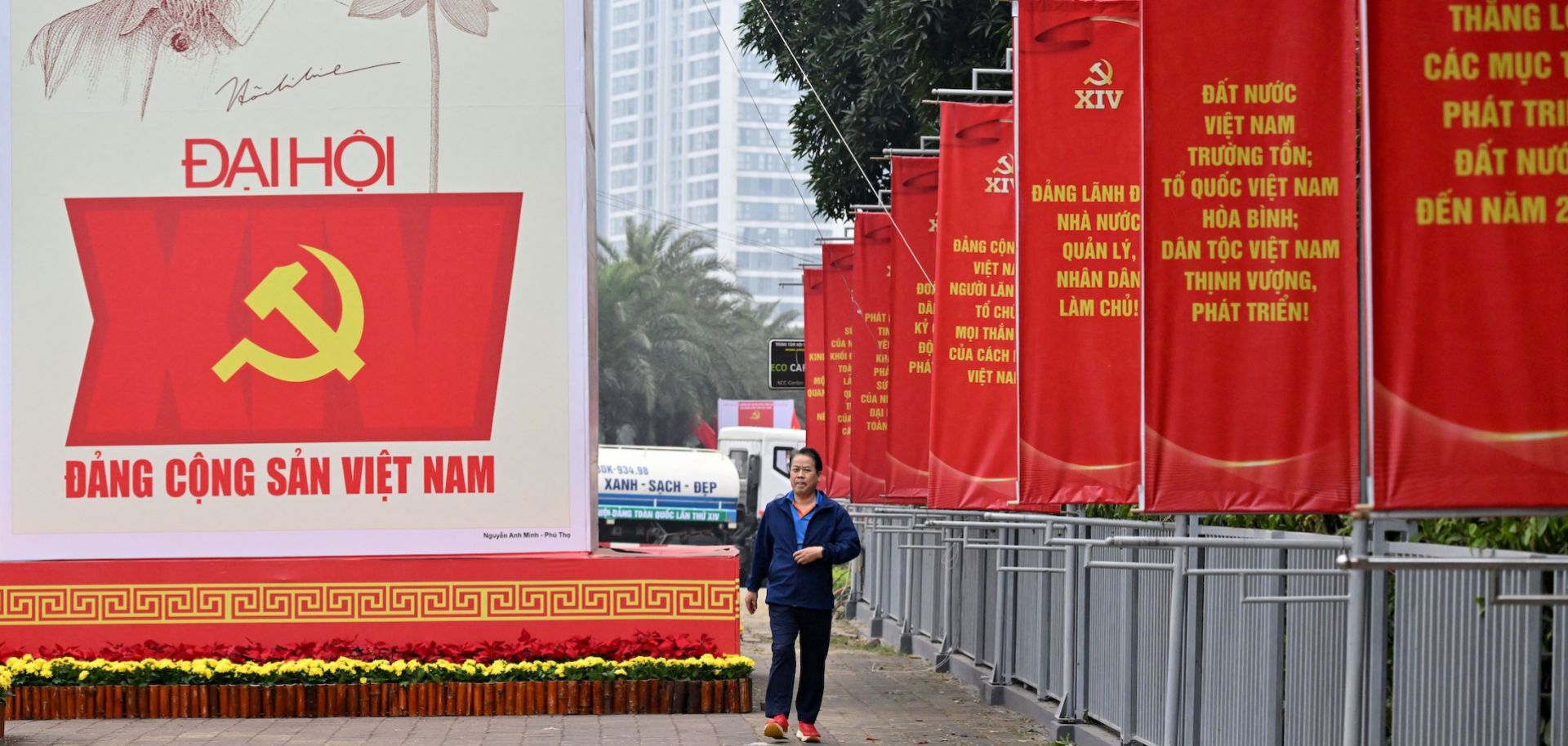
Vietnam's 14th National Party Congress will likely consolidate authority around the party center while setting ambitious growth targets and pursuing administrative reforms, though these efforts will be constrained by bureaucratic risk aversion and insufficient implementation capacity at home, alongside intensifying external pressure from the United States and China. From Jan. 19-25, Vietnam's Communist Party is convening its five-yearly National Party Congress in Hanoi, a meeting that will set the country's leadership lineup and policy direction for the 2026-2030 term. Roughly 1,600 delegates are attending and will elect a new Central Committee, which in turn will select the Politburo and other top party organs that effectively determine Vietnam's paramount leadership and the composition of the party-state system's pillars of leadership. The Congress will also approve core political and economic national priorities for the next five years, including growth targets and governance agendas. Leadership outcomes will almost certainly include a decision to retain current Communist Party General Secretary To Lam in the top party role, as well as, more controversially, whether he also assumes the state presidency. Separately, the Congress will formally endorse macroeconomic policy ambitions that have already been signaled in draft and public statements tied to the next plan period, including an official party target of at least 10% average annual GDP growth in 2026-2030 (and parallel mandates around seeking 10% growth for 2026 alone). Other economic priorities will include shifting to higher value-added manufacturing, expanding infrastructure investment in energy and transportation, strengthening domestic private sector participation, and tightening state capacity through administrative restructuring. While the Congress itself is the headline event, the documents approved at the meeting will serve as the authoritative mandate for the next five-year governance cycle.
- Vietnam's leadership has traditionally been organized around four leadership pillars: Communist Party general secretary, state president, prime minister and National Assembly chair. However, party regulations issued in 2025 formally elevated the Standing Member of the Party Secretariat as a fifth top leadership role, thus formally changing Vietnam's rule-by-consensus model from a four- to a five-pillar structure.
- While the Congress determines the party leadership slate, appointments to the five pillars will be ratified in stages by the National Assembly in mid- to late-2026, meaning the Congress effectively pre-decides but does not immediately formalize the full leadership lineup.
- Following Ho Chi Minh's death in 1968, the offices of the general secretary and state president have remained separate, but three leaders have held the role concurrently: Truong Chinh in 1986, Nguyen Phu Trong in 2018-2021 and Lam himself briefly in 2024. Still, each case occurred during exceptional transitions rather than as a sustained institutional norm.
The Congress marks the culmination of a leadership transition triggered by the health decline and 2024 death of long-time party chief Nguyen Phu Trong. Trong's final years were marked by visibly declining health and a managed succession process. During this period, Vietnam's consensus-based leadership model came under strain as decision-making increasingly gravitated toward institutions capable of enforcing discipline and continuity. Central to this shift was the expansion of Trong's anti-corruption campaign. While framed as a nationwide effort to restore legitimacy and discipline, the campaign was operationalized through enforcement bodies whose influence grew as Trong's own capacity waned. Within this environment, the Ministry of Public Security emerged as a pivotal pillar of governance, reflecting the growing prioritization of internal stability and elite discipline. Lam, who led the ministry from 2016 to 2024, became the anti-corruption campaign's principal enforcer, overseeing investigations, arrests and coordination that translated party discipline into the removal, prosecution and forced resignation of senior officials. Accelerated elite turnover, heightened risk aversion and the weakening of traditional balances among the party's leadership pillars altered elite bargaining dynamics in favor of the security apparatus and narrowed the field of viable succession candidates, particularly with respect to technocrats. Following Trong's death, the system moved quickly to prevent a leadership vacuum, with Lam first assuming caretaker responsibilities and then being confirmed as general secretary in August 2024. Since taking the top party post, Lam has emphasized administrative streamlining and state execution capacity, aligning with an institutional push to simplify decision making, clarify authority and speed up policy implementation across ministries and provinces. The Congress, therefore, represents the first formal opportunity to consolidate the post-Trong order and determine whether Vietnam restores its traditional powersharing equilibrium or codifies a more centralized, security-anchored governing model under Lam.
- Trong was general secretary from 2011 until his death in 2024, spanning three consecutive five-year terms and making him Vietnam's second-longest-serving party chief.
- Vietnam's anti-corruption campaign, which was launched in 2016, reached an inflection point in 2022 after authorities arrested the sitting health minister and the sitting Hanoi Party chairman in connection with the Viet A COVID-19 test kit corruption scandal. This marked the first instance in which sitting cabinet-level and major municipal leaders faced criminal prosecution, rather than internal party discipline. Since then, investigations have widened across ministries, provinces, state-owned enterprises and the private sector.
- High-level departures from anti-corruption enforcement included the resignation of former President Nguyen Xuan Phuc in January 2023; the removal of two deputy prime ministers the same month; the resignation of former President Vo Van Thuong in March 2024; and the resignation of National Assembly Chairman Vuong Dinh Hue in April 2024. Multiple ministers, senior party officials and state-owned enterprise executives have also faced arrest and prosecution.
- In 2025, under Lam's leadership, Vietnam approved a major streamlining of the state apparatus, cutting the number of central government ministries from 18 to 14 and ministerial-level agencies from four to three, while restructuring local governance by eliminating the district-level tier (abolishing roughly 700 district-level units nationwide). The reform replaced Vietnam's four-tier administrative system (central-provincial-district-commune) with a three-tier structure (central-provincial-commune) and consolidated 63 provinces and centrally governed cities into 34 administrative units. Beyond efficiency prerogatives, these changes reduced the number of de facto autonomous bureaucratic and local power centers, thereby strengthening central oversight over policy implementation and reinforcing the shift toward more centralized governance.
Politically, the Congress will likely increase the power of the party's central leadership rather than reaffirm a more dispersed governance structure, but, in either case, caution at lower levels of governance will likely slow the implementation of at least some national-level policymaking. The central question is whether Vietnam preserves its tradition of collective rule and intra-elite balancing (now formally expanded into a five-pillar framework), or whether authority is more clearly concentrated around the party leader through consolidation and/or the sidelining of other top roles. The immediate variable is whether Lam also assumes the state presidency, which would formalize a stronger convergence of party and state authority. The most likely scenario is consolidation with constraints, wherein authority becomes more centralized around the general secretary — potentially through concurrent holding of the presidency — but remains limited by the Politburo's collective decisionmaking rules, the Party Secretariat's control over cadre management and day-to-day party operations, and the military's institutional autonomy over senior promotions and defense affairs, thereby preventing unilateral rule. Under this outcome, governance would become more centrally coherent and directive, with clearer prioritization and accountability. A second plausible scenario is formal continuity, in which the presidency remains separate and leadership balance is preserved across the five pillars, even as administrative restructuring and discipline intensify. To determine which among these scenarios is becoming more likely, early indicators following the Congress will include whether party and state roles are combined, the balance between security officials and Party Secretariat officials in the new Politburo and how detailed restructuring mandates are. A Politburo weighted toward security officials would point to a governance style centered on discipline and enforcement, while a stronger Secretariat presence would point to tighter centralized management aimed at pushing policy implementation. Importantly, consolidation under Lam is focused on strengthening oversight and enforcement, not on expanding delegated authority, meaning day-to-day implementation will remain with lower levels. As such, across both scenarios, political risk is most likely to manifest in policy execution bottlenecks, with continued anti-corruption enforcement and administrative restructuring encouraging risk aversion within the bureaucracy and complicating implementation at subnational levels. This implies a system that is increasingly predictable at the strategic level, given clearer priorities and fewer policy reversals — but one with heightened sensitivity to rules, inspections and disciplinary risk at the operational level.
- At a December 2025 party meeting ahead of the Congress, some delegates backed Lam's bid to be both the general secretary and state president, while others did not clearly support it, signaling a lack of consensus within the Party. Vietnam's military — a powerful faction that currently holds the presidency via Gen. Luong Cuong — has reportedly been negotiating safeguards to limit Lam's authority if he takes on both roles, suggesting active pushback or at least resistance to the idea of power consolidation.
- The possibility that Lam could concurrently hold both positions has been widely interpreted as aligning Vietnam's leadership structure more closely with China's model, in which Chinese President Xi Jinping simultaneously holds the top party and state roles. But while this would look similar on paper, the effects would not be identical, at least in the short- to medium-term. This is because Vietnam's system still distributes actionable authority across multiple senior leaders and institutions, limiting how quickly or how far power can be centralized around a single individual, whereas in China, parallel institutions have been steadily hollowed out under Xi over the past decade.
Economically, the Congress is set to endorse an unusually ambitious growth agenda that places significant demands on state capacity and policy execution, resulting in largely pro-investment policies at the national level that nonetheless will be weighed down by red tape. Vietnamese leadership has already signaled a target of roughly 10% average annual GDP growth in 2026-2030, implying a step change from recent performance and a clear expectation that Vietnam's growth model must scale up in both output and productivity. In his opening remarks on the first day of the Congress, Lam explicitly framed this as requiring a "new model" of development centered on technology, stronger domestic private firms and institutional reform. Achieving such growth would require continued expansion of manufacturing, rapid infrastructure buildout (particularly in power generation, grids, transport and logistics), and deeper participation by domestic private firms alongside foreign enterprises. At the same time, the Congress will likely reaffirm the state's "leading role" in steering development, reinforcing a hybrid model in which markets drive activity but administrative direction, planning and discipline remain central. Entering the new plan period, policymakers are already balancing growth acceleration against financial risk (i.e., seeking to boost GDP while avoiding a repeat of past episodes where rapid credit expansion fueled property excesses, strained local government finances and increased pressure on the banking system). External trade risk — namely, U.S. tariffs and heightened enforcement scrutiny on Vietnamese exports — adds another constraint by increasing uncertainty for export-oriented manufacturing, raising compliance costs and reinforcing Hanoi's incentive to prioritize higher-value production, domestic supply chain depth and connective infrastructure. With Hanoi hesitant about repeating past efforts in which property- and construction-led growth generated debt and corruption concerns, these dynamics suggest that growth will be pursued selectively rather than indiscriminately. Priority will likely be given to sectors and projects deemed strategically important, particularly those focused on energy security, export competitiveness, high-end manufacturing and national connectivity infrastructure (e.g., ports, airports and rail links). The implication is a policy environment that remains broadly pro-investment but increasingly procedural (e.g., more red tape and additional signoff requirements), as approvals, land use decisions and procurement face heightened scrutiny amid ongoing anti-corruption enforcement and administrative restructuring. For businesses, the base case remains continued manufacturing expansion and large-scale infrastructure investment, but with greater sensitivity to financing conditions, how rules are applied locally and execution timelines at the provincial level.
- In 2025, the United States imposed a 20% tariff on goods of Vietnamese origin, along with a 40% duty on transshipments from third countries, particularly China. However, details on how "transshipment" will be defined and enforced remain unresolved, and Vietnamese officials have continued talks with U.S. counterparts to clarify terms and address non-tariff barriers, reflecting continued fluidity and uncertainty in enforcement and tariff implementation.
- Vietnam's economy expanded by 8% in 2025, marking a sharp acceleration from 2024 and reinforcing leadership confidence that higher growth targets are achievable entering the 2026-2030 period, despite U.S tariffs.
The Congress is unlikely to yield any foreign policy changes, with Vietnam maintaining its established multivector approach and hedging strategy between China and the United States, wherein it can largely avoid taking sides. Draft Congress documents recently elevated "foreign affairs and international integration" to the same level as defense and security, signaling that Vietnam increasingly views its foreign relationships as central to regime stability, alongside economic development. The baseline forecast is continuity in Vietnam's "bamboo diplomacy" doctrine, wherein Hanoi will keep balancing the United States and China, avoid formal alignment and hedge through multivector ties with Russia, Japan, South Korea, India, Australia, the European Union, broader Southeast Asia and beyond. However, the operating environment is tightening. U.S. tariffs and enforcement uncertainty increase the economic and political cost of Vietnam's export dependence on the U.S. market, pushing Hanoi to demonstrate stronger supply chain transparency while also widening market access and investment sources to dilute U.S. leverage. At the same time, Vietnam will likely selectively deepen economic connectivity with China in areas that serve national growth and logistics objectives (most visibly through large-scale rail projects and Chinese loans), while also continuing to manage strategic mistrust vis-a-vis Beijing. With respect to the Congress, the eventual leadership structure will shape how Vietnam conducts foreign policy more than what it seeks to achieve. If authority is more centralized around the party center after the Congress, Hanoi is likely to present a more unified and disciplined front in negotiations on trade, technology and major infrastructure financing, reducing mixed signals and internal friction in high-stakes talks. At the same time, a stronger role for the security apparatus in governance would likely translate into greater caution in foreign engagement, particularly in areas touching on technology transfer, data and politically sensitive partnerships.
- Despite deep economic ties, Vietnam continues to view China as its primary long-term security challenge, driven by persistent maritime disputes in the South China Sea, repeated confrontations involving Chinese coast guard and survey vessels in Vietnam's claimed exclusive economic zone, and Hanoi's opposition to China's expansive ten-dash-line claims, which Vietnam formally rejects. These tensions have persisted even as Vietnam expands trade, infrastructure cooperation and supply chain links with China. Vietnam is thus likely to maintain a firm but calibrated posture in the South China Sea after the Congress, continuing to resist Chinese encroachment through law enforcement presence, formal diplomatic protests and repeated public assertions of its legal claims under international law, while avoiding actions that would trigger open escalation or undermine parallel economic cooperation.
