
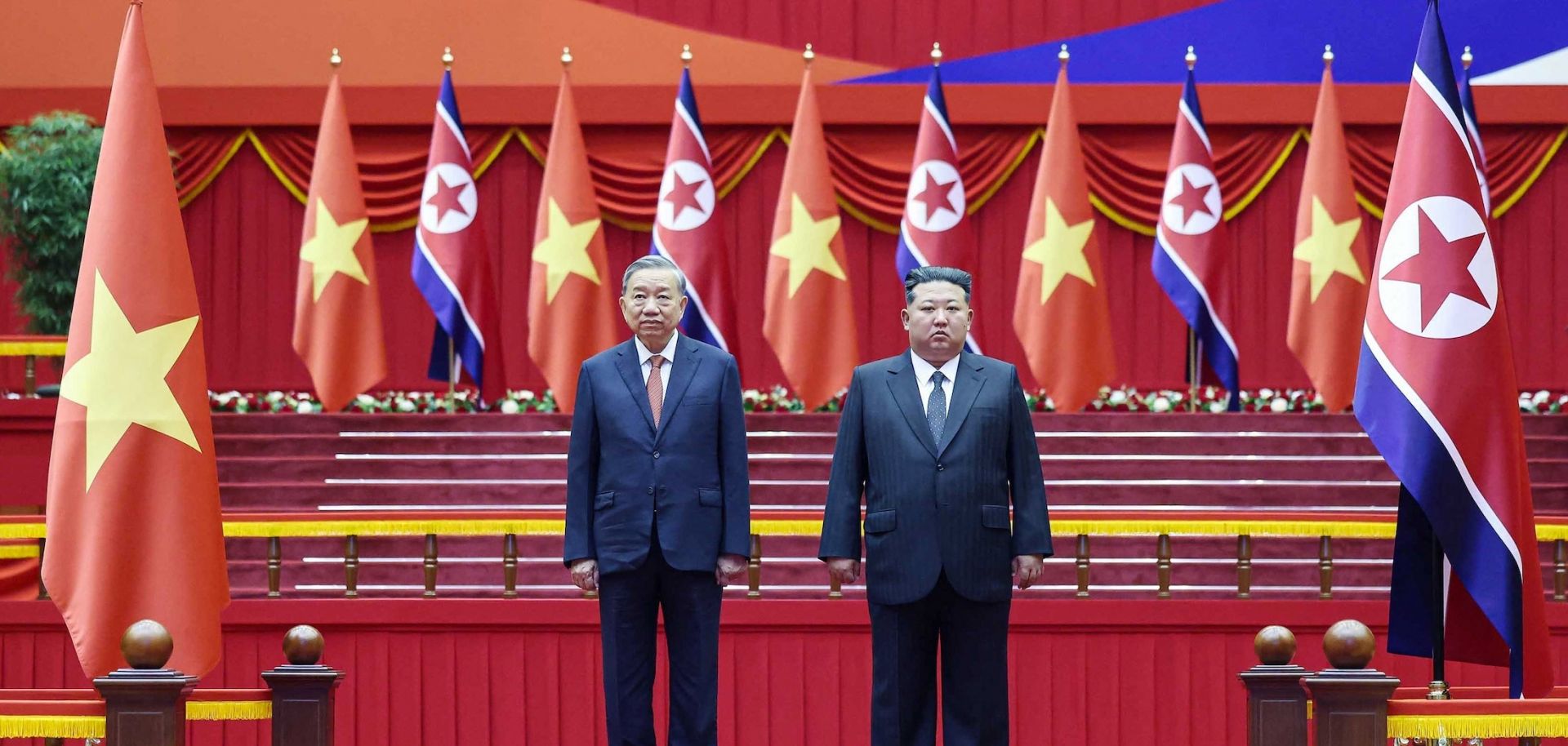
The first visit by Vietnam's leader to Pyongyang in nearly two decades reflects Hanoi's balancing strategy and North Korea's bid to broaden ties beyond China, though numerous constraints limit how far ties can deepen beyond certain symbolic steps. From Oct. 9-11, Vietnamese Communist Party General Secretary To Lam visited Pyongyang at the invitation of North Korean leader Kim Jong Un, marking the first Vietnamese leader-level trip since 2007 and only the second since 1950. The visit coincided with the 80th anniversary of the ruling Workers' Party of Korea (WPK), around which Pyongyang organized a series of large-scale commemorations and diplomatic events. During his visit, Lam received a formal welcome ceremony, including a 21-gun salute and held high-level talks with Kim. The two leaders committed to deepen exchanges across party, parliamentary, governmental and local levels; broaden cooperation in sectors such as culture, education, health, tourism and information and communications; and intensify coordination in multilateral forums like the United Nations and Association of Southeast Asian Nations Regional Forum. Vietnamese and North Korean state media sources framed the visit as a renewal of classic socialist solidarity, emphasizing mutual support in international forums and adherence to international law, with Hanoi pushing for the advancement of their ''traditional friendship'' into a new, more substantive phase.
- Lam offered to share Vietnam's market liberalization and reform experience spanning market management, global economic integration and export policy.
- Public statements also linked the visit with each party's internal calendar. Vietnam is preparing for its 14th National Party Congress and North Korea is preparing for its ninth Party Congress. Both are likely to occur in the first half of 2026.
- As part of the WPK's 80th-anniversary celebrations, Pyongyang hosted a range of foreign dignitaries in addition to Lam, including Chinese Premier Li Qiang, Russian Security Council Deputy Chairman Dmitri Medvedev, Laotian President Thongloun Sisoulith and senior delegations from Angola, Egypt, Iran, Syria and Cuba.
- Missile systems including new Hwasong-20 solid-fuel ICBMs — which possess greater mobility, faster launch times and an extended operational range over previous variants — were unveiled at a North Korean military parade on Oct. 10 in the presence of foreign dignitaries including Lam. The display was intended to reinforce that North Korea has achieved a credible second-strike capability against the United States.
- Lam also pushed for Pyongyang's endorsement of the United Nations Convention on the Law of the Sea, or UNCLOS, which forms the legal basis of Vietnam's South China Sea territorial claims that are in opposition to China's, though he did not receive it.
In recent years, North Korea has recalibrated its diplomacy to reduce overdependence on China and exploit a shifting geopolitical landscape as Vietnam has pursued a similar strategic hedging logic. While Beijing remains North Korea's primary economic and security lifeline, Moscow has become an increasingly important partner since a 2024 defense pact cemented close Russia-North Korea ties in the context of the invasion of Ukraine. Chinese Premier Li Qiang's concurrent visit, the first by a Chinese leader since 2019, highlighted Beijing's effort to reaffirm influence as Russia's presence in and influence over Pyongyang grows. Simultaneously, Pyongyang has been expanding outreach to select partners across Asia, Africa and the Middle East. The 80th anniversary of the WPK provided a high-visibility platform for Kim to showcase that engagement, projecting ideological solidarity and regime resilience despite sanctions and isolation. Vietnam, meanwhile, is navigating a complex balancing act. Over the past year, it has hosted or engaged leaders from the United States, China, Russia and South Korea, advancing a foreign policy doctrine centered on self-reliance, diversification and multilateralization. Lam's visit to Seoul in August, where he signed a $250 million defense package, exemplifies Hanoi's deepening engagement across both sides of the Korean Peninsula. Reengaging Pyongyang complements Vietnam's ''bamboo diplomacy'' doctrine in flexible, multialigned positioning within intensifying great power competition while symbolically reaffirming party-to-party solidarity ahead of its 14th National Party Congress in early 2026, which likewise serves a domestic political purpose. The region is undergoing a broader recalibration defined by escalating U.S.-China rivalry, Russia's recent assertive East Asian outreach and ongoing tensions on the Korean Peninsula. With U.N. sanctions intact and North Korea accelerating missile and submarine programs with Russian support, Vietnam's outreach represents a calibrated effort to act as a neutral interlocutor, broadening its diplomatic space without endorsing Pyongyang's militarism or jeopardizing its ties with Western, Japanese and South Korean partners while positioning itself to act as a potential intermediary between North Korea and the United States.
- Vietnam and North Korea share a long history of socialist solidarity, dating to the founding of the Democratic Republic of Vietnam and early Cold War support from Pyongyang. Diplomatic relations were formally established in 1950. Over the decades, however, ties cooled as Vietnam's market reforms and global integration accelerated, particularly after it established and deepened economic and investment ties with South Korea in the 1990s, cementing its alignment with U.S.-backed regional supply chains and effectively sidelining Pyongyang from Hanoi's liberalizing economy and Western engagement.
- Lam's Aug. 10-13 visit to Seoul, during which Vietnam finalized a $250 million agreement to purchase 20 K9 self-propelled howitzers from South Korea's Hanwha Aerospace, exemplifies Hanoi's deepening strategic engagement across both sides of the Korean Peninsula and its effort to diversify defense partnerships beyond its traditional main supplier, Russia.
- Highlighting Vietnam's ambivalence to endorsing North Korea's militarism, on Oct. 2, Hanoi reiterated its commitment to global nuclear disarmament, nuclear nonproliferation, and peaceful uses of nuclear energy, calling for decisive actions toward the total elimination of nuclear weapons. This public statement, issued just days before Lam's arrival in Pyongyang, was a deliberate effort to preempt perceptions that the visit implied support for North Korea's weapons programs.
- Vietnam facilitated the last summit between Kim and U.S. President Donald Trump in Hanoi in 2019.
Lam's visit injects fresh diplomatic energy into a long-stalled relationship and fits neatly into Pyongyang's gradual reemergence as an active player in regional diplomacy. However, deeper ties will be incremental, symbolic and highly constrained by U.N. sanctions, North Korea's dependence on China and Russia and the broader U.S.-China strategic rivalry shaping the regional order. If sustained, reengagement with Vietnam (and other countries) could help North Korea project legitimacy and diversify its partnerships beyond China and Russia, giving Pyongyang greater diplomatic maneuverability and leverage over its two main patrons. To this end, in the coming years, Hanoi-Pyongyang cooperation will modestly deepen in less sensitive domains such as culture, health, education, tourism and state media and public communications exchanges. However, any deeper bilateral cooperation with Vietnam — such as expanded trade, infrastructure investment or technical exchanges in energy and defense — will likely be limited due to U.N. sanctions, pressure from Washington and Seoul and Vietnam's drive to avoid accusations of violating international nonproliferation commitments. Even within the bounds of deeper ties, Vietnam's economic liberalization experience will likely remain advisory and low-risk. It could take the form of technical assistance, capacity building or small pilot projects, particularly in non-sanctioned sectors like agriculture, local governance or special economic zones, rather than wholesale liberalization, which Kim is not even remotely considering. The Kim regime will, moreover, likely resist reforms that threaten political stability or elite privileges. Finally, Vietnam's insistence on highlighting references to international law, including repeated references to UNCLOS, may also invite some pushback from China (and potentially North Korea) as encroaching on Chinese influence, posing an additional potential constraint on how far the Vietnam-North Korea relationship can deepen.
- During the visit, Hanoi and Pyongyang signed a defense cooperation agreement, covering areas such as delegation exchanges, military medicine and training, reviving institutional links between their defense ministries but stopping short of any arms or technology transfers due to U.N. sanctions and Vietnam's nonproliferation obligations. Though agreed in principle, defense cooperation is thus highly likely to stay symbolic and limited.
- Lam's visit — alongside those of other leaders — forms part of a wider North Korea strategy to broaden its diplomatic footprint and break out of its overdependence on China. Beijing's engagement, meanwhile, shows it is recalibrating its relationship with North Korea in light of Pyongyang's expanded diplomatic options (mainly Russia), perhaps tolerating Pyongyang's revival of ties with others as a buffer against U.S. pressure while ensuring it maintains a significant degree of leverage over Pyongyang.
