
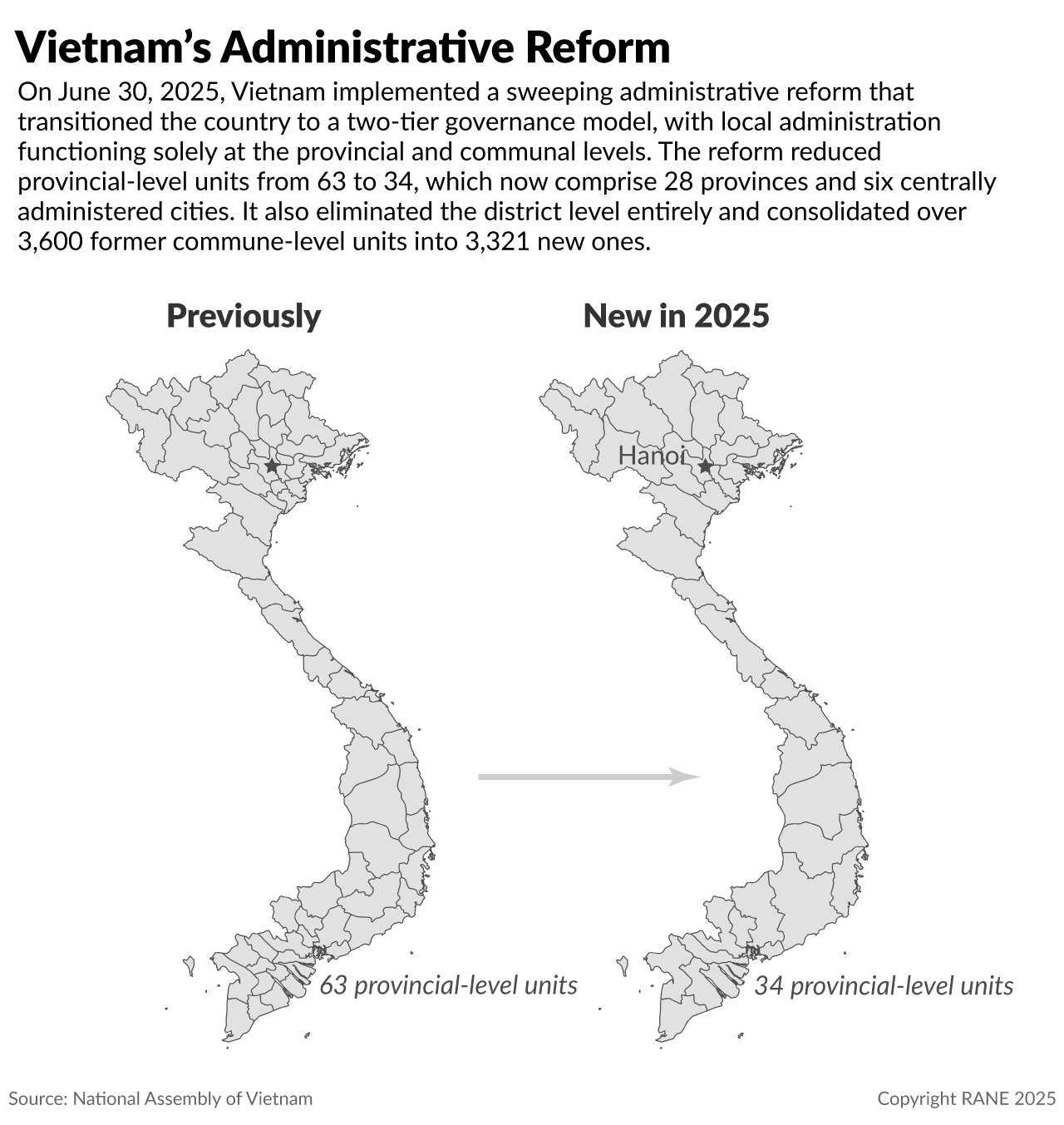
Vietnam's historic administrative restructuring will trigger short-term bureaucratic friction but lays the foundation for leaner administration, fiscal efficiency and improved investment conditions if the government effectively implements the changes over time. On June 30, Vietnam officially rolled out its most significant administrative restructuring in its post-unification history. This followed the National Assembly passing a resolution on June 12 to merge the country's 63 provincial‑level units into 34, now comprising 28 provinces and six centrally governed, provincial-level cities. This reform rests on an earlier April 12 directive from the Central Committee that authorized merging 52 previously existing provinces into 23 new units, the elimination of the entire district level (formerly there were 696 mid-level jurisdictions between province and commune), and a 60-70 % reduction in commune-level units under a new province-commune two‑tier model (with the prior inclusion of the district level constituting a three-tier model). The new local administrations formally assumed full operational authority under the consolidated two-tier model on July 1.
- On April 14, the Vietnamese government issued an edict defining precise boundary changes, population data and administrative centers for all units with particular emphasis on the 23 newly merged entities.
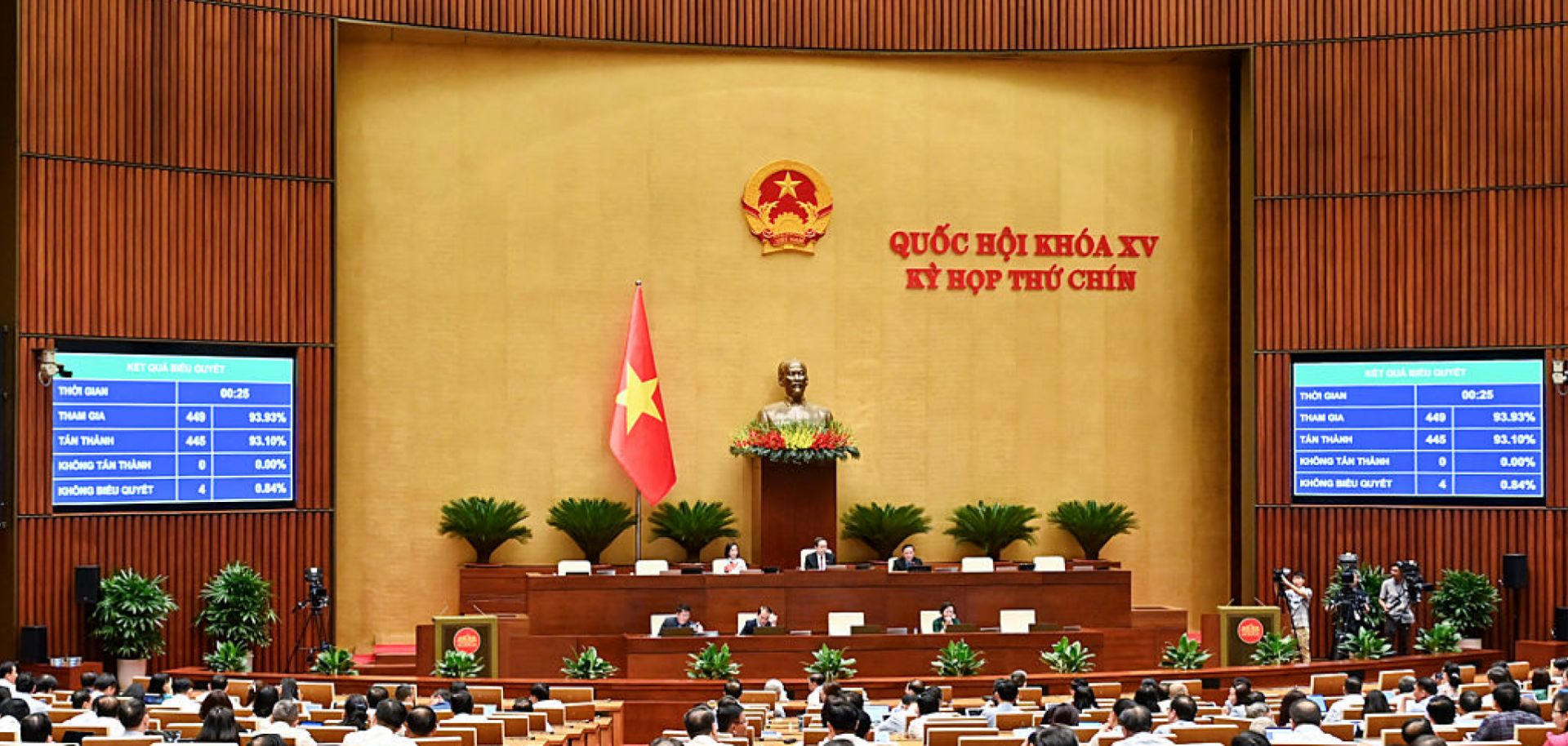
- Following the June 12 National Assembly vote, which saw 461 of 465 delegates approve the resolution, the new provincial governments held inauguration ceremonies to dissolve district‑level bodies, establish new Party committees and install provincial and commune leadership.
- Though constitutionally powerful, the National Assembly typically ratifies decisions already made by the Vietnamese Communist Party's Politburo or Central Committee.
Vietnam's administrative restructuring represents the next stage of years of anti-corruption efforts, political consolidation and technocratic reform. The restructuring also comes ahead of Vietnam's next leadership reshuffle at the 14th Party Congress in 2026, which signals an effort by General Secretary To Lam to lock in political gains, restructure power bases and realign local institutions in line with his centralizing agenda. The decision to merge provinces, eliminate the district level and streamline commune governance comes in the context of Vietnam's high-profile "Blazing Furnace" anti-graft campaign, which has toppled hundreds of officials — including two state presidents, multiple Politburo members and hundreds of local cadres — since its inception in 2016. Many of those implicated operated within or benefited from the fragmented, overlapping provincial and district bureaucracies that the restructuring now dissolves. By cutting the number of provincial-level units in half and removing the district level entirely, the Vietnamese Communist Party is reasserting vertical control, closing space for local patronage networks and minimizing institutional ambiguity that enabled corruption and obstruction. The consolidation also reflects Lam's approach to governance following his ascent to the top party post in early 2025. As the former Minister of Public Security and chief architect of the anti-corruption crackdown, Lam has moved to institutionalize tighter control over subnational structures and personnel pipelines. In parallel, the restructuring serves economic and administrative goals. Since 2024, Vietnam has pursued building a leaner government by reducing ministries, shrinking state media and improving public service efficiency. Streamlining local governance complements these efforts and responds to investor frustration with inconsistent project approvals and slow permitting processes reflective of disparities across provincial and district levels. Finally, the reform supports Vietnam's broader digital transformation push, including the publication of standardized geospatial data and digital administrative maps, intended to enable better spatial planning, land management and interprovincial coordination.
- This is Vietnam's largest administrative reform since Doi Moi (roughly translated as "renovation"), launched in 1986. Doi Moi was a comprehensive overhaul of Vietnam's economic system from central planning to market economics. However, the changes were economic, not territorial, rendering the current reform unprecedented.
- The central Party apparatus reduced national ministries from 30 to 22 in parallel with subnational reforms in June 2024, a prior signal of a unified effort to tighten executive control and policy coherence.
- Foreign investors have long complained of "administrative paralysis," such as slowed approvals and stalled projects, at times resulting in billions of dollars of investment remaining idle.
- On June 25, Vietnam's National Assembly also abolished the death penalty for eight specific crimes, effective July 1, including embezzlement, taking bribes, drug trafficking, espionage, attempting to overthrow the government, sabotaging state infrastructure, counterfeit medicines and inciting war. Under revised laws, offenders will receive life imprisonment instead, and existing death sentences for these offenses (if not yet carried out) will be commuted accordingly. This move aligns with the broader centralization and institutional reform agenda underpinning Vietnam's administrative restructuring, reflecting the state's effort to modernize governance, assert legal uniformity and reduce reliance on extreme punitive measures in favor of controlled, top-down discipline.
In the short term, Vietnam's administrative restructuring will likely disrupt the bureaucracy, creating some level of uncertainty for investors trying to navigate changes, and reconfigure political authority as the new system takes effect. The coming months will be a period of bureaucratic adjustment and internal competition among officials for positions and influence as Vietnam's bureaucratic machinery reorients itself under a dramatically altered administrative map. Although central authorities have insisted that investment licensing and project approvals will continue uninterrupted, the rapid merger of 52 provincial-level units into 23 new localities and the elimination of the district level introduce inevitable coordination challenges. Investors operating in sectors like manufacturing, real estate and infrastructure will likely encounter delays as jurisdictional authority shifts and new leadership teams take time to clarify internal processes. Meanwhile, provincial governments are tasked with reconciling planning frameworks, tax regimes and land-use responsibilities, potentially leading to temporary uncertainty over regulatory enforcement and other issues like project ownership. Politically, the restructuring opens space for a broad reconfiguration of local power networks. Thousands of mid-level cadres from dissolved district administrations are being reassigned, removed or folded into commune-level agencies, which over time will allow the central Party to install loyal personnel while reducing opportunities for local patronage. However, the new provincial People's Committees and Party Standing Boards, formed on June 12, will need time to consolidate control over expanded jurisdictions. This fluid environment risks temporarily weakening oversight or leading to interdepartmental friction, especially in merged provinces with prior governance disparities. At the same time, the initial phase of the reform is set to eliminate around 80,000 state-sector jobs, with further cuts anticipated as communal-level redundancies are phased out. While such fiscal cuts will eventually support infrastructure and digital modernization, the immediate transition could provoke civil service pushback, leading to administrative delays and the slow-walking of changes in areas where public sector employment is a critical source of income and political stability.
- Vietnam's Ministry of Home Affairs projects a long-term total reduction of up to 250,000 government positions, enabling projected savings of $7.3 billion from 2026-2030.
- An example of likely overburdened local administration is in Vietnam's commercial center Ho Chi Minh City, where its merger with nearby former provinces Binh Duong and Ba Ria-Vung Tau is projected to strain the city's healthcare infrastructure as the expanded jurisdiction formalizes the city's role as the primary provider of specialized care with a now-much larger population.
In the long term, the reform will strengthen the Vietnamese Communist Party's central authority while modernizing the administrative state, positioning Vietnam for more predictable governance, faster policy execution and reduced administrative overlap. But it will also risk institutional overreach, rural marginalization and uneven provincial performance that will require sustained attention in the coming years. Vietnam is already economically competitive in the region (for example, via trade access, labor cost advantages and geographic positioning near China). However, the administrative changes will likely further enhance this appeal by making governance capacity and investment conditions more durable, provided implementation is sound. The shift to a two-tier system streamlines authority, which, after the initial adjustment period, will likely lead to more efficient public service delivery, improved policy coordination and faster response times for land use, licensing and infrastructure approvals. The consolidation of 52 units into 23 new localities also allows for economies of scale in fiscal management, with larger provinces better equipped to undertake integrated planning across urban and rural zones. In merged regions, the resulting jurisdictions now possess greater demographic and geographic heft, which could translate into stronger regional economic hubs if supported by targeted infrastructure and regulatory alignment. Politically, the Vietnamese Communist Party gains tighter vertical oversight over local governance, with fewer provincial committees and councils to manage and a more centralized appointment process. This reduces opportunities for local elite entrenchment while giving the central leadership greater control over promotions and disciplinary mechanisms. However, the erosion of district-level governance also risks weakening mechanisms for community-level representation and localized issue resolution, especially in rural areas where commune governments could become overburdened, which will stoke localized protest risks. Over time, this could generate public dissatisfaction if it is not offset by efficient governance and expanded service delivery capacity. For businesses, long-term improvements in administrative clarity, regulatory predictability and spatial planning will likely enhance Vietnam's investment climate, particularly for industrial parks, logistics corridors and urban development zones. Standardized geospatial mapping and unified land registries will also facilitate clearer land-use rights and reduce approval backlogs. Nonetheless, much depends on how quickly and uniformly the new structures mature. If merged provinces struggle to harmonize policies or budgets, persistent asymmetries in enforcement and capacity could result in inconsistent enforcement, approval delays or coordination breakdowns between jurisdictions.
- Rural communes will inherit oversight of functions formerly handled at the district level, portending overextension and institutional strain risks in underserved areas.
- As an example of future likely upside, Ho Chi Minh City's now larger administrative geography positions it well to become a tourism megacity, integrating urban, coastal, forest and cultural assets and projected by the government to see a 30-40% tourism boost in the coming years while diversifying its tourism economy across new sectors like wellness, cruise and eco-tourism.
- The reform also comes as Vietnam grapples with U.S. tariff risks, now set at 20% (and 40% for transshipped goods from China) amid a new trade agreement the United States announced on July 2.
