
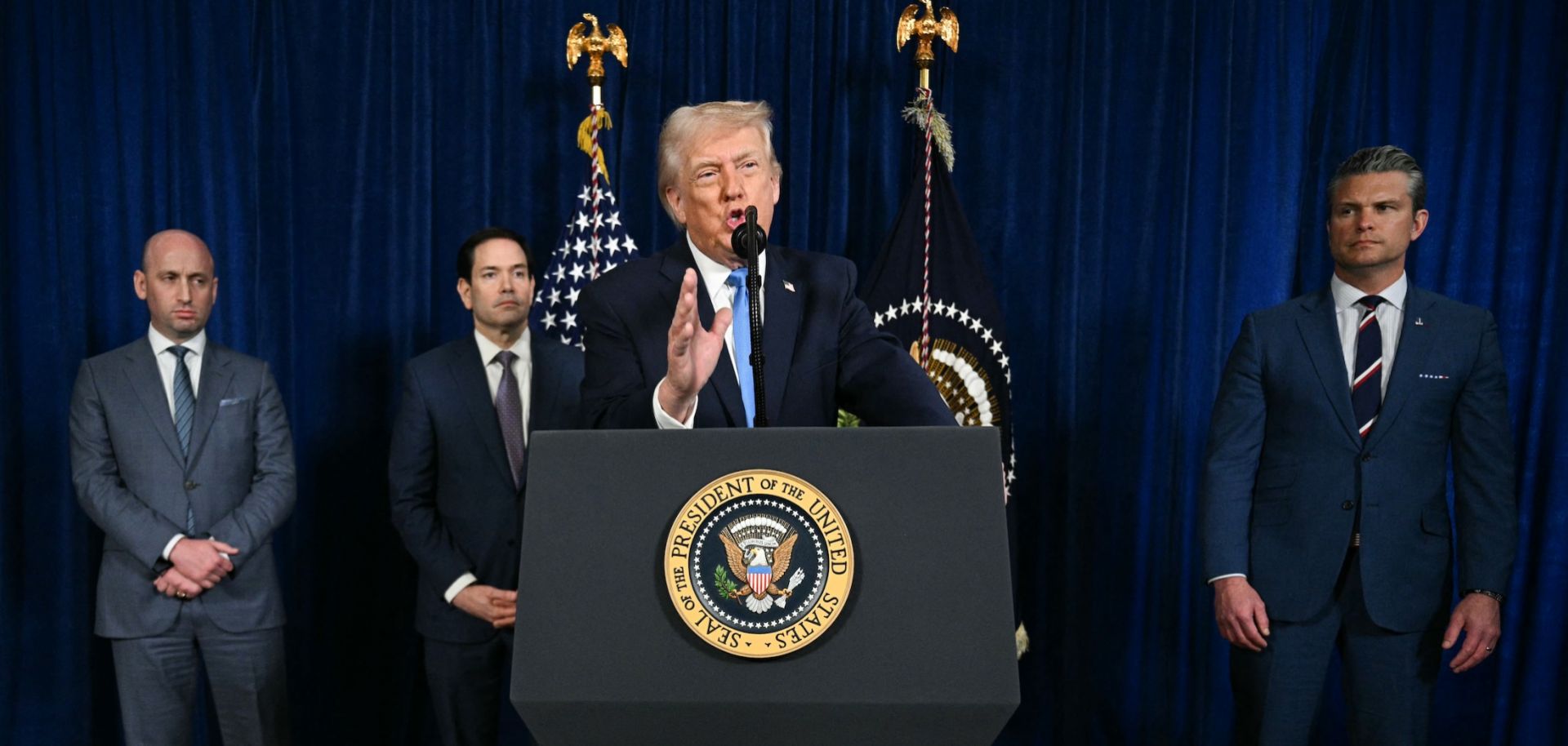
In the first year of his second term, U.S. President Donald Trump vastly expanded the use of U.S. military force abroad, culminating in the successful Jan. 3 operation to remove Venezuelan President Nicolas Maduro. According to data from the Armed Conflict Location and Event Data Project, the Trump administration oversaw at least 626 airstrikes through the end of 2025 (a figure that does not include the Venezuela strikes), compared to the 555 strikes conducted during former President Joe Biden’s entire four-year term. In addition to Venezuela, the Trump administration has publicly acknowledged bombing Iran, Iraq, Nigeria, Somalia, Syria and Yemen, along with scores of vessels in the southern Caribbean Sea and eastern Pacific Ocean.
This uptick in U.S. strikes around the world fits into Trump’s self-described “peace through strength” strategy, which frames aggressive actions abroad as crucial to supporting U.S. national security and political objectives. Although Trump routinely portrays himself as unpredictable — which he considers an asset in foreign policy — his use of force since returning to the White House reveals 10 overarching patterns:
1. Trump is risk-tolerant and willing to break norms, but his success so far is not guaranteed to continue. To be sure, some of the U.S. strikes over the past year (e.g., those in Iraq, Somalia, Syria and Yemen) have occurred in countries where the United States has frequently carried out military operations and, with the exception of Yemen, at the invitation of the respective governments. Similarly, the U.S. strikes in Nigeria fit into a broader regional pattern and were done in coordination with that country’s government. However, the U.S. attacks in Iran — and especially the strikes in Venezuela and against alleged narcotraffickers at sea in the Western Hemisphere — demonstrated not only a significant appetite for risk, but also little compunction about violating international law and global norms. With Trump so far portraying these operations as successes, he will likely pursue similar risky and norm-breaking operations over the remainder of his term. But his success is not guaranteed to continue, as Trump’s military operations may eventually result in U.S. fatalities and/or more significant retaliation, thus complicating, if not outright undermining, his gambles.
2. Trump prefers aerial strikes over ground campaigns, but there is a slippery slope to more boots on the ground. Despite his frequent use of airpower, Trump has repeatedly said he does not want to get entangled in “forever wars” and has hesitated to put troops on the ground. Even in Venezuela, the ground presence was comparatively small, brief and highly targeted. In places where the United States has troops in-country, namely Iraq and Syria, the Trump administration has tolerated a limited presence but has still sought to reduce troop numbers or reposition soldiers to safer areas. With Trump seemingly truly believing in the goal of avoiding new foreign entanglements, along with strong bipartisan opposition to prolonged ground campaigns, there is little reason to expect that Trump will suddenly favor a large foreign occupation. However, his administration’s repeated use of airpower risks becoming a "slippery slope" that nonetheless leads to increased pressure to put boots on the ground for longer and longer periods. Indeed, history shows that airpower alone rarely achieves, let alone sustains, strategic objectives, thereby increasing the incentives for the use of ground troops. Absent ground troops, aerial decapitation strikes can also often create conditions for significant internal unrest — a current concern in Venezuela following Maduro’s capture.
3. Trump generally telegraphs his intentions in advance, but this risks blowback and/or escalation. Before the U.S. strikes on Iran’s nuclear program in June 2025, Trump concisely summed up what he often touts as an advantage of his foreign policy style: "I may do it. I may not do it. Nobody knows what I’m going to do.” But while Trump is famous for his policy reversals and seemingly sudden moves, in reality, he almost always sends advanced signals of military action abroad. To be sure, Trump’s threats are hardly sufficient to forecast attacks (see the fourth takeaway below), he does not disclose details about precise means or timing, and he often frames force as only one option under discussion. But even with these caveats, Trump almost always — and certainly ahead of the most consequential attacks, such as those in Iran and Venezuela — rhetorically lays the groundwork, at times for weeks or even months. This is both a means to try to coerce targets through threats (again, see the fourth takeaway below) and to test the political waters at home to ensure he has sufficient backing. While Trump is likely to continue using this signaling strategy, it is not without risks. For one, future targets may take more defensive preparations, thus making U.S. operations riskier. Trump also may end up politically boxing himself into military action, increasing the risk of escalation. Conversely, U.S. deterrence may erode if Trump does not make good on threats, sending potentially worrying signals to adversaries.
4. Trump frequently threatens force as a means of coercion, but these gambles may not always pay off. Trump has repeatedly threatened military action to achieve varying goals. In addition to ongoing and seemingly more serious threats against places like Cuba, Colombia and Mexico, Trump has more outlandishly threatened to use force to take control of the Panama Canal and the Danish autonomous territory of Greenland. Most recently, Trump has threatened further military action in Venezuela if its new leadership does not address U.S. demands. Trump has also used the reverse — threatening to remove military assets and/or not come to allies’ aid if attacked — to coerce NATO countries to spend more on defense. These efforts align with his strategies in other contexts, both at home and abroad (e.g., Trump’s aggressive tariff policy), in which he threatens a maximalist position to try to get his opponents to back down. As threats regarding the use of force have already brought some successes in coercing both allies and adversaries into taking steps he wants, Trump is all but certain to continue doing so. But this strategy also opens the door to conflict escalation (if targets respond with similar threats), failures of U.S. credibility (if the United States does not follow through on threats), and a further loss of U.S. soft power and moral authority, alongside the erosion of global norms and U.S. alliances and partnerships.
5. Trump sees the Western Hemisphere as the U.S. sphere of influence, but raises the risk of regional backlash and adversarial mimicry. Trump’s rhetoric and policy promulgated by his administration, not least the new National Security Strategy unveiled in December 2025, make clear that he views the Western Hemisphere as a special sphere of U.S. influence that is inextricably linked to the security of the U.S. homeland. Following the U.S. attack in Venezuela, Trump and other top officials have renewed explicit threats against Colombia, Cuba, Greenland and Mexico, while a variety of other regional countries (especially those grappling with narcotics trafficking and violent crime) are also potential candidates for future U.S. military action. Trump’s lampooning of Canada as the “51st state” and prior threats to seize the Panama Canal fit into this mold as well. In the wake of the Venezuela operation, the U.S. focus on the Western Hemisphere seems likely to only grow, as Trump and his allies double down on the idea of the “Donroe Doctrine” — an expanded version of the 19th-century Monroe Doctrine that opposed European imperialism in the Western Hemisphere. A greater U.S. focus on combating regional challenges (ranging from criminal activity to foreign influence) may bring some dividends — and even applause from certain governments. However, it also opens the door to major regional backlash that pushes back against U.S. efforts at regional hegemony. Perhaps more troubling, the idea of a U.S. sphere of influence will also likely further encourage and accelerate existing efforts by China, Russia and many other middle powers to claim the same in their respective near-abroad.
6. Trump backs offensive cyber operations, but with uncertain consequences. One of the more underappreciated aspects of the U.S. operation in Venezuela is the degree to which U.S. hackers played a crucial supporting role in disrupting electricity in Caracas, which helped clear the way for U.S. aerial assets to fly in largely uncontested. What is also notable is the degree to which Trump all but confirmed these efforts, arguably the most public any U.S. president has been in discussing U.S. offensive cyber operations. The apparent cyberattacks targeting Venezuela (which came roughly three weeks after a suspected U.S. cyberattack disrupted operations at Venezuela’s state-owned oil firm) align with Trump’s desire to be more aggressive in cyberspace — a holdover from his first term. Such operations will likely become even more frequent, especially since they offer Trump a way to use force abroad while still staying below the threshold of direct, kinetic confrontation. However, there are next to no rules and extremely untested and uncertain norms about offensive cyber operations meant to cause significant real-world disruption, let alone destruction. This leaves the door open for a miscalculation — such as a cyberattack with far larger reverberating consequences than intended — and also helps to normalize such behavior for other adversaries to use.
7. Trump sees (at least somewhat) symbolic attacks as useful, but at the cost of being ineffective. There is always a degree of symbolism involved in the use of force, but as a canny politician, Trump leans into symbolism more than others, not least via the rebranding of the Department of Defense to the Department of War. More practically, from the Christmas Day 2025 strikes against Islamic State-linked targets in Nigeria (which Trump called a “Christmas present” for killing Christians) to the release of video footage showing maritime attacks in the southern Caribbean Sea and eastern Pacific Ocean, Trump has shown some appreciation for attacks with symbolic value, both to appeal to his political base at home and as a warning to others. But the challenge with symbolism is that there is often a tradeoff with effectiveness: experts all but universally agree that the Trump administration’s attacks against alleged maritime narcotraffickers will do nothing to stop the flow of drugs to the United States. The one-off strikes targeting Islamic State fighters in Nigeria will hardly stem their influence either. Although the strikes may have accurately hit targets in areas where the Islamic State and other militants are expanding, they also did not occur in areas of the country where these extremists are most prominent.
8. Trump leaves some of the biggest questions unanswered, at the risk of emboldening U.S. adversaries. Trump is hardly the first president to adopt a position of so-called “strategic ambiguity” when it comes to foreign military commitments, but he has embraced uncertainty far more than others. This is likely partly due to significant divisions among top advisers, and partly a calculated move. But whatever the precise reason(s), Trump has sent in some cases explicitly contradictory messages and in other cases extremely vague ones regarding if and how the United States would respond in various contingencies, not least regarding a potential Chinese move against Taiwan. A more immediate concern for U.S. allies is that, even after NATO members pledged to increase defense spending, there is still deep uncertainty over whether the Trump administration would defend smaller allies, like frontline Baltic states, should Russia make a move against them. Although these contradictions and uncertainty may facilitate some level of deterrence, they also risk doing the opposite. Notably, in the days since the Jan. 3 U.S. operation in Venezuela, media reports conflicted on whether top officials in Beijing, Moscow and elsewhere were alarmed by the U.S. precedent or felt emboldened to act more freely in their own near-abroad. While great powers like China and Russia may not need further justification for military action, many middle powers are certainly trying to read the tea leaves in Washington — and depending on what they interpret, they may feel they have a green light, or at least not a red one, to take their own actions.
9. Trump respects what he views as power, but this belief leaves great powers off the hook and risks underestimating middle powers. With the exception of Iran, no target of the Trump administration’s military operations has had a serious ability to retaliate. And even in the case of Iran, Trump only authorized strikes on the country after Israel spent days degrading Iranian air defenses, thereby facilitating U.S. strikes with less immediate physical risk. By contrast, Trump has been far more hesitant to stoke tensions with great powers like China and Russia, be it militarily or in other spheres like trade. He has also generally sought to quickly de-escalate tensions when U.S. policies begin to have domestic blowback, such as when China began constraining exports of critical minerals. To be sure, all presidents have been more cautious in their actions when dealing with great powers. However, Trump appears to be distinctive in his belief in a so-called “might makes right” world order, where the United States (and, by extension, other great powers) can coerce smaller and middle powers with impunity. On the one hand (as highlighted in the eighth takeaway above), this fuels the further erosion of the U.S.-led Western order in favor of a more unstable multipolar system. But on the other hand, it risks underappreciating the capabilities of at least some middle powers to resist U.S. coercion, including potentially via kinetic retaliation.
10. Trump is mimicking aspects of foreign strategy at home, but this risks inviting all sorts of opposition, including violence. While Trump is far from greenlighting airstrikes against U.S. cities, he is applying many of his aggressive foreign policy tactics to security matters at home. This has included making frequent threats to use force, pushing legal boundaries and political norms in deploying federal law enforcement and military personnel, and approving symbolic but ultimately less effective operations designed to score political points. Regardless of whether these efforts are effective in their ostensible goals to curb violent crime in the United States and remove undocumented migrants with serious criminal histories (and there is plenty of evidence suggesting they are not, or at least not as much as Trump claims), they are certainly stoking backlash in the United States. This ranges from large but peaceful protests to more concerning actions, like violent attacks targeting federal agents and bloody street confrontations with federal law enforcement, most recently seen in Minneapolis on Jan. 7. And with Trump pledging to double down on this strategy, more violent flashpoints are expected in 2026, especially as high-stakes midterm elections in November further heighten tensions.
