
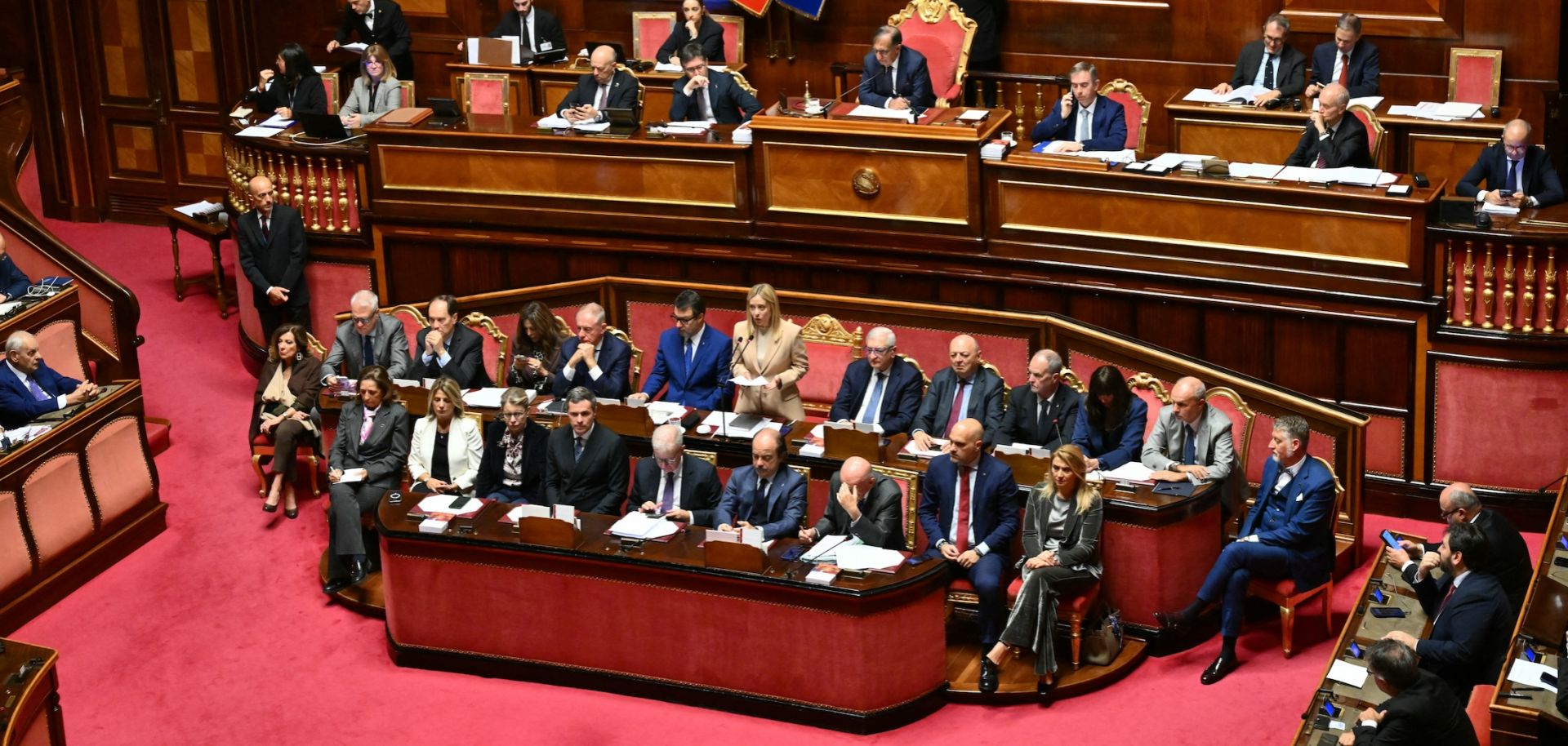
Italy's political and fiscal stability has markedly improved under Prime Minister Giorgia Meloni, and while upcoming institutional reforms could help her further consolidate power ahead of the 2027 elections, weak growth and the expiry of EU recovery funds may compel her to abandon recent fiscal prudence, potentially once again testing investor confidence in the country's fiscal trajectory. On Oct. 30, Italy's Senate gave final approval to Meloni's flagship justice reform, which establishes separate career paths for judges and prosecutors and bans magistrates from switching between these roles. The proposed constitutional amendment also restructures the High Council of the Judiciary (CSM) — the top self-governing body of the Italian judiciary — into two distinct branches and expands the President of the Republic's authority over appointments, promotions and disciplinary action. The reform will now proceed to a confirmatory referendum, expected in March or April, where Italian voters will decide whether the constitutional changes take effect.
- The government argues the reform will improve accountability and efficiency within the judiciary, though critics warn it could weaken prosecutorial independence and expand political influence, heightening concerns of rule-of-law backsliding amid already tense relations between the executive and the judiciary. The European Commission and Parliament have raised concerns about the rule of law in Italy under the Meloni government, citing potential interference with the judiciary as one of the reasons. However, despite the controversies surrounding it, the judicial reform is unlikely to have a major practical impact because it primarily focuses on altering institutional structures, rather than affecting court decisions. Consequently, the changes are expected to have few tangible implications for the rule of law or for companies operating in Italy, beyond contributing to broader debates over judicial independence and the state of democracy in the country.
Meloni's coalition has become Italy's longest-serving government in over a decade, combining rare political stability and fiscal prudence with pragmatic EU engagement and a conservative domestic agenda that has consolidated her position at home and strengthened her influence in Brussels. In September 2025, Meloni's right-wing coalition became Italy's longest-serving government since former Prime Minister Silvio Berlusconi's 2011 coalition and only the third in the country's postwar history to reach three years in office. This stability — a contrast to the significant political uncertainty plaguing other European countries, like Germany, France, the United Kingdom and Spain — stems from the coalition's comfortable parliamentary majority, solid approval ratings for the three ruling parties and broad policy alignment. When Meloni took office in October 2022 at the head of Italy's most right-wing government since World War II, many feared a shift toward euroscepticism, a more conciliatory stance toward Russia and fiscally irresponsible policies. But three years later, those concerns have largely failed to materialize. Constrained by geopolitical and economic realities, Meloni's government has maintained fiscal prudence, upheld support for Ukraine in its war against Russia and pursued pragmatic cooperation with the European Union, including on sensitive issues like migration — helping Meloni to emerge as an increasingly assertive voice in Brussels. Domestically, Meloni has balanced this moderation with a conservative agenda focused on traditional family values, tighter migration controls and stricter law and order measures.
- Meloni's personal popularity and that of her Brothers of Italy (FdI) party have both risen since the 2022 elections. FdI, which won 26% of the vote in 2022, has since stabilized at around 31% in opinion polls. Meloni's coalition partners — Matteo Salvini's Lega and Antonio Tajani's Forza Italia — have also maintained steady backing of roughly 8% each. Meloni's own approval rating is around 42%, which is higher than that of many of her European counterparts, including embattled German Chancellor Friedrich Merz and French President Emmanuel Macron.
- Recent political milestones have further strengthened Meloni's position. In June, an opposition-backed referendum on citizenship and labor reforms failed to reach the 50% turnout threshold by a wide margin. The failed referendum underscored the continued weakness and fragmentation of the Italian left, as well as the ruling coalition's success in mobilizing its base through a boycott campaign, aided by Italy's traditionally low participation rates in referendums.
The upcoming justice referendum and planned electoral reform will influence Meloni's reelection prospects in 2027, carrying both the risk of a political setback and the potential to strengthen her government's control over parliament. Should Italian voters support the justice reform, it would strengthen Meloni's position ahead of the 2027 parliamentary elections. Unlike an abrogative referendum, the vote does not need a specific voter turnout to be valid, reducing the risk for Meloni that low turnout could invalidate the result and turn a lack of participation into a political defeat. Still, referendums in Italy have historically proven to be politically risky for those in power, as seen in 2016, when a failed constitutional vote eroded then-Prime Minister Matteo Renzi's authority and ultimately forced him to resign. The referendum on Meloni's judicial reform could likewise evolve into a broader judgment on her government. Even if a specific voter turnout is not needed, the level of voter participation will be key in determining the political weight of the outcome, as one supported by high turnout would carry much greater legitimacy than one decided with limited voter engagement, regardless of the ultimate result. Meanwhile, the government is also preparing an electoral reform to grant a larger majority bonus to the winning coalition ahead of the 2027 elections, a move aimed at boosting Meloni's reelection chances and strengthening her parliamentary majority. The plan, currently on hold and still under discussion within the coalition, likely reflects concerns that Meloni's bloc could struggle to retain control of key parliamentary seats — and may even lose its Senate majority — if opposition parties were to unite behind a single electoral front.
- Despite ongoing fragmentation among Italy's left-wing opposition parties, a unified electoral front could still threaten Meloni's majority under the current mixed system, which allocates roughly one-third of parliamentary seats through first-past-the-post races and the rest proportionally. In this setup, coordination among opposition forces can have a decisive impact, as internal polling indicates that if the Democratic Party, Five Star Movement and smaller centrist groups were to agree on single candidates in each constituency, they could win several first-past-the-post districts (particularly in the south), potentially depriving the governing coalition of its Senate majority in 2027.
- The electoral reform that Meloni's government is considering would overhaul seat allocation by scrapping most first-past-the-post districts and shifting to a fully proportional system with a majority bonus granting the leading coalition up to 55% of seats if it wins around 40% of the vote. Such a system would secure a more stable majority for Meloni, while also limiting opposition gains in competitive single-member constituencies. The proposal could be passed through ordinary legislation that would not require a referendum.
- In 2016, then-Prime Minister Matteo Renzi called a constitutional referendum aimed at reducing the size and powers of the Senate, streamlining lawmaking and strengthening the executive to ensure greater government stability. The reform quickly turned into a referendum on his leadership. Nearly 60% of voters rejected the proposal, with a turnout of around 65% (a relatively high level in Italy), prompting Renzi to resign the following day.
Political stability and fiscal discipline have bolstered market confidence and financial stability, but Italy has struggled to translate this into sustained economic growth amid deep structural weaknesses and sluggish reform progress, raising the risk of renewed fiscal loosening and market unease in the coming years as EU recovery funds come to an end. Italy's government cut the fiscal deficit from 8.1% of GDP in 2022 to a projected 3.0% this year and 2.9% next year, according to the International Monetary Fund. This fiscal improvement prompted upgrades to Italy's credit ratings and narrowed the country's bond spread with Germany, a key benchmark of investor confidence and perceived sovereign risk within the eurozone. Yet much of Italy's economic growth challenges stem from deep-rooted structural factors that long predate Meloni and which her government has so far largely failed to address. These problems include low productivity, regional disparities, excessive bureaucracy, an aging population, a fragmented industrial base dominated by small firms, and a slow judicial system. Such challenges are now also being exacerbated by more recent headwinds, such as high energy and input costs, further constraining Italy's industrial competitiveness and investment attractiveness. According to ISTAT, Italy's national statistics office, industrial output has fallen by roughly 7% since Meloni took office in October 2022. ISTAT also projects GDP growth at only 0.5% in 2025 and 0.8% in 2026 (after a modest 0.7% increase over the previous two years), well below the eurozone average. Additionally, Meloni's administration has pursued gradual reforms — including a multi-year tax overhaul to simplify brackets and ease corporate burdens, a review of Italy's consolidated financial markets law (the Testo Unico della Finanza) to modernize capital markets, and measures to cut red tape. However, progress on these initiatives has been slow and uneven. Many remain under discussion or have only been partially implemented, with business leaders and industry groups often criticizing them as symbolic rather than transformative. The European Union's 200-billion euro post-pandemic Recovery and Resilience Plan has been a key driver of reforms and investment in Italy, but with these funds expiring in 2026 and few new growth drivers emerging, Rome will struggle to translate political stability into stronger growth by the next election cycle, especially as the full impact of higher U.S. tariffs is yet to be felt on Italy's export-oriented sectors. This could prompt Meloni's government to ease its recent fiscal discipline to stimulate growth at the risk of renewed market unease over the country's fiscal trajectory, given its debt-to-GDP ratio remains very high at around 137%.
- In September, Italy's 10-year borrowing costs fell to match those of France for the first time since 1998, underscoring investors' confidence in Rome's improved fiscal outlook and relative political stability, in sharp contrast with France's. As of Nov. 4, Italian yields stood only slightly above French levels, at 3.4% versus 3.44%, while the spread over German Bunds narrowed to around 75 basis points, down from nearly 250 in mid-2022 and marking its lowest level in decades.
- Credit-rating agencies have generally rewarded Italy's fiscal discipline and political stability. S&P upgraded its sovereign debt rating for Italy to BBB+ in April 2025, Moody's shifted its Baa3 outlook to positive in May, and Fitch raised its Italy rating to BBB+ in September.
- Last month, the Bank of Italy lowered its 2026 growth forecast from 0.9% to 0.7%, citing the euro's recent appreciation and the impact of U.S. tariffs (which are now set at 15% for most EU exports to the United States).
