
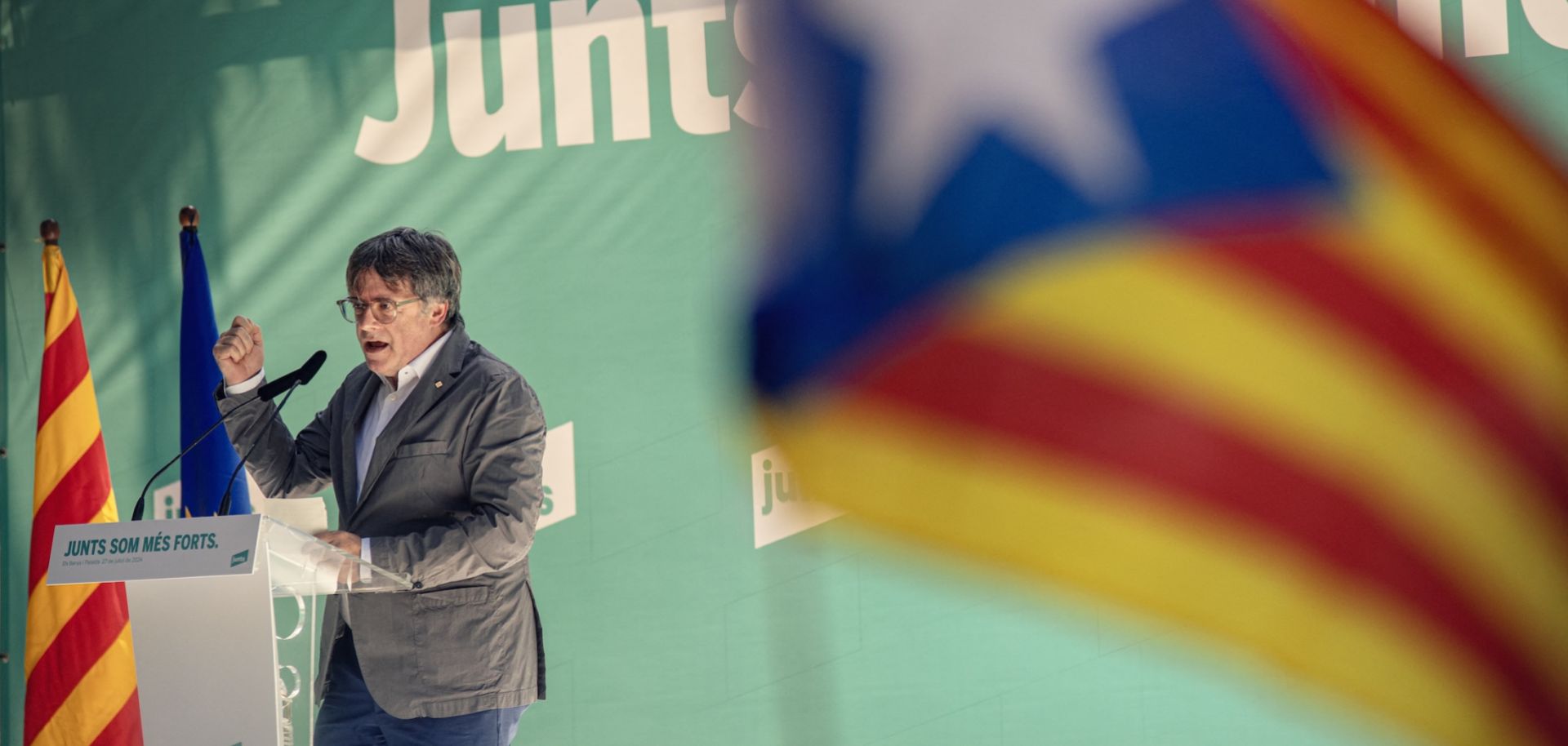
The end of a political pact between Spain's governing party and a Catalan regional party will deepen legislative paralysis, undermine Prime Minister Pedro Sanchez's ability to govern, and open the door to an early election amid mounting domestic and international pressures. On Oct. 27, Catalonia's pro-independence Junts party announced the end of its political pact with Spain's ruling Socialist Party, accusing the government of not honoring the terms of their agreement. In a press conference, Junts leader and former Catalan president Carles Puigdemont said the party was ''not willing to keep helping a government that does not help Catalonia.'' As a consequence of this decision, a consultation forum between Junts and the Socialist Party (which had facilitated 19 meetings between the two parties over the past two years) will be dissolved. Reacting to Junts' announcement, the Socialist Party issued a press release saying that it remains open to dialogue with its former ally and denied any accusations of not having honored the terms of their pact.
- Spanish Prime Minister Pedro Sanchez's Socialist Party finished second in the July 2023 general election, falling short of the seats needed in parliament to secure his reappointment without support from smaller parties. To remain in power, the Socialist Party reached deals with several smaller parties. This included a deal with Junts in November 2023, under which Junts agreed to support Sanchez's investiture in exchange for several concessions, including the approval of an amnesty law for Catalan politicians and activists involved in the illegal 2017 independence referendum.
- While Sanchez's government fulfilled some of its commitments — most notably the passage of the amnesty law in May 2024 — Junts has accused him of failing to deliver on others, such as granting Catalonia greater control over migration policy and making Catalan an official language of the European Union. In addition, Spanish courts have suspended key parts of the amnesty law, particularly those that would allow Puigdemont to return to Spain, after he fled to Belgium in 2017 to avoid arrest.
Junts' decision to break its pact with the Socialist Party follows months of mounting tensions and corruption scandals that had already been straining Sanchez's ability to govern. The Socialist Party and its coalition partner, the left-wing Sumar alliance, together hold only 146 of the 350 seats in Spain's Congress of Deputies. To pass legislation and fend off censure motions from the opposition, Sanchez has relied on support from several smaller parties, including Junts. However, the worsening of relations between the two parties has made it difficult for the government to pass laws. In December, Junts sided with the conservative opposition to block a government proposal to raise taxes on energy companies, and in September, it did the same to halt a plan to shorten the work week. The rupture also came amid a series of corruption scandals affecting Sanchez's government, including one involving alleged kickbacks and inflated face mask contracts during the COVID-19 pandemic, tied to a former adviser to Sanchez. Finally, Junts' move coincides with the rise of the far-right, anti-immigration, pro-independence Catalan Alliance, which is gaining ground in polls and threatening Junts' support among more conservative secessionist voters.
- A September opinion poll published in the Spanish newspaper La Vanguardia indicated that if regional elections were held in Catalonia, Junts' seats in the Catalan parliament would fall from 35 to 21. Conversely, the Catalan Alliance would see a substantial increase, growing from just two to 19 seats in the 135-seat parliament.
The collapse of the alliance will intensify Spain's legislative paralysis, highlighting the government's growing struggle to pass laws and increasing the possibility of an early general election. The pact's breakdown will immediately make it even harder for Madrid to pass legislation, which the Sanchez government has consistently struggled to do since the 2023 general election. In 2022 (the last full year of the previous parliament, when Sanchez's coalition held more seats), the Congress of Deputies passed 73 laws. In contrast, only 25 laws were passed in 2024, and just 18 so far this year. The most significant failure has been the government's inability to secure enough parliamentary support for a new national budget. The last budget was passed in late 2022 for the 2023 fiscal year, and has since been continuously extended. Should the government also fail to pass a 2026 budget, Spain will continue to operate under the extended 2022 accounts. This will likely prevent an immediate fiscal crisis, as the state would remain funded and able to spend along existing budget lines. However, Madrid would have very limited flexibility to launch new programs, shift spending priorities or respond to emerging challenges. One consequence could be the inability to increase defense spending — something both the United States and, to a lesser extent, European NATO members have been urging Madrid to do. In a low-probability but high-impact scenario, continued inaction could prompt the White House to impose higher tariffs on EU imports of Spanish goods, such as ham or wine. A third consecutive budget rollover would also deepen the perception of political paralysis and further erode the legitimacy of Sanchez's government. Although a general election is not required until July 2027, Sanchez could choose to call an early vote in 2026 to stem further losses in support and try to reassert control over an increasingly gridlocked parliament.
- The end of the Junts-Socialist pact also exposes Sanchez to a no-confidence motion from the conservative opposition, which includes the center-right People's Party and the far-right Vox party. However, according to the Spanish constitution, a no-confidence motion also involves a vote to appoint a new prime minister. Junts, a party that is critical of Spanish centralism and wants Catalonia to become an independent country, is highly unlikely to support a vote that could result in a prime minister from either the People's Party or Vox.
- According to an ElectoPanel opinion poll released on Oct. 26, the People's Party would obtain 31.2% of the vote in a general election, followed by the Socialist Party (28.3%) and Vox (18.5%). This means that both the People's Party and the Socialist Party would perform worse than in the 2023 general election (where they received 33% and 31.6% of the vote, respectively), while support for Vox would increase (it received 12.3% of the vote in 2023).
