
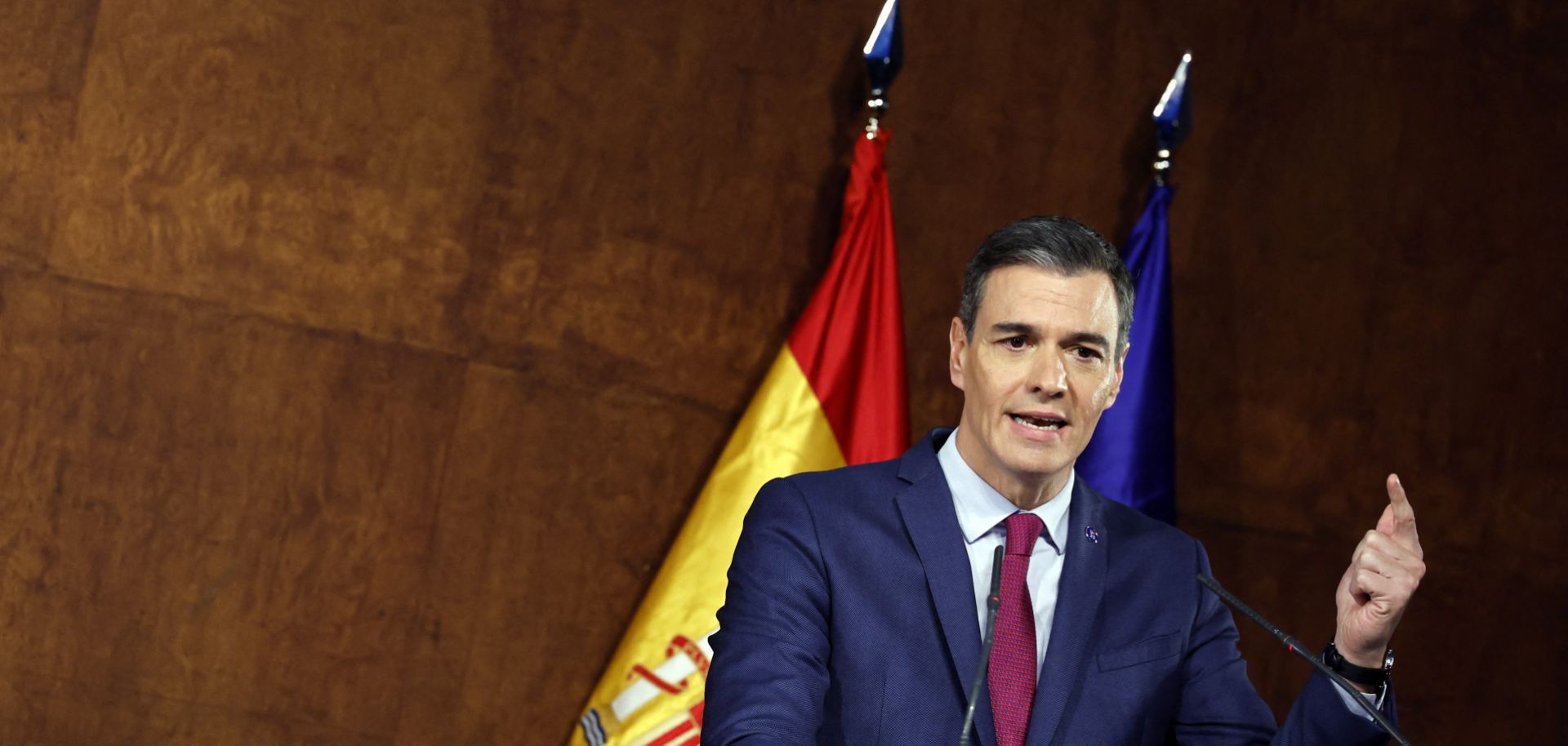
The Spanish government's decision to grant amnesty to Catalan secessionists will keep it in power and ensure policy continuity, but this will come at the cost of heightened social unrest, legal challenges from the opposition, and a renewed push for Catalan independence that will increase political uncertainty. On Nov. 9, Spain's acting Prime Minister Pedro Sanchez's Socialist Party (PSOE) reached a deal with the Catalan pro-independence Junts party according to which Junts will support Sanchez in a vote of investiture in Parliament on Nov. 16. In exchange, the new Spanish government will pass an amnesty law for the Catalan political and institutional leaders who were involved in the region's independence process between 2012 and 2023, which included the organization of an illegal independence referendum in 2017. The agreement between PSOE and Junts came after several days of street protests at PSOE's headquarters in Madrid against the deal and ahead of a country-wide demonstration on Nov. 12.
- Spain held an inconclusive general election in July, in which the center-right People's Party (PP) won the most seats but not enough to form a government. Sanchez's PSOE ended in the second position, also without enough seats to form a government.
- In late September, PP leader Alberto Nunez Feijoo lost a vote of investiture in Parliament, paving the way for Sanchez to seek his own investiture vote. To form a government, PSOE and its left-wing partner Sumar need support from two secessionist parties in Catalonia, the Republican Left of Catalonia (ERC) and Junts, in addition to smaller parties in the Basque Country. If no government is formed by Nov. 27, Spain must hold an early general election on Jan. 14.
- In late October, Sanchez made financial concessions to the Catalonian government to secure the ERC's support, including writing off 15 billion euros in Catalonia's debt to the Spanish central government and promising additional investments in infrastructure in the region. Negotiations with Junts were more complicated because the party demanded an amnesty law in exchange for its support. While the law is expected to cover hundreds of people involved in the independence process for over a decade, it will particularly benefit Junts leader and former Catalan regional president Carles Puigdemont, who lives in self-imposed exile in Belgium to avoid his arrest in Spain.
The most immediate implication of the PSOE-Junts agreement is that it paves the way for Sanchez to win a vote of investiture and secure another four-year term as prime minister, facilitating policy continuity. This means that the new Spanish government will be in a position to pass legislation and implement reforms, something that it currently cannot do in its caretaker facility. This will enable Spain to continue receiving billions of euros in EU funds, which will contribute to economic growth. It will also enable PSOE and Sumar to implement their economic policy agenda, which includes higher pensions, a higher minimum salary, and additional spending on healthcare. This will probably come at the expense of higher taxes, especially for large corporations and wealthy individuals. Under Sanchez, Madrid will remain supportive of the process of EU integration, especially when it comes to EU-wide spending programs and a more flexible approach to fiscal deficit and debt rules. In terms of foreign policy, Spain will continue seeking close cooperation with Morocco on issues ranging from energy to immigration, while Madrid will also support continued EU financial and military assistance for Ukraine.
While the amnesty law will prevent an early general election and result in political continuity, it will also increase the risk of social unrest, legal battles and a renewed push for Catalan independence. After Sanchez wins the vote of investiture on Nov. 16, his administration will send an amnesty law to parliament, which will likely be approved in early 2024 by the same parties that supported Sanchez's investiture. The PP controls the Senate, the upper chamber of Spain's parliament. The Senate, however, can only delay but not block the law, meaning the PP and the right-wing Vox party will fight the amnesty law in the streets and in courts. Thousands of Spaniards have already protested against the amnesty law, and these protests will grow bigger following the PSOE-Junts deal. As a result, social unrest will likely increase in Spain in late 2023 but especially in early 2024 when the law is formally debated and approved. In addition to demonstrations, the PP and Vox will legally challenge the amnesty law, both at the national and EU levels, which could start a legal battle that will add uncertainty about its future, though this process will likely take months. Another main implication of the amnesty law is that it will allow Puigdemont to return to Spain, where he will start a campaign for a legally binding independence referendum for Catalonia. But such a referendum would require a reform of the Spanish constitution, which requires a three-fifths majority in the Spanish Congress of Deputies that Sanchez and his coalition partners do not control. This means that while the amnesty law will likely trigger renewed calls for Catalan independence and add uncertainty about the region's future, a legally binding independence referendum will remain elusive in the short-to-medium term. While the risk of another illegal push for independence will persist, the ERC and Junts are interested in preserving the economic concessions that Sanchez made to Catalonia, which means that the risk of unilateral secession will remain low.
- The text of the Nov. 9 agreement says that Junts will continue to demand a legally binding independence referendum in Catalonia, while PSOE will support Catalonia's autonomy within the Spanish state.
- Roughly 7,000 people gathered at PSOE's Madrid headquarters to protest against Sanchez's plan to grant amnesty to Catalan separatist leaders. The protest led to clashes with the police, resulting in 29 police and 10 demonstrators getting injured. While the PP and Vox condemned the violence, they also accused Sanchez of triggering it by negotiating with Catalan secessionists. Following the announcement of the PSOE-Junts deal on Nov. 9, Vox party leader Santiago Abascal called for people to continue taking to the streets to protest.
- On Nov. 8, EU Justice Commissioner Didier Reynders sent a letter to the Spanish government asking for clarifications on the content of the amnesty law, arguing that the prospect of such a law was generating ''serious concerns'' both in Spain and abroad. Felix Bolanos, Spain's minister for parliamentary relations, responded by saying that while Madrid will keep Brussels informed, it cannot provide any information at this point because the law has yet to be written.
