
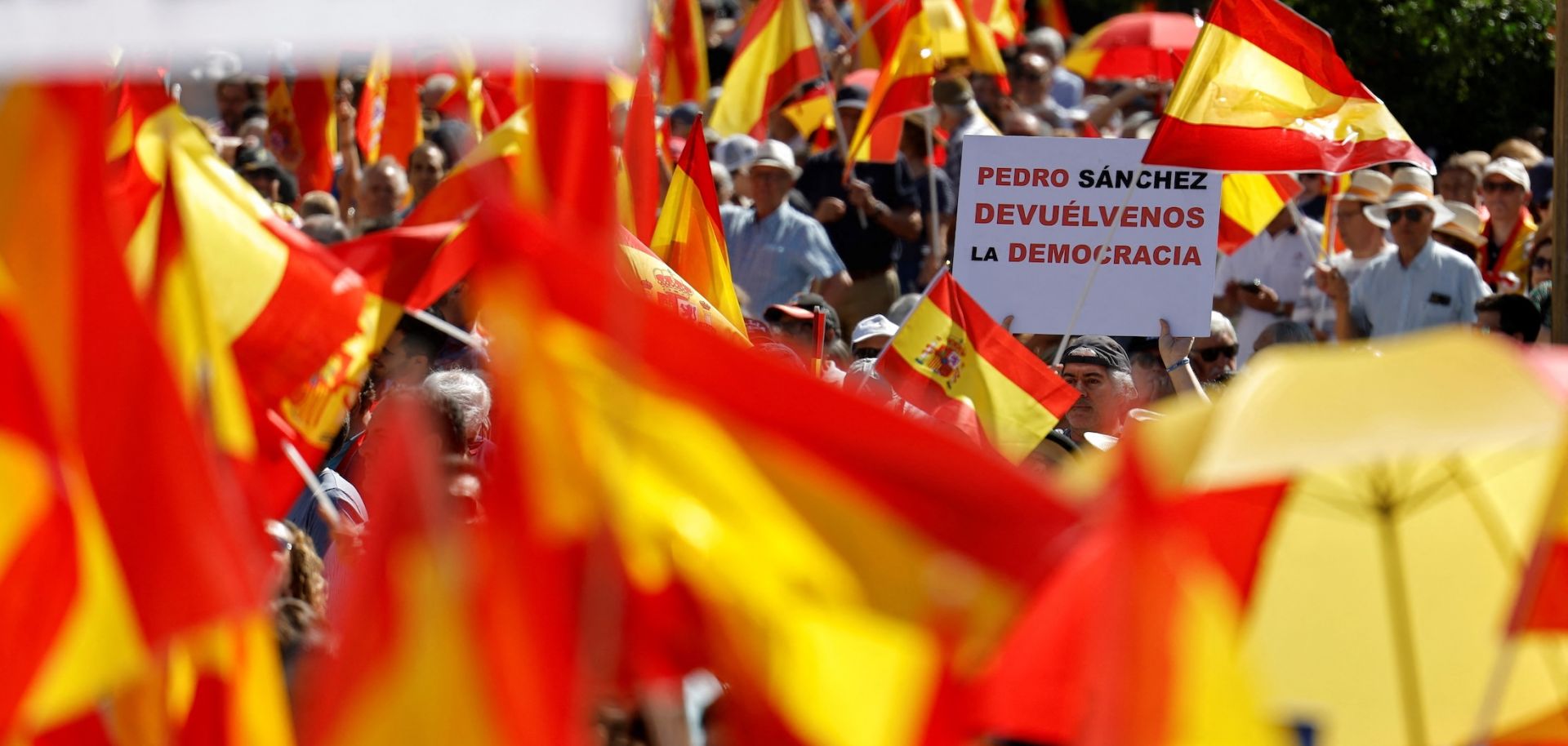
In Spain, mounting political instability, driven by corruption scandals, opposition pressure and legislative gridlock, is weakening Madrid's ability to govern effectively, complicating its commitment to hike defense spending and undermining policymaking that will worsen uncertainty for households and businesses. Thousands of people gathered in central Madrid on June 8 to protest against the Spanish government and demand Socialist Prime Minister Pedro Sanchez's resignation. The event was organized by Spain's main opposition party, the conservative People's Party, which claimed that some 100,000 people attended (the government said that some 50,000 people attended). Speaking at the event, People's Party leader Alberto Nunez Feijoo said that "Spain needs a revolution of decency and freedom" and urged Sanchez to step down and call for an early general election (Spain does not need to hold an election until mid-2027). In response, members of the Spanish government belittled the protest and mocked the alleged low turnout.
- Since the July 2023 general election, Sanchez has led a minority government that also includes the left-wing Sumar party. To pass legislation, the government relies on support from small pro-independence parties in Catalonia and the Basque Country. This has seen Madrid make significant concessions to Catalan separatists that have irritated Spanish conservatives, including approving a law granting amnesty to all people involved in the illegal 2017 Catalan independence referendum.
- The June 8 protest took place against the backdrop of a series of corruption investigations involving members of both Sanchez's family and his Socialist Party. Sanchez's wife, Begona Gomez, is being investigated for alleged corruption and influence peddling; while Sanchez's brother, David Sanchez, is facing trial over allegations of influence peddling and other offenses. Former transport minister Jose Luis Abalos is also under investigation for allegedly receiving bribes in exchange for awarding contracts to sell face masks to the Spanish state during the COVID-19 pandemic (the Socialist Party suspended Abalos's membership in February 2024). The latest scandal erupted in late May, when a former member of the Socialist Party was accused of trying to orchestrate a smear campaign against the leader of the Guardia Civil police unit that is currently investigating these cases.
Despite mounting political pressure, Sanchez is unlikely to call early elections unless shifting political dynamics or additional scandals make it strategically necessary. In the coming months, the conservative People's Party and the right-wing Vox party will continue to demand Sanchez's resignation and early elections. These parties may even trigger a no-confidence motion against the prime minister. However, the People's Party and Vox lack the necessary number of seats in parliament to oust Sanchez, especially as the Catalan and Basque parties that support Sanchez are unlikely to turn against him, as this would open the door to a conservative government that would be less willing to make concessions to them than Sanchez. Moreover, the Socialist Party is mostly aligned behind Sanchez, making an intra-party move to remove him highly unlikely. As a result, the decision to hold an early general election will be primarily in Sanchez's hands. In the short to medium term, the prime minister is unlikely to resign, especially as opinion polls suggest that an early general election would result in another heavily fragmented parliament where Sanchez would, once again, need to rely on a very heterogeneous coalition if he wanted to be re-appointed. That said, there are two scenarios where Sanchez may decide to call a snap ballot. One would be the eruption of new corruption scandals that weaken the government so much that it has little option but to call an election; this could happen if the scandal is so big that Sumar exits the coalition, or if the smaller parties that support Sanchez in parliament decide that backing him has become more of a liability than an asset. The other scenario would be if Sanchez believes that an early election could actually increase the Socialist Party's presence in parliament. In such a case, he might use the election to shift public focus from the scandals and onto the risks of a right-wing coalition between the People's Party and Vox.
- In the 2023 general election, the People's Party secured 33.1% of the vote, followed by the Socialist Party with 31.7%, Vox with 12.4% and Sumar with 12.3%. Opinion polls for the next general election show a similar situation, with the People's Party polling between four and six points ahead of the Socialist Party, but with no single party in a position to form a government alone.
In addition to slowing the implementation of domestic reforms, the ongoing political instability will impede the government's ability to pass a budget, which will likely limit defense spending increases but will also help Spain further reduce its fiscal deficit. Spain's ongoing political instability will have several implications. First, the government will likely face continued difficulties passing a national budget. The last approved budget was in late 2022, and in both 2023 and 2024, Madrid extended it due to insufficient parliamentary support — a scenario likely to repeat in 2025. On the one hand, an extended budget in 2025 will probably enable Madrid to further reduce its fiscal deficit, as it has in recent years thanks to a combination of relatively high economic growth, higher taxes on companies and households, and limited increases in public spending (in part because of the lack of new annual budgets). This is good news for the Spanish economy, where debt currently stands at roughly 102% of GDP. But on the other hand, the budgetary constraints are happening at a time when Spain is under pressure from its NATO partners to take its military spending to at least 2% of GDP this year, up from 1.3% in 2024. While Madrid has pledged to leverage unused funds from other areas to meet this commitment in 2025, without a new budget, the government will struggle to keep up with its defense spending commitments in the coming years. Beyond the budget, other policies currently in the government's agenda (which include reducing the labor week from 40 to 37.5 hours and building new homes to cope with Spain's housing crisis) will depend on the support from the small parties that back the government in parliament. This will force Sanchez's government to negotiate every single piece of legislation, which will both delay the policymaking process and increase uncertainty about whether the reforms will be adopted and with what changes.
- According to the European Commission, Spain's fiscal deficit fell from 6.7% of GDP in 2021 to 3.2%. Brussels expects Spain's fiscal deficit to fall further to 2.8% in 2025 and 2.5% in 2026.
- In April, Sanchez announced that Spain would increase military spending by 10.5 billion euros this year without cutting spending in other areas or increasing taxes. According to Madrid, this will be made possible by the government using funds it did not spend in 2023 and 2024, along with repurposed funds from EU programs. However, it is unclear whether this strategy is sustainable without a new budget that formally increases defense spending. Moreover, NATO leaders are expected to formally approve increasing the alliance's defense spending commitments for members to 5% of GDP by the early 2030s, which will prove very hard for Spain to meet. Against this backdrop, Madrid will likely push for a longer timeline to meet NATO's new 5% target and will also likely promote a laxer definition of defense spending to include efforts to fight against climate change and natural disasters.
