
Editor's Note: This assessment is the fifth installment of a series exploring whether Ukraine or Russia is more capable of emerging victorious from a protracted war. The fourth installment, which argued that Western support was unlikely to override Ukraine's inherent disadvantages in 2024 and 2025, can be found here, while the first, second and third parts can be found here, here and here.
In February 2024, we argued that Ukraine's structural manpower deficit and limited ability to deepen its strike campaign inside Russia amid underwhelming Western support constituted major obstacles to Ukraine's ability to enter negotiations with Russia from a position of strength or win the war outright. Since then, the deployment of North Korean troops in support of Russia, Donald Trump's victory in the U.S. presidential election and Russia's accelerating advances in recent weeks have offered an opportunity to update the key forces of the war.
A Weakened Case for Ukrainian Optimism in 2025
By the time Trump assumes office in the United States next year, Ukraine's ability to achieve victory will likely have reached a new low as Russian forces continue to advance. Since October, Russian forces have pushed forward at their fastest pace since 2022, having in recent months broken through well-established lines in eastern Ukraine, enabling more rapid advances against less fortified areas. Russian forces are primarily advancing along at least three axes, namely Vuhledar, Pokrovsk and Kupyansk, though they will likely step up pressure across the entire front to limit Ukraine's ability to reinforce key areas. Other than the cold winter weather expected in the coming weeks, there is little immediate reason to believe the Ukrainians will quickly arrest these Russian advances or stop them from renewing next year.
With the aid of over 10,000 North Korean forces now pressuring Ukrainian units in Russia's Kursk region, Russia's advances in Ukraine are even more likely to continue apace. Moscow believes Ukraine's Kursk incursion, which began in early August, presents an opportunity to deal major casualties to experienced Ukrainian units and will not allow Ukraine's toehold in Kursk to serve as leverage in a negotiation. As a result, Russia will continue to prioritize further advances in eastern Ukraine, particularly since Ukraine's forces would need to withdraw from Kursk as part of any peace negotiations in 2025. Kyiv, for its part, will gradually lose support for maintaining its costly salient in Russia, which has failed to change Moscow's negotiating position or significantly increase Western support. Despite widespread acceptance that Ukraine needed to test the incursion's effect on Russia and the West, Ukraine's military command and the public could increasingly pressure Kyiv to redistribute troops away from the region to slow Russia's advances in Ukraine's own territory. Therefore, Ukraine is unlikely to hold its positions in Kursk in the long term and will likely withdraw from the region as soon as early next year.
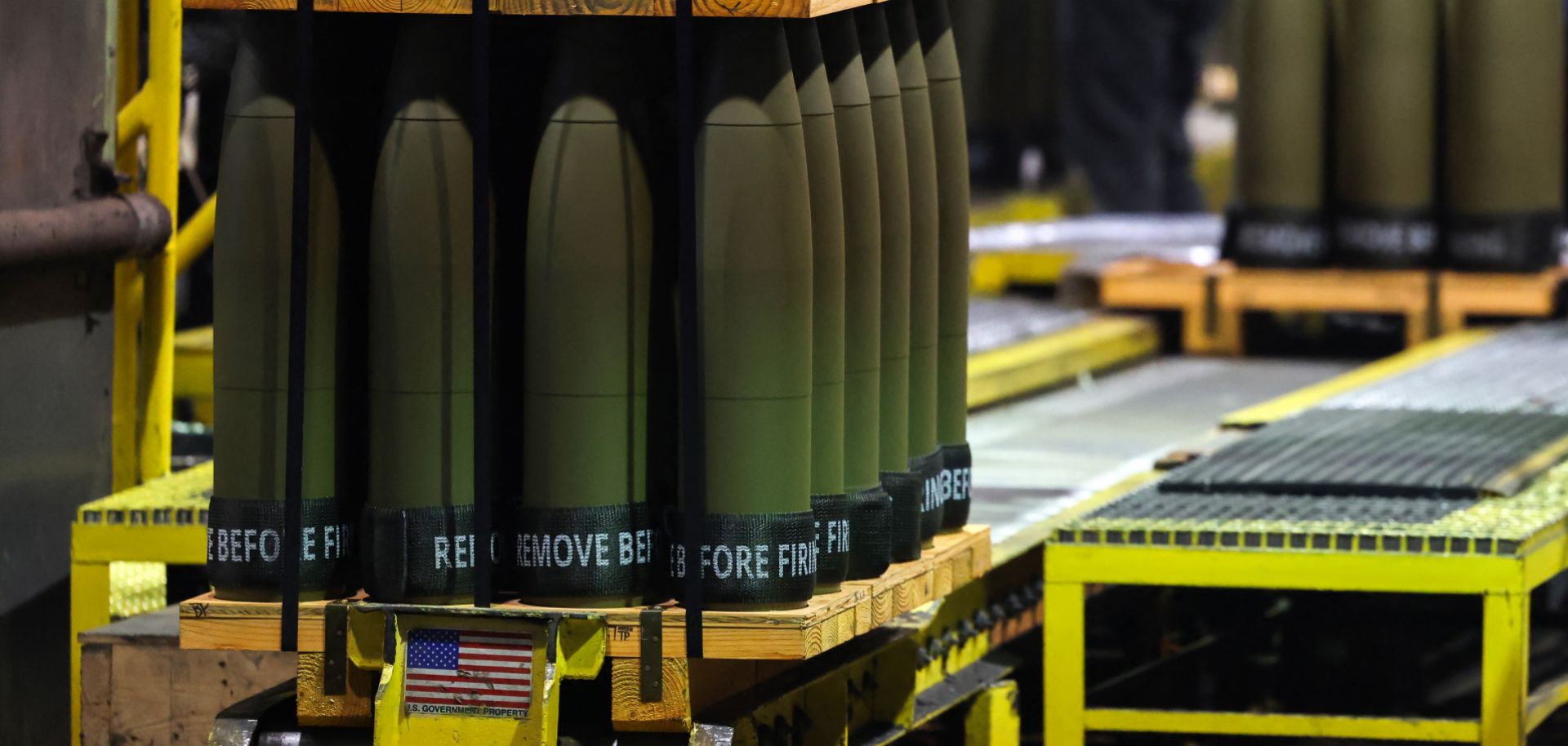
Amid these territorial losses, Ukraine continues to struggle to attain key weapons systems for its war effort. The case for Ukrainian optimism in 2025 was largely premised on the West providing Ukraine greater access to weapons amid expanded Western arms production for key systems such as artillery and anti-air interceptor missiles finally coming online. But for now, there is no strong signal that this will be the case, as increasing U.S. production remains insufficient to replace stockpiles, while European states, despite production increases of key munitions such as 155 mm artillery production, currently lack the industrial capability to mass produce other key systems for Ukraine, like anti-air systems and interceptor munitions. There is little indication that European states have the funds to alter course by increasing production, and even if further investments materialize, most would take well over a year to produce weapons that reach the Ukrainian battlefield.
Arguably the greatest source of optimism for Ukraine is Russia's own difficulty procuring arms. In October, Russia lost more armored vehicles, aircraft, helicopters and other equipment than in any other month since October 2022, when the Russian military was expelled from Ukraine's Kharkiv region in a surprise offensive. At the same time, despite the Russian government's claims of constantly growing military-industrial potential, there is little data to support the idea that Russia's production of key systems has grown much larger than 10% compared with last year. In fact, accounting for key inputs' production volumes and the ruble's inflation, the production growth rates of most Russian weapons have stagnated this year, leading many economists to conclude that annual production growth rates likely peaked.
That being said, Russia is stockpiling certain long-range munitions that could strike the remaining substations around Ukraine's nuclear power plants and ensure that this winter, already likely to be Ukraine's most difficult in recent history, could include 20-hour nationwide power outages. The demographic damage of Ukrainians fleeing winter blackouts would provide Moscow significant leverage over Kyiv and the West, providing another reason Western governments could delay a decision on allowing Ukraine to use long-range strike capabilities into next year.
Ukraine's Structural Manpower Deficit and Moscow's Growing Advantage
Ukraine's manpower shortage will continue to weigh heavily on its ability to achieve victory or even end hostilities without a capitulation to most Russian demands. Reports suggest Ukraine's daily manpower intake of new recruits peaked at around 30,000 per month after parliament passed an updated mobilization law in April. For most of the summer, this increase enabled Ukraine to meet Russia's monthly intake numbers of approximately 25,000-30,000 per month.
But more recent reports, including those citing Western intelligence estimates, show that Ukraine's monthly intake has again likely fallen below 20,000, meaning Russia may be better positioned to replace losses and grow its frontline manpower advantage with each passing month. On Oct. 29, Ukraine announced another round of mobilization of 160,000 people to raise the staffing levels of units by over 85%, but Kyiv did not provide further details. The nature of the announcement suggests the number is likely a quota that local military administrations will have to meet through the cancellation of previous exemptions, showing that Ukraine's mobilization is bringing greater social friction and economic damage than Russia's.
Additionally, Russia's tapping of North Korean manpower will enable Moscow to strengthen its biggest advantage over Ukraine even further. In mid-October, South Korea said the North would deploy four brigades of up to 12,000 troops to support Russia, and the United States has since confirmed that North Korean soldiers will soon enter combat on Russia's side. Considering that North Korea has an estimated 1,320,000 active duty personnel, a mere doubling of the North Korean contingent would appear entirely manageable and cut Russia's monthly manpower recruitment burden by roughly one-third for any given month, further easing the economic and social burden of mobilization. Notably, it is unclear what the upper bound on this new manpower source is for Moscow, as North Korea's leadership is likely highly interested in exchanging forces for Russia's economic support in the form of cheap food and fuels, technical support for North Korea's military modernization, and experience in modern warfare.
Although a second round of Russian mobilization in 2025 remains possible, it is unlikely at least in the short term amid Moscow's successful strategy of offering higher compensation to recruits, particularly since the Kremlin may not want a military escalation to undermine the incoming U.S. Trump administration's attempt to pursue a negotiation. Additionally, another mobilization would prompt more Russians to flee their own country and come at the cost of inflation. But should a Trump team's negotiation efforts with Moscow fail to result quickly in reduced support to Ukraine and a cease-fire, Moscow could conduct further mobilization toward the middle of next year with manageable social and economic repercussions, framing the move as a ''mobilization for victory'' that would further decrease Ukraine's and the West's negotiating leverage and push them to soften their stances in negotiations.
Overall, these factors will make it difficult for Ukraine to resist Russia's invasion reliably unless it can better tap into the manpower of its Western backers and other international partners. But here the situation is very pessimistic: while French President Emmanuel Macron broached conversions with allies on a possible Western non-combat deployment to Ukraine to free up more Ukrainian manpower for frontline combat service, these talks quickly stalled, although some Eastern and Northern European states privately expressed some cautious openness to further discussions. Unless this conversation is renewed in some fashion, even if only in the context of a post-cease-fire force to help secure Ukraine, Ukraine's manpower disadvantage will likely worsen next year.
Western Security Guarantees and Strategic Deterrence of Russia
Ukraine and the West's definition of a Ukrainian victory will likely continue to atrophy throughout 2025 as it did in 2024 following the failure of Ukraine's 2023 counteroffensive. Ukraine's new definition of victory will not involve returning any of its captured territories from Russia; instead, Kyiv will frame victory as merely stopping Russian advances and then receiving military support capable of deterring Russia from restarting the war after a cease-fire.
Some in the West believe that Ukraine's reluctance to accept territorial concessions along current battlelines is the largest obstacle to peace or a truly reliable end to the war. But this is a misconception, as Ukraine would accept such concessions if, in exchange, the West provided it with any kind of real security guarantee that Russia could not veto by simply continuing the war. Recent statements by both the Ukrainian and Russian leaders make this clear. On Nov. 7, Ukrainian President Volodymyr Zelensky reiterated that a cease-fire is impossible without security guarantees, as they are the only way to undermine the credibility of future Russian threats to reignite the war until Kyiv and the West yield to its demands.
Blocking these guarantees is also Russia's biggest demand in negotiations, namely the removal of any guarantees to Ukraine's security in the form of eventual NATO membership (its Article V protections and associated nuclear umbrella) or Western support capable of strategically deterring Russia from renewed invasion. Indeed, Russia's invasion is driven less by a desire to seize territory, and more by a desire to keep Ukraine from securing such guarantees. Putin reiterated this on Nov. 7 during his speech at the annual Valdai Forum, in which he implied Russia did not need to occupy all of the Ukrainian territory it claims, saying ''everything depends on the dynamics of the events taking place,'' and instead stressed that peace hinged on Ukraine's neutrality, noting it was otherwise ''difficult to imagine the existence of any good-neighborly relations between Russia and Ukraine.''
Putin and Moscow's vague and constantly shifting rhetoric on the territories is intended to encourage Western countries to accept negotiations with him by reinforcing the idea that Russian acceptance of a cease-fire on current battlelines is possible. Putin will likely initially insist on the annexation of the Ukrainian regions in their administrative borders in negotiations with Trump in order to frame openness to forgoing the rest of the territories as a concession by Russia, to which the West would have to reciprocate by meeting Russia's other biggest demand in exchange for stopping the war: an end to Ukraine's NATO prospects and military limitations to stop Ukraine from being able to strategically deter Russia — a sort of guarantee of Ukraine's indefensibility. The latter is necessary to stop Ukraine and the West from reneging on a deal and suddenly securing Ukraine or bringing it into NATO at a later time in a way Russia would be conventionally deterred from interrupting.
While Ukraine is pursuing building its own weapons, including ballistic missiles and armed drones, these systems will never be available in large enough quantities to seriously deter Russia, leaving Ukraine still dependent on Western weapons that Russia aims to halt. This is precisely why Zelensky's five-point ''victory plan,'' revealed in a speech to his country's parliament on Oct. 16, is focused on Ukraine receiving security guarantees in both political and military forms in the hope that a combination will be strong enough to deter Russia and achieve an acceptable peace. Politically, it calls for an invitation for Ukraine to join NATO. Even if the country is not rapidly accepted into the alliance, as this involves a lengthy ratification process among member states, it is intended to show that Moscow cannot continue to insist on Ukraine's neutrality in peace talks. But even if Ukraine's Western political integration is blocked in a peace deal, the rest of the plan involves receiving security guarantees through Western weapons, in order to provide Ukraine with more robust defensive capabilities that can increasingly transfer the war into Russian territory and thereby establish non-nuclear strategic deterrence vis-a-vis Russia.
The incoming Trump administration, however, is less likely to test Russia's red lines by providing Ukraine any strong security guarantee of either a political nature in the form of NATO forces or a military nature in the form of powerful weapons such as Tomahawk missiles, which Ukraine has reportedly asked for. Instead, the Trump administration could frame any agreement that prevents Ukraine from securing deterrent capabilities as the country's best bet to not be at war with Russia.
Some have labeled such a deal as a ''Minsk III'' agreement, as it would be vaguely similar to the Minsk Agreements, which allowed for a cease-fire between Ukraine and a Russia-backed insurgency from 2015 to 2022, a deal intended to allow Moscow to exercise leverage over all of Ukraine by restricting Kyiv's foreign and domestic policy. Such a peace deal, however, would present a significant threat to Ukraine's security given that this would not be acceptable to much of the Ukrainian public unless as a last resort should the country be incapable of further resistance and its remaining territories overrun, as Kyiv seeks an independent foreign and domestic policy outside of Russian control. Meanwhile, if Ukraine accepts an end to hostilities with terms less favorable than the unfulfilled Minsk Agreements, it could trigger increased domestic turmoil, destabilizing the country and encouraging Moscow to prolong the conflict.
Even Zelensky's nominal political opponents in Ukraine understand this threat. For example, on Nov. 6, former Ukrainian President Petro Poroshenko named five ''red lines'' for Ukraine in any negotiation with Russia in the context of Trump's return to the U.S. presidency. These include no relinquishing of claims to territory, no compromises on Ukraine's independence or ''return to Russia's zone of influence,'' and no limitations on the power of the Ukrainian Armed Forces, as they are ''the most reliable and effective guarantor of the continued existence of the Ukrainian state.'' Additionally, Poroshenko stressed the need to ''convince Trump that no other alternative to ending the war that he is talking about can take place'' without at least the prospect of Ukrainian membership in NATO.
For Ukraine to achieve even a minimalist definition of victory, all of this means that the United States and the broader West would have to surprise Russia and throw its current calculations and expectations off balance by providing much stronger support to Ukraine via more strategic and assertive actions. This could entail removing restrictions on U.S. weapons supplies to Ukraine and their use inside Russia. It could also involve enacting more economic measures aimed at hurting Moscow's finances, such as breaking up OPEC+ and crashing oil prices worldwide through increased U.S. production and tougher enforcement of the G-7 price caps on Russian oil and gas products. But these steps remain unlikely, even with Trump returning to the White House. Therefore, Ukraine's definition of victory and prospects for it are at risk of further dimming throughout 2025.
