
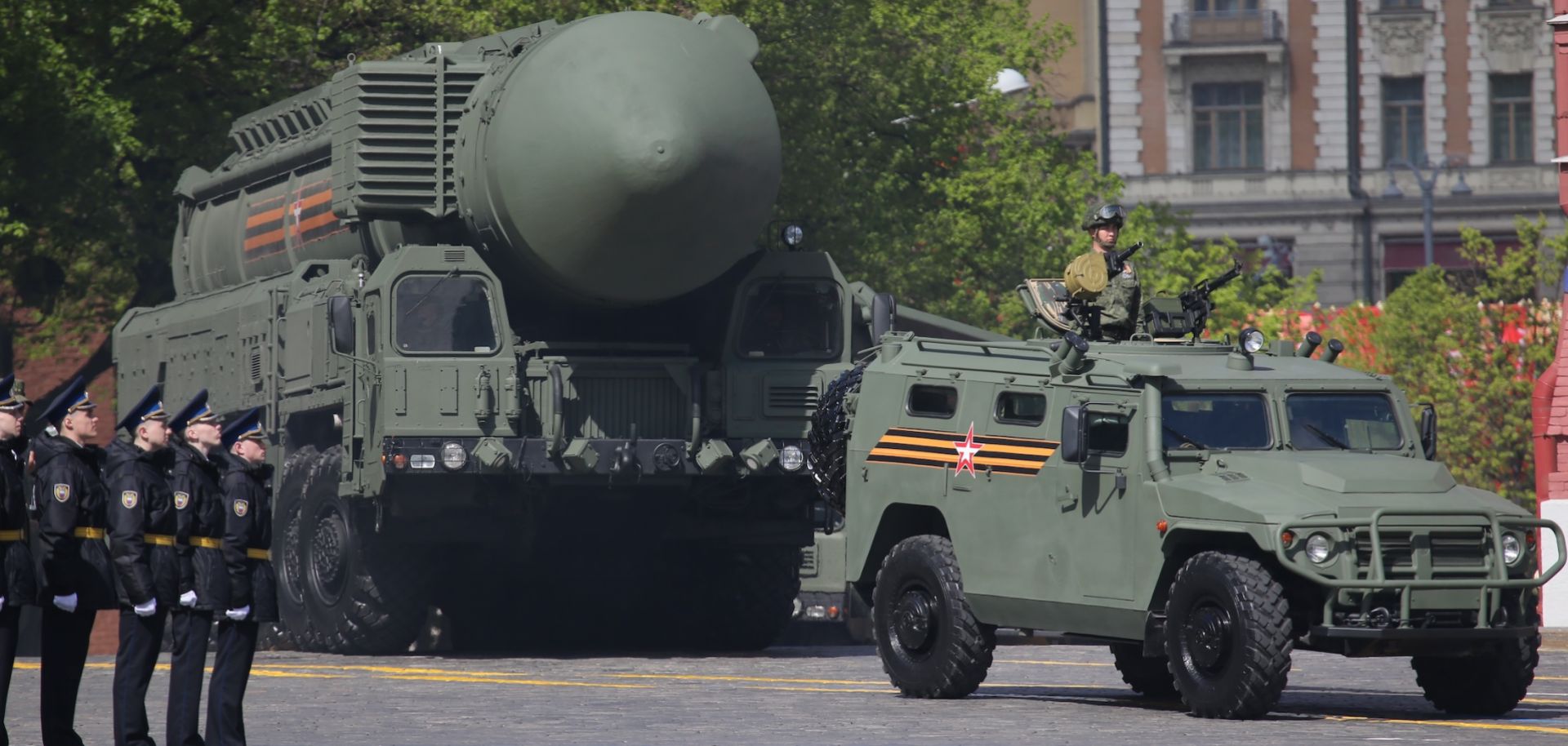
Russia's recently announced changes to its nuclear doctrine are unlikely to have much success in limiting Western support to Ukraine, but Russia remains unlikely to use nuclear weapons for the foreseeable future because its battlefield position and leverage over Ukraine will likely remain secure. On Sept. 25, Russian President Vladimir Putin announced that, as the result of an inter-agency analysis, he was proposing several key changes to Russia's nuclear doctrine that would be imminently approved. Putin said the list of governments and alliances against which Russia exercises nuclear deterrence would be expanded, as would the list of threats that could warrant a nuclear response by Russia. Specifically, the Russian president announced that aggression against Russia by any non-nuclear state that was backed by a nuclear-armed country would now be considered a ''joint attack'' that could elicit the use of nuclear weapons. Additionally, Putin specified that Russia would consider deploying its nuclear arsenal if it received ''reliable information'' that a ''massive launch of attack vehicles'' had entered Russian territory, with such vehicles being defined as ''strategic or tactical aircraft, cruise missiles, drones, hypersonic and other aircraft.'' Finally, Putin said Russia's updated doctrine would specifically authorize the use of nuclear weapons in response to conventional attacks against Belarus, Moscow's close ally.
- Putin said the updated doctrine would describe the use of nuclear forces as ''an extreme (final) measure to protect the country's sovereignty,'' but did not describe the extent to which he felt Russia's sovereignty was currently under threat. The new doctrine will likely be published in the coming days or weeks and may include other details, though notable changes beyond those mentioned by Putin are unlikely. The current version of Russia's nuclear doctrine was signed by Putin and published in June 2020. It includes four cases in which the Russian president can decide to conduct a nuclear strike: the launch of a ballistic missile attacking Russia or its allies; the use of nuclear weapons or other types of weapons of mass destruction against Russia or its allies; a major attack against critical infrastructure or military facilities (presumably including through cyberattacks or other non-kinetic means); and an attack on Russia using conventional weapons if it threatens the existence of the Russian state.
- Discussions of the possible need to adjust Russia's nuclear doctrine have been underway in Moscow since 2023. Russian security commentators had argued that while the current doctrine was more or less correct in identifying the conditions under which Russia could use nuclear weapons, the current version of the document was not fulfilling its deterrent purpose in key areas. They proposed being more explicit to instill greater fear of a potential nuclear strike against Ukraine or Western governments and to clearly establish deterrence concerning Moscow's satellite in Belarus, an inseparably aligned government via the Union State.
Despite the changes, Russia remains unlikely to use nuclear weapons as long as it can continue the war in Ukraine via conventional means and maintain dominating leverage over Kyiv, thereby precluding threats to Putin's regime. Putin's latest statements and upcoming formal doctrinal changes do not change the Kremlin's preparedness or thought process regarding using nuclear weapons. Indeed, Russia's current doctrine permits the use of nuclear weapons in response to a conventional attack that broadly ''threatens the existence of the [Russian] state,'' which already gives Moscow ample grounds to use nuclear weapons against Ukraine or the West. But Russia has not used nuclear weapons since launching its February 2022 invasion of Ukraine because there has not been an acute threat to Putin's government. And Moscow remains very unlikely to do so as long as Ukraine lacks the ability to seriously threaten Russia's battlefield position, which for Kyiv, would require securing more Western weapons and mobilizing more forces to retake greater swaths of its territory in southern Ukraine. This will remain the case even after Western governments likely eventually let Ukraine use Western weapons to strike deeper into Russia, which would impose higher costs on Moscow for continuing the war, but not pose a threat big enough to warrant the use of nuclear weapons. This is because, for the foreseeable future, the West is unlikely to provide Kyiv with enough long-range weapons to jeopardize the Kremlin's ability to frame the invasion as a major success, or coerce Russia into entering hypothetical peace talks with much less leverage. Meanwhile, Ukraine's incursion into Russia's Kursk region occupied little territory and is now easily contained by Russia's more numerically superior forces, and therefore poses no threat to Putin's hold on power. Furthermore, the factors already constraining Russia from nuclear escalation earlier in the war, when Russian gains may have been locked in, remain in force. For one, nuclear use against Ukraine would remove Moscow's ability to call Western support to Ukraine escalatory by comparison. It would also risk a Russia-NATO conflict that could cause massive physical destruction, casualties and further unnecessary economic harm to Russia. In addition, deploying nuclear weapons against Ukraine could cause some of Russia's key foreign partners, such as China, as well as the thousands of international companies still operating in Russia, to reassess their ties with Moscow. Under these circumstances, arguably the most likely option Russia could resort to would be using tactical nuclear weapons, most likely in Ukraine but potentially on its own territory against Ukrainian forces in the Kursk region. Russia would argue that this is not as escalatory as using nuclear weapons against a foreign territory and would be more readily accepted by Russia's international partners as an act of self-defense. But if Russia decides to use tactical nukes in Kursk, it would also likely start deploying such weapons against Ukrainian forces in Ukraine, which Russia would claim is a justified response to Ukrainian attacks inside Russia.
- On Sept. 26, a U.S. intelligence assessment reported on by the New York Times predicted that Ukrainian use of Western long-range missiles will have little effect on the course of the Russia-Ukraine war because the amount Western allies may provide is limited. Russia possesses non-nuclear means to respond to such a move, most likely through a combination of an escalation of its ongoing sabotage campaign in the West and more devastating strikes on Ukraine this winter.
- Russia still has a long list of actions it would likely take to move up the escalation ladder before actually using nuclear weapons. These include a return of nuclear weapons tests, including test detonations of tactical weapons, threatening movements of its nuclear forces to prepare for their use, a formal increase in Russia's nuclear threat level and more explicit threats to use nuclear force.
- Russia would also likely first carry out more threatening deployments of its strategic nuclear forces, such as sending nuclear-armed submarines near the United States, increasing flights of its strategic bombers near NATO and deploying nuclear-capable hypersonic missiles along its borders. Russia would likely equip these platforms with non-traditional dual-use strategic systems popularly dubbed ''super weapons,'' such as the Burevestnik nuclear-powered cruise missile, the Poseidon nuclear-powered and armed torpedo and the Sarmat super-heavy intercontinental ballistic missile (which reportedly underwent a ''catastrophic failure'' in a test on Sept. 21).
- Russia can also engage in other forms of nuclear blackmail against Ukraine and the West without having to use nuclear weapons, for example by threatening a radiological incident in Ukraine through strikes on or near nuclear power facilities in Ukraine.
The adjustments to Russia's nuclear document are instead intended to fuel Western war fatigue and continued caution regarding support for Ukraine, but the West is still likely to eventually allow Ukraine to strike deeper inside Russia with Western weapons while Kyiv continues its air campaign against Russian transport and energy infrastructure. In his announcement, Putin did not indicate whether the West's steady support for Ukraine, including the likely decision to allow Ukraine to use longer-range weapons inside Russia, would fall under the updated conditions for using nuclear weapons. But the changes are intended to threaten the West with direct confrontation by making even more explicit Moscow's preexisting ability to use nuclear weapons in response to Ukrainian attacks. Moscow hopes these threats will fuel political developments in Western countries favorable to Russia in the coming months, particularly in the United States. The first test of Putin's statements will occur when U.S President Joe Biden travels to Germany on Oct. 10-12 to discuss future Western support to Ukraine, most notably whether to allow Ukraine to strike Russian targets with longer-range weapons such as Storm Shadow cruise missiles or Army Tactical Missile System (ATACMS) ground-launched missiles. However, Putin's comments are unlikely to stop Western leaders from eventually agreeing to extend Ukraine's strike range with Western weapons inside Russia because such strikes are likely needed to slow Russian advances and push Moscow to accept an end of hostilities. Moreover, Putin's statements will not affect Ukrainian conduct, as Ukraine for well over a year has crossed the formal lines of Russia's nuclear doctrine by conducting near-daily strikes on Russian oil and gas infrastructure using both domestically and internationally produced drones and missiles. If anything, Ukraine will see Russia's new doctrine as nuclear saber-rattling due to a lack of other options, a sign of weakness that will prompt Kyiv to double down on its campaign.
- Putin's decision to disclose the upcoming changes just before Ukrainian President Volodymyr Zelensky's meeting with Biden and other U.S. politicians on Sept. 26-27 suggests the Kremlin intends to bolster the arguments of top U.S. officials and leading politicians urging restraint in U.S. support for Ukraine. Immediately following a meeting with Zelensky in New York on Sept. 27, their first since 2019, Republican presidential candidate Donald Trump wrote on his social network Truth Social that if he does not win the November election, ''the war will never end and will escalate into World War III."
