
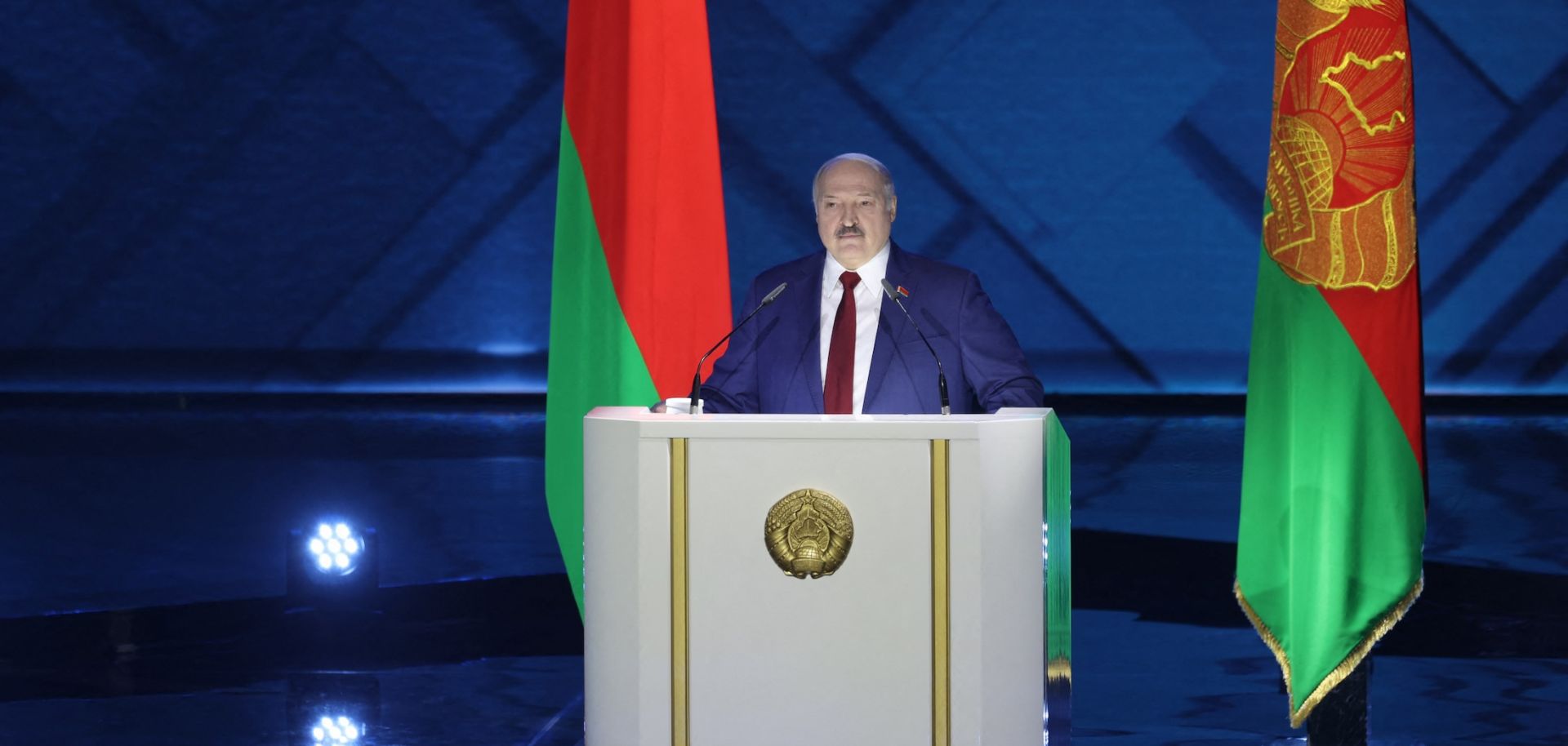
The upcoming All-Belarusian People's Assembly will further lock in Belarus' integration with Russia and prepare the country for President Alexander Lukashenko's eventual succession process. Belarus' extra-parliamentary body, more commonly referred to as the Belarusian People's Congress (BPC) by the government, will gather April 24-25 and consists of 1,200 members — primarily officeholders from the legislative and executive branches of power, as well as judiciary members and smaller numbers of delegates from non-government institutions. The convocation will be the newly empowered body's first since it received new powers in a February 2022 constitutional referendum held under neither free nor fair circumstances just three days after Russia launched its invasion of Ukraine. The constitution's amendments give the BPC the power to certify election results, impeach the president, initiate changes to the constitution, and enact a state of emergency or martial law. The BPC's new constitutionally enshrined functions also include appointing judges to the Supreme and Constitutional Courts, appointing members of the Central Election Commission, and approving the deployment of Belarusian troops to foreign territories.
- On April 10, Belarusian government organs, state-controlled trade unions and state-controlled ''civil society'' structures finalized their delegates for the BPC.
- The body last gathered in February 2021, when it did not have constitutionally enshrined functions and consisted of over 2,500 delegates. This year's lower number is due to fewer delegates from regional and local officeholders and government-loyal ''civil society'' organizations.
- Whereas previous Congresses took place every five years and were primarily designed to provide the veneer of near-unanimous and grass-roots support for Lukasheko's regime, because of its new responsibilities, the Congress will now convene at least once annually and have a 15-member secretariat that will operate all year round.
The Congress' priority is to secure the continuity of the regime during an eventual succession process, and the upcoming Congress could provide clues as to when and how this process could take place. By giving the body new powers, Lukashenko is likely seeking to prevent his successor from either deliberately or inadvertently undoing his legacy and putting those close to him at risk. Lukashenko and his allies want to prevent a recurrence in Belarus of the flawed post-Soviet successions witnessed in other nations, where the leader and his allies were sidelined upon leaving office. The most recent example weighing heavily on Lukashenko's mind is the mass unrest that swept through Kazakhstan in January 2022, casting immense doubt on the succession process that both Lukashenko and his Russian counterpart Vladimir Putin had considered a potential model. Strengthening the BPC paves the way for the creation of a long-functioning institution controlled by Lukashenko loyalists with concrete powers to constrain the next president. However, there is no guarantee this second power center will function properly in the long run or during an acute crisis, as its presumably strong constitutional powers may lead to a duality of power that could increase conflict between the president and the BPC. Due to this concern, the reforms were designed to enable Lukashenko to simultaneously lead the BPC while serving a seventh, five-year term as president in 2025. Lukashenko will most likely head the Congress while continuing to occupy the presidency. He will probably only leave the latter position when he is ready to retire from the more day-to-day responsibilities of running Belarus and appearing before the media, though he will still maintain near-complete authority over how the country is governed. The preparations are also, in part, likely out of an abundance of caution, as 69-year-old Lukashenko is aware of risks to his health and wants to ensure that the necessary structures are in place well in advance should he need to abruptly step down. However, all real levers of power, including functional control of the military, security services and law enforcement, will remain firmly under the control of the office of the president, meaning that Lukashenko is unlikely to leave the presidency until absolutely necessary. On the other hand, if Lukashenko does not head the BPC, it would suggest he is confident in his ability to remain in power, despite a handful of incidents in recent months raising questions about his physical health. It would also indicate that he thinks he already can control the BPC should health concerns prompt him to leave the presidency.
- Other than from Heydar Aliyev to his son Ilham Aliyev in Azerbaijan in 2003, there has never been an autocratic power transfer that can be considered entirely complete and successful in preserving the interests of the ruler in post-Soviet Eurasia. Lukashenko, alongside Russian President Vladimir Putin, aims to steer clear of instances akin to the unsuccessful post-Soviet successions, such as the abrupt passing of Uzbek dictator Islam Karimov in 2016, which resulted in the imprisonment of several of his family members and close associates. Another example is that of Turkmenistan's leader, Saparmurat Niyazov, who died suddenly in 2006. His former dentist and health minister, Deputy Prime Minister Gurbanguly Berdimuhamedow, was named the organizer of Niyazov's funeral and soon emerged victorious following a brief power struggle, overcoming the chairman of Turkmenistan's legislature who was supposed to become acting president per the country's constitution.
- In 2019, Kazakh President Nursultan Nazarbayev stepped down and designated a hand-picked successor as president but retained the office of head of the country's Security Council and numerous other special titles, statutory rights and protections, including immunity from prosecution. However, these measures did very little to prevent current President Kassym-Jomart Tokayev from assuming leadership of the Security Council, reversing these protections in January 2022 and subsequently conducting a methodical campaign to reduce the influence of Nazarbayev's family members through anti-corruption campaigns. Meanwhile, Yeltsin's naming of Putin as his successor in 1999 can only be called a partial success for Yeltsin and his associates at best. Yeltsin admitted before his death in 2007 that selecting Putin was a mistake, and Yeltsin's legacy has been largely repudiated by contemporary state ideology. Yeltsin's son-in-law, Valentin Yumashev, remained an advisor to Putin until 2022, but the Yeltsin family is now believed to spend much of their time outside Russia and quietly oppose the war in Ukraine.
- The head of the secretariat of the BPC, longtime loyal functionary Valery Mitskevich, claimed on April 1 that ''this is a new body, which, of course, will make decisions differently.'' These and similar statements by regime officials are intended to imply that the body will somehow satisfy the public demand for political change that prompted the months of mass protests that swept the country in the fall of 2020. The public, however, will remain disappointed; due to the lengthy jail terms imposed on those with opposition sympathies, the opposition movement is expected to persist underground or in exile throughout 2024 and 2025.
The Congress will solidify Minsk's current foreign policy toward integration with Russia and closer relations with China and other non-Western powers, while framing these developments as irreversible. The Congress' new responsibilities include ''determining the strategic vectors for the development of the state and society'' and the country's foreign policy course. To that end, the BPC is very likely to adopt resolutions or make statements calling for the inviolability of the country's current course of integration with Russia via the Union State, and for plans in this area to be completed on time or even ahead of schedule. This is important for Lukashenko because the country's pro-Russia stance is not overwhelmingly popular, and Lukashenko wants to frame the policy direction as outside of his sole personal purview and through the action of state organs, like the BPC, purportedly representing a broader segment of Belarusian society. The body will likely simultaneously call for new agreements to solidify Belarus' growing ties with China and other non-Western countries in order for Minsk to replace the West as the counterweight to Russia's growing economic influence and enable Belarus to engage in geopolitical balancing. Ties with China and other third countries are important to help prevent Lukashenko's government from becoming fully reliant on Russia, which could eventually result in pressure from Moscow for more unpopular moves, such as allowing volunteer ground forces to support the war in Ukraine. The BPC's calls for economic ties with China and other Global South countries are intended to provide leverage for Lukashenko's government in its integration negotiations with Russia to secure terms that better preserve living standards in Belarus and do not impinge on the interests of the country's economic elites.
- On March 6, Belarusian Foreign Minister Sergei Aleyni told the foreign ministry's collegium that the BPC ''demonstrates to foreign countries genuine democracy, and not a copy of Western pseudo-democratic patterns.'' This statement shows how Belarusian authorities will try to use the BPC to ingratiate themselves with other illiberal governments around the world.
