
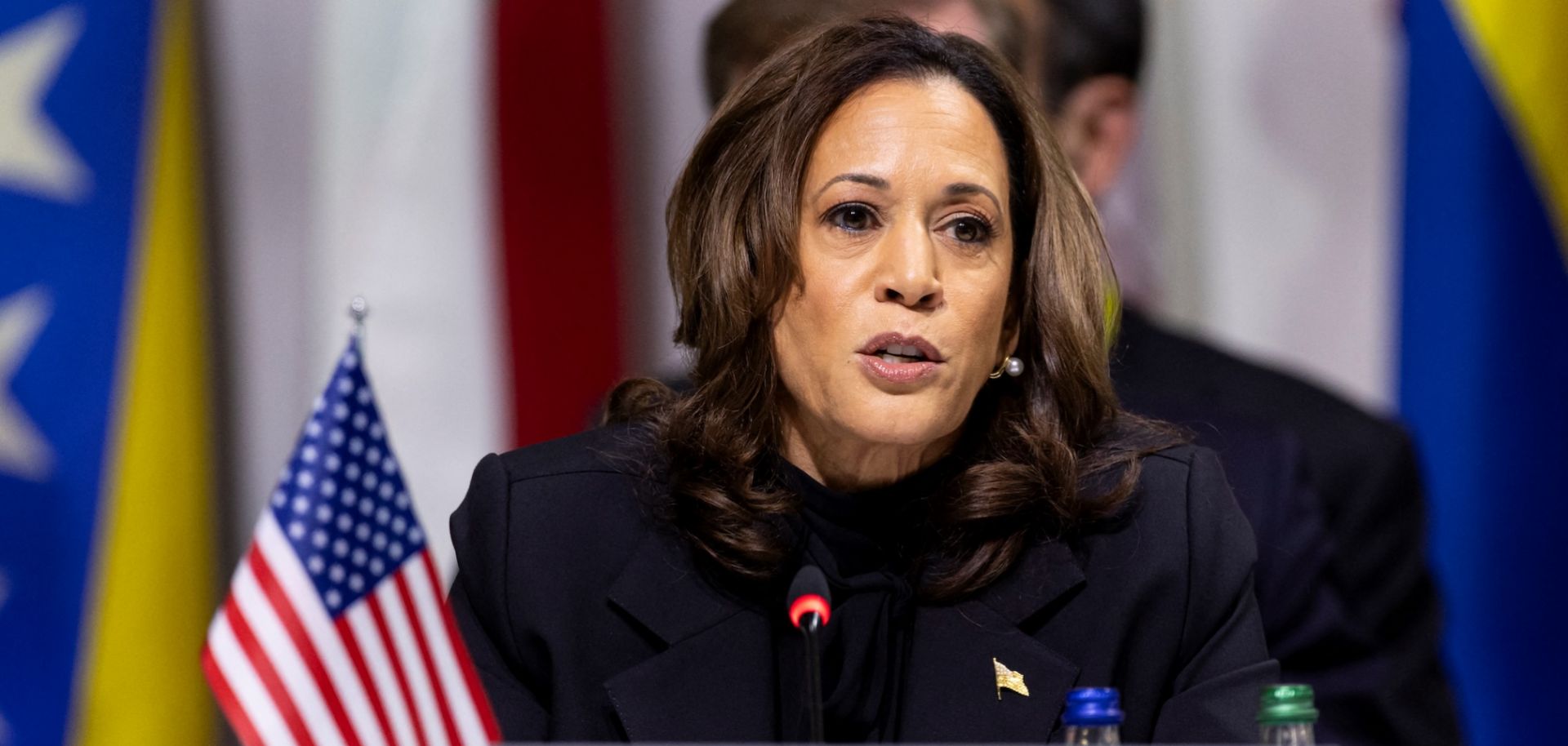
If elected U.S. president in November, Kamala Harris will likely seek to maintain support to Ukraine around current levels in 2025, but developments on the battlefield and Russia's more aggressive actions against the West could result in stronger U.S. support for Kyiv or, in less likely scenarios, U.S. pressure on Ukraine to accept a peace deal or a broader NATO-Russia conflict. During her speech at the Democratic National Convention on Aug. 22, Harris spoke in favor of continuing military and financial support to Ukraine and criticized Republican candidate Donald Trump's stance on the issue, saying that while ''Trump encouraged Putin to invade our allies… As President, I will stand with Ukraine and our NATO allies.'' Her remarks on Ukraine starkly contrasted with those made by Trump in the Sept. 10 presidential debate with Harris, where he twice declined to say whether he wanted Ukraine to win the war, and instead asserted that the United States was ''playing with World War III.'' Trump also repeated his claim that he could quickly negotiate an end to the war, saying ''I'll speak to one, I'll speak to the other, I'll get them together,'' referring to the presidents of Russia and Ukraine. Harris responded that ''the reason that Donald Trump says that this war would be over within 24 hours is because he would just give it up.'' Harris' decision to emphasize continued support to Ukraine should she win the election is likely partially intended to attract foreign policy voters, as polling continues to show that the majority of Americans favor maintaining or increasing support for Ukraine — a trend unbroken since the start of Russia's 2022 invasion.
- A YouGov/The Economist monthly national poll conducted in August among 1,565 U.S. adult citizens found that 25% of Americans say the United States should increase military aid to Ukraine and 27% say current levels of military aid should be maintained, with only 28% saying the United States should decrease aid, and the rest unsure. 63% of respondents also said they sympathized more with Ukraine while just 3% said they sympathized more with Russia, with 23% saying they sympathized with neither side and 11% saying they were unsure. Furthermore, the percentage of Americans saying Ukraine was winning the war doubled to its highest level since 2023 compared with YouGov's last poll in June, up from 11% to 22%, likely because of Ukraine's incursion into Russia's Kursk region that commenced Aug. 6.
Contrary to perceptions that Harris would merely continue U.S. President Joe Biden's approach to Ukraine, new officials, political pressure and events on the battlefield could change her administration's policies. A Harris administration's policies toward Ukraine and Russia would likely initially reflect those of the current administration, with Harris striving to continue financial and military aid while focusing on minimizing escalation to avoid drawing the United States and NATO into open conflict with Russia. However, there is likely to be significant staff turnover in a new administration. And this — combined with political pressure from Congress, voters and the U.S. national security establishment to formulate a more comprehensive strategy accounting for the U.S. need to deter Chinese ambitions in the Indo-Pacific — could drive policy change in 2025. Harris' strategy on Ukraine will likely rely heavily on input from her top advisers, most notably her national security adviser Phillip Gordon and, to a lesser extent, her deputy national security advisor Rebecca Friedman Lissner. Finally, the evolution of the war itself will likely impact the next White House's policies, because if the situation on the battlefield suddenly changes, Western powers could be forced to boost support for Ukraine or seek negotiations with Russia.
- Gordon is the top candidate to replace National Security Advisor Jake Sullivan, who faces criticism over his cautious Ukraine support. Known for opposing efforts to reset U.S.-Russia relations and advocating stronger U.S. action, Gordon could take a more hawkish stance on Ukraine. However, he has also criticized U.S. policies in the Middle East as overly ambitious and resource-draining. While supportive of involvement in Ukraine, he may view the conflict as a potential strategic quagmire, with prolonged war yielding no clear benefits for Washington or Kyiv.
- Rebecca Friedman Lissner would also likely occupy a senior post in the Harris administration. Her work has focused primarily on the U.S.-China competition, but she has not yet offered a vision for how U.S. policy on the Russia-Ukraine war fits into that competition.
- U.S. Secretary of Defense Lloyd Austin has been cautious about providing Ukraine with expanded defense capabilities due to concerns about escalating tensions with Russia and reducing the U.S. military's readiness in other theaters. Austin's stance reflects the caution and conservatism of the U.S. Defense Department more broadly compared with the National Security Council and the State Department. His replacement in a prospective Harris administration, such as reported leading candidate Michele A. Flournoy, could be significantly less cautious. However, while Flournoy has emphasized that the United States should have done more to support Ukraine, her work has not emphasized a specific outcome Washington should achieve in the conflict, but has instead focused on preparing ''for the next Ukraine'' — a reference to security challenges in the Indo-Pacific.
Against this backdrop, there are four main broad scenarios for how a Harris administration could impact the war in Ukraine in 2025 (and beyond):
Scenario #1 (Likely): The United States maintains support for Ukraine but does not meaningfully increase it, and the war continues at its current intensity.
In this scenario, a Harris administration in 2025 maintains military and financial aid to Ukraine through a roughly $60 billion supplemental support package of similar size and scope to the one Congress passed in 2024. But a combination of factors — including the White House's fear of further escalation with Russia, concerns about readiness in the Indo-Pacific to deter China or manage sudden crises in other regions such as the Middle East, continued disagreements inside the U.S. Congress, and actions taken in the lame duck period of the Biden administration (such as passing a 2025 support package and relaxing restrictions on Ukrainian weapons supply usage) — mean that the Harris administration does not meaningfully bolster support to Kyiv beyond the level of the previous administration. Ukraine still receives enough weapons to prevent rapid Russian advances, but Russia continues to gain ground and increase its negotiating leverage. Various peace summits occur throughout the year, including potentially even direct talks between Ukrainian and Russian officials about establishing some limits on the war, like attacks on energy infrastructure and merchant vessels. However, substantive negotiations toward ending the war do not commence.
Scenario #2 (Somewhat Likely): The Harris administration increases support for Ukraine, prompting modest Russian retaliation and threatening Moscow's negotiating leverage.
In this scenario, the Harris administration increases support to Ukraine, presumably as part of an adjusted strategy, bolstering Ukraine's position in 2025 and likely beyond. Emboldened by a lack of meaningful Russian escalation in response to actions taken in the final weeks of the Biden administration and start of Harris' term (beyond an expected expansion of Moscow's preexisting sabotage and cyber campaigns) and believing that the Biden administration's policies did not provide enough support to Ukraine or impose sufficient costs on Russia, the Harris administration surges support to Ukraine in order to convince the Kremlin that it should lessen its terms and agree to a negotiated settlement. This conclusion is in part motivated by the calculation that increased support to Ukraine in the short term frees greater U.S. resources in the long run toward deterring China. Therefore, the Harris administration works with Congress to increase the annual amount of support for Ukraine beyond $60 billion and pass legislation appropriating similar amounts for multiple years in advance. The Harris administration also works to further relax weapons restrictions beyond measures taken under the Biden administration by, for example, allowing increased ranges of Ukraine's strike inside Russia with its weapons and/or providing new munitions to do so. A combination of these steps would shatter Moscow's belief that it can wait out Washington and Europe to achieve more favorable terms in negotiations over Ukraine in a year or two. While these steps do not necessarily prompt Russia to reduce its negotiating stance or ensure meaningful negotiations in 2025, they are likely to do so in 2026 and beyond, as the cumulative effects of the war impose accumulating costs on Russia.
Scenario #3 (Unlikely): As a result of Russian territorial gains in Ukraine and domestic U.S. challenges, Washington steps up backchannel efforts to negotiate an end of the war with Moscow and pressures Kyiv to accept Russian terms.
In this scenario, a combination of factors — most notably, a sudden decline in Ukraine's battlefield position, a catastrophic winter in 2024 prompting hundreds of thousands more Ukrainians to flee, and Russia's escalating sabotage and destabilization campaigns against the West — prompt the Harris administration and potentially other Western governments to pressure Kyiv to enter talks under threat of reduced support, and open backchannel talks with Moscow. The United States and other Western powers fail to muster the political will and financial capability to respond to Russian escalations amid domestic economic and political crises, and instead explore the possibility of resetting relations with Moscow in exchange for Russia freezing the war. It would likely take a combination of factors to produce this scenario, such as the Harris administration's preoccupation with domestic issues following post-election political violence and turmoil, Republicans winning control of Congress, a U.S. economic slowdown and, most importantly, a major Russian escalation (which could take the shape of another successful mass mobilization in early 2025 that threatens an impending collapse of Ukrainian lines on the battlefield). Under this scenario, the Harris administration may conclude that its best option is to enter direct talks with Moscow before Washington loses more negotiating leverage. Such talks would involve restricting Western military support to Kyiv and agreeing to Moscow's demand to halt Ukraine's Western integration in exchange for a cease-fire along current battle lines (assuming Ukraine withdraws from Russia's Kursk region). This scenario would spark unrest in Ukraine and a mass flight of Ukrainians fleeing to the European Union. It would also leave Ukraine vulnerable to Russia resuming the war at a time of its choosing, which Moscow could potentially do just months after signing the cease-fire, claiming Western violations of the deal.
Scenario #4 (Unlikely): Russian escalation prompts the West to increase support for Ukraine, threatening a tit-for-tat spiral of escalatory responses that risk triggering a Russia-NATO conflict.
In the waning days of the Biden administration or in the early days of the Harris administration, Russia significantly escalates its physical and cyber operations against Western targets by conducting more disruptive and/or violent attacks that result in casualties, including devastating cyberattacks (such as those targeting critical infrastructure like electric substations and water supply facilities, or those conducted in partnership with criminal ransomware gangs to cease the operations of major businesses), increasingly frequent and deadly sabotage attacks, or more disruptive attacks (such as those targeting Atlantic undersea cables). In the wake of these Russian attacks, Western governments respond strongly by allowing Ukraine to use Western weapons inside Russia and funding new large-scale military support packages for Kyiv. Russia, in turn, claims the new support measures risk undercutting its battlefield advantage and ability to enter hypothetical peace talks with overwhelming leverage, as is the case currently. Russia, in turn, further escalates the war in Ukraine and seeks to double down on its sabotage efforts in the West, claiming the new support measures risk undercutting its battlefield advantage and ability to enter hypothetical peace talks with overwhelming leverage, as is the case currently. This instigates a tit-for-tat of escalatory responses between Russia and the West, which increases both sides' risk tolerance and puts the conflict much closer to a Russia-NATO war.
