
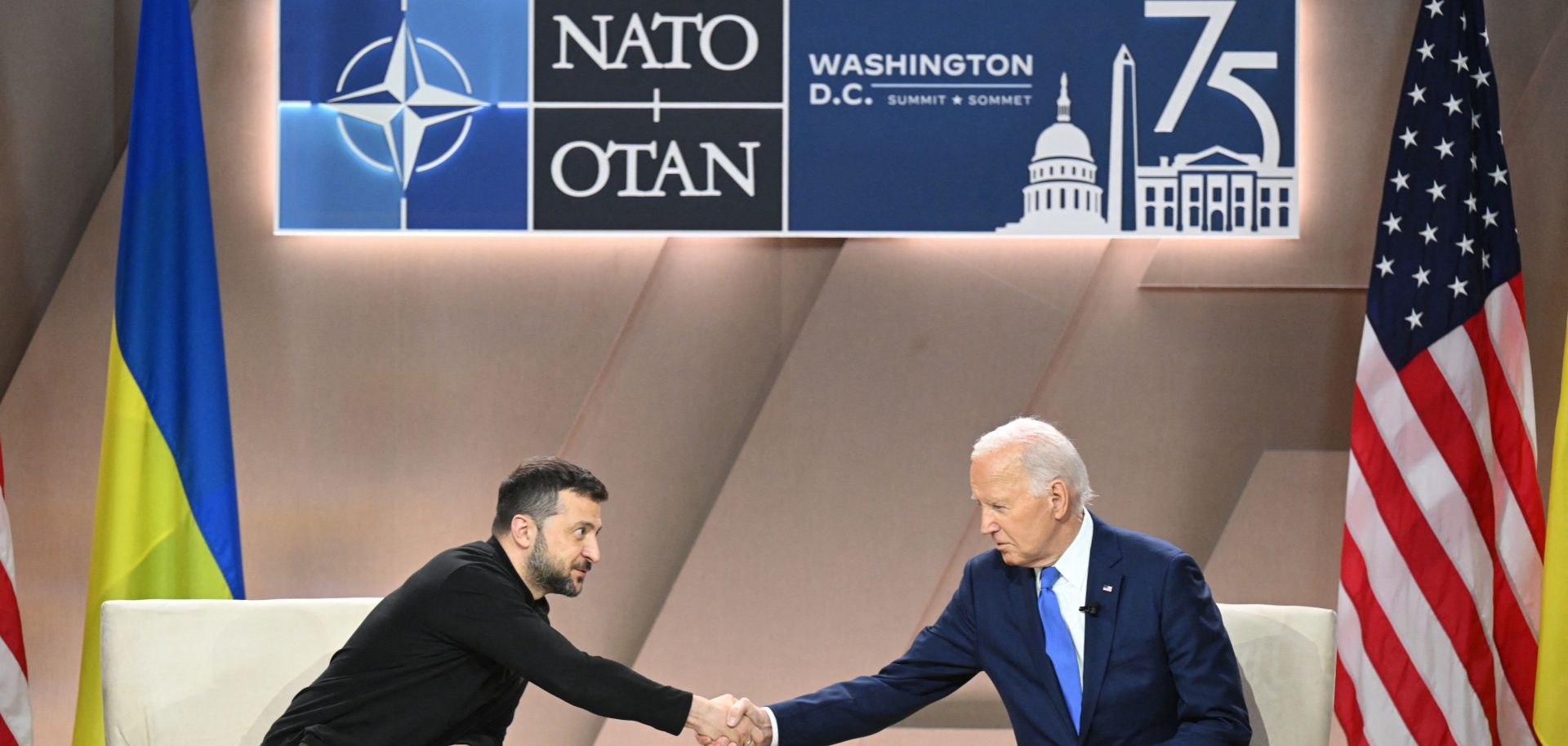
The NATO summit's failure to provide decisive security guarantees or material support to Ukraine in the years ahead will enable Russia to maintain its current strategy of degrading Ukraine, fueling the war's continuation until Kyiv is forced into negotiations on Moscow's terms. NATO's 75th anniversary summit in Washington D.C. concluded on July 11. The Western security alliance's joint communique failed to provide any plan or timeline for Ukraine's accession, and instead only claimed that Ukraine's course toward NATO membership was now ''irreversible,'' which means accession will likely remain frozen so long as the war continues. Several alliance members including the United States, Germany, Romania, the Netherlands and Italy claimed they would provide additional strategic air defense components and systems to Ukraine, including Patriot (though many of the batteries had previously been pledged), in addition to dozens of tactical air defense systems including NASAMS, HAWKs, IRIS-T and Gepard. Furthermore, the U.S., Dutch and Danish governments said the first F-16 fighter jets would soon be delivered to Ukraine and be flying later this summer. Notably, NATO states agreed to coordinate a portion of the security assistance and training process within the alliance's command structure through an initiative named NATO Security Assistance and Training for Ukraine (NSATU), drawing from NATO's common budget to the amount of 40 billion euros ($43 billion) in the coming year. This would force the United States to formally withdraw from the NSATU mission should former President Donald Trump win reelection in November and decide to reduce U.S. support for Ukraine. But the measure fell well short of the initial vision that NATO Secretary General Jens Stoltenberg laid out months ago, which would have more effectively ''proofed'' a portion of NATO support for Ukraine from another Trump presidency by having states commit a larger amount of funding to the mission with a specific time horizon of five years.
- The alliance encharged a NATO Senior Representative in Kyiv, a senior civilian representative to act as a focal point for NATO's engagement with senior Ukrainian officials and thereby deepen Ukraine's institutional relationship with NATO.
- Notably, the communique highlighted China's role in providing decisive military and economic support to Russia's war effort in Ukraine, as well as the systemic challenge to European and global security posed by China, highlighting the alliance's growing global remit first emphasized in its 2022 strategic concept. The presence of Indo-Pacific leaders from Japan, South Korea, New Zealand and Australia at this year's summit showed NATO responding to Russia and China's deepening ties by pressuring Russia's eastern frontier through increased cooperation among U.S. allies in the region.
- For the first time since the Cold War, the United States and Germany agreed to deploy American intermediate-range missiles in Germany by 2026, most importantly Tomahawk missiles and eventually hypersonic missiles once they finish testing. The deployment is intended to buy time for France, Germany, Italy and Poland to develop similar systems, and Russia said it would respond through military means.
Despite strong Western support, Kyiv has yet to receive long-term guarantees that will ensure its security or boost its negotiating leverage vis-a-vis Moscow in the years ahead. If Western support for Ukraine continues at current levels (which is not a given due to evolving political dynamics in many countries, especially the United States), Ukraine can likely secure itself against a major Russian advance in the short-to-medium term. But even current support levels cannot stop Russia from steadily degrading Ukrainian forces on the frontline and continuing to launch mass airstrikes across the war-torn country, imposing unsustainable economic, demographic and political costs on Kyiv. The additional anti-air systems and aircraft set to be delivered by the alliance will help Ukraine defend its skies. But the summit's pledge of 40 billion euros in support next year is roughly equal to the level of Western assistance that Ukraine is currently receiving. And despite coming with the possibility for renewal in 2025 and beyond, it will not meaningfully increase Ukraine's negotiating leverage vis-a-vis Russia because the support is too small to enable Ukraine to retake significant territory, and is not guaranteed long enough into the future to obstruct the Kremlin's belief that, because the total monetary amount of NATO support has likely already peaked, time is on its side and its forces can continue taking small amounts of territory and degrading Ukraine's civilian infrastructure and population in the years ahead. The only way in which the West can improve Ukraine's position in eventual negotiations with Russia is by giving Kyiv strong security guarantees capable of deterring future Russian aggression. These would need to either include a concrete path to NATO membership for Ukraine, or sufficient quantities of weapons (including advanced and long-range systems with permission to strike deep inside Russia) to pressure Moscow and help Ukraine retake more of its territory, and the summit did not yield any progress toward either. During the summit, NATO stressed that Ukraine could not see progress on its membership bid until the war is over, while failing to provide Kyiv with sufficient quantities, range and advancement of weapons it needs to increase the costs of the war for Moscow. In doing so, NATO is thus effectively enabling a war of attrition that Russia would be better equipped to win due to its larger population and industrial base compared with Ukraine, which is dependent on the West's fickle political support for military supplies. But while the West has become increasingly flexible on what Ukraine can do with its armament in recent months (like tolerating attacks deep inside Russia's territory), the NATO summit also did not provide any new or significant progress on this issue.
- On July 10, Ukrainian President Volodymyr Zelensky met with U.S. House Speaker Mike Johnson and a delegation of U.S. senators ahead of a meeting with President Joe Biden on July 11 to discuss further U.S. support measures for Ukraine.
- The 2023 NATO summit in Vilnius resulted in various NATO states committing to bilateral security treaties with Ukraine. But outside material and financial support, those treaties failed to contain provisions capable of increasing Ukraine's negotiating leverage. On the eve of this year's NATO summit on July 8, Poland and Ukraine solidified their bilateral security treaty, which notably included a provision specifically allowing Poland to intercept Russian missiles launched in the direction of Poland within Ukrainian airspace. However, on July 10, Polish Defense Minister Wladyslaw Kosiniak-Kamys said the provision would not be activated because there is no consensus in NATO on allowing this, adding that the White House opposed letting Poland intercept such Russian missiles, citing escalation concerns.
- Ukrainian officials including President Zelensky also used the NATO summit to argue for the provision of other longer-range weapons, and for the further easing of restrictions on using Western weapons, such as the Army Tactical Missile Systems (ATACMS), inside Russia. Policy changes that enable Ukraine to use more of its Western weapons directly against Russia will likely remain slow and be made quietly on a bilateral basis outside of NATO in order to minimize the risk of escalating tensions with Russia.
The summit did little to lock in U.S. support for NATO and Ukraine, both of which could be curtailed if Trump wins the presidential race in November, which could increase pressure on Kyiv to enter negotiations on Moscow's terms in the years ahead. In recent months, NATO has taken several steps to ensure some degree of policy continuity regardless of the outcome of the U.S. presidential election. For example, two-thirds of the alliance's members are currently meeting NATO's target of spending at least 2% of their GDP on defense, which should mitigate a potential Trump administration's criticism of NATO. NATO has also expanded relations with non-NATO members to coordinate a continued flow of weapons and money to Ukraine. ''Trump-proofing'' NATO states' (and most importantly, the United States') support for Ukraine was widely reported as a goal for the summit, but the alliance fell short of achieving this because the decisions made during the event will not meaningfully restrict a future Trump administration's ability to potentially reduce U.S. support for Ukraine and weaken Kyiv's position in eventual negotiations with Moscow. Indeed, the agreements to provide Ukraine with at least 40 billion euros of support and create a mission to coordinate support using NATO's command structure have no bearing on whether a Trump White House would authorize another supplemental spending package for Ukraine in 2025 to replace the $60 billion in supplemental funding for Ukraine that the United States passed in April 2024, which will be exhausted by the middle of next year. The NATO mission will not prevent a Trump administration from significantly reducing the size of any additional supplemental support package for Ukraine and slowing its passage in Congress — especially if the Republican Party secures control of both the House and Senate in the November election.
- Trump already has partners in NATO potentially sympathetic to his vision of threatening to reduce support to Ukraine and negotiating with Moscow, namely Hungarian Prime Minister Victor Orban, who met with Trump on July 11 immediately following the summit. The previous week, Orban visited Moscow and Beijing to advocate for reducing support to Ukraine as part of an effort to speed an end of hostilities on terms disfavorable to Ukraine.
