
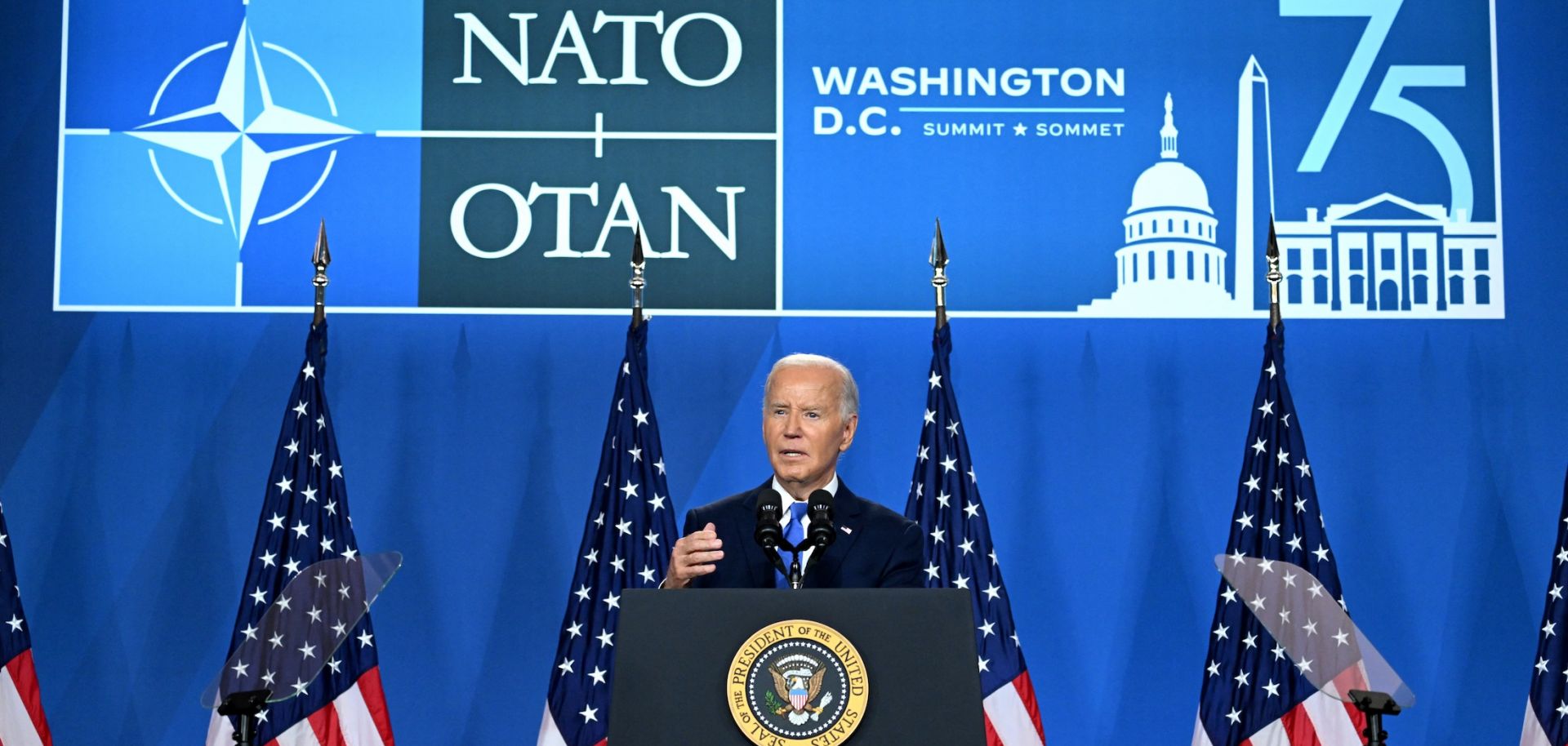
In his remaining time in office, U.S. President Joe Biden will likely take more aggressive action against Russia over Ukraine and push Israel to agree to a cease-fire with Hamas, but other aspects of foreign policy will remain largely unchanged. Biden's decision to drop out of the presidential race has opened up options for him to take a more unpopular approach to foreign policy in his remaining six months in office. This will be particularly true after the Nov. 5 election, when any policy decisions he makes will not affect the campaign of his Democratic Party's presidential nominee, who will almost certainly be Vice President Kamala Harris. Biden will face limitations in Congress for any significant legislation before leaving office, as Republicans still control the House of Representatives. But given that foreign policy falls more directly under the president's prerogative, he will have more freedom to make changes in this area. However, whether any foreign policy shifts would survive past his term, particularly if former U.S. President Donald Trump wins reelection, will depend on the policy in question, as Biden's successor can quickly reverse any executive action taken in the coming months.
In the Middle East, Biden will increase pressure on Israel to reach a deal with Hamas, but the Israeli government has an incentive to hold out and hope for a more pliant Trump administration; there is also a chance Biden will seek to finalize an Israel-Saudi Arabia normalization deal, but this will prove difficult amid the ongoing war in Gaza. The Hamas-Israel war in Gaza and the Biden administration's steadfast military and political support for the Israeli government has caused significant turmoil within the Democratic Party, with many in its progressive wing hotly criticizing Israeli attacks that have killed thousands of Palestinians in the strip. Still, the majority of Americans — including a high proportion of moderate voters — support Israel, which will limit Biden's ability to punish Israel's far-right leaders for some of their policies that have inflamed tensions in the region, especially ahead of the November election. While the White House has begun to more frequently sanction far-right Israelis in recent weeks, this process could accelerate after the U.S. election as a part of a stronger push by Biden to try to negotiate a cease-fire to cap off his legacy. Nevertheless, the Israeli government will have a strong incentive to resist Biden's pressure and hope for a more lenient Trump administration. Moreover, there is no guarantee that Biden's pressure will meet Hamas' own demands for a cease-fire, which could still include a demand for the Israeli military to leave Gaza in what would constitute a defeat for Israel.
- In the coming months, Biden is also more likely to offer concessions to Saudi Arabia, such as civilian nuclear energy cooperation, to seal a normalization deal with Israel, which Biden could also view as the crowning achievement of his presidency. However, given the Hamas-Israel war, Saudi Arabia is in no position to normalize ties with Israel unless Israel moves toward a two-state solution, which is impossible under the current right-wing Israeli government.
- Once he is inaugurated on July 28, new Iranian President Mohsen Pezeshkian may push for nuclear talks between the United States and Iran on sanctions relief, but the Biden administration will still oppose launching such talks ahead of the U.S. election in November, given the potential impact it could have on Harris' campaign. Biden could open up talks after the election if Harris wins, though this would largely hinge on the status of the Israel-Hamas war and whether Israel's conflict with the Lebanese militant group Hezbollah has widened substantially, given that both Hamas and Hezbollah are Iranian proxies. If, by contrast, Trump wins the U.S. presidency, the Iranian government will have little interest in negotiating with a lame-duck president, knowing that Trump will not recognize any deal signed between Biden and Iran once he takes office.
When it comes to the war in Ukraine, the Biden administration's tolerance for escalation against Russia will likely increase in the coming months, which could see the United States further relax its restrictions on Ukrainian attacks on Russian territory. The Biden administration will likely accelerate the pace of disbursing weapons to Ukraine that would increase Kyiv's capacity to strike Russian territory, such as long-range precision strike weapons that Moscow would view as escalatory. After the U.S. election, Biden will also likely try to quickly push through a final aid package for Ukraine, but his success will depend on the outcome of the election — namely, whether Republicans (who have been more skeptical of maintaining financial support to Kyiv) take control of Congress and/or the White House, which would give current Republican lawmakers little incentive to work with lame-duck Biden on such a package. In addition, Biden will likely relax restrictions on Ukraine's use of U.S.-made weapons in striking targets on Russian soil, which would make it more difficult for Russia to immediately enter talks with a potential Trump administration due to the increased Ukrainian strikes that would need to be responded to with military force, though Trump would likely re-institute such restrictions if he is reelected. Finally, Biden's decision to drop out of the presidential race will give him greater political freedom to pursue more aggressive sanctions on Russia without the same degree of concern about the potential negative impact on the U.S. economy and global oil prices, particularly after the U.S. election. This could see the Biden administration step up its enforcement of the G-7 oil price cap against Russia, and/or impose more robust secondary sanctions on the global financial institutions that are supporting Russia's economy and ability to continue its war in Ukraine through the procurement of technology and military arms. While they could be reversed by a potential Trump administration, such sanctions would still immediately prompt many companies and financial institutions to cut off ties with Russia on sanctioned activity.
- Theoretically, Biden's new lame-duck status opens up the possibility for his administration to more effectively pursue a diplomatic peace initiative with Russia, but there are no signs this is under consideration. Taking such action would also risk undermining Harris' presidential campaign, as she will likely oppose Trump's policy on Ukraine and Russia, and highlight the threat posed by Russian aggression to argue that steadfast support of Ukraine is necessary for U.S. national security.
- Biden is likely to continue vocally supporting U.S. commitments to NATO. But if Trump is reelected, there is little Biden can do to prevent Trump from potentially pulling the United States out of the Western security alliance. In the coming months, the European Union and the United States will work together to finalize the G-7 plan to back a $50 billion loan for Ukraine funded by frozen Russian assets, though that would have likely been the case regardless of whether Biden dropped out of the race.
Biden's exit from the race is unlikely to significantly change his hard-line approach to China, though it will give him more freedom to pursue stronger sanctions on Chinese entities with ties to Russia. For the remainder of its term, the Biden administration will push forward with the restrictions on China's technology sector that it has been preparing for months. Even before Biden announced his withdrawal from the presidential race, the White House was reportedly considering invoking the U.S. Foreign Direct Product rule to place more stringent controls on exports of foreign-made semiconductor manufacturing equipment that uses any U.S. technology to China, which Europe sees as a draconian way for Washington to force the European (and Asian) companies to cut off exports to China. The Biden administration will also likely move forward with new restrictions on using Chinese communications equipment in connected vehicles. Additionally, the Biden administration has repeatedly warned China that it will more frequently sanction Chinese entities that violate U.S. sanctions on military and technology exports to Russia. Now that Biden will not need to be as concerned about the consequences to his own administration's relationship with China on the matter, he has more freedom to make good on these threats in the coming months, which could see the White House take action against more significant Chinese companies that are found to be violating U.S. sanctions on Russia.
- Biden's decision to exit the race is highly unlikely to impact his trade policy with China, and Biden's new tariffs on strategic technology imports from China that are set to take effect on Aug. 1 will proceed without any changes.
Biden will seek to resolve a number of outstanding trade issues with the European Union, but any deal could be short-lived if Trump is reelected. Up until now, Biden's trade policy with Europe has been somewhat constrained by his competition with Trump in securing the support of U.S. union members (particularly in the steel industry), who comprise a key voting bloc in swing states. Biden will likely sustain this approach through the U.S. election in November, to avoid driving any union voters away from Harris toward Trump. But after the U.S. election, Biden may make a final push to resolve some of the trade disputes between the United States and the European Union. In negotiations over the United States' Sec. 232 national security tariffs on European steel and aluminum, the Biden administration could agree to scrap the tariffs, as well as drop Washington's demands that the United States and the European Union adopt a common tariff on imported steel. However, Biden's hands will remain tied in regards to heeding Brussels' demands that Washington adopt a carbon-border adjustment mechanism for steel and aluminum, which would require Congressional action. Biden may also be in a position to accept Europe's push for a critical raw materials trade agreement, which would allow for the use of European critical raw materials in electric vehicles that qualify for a tax credit under the U.S. Inflation Reduction Act. If elected, Trump could reverse all of these measures, though they would increase the political cost for him to do so and may even, in the case of Sec. 232 tariffs, require a new investigation be triggered before re-implementing tariffs.
- Biden's decision to drop out of the presidential race is less likely to yield any momentum in global tax negotiations and the related U.S.-EU dispute over European digital services taxes (DSTs), as there is near unanimous opposition in the United States toward European DSTs and any implementation of U.S. commitments in international tax negotiations would require Congressional approval.
In Latin America, Biden may consider strengthening sanctions on Venezuela, but may ease its focus on the U.S.-Mexico border, particularly after the U.S. election. Given that Republicans have already tried to connect Harris to the U.S.-Mexico border crisis, Biden is unlikely to change any of his policies on immigration, Mexico and Central America ahead of the November U.S. election, especially as his strategy to reduce flows across the U.S. southern border has led to a sharp decline in encounters at the border, which fell by 56% between December 2023 and June 2024. However, after the election, Biden could reverse the executive order he issued in June that limits the number of asylum-seekers who can cross the border from Mexico, though he has yet to give any sign he plans to do so. Biden is now also more likely to increase sanctions pressure on Venezuela, where leader Nicolas Maduro is set to soon secure a controversial third term in a likely sham presidential election on July 28. The Biden administration lifted some sanctions on Venezuela in October 2023 in exchange for Caracas agreeing to hold a free and fair presidential election, but the White House re-implemented those sanctions in April amid the Maduro government's recent efforts to sideline, silence and persecute opposition leaders ahead of the vote. However, the Biden administration has yet to fully reinforce the sweeping sanctions on Venezuela's oil sector that then-President Trump imposed in 2019, for fear of causing a spike in global gas prices that would anger U.S. voters ahead of the November election. After the U.S. election, however, Biden will have more political space to strengthen sanctions against the Maduro government, including those on the country's vital oil exports, which Maduro relies on to fund his regime.
When it comes to sub-Saharan Africa, Biden will likely largely stay the course for the remainder of his term. Biden's exit from the presidential race is unlikely to impact his strategy in West Africa, where the United States will likely continue to prioritize efforts to secure a new drone base in a coastal state — likely Cote d'Ivoire — as its forced withdrawal of troops from Niger is completed by mid-September. Washington will also likely sustain efforts to buttress coastal West African states' defense capabilities, whether through intelligence sharing or the provision of military equipment. However, in the wake of Biden's announced withdrawal from the U.S. presidential race, Russia could look to exploit a perceived leadership vacuum in the United States to accelerate its outreach to coastal West African states. Biden's decision not to run is also unlikely to cause deviations in his approach to East Africa for the remainder of his term. In Kenya, Biden will likely seek to remain on good terms with President William Ruto to ensure Kenya does not pull out of the U.N.-backed security deployment to gang-ridden Haiti. This will likely see Biden maintain a conciliatory stance toward Ruto's management of the ongoing anti-government protests in Kenya, as long as Nairobi's security response to the unrest does not escalate. Biden's decision not to seek reelection is similarly to significantly impact U.S.-South Africa relations in the coming months as well, with the White House likely remaining committed to the Just Energy Transition Partnership that the United States and European powers reached with South Africa in 2021 to support the country's decarbonization efforts.
