
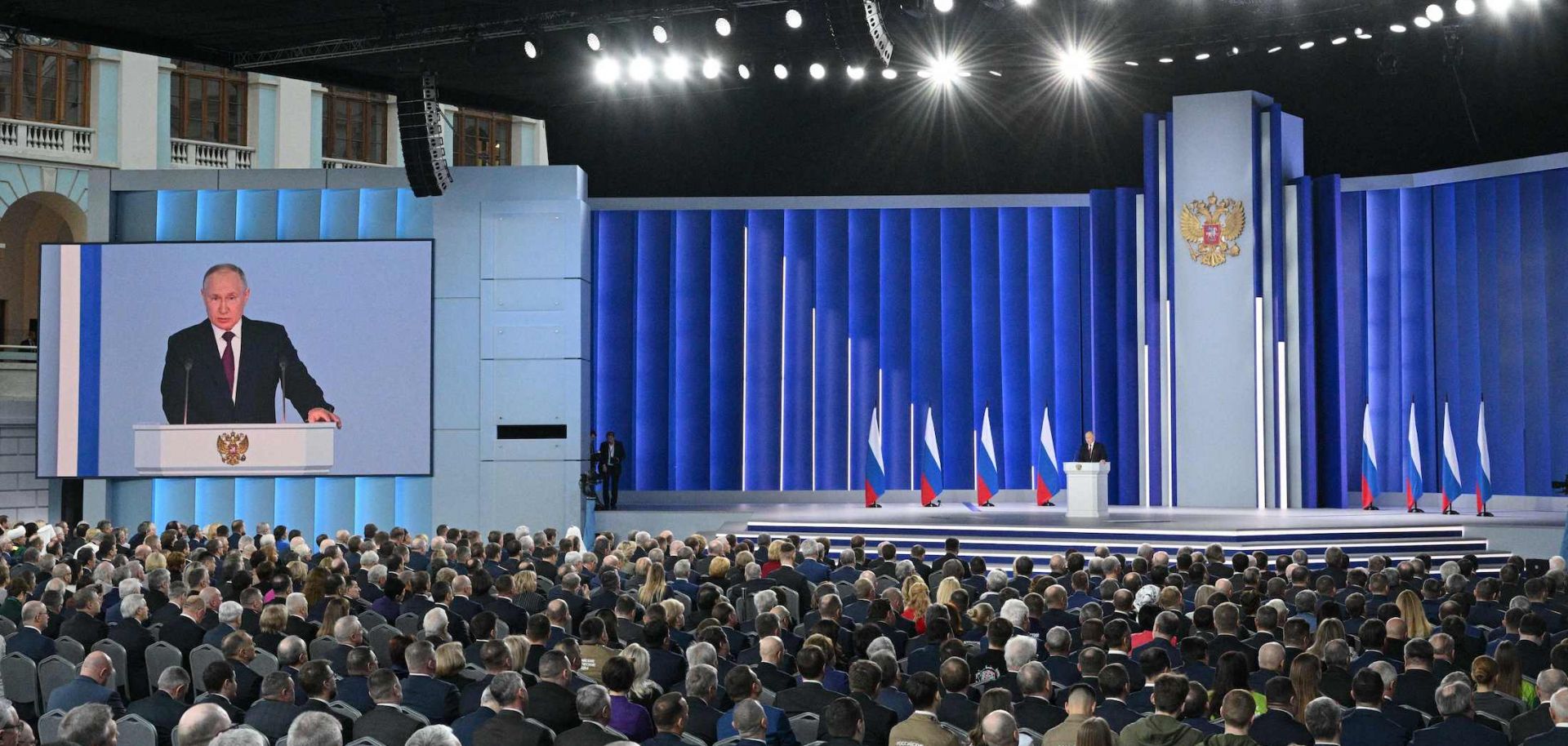
Russian President Vladimir Putin delivers his annual state of the nation address at the Gostiny Dvor conference center in Moscow, Russia, on Feb. 21, 2023.
When Russian President Vladimir Putin first launched his ''special military operation'' in Ukraine, he likely envisioned that his 2023 annual address to lawmakers would be one of triumph following the successful ''return'' of large portions of Ukraine to the ''Russian civilization.'' But after a year of brutal combat, Russia today finds itself locked in a costly war against Kyiv and its Western allies with no quick end in sight — a reality reflected by the speech Putin instead delivered on Feb. 21. The Russian leader reiterated his deep antipathy for the West and in particular the United States, echoing the same themes from the speech he made exactly a year ago. But he notably did not provide a clear roadmap for a Russian victory in Ukraine, outside of assertions that Russia was prepared for a long-term confrontation with the West.
In a competing speech made hours later in Warsaw, U.S. President Joe Biden similarly stressed his country's preparedness for a prolonged conflict, vowing to ensure that Ukraine would ''never be a victory for Russia.'' This came just a day after Biden's historic visit to Kyiv ahead of the one-year anniversary of Russia's Feb. 24 invasion of Ukraine, during which Biden asserted that Putin ''thought he could outlast us. I don't think he's thinking that right now.''
As the war enters its second year, I thought it pertinent to reflect on the tactical and strategic failures Russia has suffered in Ukraine (which confirms why many, including myself, thought a full-scale invasion was relatively unlikely in the first place), along with the ways the conflict has impacted Russians' lives and reflect their leaders' perception of the world.
Why the Invasion Seemed Unlikely
Looking back, a year ago we at RANE fully recognized the possibility of an invasion, but it did not appear the most likely scenario until Putin's Feb. 22 address all but acknowledging his intention to dominate Ukraine and replace its leadership. And a year following the start of the invasion, Russia's setbacks in the war underscore many of the reasons I did not think it was the most likely scenario in the first place, as well as some areas where Russian efforts actually exceeded my expectations.
That the Kremlin dreamed of returning Russian control over Ukraine was clear, especially after the falsehood-ridden essay published under Putin's name in July 2022 arguing that Ukraine is not a real country. And it was not a secret that Putin sought to avenge Russia's defeat in the Cold War by humiliating the United States, simultaneously undermining democracy and the post-World War II international legal framework, which a successful Russian seizure, occupation and annexation of large parts of Ukraine would entail.
But the problem was that the full-scale invasion and regime change in Kyiv — which Kremlin rhetoric and Russian troop concentrations threatened — did not actually have the resources to be successful. It was unclear to me how a Russian invasion force of under 300,000, assembled in Belarus and the entire border along multiple axes of advance, could successfully seize and occupy a country of over 40 million people and which planned to mobilize 700,000 or more combat personnel in case of an invasion. The audacity of Russia's plan was accentuated by the fact that Russia's intention to invade, and even the basic plan itself, had widely circulated in the Ukrainian and Western press for nearly four months before the invasion — giving Russia no strategic surprise, the Ukrainian military to time to prepare and the administration of U.S. President Joe Biden a chance to rally a broad coalition to support Ukraine. But people were still shocked when it actually happened, largely because it was such a gross violation of basic human decency and the idea that states cannot invade and annex their neighbors, citing their ''historic territories.''
Based on public reports, it was clear that Russia's plan would have to rely heavily on political machinations and traitors within Ukraine's institutions to have any chance at achieving the runaway victory it was premised upon. Myriad behind-the-scenes political schemes would be needed to remove Ukraine's government and replace it with more pliable leaders, as well as pro-Russian politicians, bureaucrats and security service personnel who would defect to Russia to aid the invading army and political and administrative support for its actions.
In some places, these efforts worked. For example, how Russian forces so easily broke out of Crimea and seized the Antonovsky bridge intact to cross the Dnieper River into Kherson in the invasion's opening days was likely the result of these efforts. However, the far more important political efforts in Kyiv involving replacing Ukraine's government with pro-Russian leadership were fantastical, and at the time I knew they were doomed to fail given the overwhelming majority of the Ukrainian people's utter disdain for Russia's first invasion in 2014. Most details of exactly how Moscow thought it could achieve this are still unclear. But it was already entirely implausible that Russian forces could encircle Kyiv and then install (and let alone maintain) a pro-Russian puppet government based loosely on Alexander Lukashenko's regime in Belarus that would surrender some of the country's sovereignty to Russia, or even compel Ukraine's existing leadership to accept a diplomatic settlement.
This led analysts like me to search for and weigh alternative scenarios. In the weeks leading up to the Feb. 24 invasion, U.S. officials cited in media reports claimed Kyiv and the Ukrainian state could fall in a matter of days or weeks if Russia launched a full-scale invasion. Given the United States' apparently bloated perceptions of Russia's military power and ability to conduct successful political coercion in Ukraine, maybe Putin believed he could effectively extract unilateral concessions from the West or Ukraine's leaders without having to take Kyiv. And if that didn't work, Putin could simply not conduct the invasion at all, instead casting Russia as a victim of the West's arrogance and unwillingness to take Russia's ''legitimate'' security concerns seriously. The mere threat of an invasion would still rattle Ukraine's economy and Western unity, creating damage that Putin would then seek to make semi-permanent by constructing new bases and deploying new weapons in the regions bordering Ukraine. This would effectively enable Moscow to exert constant diplomatic and military pressure against Kyiv and the West at a lower cost than an invasion, while also buying Russia time to mobilize enough soldiers to ensure victory when it was ready to launch an incursion in Ukraine.
The alternative scenario — in which Moscow voluntarily and preemptively mired itself in a major long-term conflict — still seems doubtful because even a detached tyrant like Putin, claiming to know Russia's history, would know of the immense risk this could pose to him and Russia. On numerous occasions, disastrous wars have helped fuel profound political changes in countries around the world, and Russia is no exception. Setbacks in conflicts over the course of Russia's history — be it the Livonian Wars under Ivan the Terrible, World War I under Tsar Nicholas II, or even the Soviet Union's comparatively small-scale intervention in Afghanistan — and the resulting casualties have led to significant political instability and even regime change in Russia, which serves as a warning for the country's current leaders.
But conflicts can often take many years before being widely seen as strategic quagmires. Indeed, Putin believed (and likely still believes) that he has uniquely prepared Russia to overcome domestic political risks in the long run. What was not clear when he initially launched the Ukraine invasion was the extent to which Putin's messiah complex, paranoia and the cynicism of others — characteristics often ascribed to tyrannical rulers — had taken over his decision-making, effectively causing him to view the need to invade through the lens of personal or regime security. Putin likely felt that an independent Ukraine conducting democratic power transfers and integrating with the European Union — which was the course Ukraine was on if Russia did not invade — was a threat to his own rule and the staying power of his ideology in Russia.
A failed invasion, however, would only deepen Putin's laundry list of Ukraine-related security concerns, voiced in his two pre-war addresses. Giving the order to invade would thus not necessarily be in the best interest of the Russian state. Indeed, such selfish, reckless conduct would undermine Putin's carefully cultivated image of a cold-blooded ''genius geopolitician'' at home and abroad. But he ultimately chose to give up this image in favor of being the ''gatherer of Russian lands'' at home.
What was also not entirely clear at the onset of the invasion was just the extent to which Putin was being fed completely warped information about Ukraine from his advisors and security services, likely over the course of many years, which probably led to a deeply distorted image of Ukraine, particularly given that Putin does not use the internet and reportedly only reads digests arranged for him. Putin's rhetoric before and immediately after the invasion seemed stuck with perceptions of Ukraine and the attitudes of its people not just from 2014, the year of Russia's initial invasion, but from 2004, the year that pro-Russian businessman Viktor Yanukovych was elected Ukrainian president after Putin campaigned for him, triggering Ukraine's Orange revolution and a repeat election that Yanukovych lost. Before and after the invasion, Putin delivered various addresses to the Ukrainian people and officials in which he seemed to believe they would lay down their arms or welcome Russia, showcasing just how out of touch he had become. On just the second day of the invasion, Putin also shamefully called on the Ukrainian Armed forces and its leaders to ''take power into their own hands'' and overthrow the Ukrainian government, presumably having been told by his advisers that such an address could actually work or have some other meaningful effect.
In summary, a year after Russia announced its ''special military operation,'' the fundamental reasons we did not believe the invasion would take place as threatened, and that Putin was instead more likely to escalate the existing conflict in eastern Ukraine or try to extend a coercive political strategy in the country, have largely borne out. First, outside of its strategically and politically insignificant gains in Ukraine's eastern Donbas region, Moscow is currently clinging to a land corridor to Crimea — the very minimal conception of victory at which most Russians will perceive the war as worth its immense cost, leaving the Kremlin with almost no ground left to give in Ukraine. Second, the invasion has done little to further Russia's interests, instead achieving many of the very things Moscow publicly claimed, over and over, that it wanted to avoid. These include stopping the further expansion of NATO and the movement of NATO forces and weapons systems toward Russia's borders, as the invasion has instead seen Sweden and Finland move toward joining the Western security alliance and Ukraine receive strategic systems like Patriot missiles.
Moscow had also insisted that it wanted to prevent Ukraine from becoming ''anti-Russia,'' but its invasion has resulted precisely in that outcome, with Ukraine certain to become, in perpetuity, the global bastion of anti-Russian sentiment. In addition, the nearly 200,000 combat casualties Russia has suffered in Ukraine, combined with the over one million Russians who have fled the country since the invasion for fear of being drafted into service, have significantly accelerated Russia's demographic decline (and brain drain) — a threat that Putin said in 2019 is the one thing that ''haunts'' him. And this trend will only deepen as Russia continues to mobilize more troops to sustain its ongoing war in Ukraine.
Fourth and finally, all these developments are taking place while the country becomes dangerously dependent on another global power, China, for essential imports and exports. As Western sanctions continue to bite and Moscow struggles to find other partners willing to provide major investments or critical technologies, China's now immense negotiating leverage over Russia will likely only grow in the coming years, seriously undermining the image Moscow seeks to project of being an independent global power.
Russia's Dominant Ideology of National Resentment
It is difficult to choose where to start when describing the momentous changes that have taken place inside Russia over the past year. Foreign observers have consistently underestimated the importance of domestic politics in explaining the conduct of Putin's Russia. But while Russia's political system and society may appear largely the same from a distance, the truth is that the war has solidified a fundamental alteration to the regime's ideology, as well as the lived experience of everyday people in the country.
Indeed, it was very fitting that the Soviet leader Mikhail Gorbachev passed away in August 2022, because Gorbachev reportedly said that Putin ''destroyed his life's work'' with the invasion of Ukraine. Gorbachev and the later Russian President Boris Yeltsin represented a formerly dominant ideology in Russia (and the Soviet Union) among elites that essentially saw their country as a European entity. Of course, this perception still acknowledged Russia's unique Eurasian geographic and cultural characteristics, but it saw the country's identity as indelibly linked to the European and the broader Western political, ideological, ethical, legal and related spheres. This view of Russian identity became increasingly marginalized under Putin's rule, and since his 2022 invasion of Ukraine, is now all but completely unacceptable in public discourse.
Putin, in his first several years as president, initially framed himself as an adherent of the European Russian worldview. But to justify his increasingly total power and corrupt rule, he soon endorsed and began actively mainstreaming a darker and eventually dominant ideology; this was based on resentments across Russian society about the country's loss in the Cold War and subsequent chaos and eroded living standards in the 1990s that accompanied the Soviet ideology's collapse. Today, Putin's now dominant ideology functions similarly to Germany's ''stab-in-the-back'' myth that emerged after its loss in World War I. Putinism asserts that Yeltsin and Gorbachev's naive belief that Russia's cooperation with the West diminished Russia's glory by robbing it of victory in the Cold War and nearly destroyed Russian identity and civilization – and that media outlets, organizations and individuals who promoted dissent where therefore a threat to the state. The invasion of Ukraine was Putin's attempt to assert that Russia had overcome these betrayals and emerged stronger.
The rough timeframe for when this ideology more or less became dominant was after Putin's return to the presidency in 2011 (although the alternative vision of a European, liberal Russia was still somewhat present then). Following Russia's initial invasion of Ukraine in 2014, advocacy of a European Russian identity became increasingly derided on state media and in the education system, and forced out of the public eye. But the ideology was still widespread among many elites and easily accessible to those looking for it. By the late 2010s, however, Russia's crackdown on independent and dissenting voices, as well as on foreign technology and social media, was increasing in tempo and scope with every year. Since the 2022 invasion, hundreds of prominent individuals and organizations have been deemed Foreign Agents, imposing a label and reporting requirements on them intended to stop their activities. Meduza, one of the country's leading independent journalism outlets, was declared an undesirable organization; numerous Western social media platforms such as Meta were declared extremist groups; historic human rights organizations such as the Moscow Helsinki Group and Memorial, Russia's most important human rights organization initially established to document Stalin's crimes, are effectively no longer able to function following numerous court rulings; and individuals who publicly oppose the war (or even call it one, and not a special military operation) immediately face detention and potentially years of jail time.
Before the war, many analysts predicted that a full-scale conflict in Ukraine would quickly lead to mass protests in Russia, considering that such demonstrations were commonplace in the country during the fall of the Soviet Union, and that imprisoned opposition leader Alexey Navalny (who has been behind bars since January 2021) and his political organization were even able to regularly stage national protests in the years leading up to the Ukraine invasion.
This history of protests — combined with the expectation that sanctions would serve a much greater initial blow to Russia's economy than they actually did — led many to believe that in the wake of an invasion in Ukraine, Russian citizens would organize an anti-war movement that would be able to have a greater effect on public opinion. But this assumption failed to take into account just how much progress the Kremlin had made in the years leading up to the invasion in making independent and dissenting opinions increasingly marginalized and inaccessible — both through technical and political means, and by making its resentment ideology the dominant one, if not the only acceptable, in the public sphere. Nor did many analysts grasp that the years of increasingly lurid day and night propaganda (which had become meaningless background noise to many Russians and observers like me) had actually made important inroads at inoculating wide swaths of the population, including young Russians who had grown up in the Putin era, and turning people against pro-European, anti-war messages and sentiments.
Between draconian jail sentences, Russia's extensive riot police force and near-total exclusion of access to alternative opinions (outside of media outlets that have fled Russia or Western platforms such as YouTube, which is increasingly under threat of blockage), many anti-war Russians do not see a realistic avenue for advocating dissent. In this environment, Russian officials and propaganda will continue to attack Gorbachev and Yeltsin's legacies, including by emphasizing the necessity of staving off political change, or any repeat of reforms reminiscent of Gorbachev's Perestroika (restructuring), as a central tenet of the Putinist ideology. But while it is now clear that Russia is not just a failed democracy, but an alternative to democracy, Putinism will continue to call itself a democracy precisely because the ideology (or, as others would argue, lack of one altogether) of Putinism otherwise has no positive vision of the future or attractive perspective to offer foreign and domestic audiences. Putin's national address earlier this week underscored the ideology's fundamental isolationism by stressing that he views Russia's non-Western partners (not to mention the former Soviet states in Central Asia and the Caucasus), as only markets for goods and as transit routes — not as entities that Russia can seriously integrate with or actually unify toward a larger purpose, such as opposing the West.
Russia's dominant ideology of resentment is unlikely to be shed unless Russia is decisively militarily defeated in Ukraine, which appears unlikely in the near term. And, critically, because Russia's resentment ideology is now nearly totalitarian and revolves around grievances that precede Putin, it appears that the ideology can maintain mainstream public acceptance and fuel Russia's neo-imperial drive to control its neighbors, regardless of whether Putin remains in power. Putin's top priority will be attempting to create a succession system whereby willingness and ability to reaffirm this resentment ideology will be the most important traits in a potential successor, as Putin and the hard-liners around him will insist that any genuine liberalization would weaken Russia's power again (and put them in physical danger).
Believing that he can keep things stable on the home front and outlast the West, Putin will likely make seizing more and more of Ukraine his primary task so long as he rules over Russia. He likely fantasizes that he will just wait for new leaders in the West to come to power who will reduce support for Ukraine. Indeed, Putin does not have any other option, given the immense risk that backing down or de-escalating now would pose to him and his inner circle, and the difficulty Russia faces in forcing any political settlement on Kyiv. And should Putin successfully outwait the West, essentially enabling him to snatch victory from the jaws of defeat due to Western leaders' caution and lack of strategic vision, Putin or his like-minded successors will merely move on to the next obvious target, namely Kazakhstan, followed by the rest of Central Asia and the Caucasus.
While it is hard to imagine Putin's dominant anti-Western ideology functioning and perpetuating itself in the long run, it is also difficult to see exactly how it could fall apart, other than through a clear defeat in Ukraine. Therefore, the West must be equally prepared for both scenarios, but primarily focus on dealing a strategic defeat to Putin's ideology while it has the chance.
