
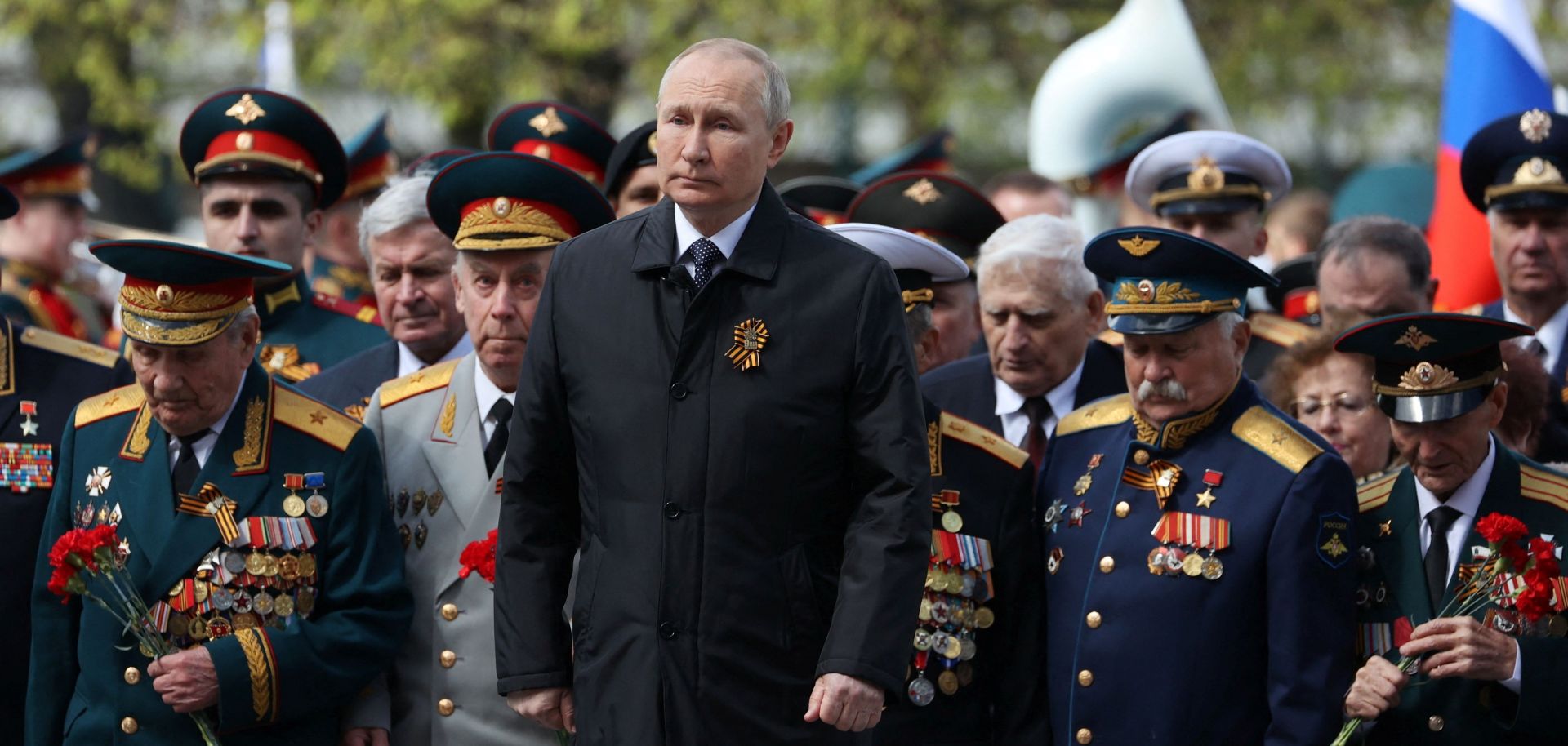
Russian President Vladimir Putin attends a military ceremony on May 9, 2022, commemorating the 77th anniversary of Russia's victory over Nazi Germany during World War II.
Editor's Note: This assessment is the first of a two-part series that explores whether Ukraine or Russia is more capable of emerging victorious from a protracted war. The first part, which outlines the current battlefield dynamics and dissects the argument that time is on Kyiv's side, can be found here.
Ukraine hopes Russia's battered weaponry, limited troop numbers, and withering economy will eventually give Kyiv a window of opportunity. But Ukraine's ability to attain sufficient Western support is not guaranteed. Given the limited prospects of Ukrainian counteroffensives this year, Ukraine and the West must find other ways to answer the opposing argument that time largely leans in Russia's favor. Because as things stand, a freezing of the conflict near its current lines would be catastrophic for Ukraine, a costly outcome for the West and a victory for Russia.
Why Time May Not Be on Ukraine's Side
The argument that time is, in fact, not on Ukraine's side in the war has numerous points to back it up. For one, Ukraine's ability to expel Russian forces — which already occupy roughly 20% of Ukraine —- will decline with time as Russia moves from the offensive to the defensive by reinforcing troops in key areas, constructing fortifications and improving logistic capabilities. Even in the unlikely event that Russia's military situation deteriorates in Kherson, Russia could simply retreat to a more secure frontline on the other side of the Dnieper River, across which a Ukrainian amphibious operation is out of the question for the foreseeable future. This outcome still would be catastrophic for Ukraine because it would leave Russia in control of the bank of the river at its mouth, enabling Moscow to strangle Ukraine's economy by blocking the export of steel, grain and other products through the lower part of the Dnieper. Ukrainian counterattacks in other areas, such as the north around Kharkiv, would provide even fewer strategic benefits to Kyiv.
Additionally, Ukraine's switch from using Soviet/Russian weapons to NATO weapons comes with long-term challenges, as each country's donations of various weapons systems for a single role (for example, self-propelled 155 mm artillery systems) on a piecemeal basis has complicated training, maintenance and logistics requirements within the Ukrainian army. Ukraine will continue to face immense logistical difficulties getting ammunition and weapons safely to the front lines.
Physical destruction in Ukraine is no less significant, as war fatigue will make the West increasingly hesitant to fund reconstruction, which is estimated to cost hundreds of billions of dollars. War fatigue is also likely to grow in Europe as the Continent's economy faces a severe risk of stagflation in the coming quarters, the effects of which will be aggravated by Europe's already-high level of public debt. Additionally, high energy prices will cause the industrial sectors of some European economies, in particular Germany's, to become less profitable and competitive, which will likely result in unemployment and a political desire across Europe to spend more at home rather than on economic support for Ukraine. In addition, Western war fatigue could cause both Europeans and Americans to pressure their governments into either reducing military support for Ukraine, or making that support contingent on Ukrainian concessions to Russia. Tapering Western military aid in this way would likely curtail Ukraine's capacity to defend itself, fueling Russia's ambitions for a new offensive.
It's also unclear how much longer Ukraine can withstand the conflict from an internal economic and political standpoint. Ukraine's economy is already forecast to contract 35-45% this year, and the decline is likely to continue as the war drags on and Russia continues to damage critical infrastructure and industry. The war also severely exacerbated the challenge of Ukraine's declining population, as 4.8 million Ukrainians (more than 10% of the country's pre-war population) are officially registered in Europe as refugees, according to the United Nations; the total number of people who have fled Ukraine is millions higher. The country's aging workforce, lack of cheap labor and cost of caring for large numbers of wounded veterans will strain finances and spur further population decline as the war grinds on.
Ukraine remains the most politically united it has been in its modern history. And there is, for now, little to no desire among Ukrainians to engage in negotiations with Russia that involve ceding territory. However, rising unemployment and falling living standards could, with time, eat away at that resolve and prompt more Ukrainians to advocate for an end of hostilities. Additionally, Ukraine's internal problems related to corruption, the influence of the oligarchy and the weakness of institutions will remain, drawing criticism of the country from international donors and further dimming Ukraine's already uncertain prospects of ever joining the European Union.
Gauging Russia's Staying Power
In addition to Ukraine's weaknesses, there is also the issue of Russia's relative strengths that could enable it to outlast Kyiv in the conflict, with the first being the Kremlin's firm hold on power. Despite increasing talk in the West of the threat to Russian President Vladimir Putin and Putinism, Russia's domestic political situation will likely remain stable. Years of repressions in the lead-up to the invasion and the near total intolerance of dissent amid wartime censorship measures have thoroughly intimidated Russia's populace and made actively opposing the Kremlin too dangerous. To counteract disenchantment, the Kremlin has framed the conflict in Ukraine as an existential struggle for Mother Russia's survival. And for the time being, there is little sign that this propaganda — combined with the government's brutal crackdowns on dissent and the high levels of overall apathy across Russian society — will fail to prevent the conditions arising that could lead to Putin's removal or discrediting.
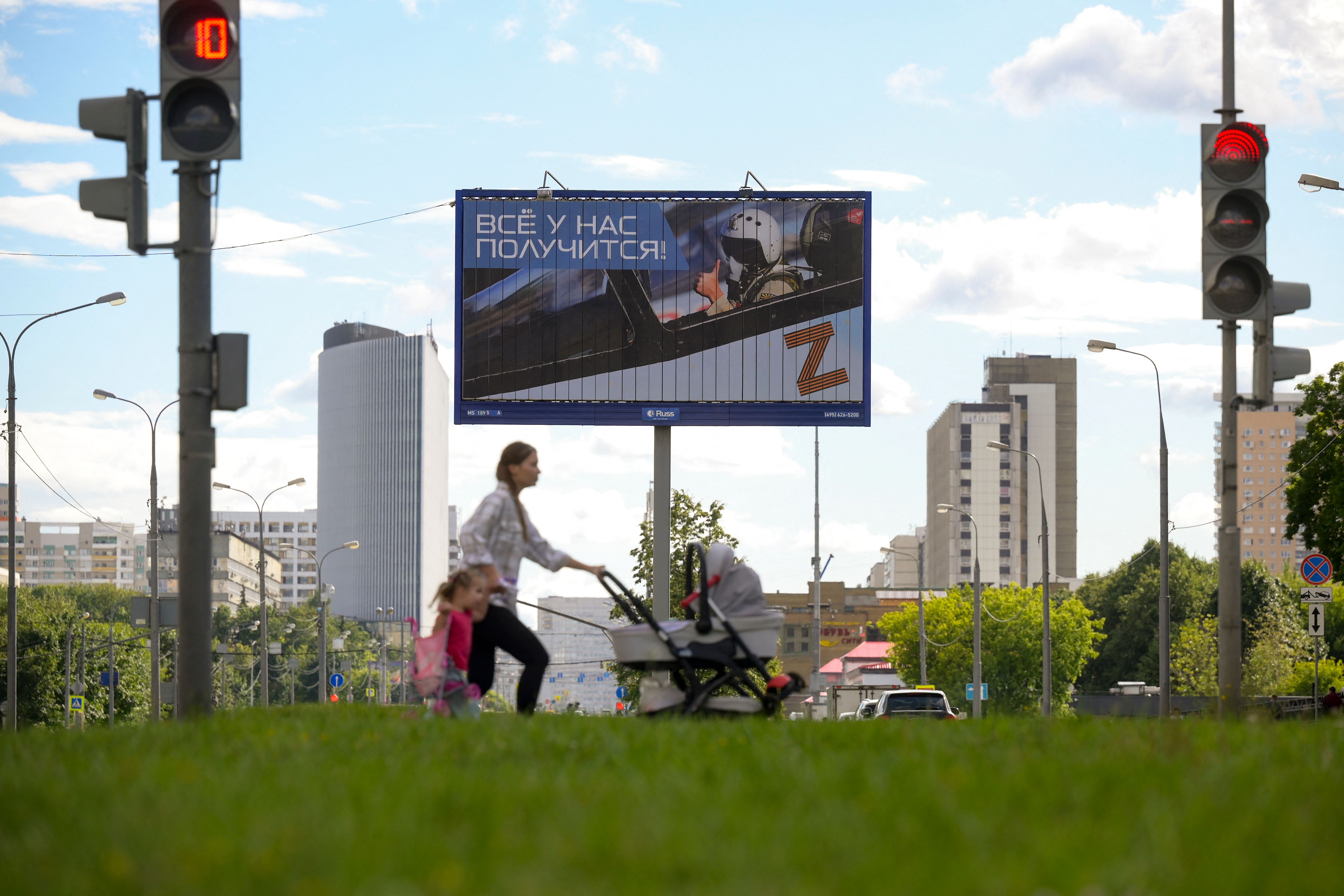
A billboard in Moscow reads ''Everything will work out for us!'' with a Russian military pilot giving a thumb up in a plane adorned with the letter ''Z,'' which has become a symbol of support for Russian military action in Ukraine. (NATALIA KOLESNIKOVA/AFP via Getty Images)
Compared with Ukraine, Russia's much larger economy may also be better equipped to withstand the toll of a prolonged war. Russia will eventually need to reformat much of its economy, which will undergo a prolonged contraction under the weight of Western sanctions. But this will not significantly alter Russia's economic and military capability to pursue the war and occupation. On the contrary, Moscow likely believes that it has correctly tied its future to the countries that will be of greater economic benefit in the long term, most importantly China. Countries that are either neutral or friendly toward Russia (including China, India and Indonesia) are forecast to experience greater economic growth over the coming decades than the demographically stagnating and politically vulnerable economies of the ''unfriendly'' Western nations that have sanctioned Moscow. Russia will experience shortages of goods and falling living standards, but Moscow will likely be able to confine the worst of the shortages to Russian regions and rural areas where they will have virtually no political salience.
Russia's relative military heft and ability to produce its own weapons will make it difficult for NATO-reliant Ukrainian forces to sufficiently weaken Russian forces over time. The most acute weapon shortages Russia will face in Ukraine will likely be of drones and precision munitions. But it will still take considerable time before such shortages prevent Russia from conducting a capable defense. Similarly, a lack of key components, machine tools, electronics and spare parts will hinder Russia's military production, but there is little indication that this will make Russia's occupation untenable. Russia's current advantage in equipment — especially artillery, air support and electronic warfare — will take months or even years of NATO deliveries for Ukraine to make up. Rather than equipment, Russia's armed forces are actually more in need of additional manpower from mobilization measures, which would enable Russia to better utilize its massive total manpower advantage over Ukraine.
Russia's Ready for the Long Game
The above dynamics paint a picture in which the Russia-Ukraine war endures as Western support remains insufficient and Putin settles in, letting time further degrade the Ukrainians' negotiating position. Moscow will likely focus on maintaining domestic stability while defending its gains and continuing to exert military force over the rest of Ukraine at a minimal cost — believing it has all the pieces in place to let time degrade the West and the Ukrainians' political resolve and economic capacity over time.
As Russia does not expect or need international recognition of its occupation, Moscow is unlikely to let concerns over the legitimacy of its actions obstruct its plans for southern Ukraine. These plans involve the subjugation and assimilation of seized territories and their use as a buffer space from which to exert continued leverage over the rest of Ukraine through military or other means, including following their likely annexation.
There is still a window for Ukraine and the West to achieve a victory, at first on the battlefield and then at the negotiating table, if the West increases the pace and volume of weapons deliveries to Kyiv and commits to stabilize Ukraine's economy. But these moves would come at an immense cost and could take many years. And so far, Europe and the United States seem hesitant to increase their support for Ukraine substantially. Unless Ukraine's allies in the West resist growing war fatigue, long-term factors appear more likely to favor Russia as the invasion grinds on.
