
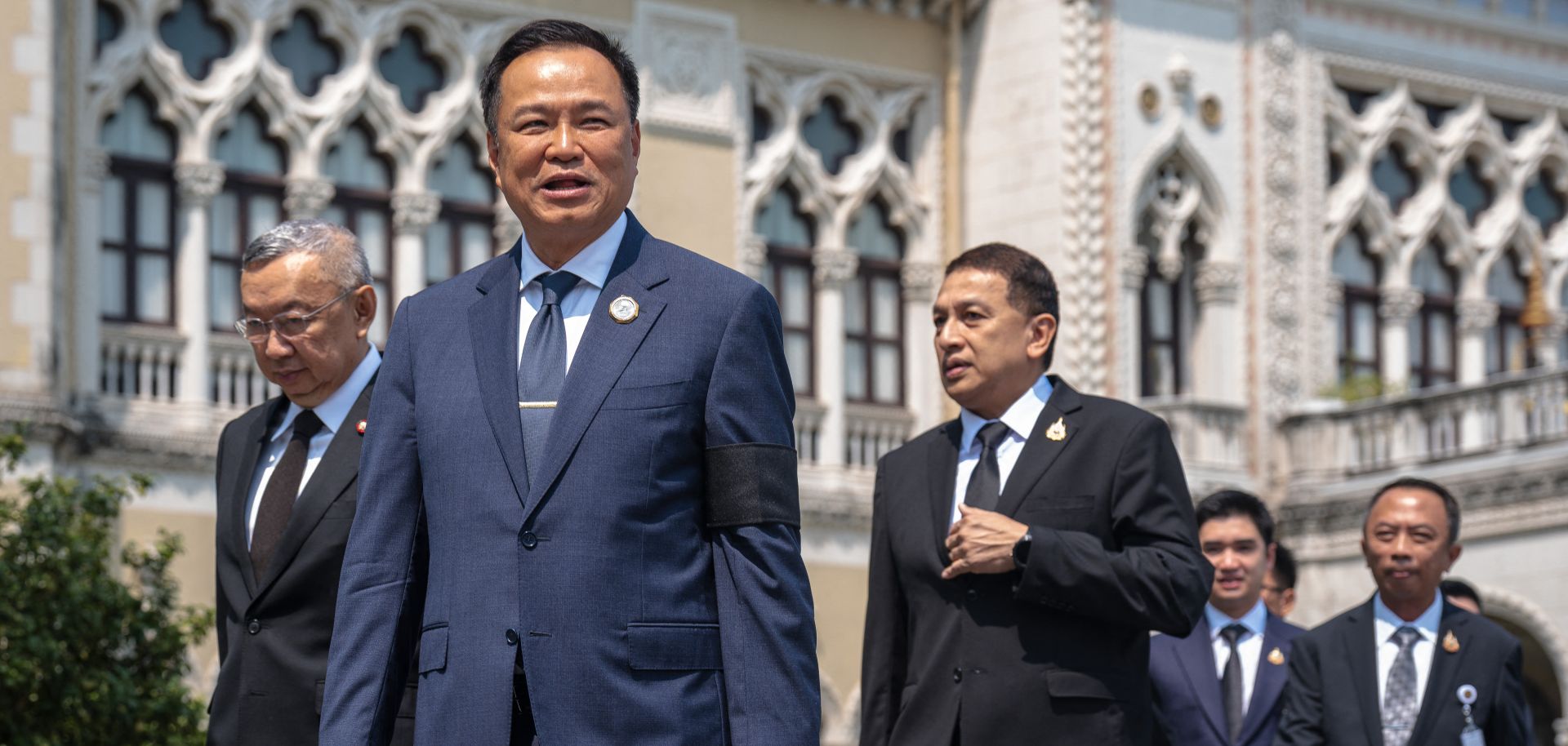
In Thailand, an electoral win for the incumbent conservative party will improve short-term political stability, but coalition politics, the power of entrenched institutions and uncertainty over the trajectory of constitutional reform will continue to constrain governance and sustain political risk. On Feb. 8, Thai Prime Minister Anutin Charnvirakul's center-right Bhumjaithai Party won a decisive plurality in snap general elections. With roughly 95% of votes counted as of Feb. 11, Bhumjaithai was projected to win about 193 of 500 seats, well short of an outright majority but far ahead of the progressive opposition People's Party, which won roughly 118 seats, and the center-left Pheu Thai Party, which won roughly 74 seats. Coalition talks began immediately, with the People's Party publicly ruling out participation in an Anutin-led coalition, while Anutin emphasized the need for a robust majority and pledged tougher border measures and a stronger military posture. The result was widely interpreted as a consolidation of the conservative vote around Anutin's campaign emphasis on border security, military readiness and national stability following the reemergence of border conflict with Cambodia in 2025, while the People's Party significantly underperformed relative to pre-election polls. In parallel, nearly two-thirds of voters approved a constitutional referendum to begin the process of replacing the 2017 charter. The vote authorizes initiating a drafting pathway but does not itself produce a new constitutional text. Meanwhile, the post-vote political environment also shifted quickly against the reformist bloc. On Feb. 9, Thailand's National Anti-Corruption Commission announced findings that 44 former lawmakers from the former Move Forward Party (the People's Party's banned predecessor), including 10 who won seats in the Feb. 8 polls, breached ethical standards over a past push to amend Thailand's royal defamation law, with the matter to be forwarded to the Supreme Court, whose decision could could affect parliamentary arithmetic if judges suspend or ban the candidates from office.
- The snap election was called in December 2025 as Anutin sought to capitalize on nationalist sentiment generated by that year's recurring conflict with Cambodia.
- Bhumjaithai increased its representation dramatically from just 71 seats it won in the last elections in 2023; the People's Party and its predecessor, Move Forward, collectively saw a reduction from 151 seats in 2023, while Pheu Thai's share fell from 141 seats in 2023, illustrating a significant realignment in parliamentary strength.
- Separately, the post-election environment has seen growing pressure on the Election Commission over transparency in vote counting. The opposition People's Party has requested recounts in 18 constituencies following public allegations of irregularities, while independent watchdogs have logged thousands of complaints nationwide. Although results have not yet been certified and no irregularities have been confirmed, the scrutiny has sparked small protests and could delay certification.
The outcome largely validated a recent dynamic in Thai politics that elections decide the distribution of seats, but institutional constraints, party fragmentation and post-vote legal and coalition maneuvers dictate who governs, with security and economic conditions further favoring conservative rule. For decades, Thailand's political system has been shaped by the military's recurring role as an extra-electoral arbiter of power, intervening directly through coups or indirectly through constitutions and oversight bodies designed to limit the authority of elected governments. This dynamic took on a more institutionalized form after the 2014 coup and became especially consequential after the 2019 elections, when a new constitutional framework ensured that electoral outcomes were subject to the acquiescence of appointed and judicial institutions in which the military has strong influence. The 2023 electoral cycle in Thailand illustrated how institutional and coalition factors can sideline electoral winners. Although the reformist Move Forward Party won the most seats, it failed to secure sufficient support in the prime ministerial vote after the military-appointed Senate withheld backing under constitutional rules, enabling Pheu Thai to subsequently form a government without Move Forward. The 2026 vote occurred after a volatile pre-election period in which constitutional and oversight bodies repeatedly intervened in politics, contributing to high polarization and voter skepticism that any single ballot would settle Thailand's underlying distribution of power. The emergence of recount demands and transparency disputes following the vote reinforces this pattern, in which post-election processes and oversight mechanisms become focal points for political contestation after headline results are clear. Moreover, the ethics case announced by the National Anti-Corruption Commission, including newly elected People's Party lawmakers, will reduce the reformist bloc's effective strength and complicate its ability to operate as a coherent parliamentary counterweight. Security conditions also mattered more than in the most recent Thai elections. The focus on security and border stability during the campaign favored conservative narratives around order and continuity, helping Bhumjaithai broaden its appeal. At the same time, while voters backed initiating constitutional reform, their support for the conservative Bhumjaithai to lead the government over reformist parties like the People's Party indicates popular concerns over security and ambivalence toward rapid or far-reaching change. Finally, the economic backdrop heightened the costs of post-election instability. Slowing growth, elevated household debt and exposure to external shocks, like a 19% U.S. tariff rate on Thai goods, have increased the political value of continuity, pushing coalition negotiations toward short-term economic management and risk avoidance rather than more disruptive policy shifts.
The election result improves Anutin's prospects for forming a stable government, but coalition dynamics, institutional intervention risks and uncertain constitutional change will favor cautious, piecemeal policymaking. With his party holding more than 190 seats, the most likely outcome is an Anutin-led coalition able to assemble a working majority, stabilizing the political environment and bringing continuity in economic policy with an emphasis on stimulus and debt management. Despite the People's Party's refusal to join a Bhumjaithai-led coalition, its influence, and therefore legislative check on Bhumjaithai, will be further reduced by ongoing legal and ethical proceedings that could lead to suspensions or disqualifications that weaken its parliamentary influence. To this end, Anutin has indicated confidence that a Bhumjaithai-led coalition government could serve a full term, which, if realized, would mark a departure from Thailand's recent pattern of rapid executive turnover and frequent leadership change. Nevertheless, several constraints will continue to challenge this vision. First, there is uncertainty about Anutin's coalition partners. While the coalition is highly likely to incorporate smaller parties with aligned policy interests, Bhumjaithai will struggle to secure the additional 60 seats needed for a majority solely through these parties. Therefore, coalition negotiations will likely involve Pheu Thai as well. This would reduce the risk of an early government collapse but could also result in slower decision-making due to conflicting policy goals in areas such as fiscal management, where Bhumjaithai favors a more cautious approach versus Pheu Thai's preference for populist spending. Meanwhile, even if vote transparency challenges do not materially alter seat distribution, recount requests and delayed certification could extend caretaker governance, complicate coalition negotiations and create early legitimacy headwinds for Anutin while he is seeking to project stability. Moreover, the referendum's approval to initiate drafting a new constitution raises expectations for reform while leaving fundamental questions unresolved, including the composition of the drafting body, sequencing of the process and the role of judicial review. This will force Anutin to manage a politically sensitive process he does not fully control, making his government vulnerable to criticism from both reformists and conservative institutions. Consequently, constitutional politics will likely become bogged down in procedural and legal disagreements, providing oversight institutions with repeated opportunities to narrow or delay reform efforts.
- There is likely to be little change in foreign and security policy under another Anutin government. Anutin's campaign emphasis on border control and military preparedness, combined with unresolved tensions along the Cambodia frontier, points toward a firmer security posture and sustained prominence for the armed forces in national decision-making. Any renewed border instability would further strengthen security institutions domestically and reduce political space for ambitious reform initiatives.
- Although Thailand and Cambodia agreed to a ceasefire in December 2025, the post-ceasefire period has been marked by continued forward military deployments, unresolved territorial disagreements and reciprocal diplomatic complaints, with troop deployments and security postures remaining largely unchanged. The absence of a comprehensive disengagement mechanism has kept border stability politically salient in Bangkok, reinforcing arguments for continuity in security policy and sustaining the military's domestic influence.
- Public debate and reformist proposals suggest any new constitution is most likely to focus on adjusting electoral rules, revising the composition or role of Thailand's appointed Senate and narrowing some powers of independent oversight bodies. Meanwhile, core provisions related to the monarchy, national security and the judiciary are unlikely to be amended. Proposals to alter the lese majeste framework, fundamentally reduce judicial authority or overhaul civil-military relations have consistently triggered institutional pushback in the past and are widely viewed by courts and conservative actors as red line issues, making their inclusion in any eventual charter improbable. As a result, constitutional change is more likely to recalibrate procedural balance within the existing system than to redistribute power away from entrenched institutions.
