
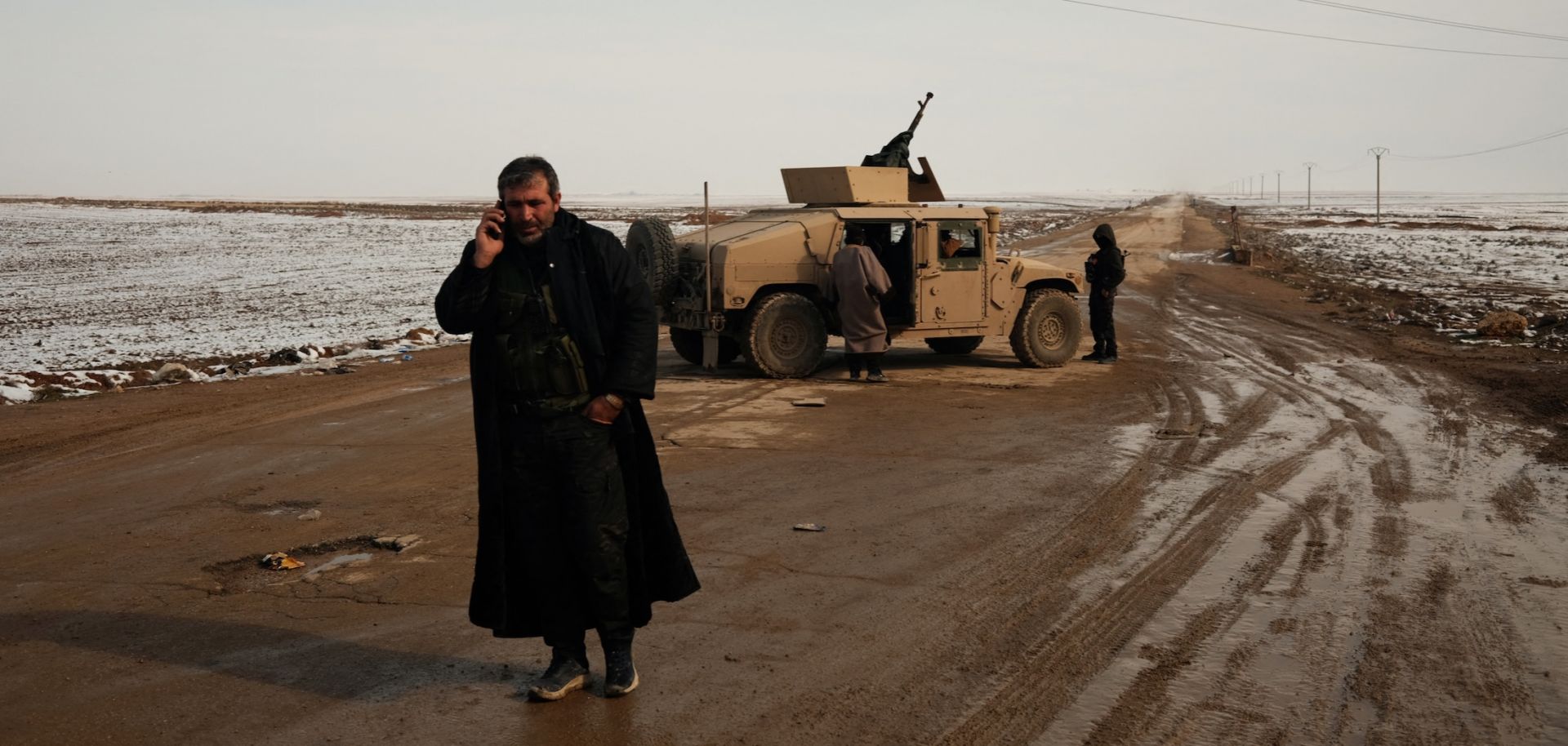
The new integration deal between the Syrian government and the Kurdish-led Syrian Democratic Forces (SDF) will modestly improve Syria's stability and state-building prospects, accelerate a U.S. military withdrawal and open space for a Syria-Israel security pact, though gains remain fragile due to risks of local violence and a persistent Islamic State threat. On Jan. 30, the SDF and the Syrian transitional government announced a broad agreement on the former's integration into the latter. The deal formalizes the Jan. 18 ceasefire that stopped recent clashes between the two sides, committing the SDF and the Syrian government to a broader cessation of hostilities. Key components of the agreement include a phased integration of select SDF units into the Syrian Defense Ministry, the deployment of Syrian Interior Ministry forces to Kurdish-majority cities like Qamishli and Hassakeh, the merger of Kurdish-led civil administrations into state institutions, and Syrian state assurances regarding Kurdish educational and citizenship rights. The deal also establishes a new military division incorporating three SDF brigades, as well as a separate brigade for forces in the SDF-held town of Kobani, which will be placed under the authority of the Aleppo governorate. The SDF's leadership publicly framed the agreement as a necessary compromise to avoid further bloodshed, while Damascus presented it as a step toward restoring sovereignty and territorial unity. The United States, which played a mediating role, welcomed the agreement as stabilizing and consistent with its priorities of combating the Islamic State.
- Local media outlets reported that Syrian state security forces are already deploying in parts of the northeast, including the city of Hassakeh, an SDF stronghold.
- On Jan. 16, Syrian interim President Ahmed al-Sharaa issued a decree formally affirming Kurdish Syrians as an essential component of the nation, granting citizenship to stateless Kurds, recognizing Kurdish as a national language with permitted instruction in schools, and declaring Nowruz a national holiday.
The integration deal was made possible by a combination of the Syrian government's battlefield gains and sustained U.S. pressure on both sides, breaking a months-long impasse in negotiations. In March 2025, the Syrian government and the SDF reached a preliminary understanding on security coordination and Kurdish political integration. Subsequent negotiations to hash out the details then stalled over Kurdish demands on governance, citizenship and cultural and linguistic rights, leaving implementation frozen for months. However, in early January, the Syrian military launched an offensive against the SDF, which resulted in the government gaining control of most of northeast Syria. This fundamentally shifted the balance of power toward Damascus and, in turn, made the Kurds more open to compromise, especially given diminished U.S. support. At the same time, the administration of U.S. President Donald Trump also ramped up its mediation efforts, pressuring both sides in parallel. The White House urged al-Sharaa's government to accommodate core Kurdish civil and educational demands to make integration politically viable, while simultaneously signaling to the SDF that continued autonomy was no longer strategically sustainable. Washington's messaging underscored its support for Syria's territorial unity and the central government's critical role in the fight against the Islamic State — a responsibility the formerly U.S.-backed SDF had held. Together with the Syrian government's battlefield gains, this U.S. pressure helped break the stalemate in negotiations, ultimately making an integration agreement possible.
- The March integration agreement also partially stalled as the SDF adopted a more maximalist negotiating posture, reinforced by the June outbreak of sectarian violence between Druze factions and government forces and the subsequent Israeli intervention, which led SDF leaders to assess that prolonged resistance could yield external backing similar to that extended to Druze militias.
- The United States' core objectives in Syria include preserving a united territorial state capable of leading operations to counter the Islamic State, preventing a security vacuum that could destabilize neighboring countries, curbing Iranian influence and militia entrenchment, and enabling durable security arrangements with Israel, all while reducing the need for a long-term U.S. military presence.
While the agreement could trigger localized violence from Kurdish individuals and hard-line SDF fighters, it will likely improve overall security by reducing sectarian tensions, easing pressure on the Syrian government. The increased deployment of Syrian security forces to the northeast will make localized violence there more likely. Aggrieved Kurdish individuals and hard-line SDF fighters may try to sabotage integration efforts by attacking state forces, which would risk triggering government crackdowns. Undisciplined government elements could also independently target Kurdish communities. However, the agreement will likely reduce sectarian tensions by preventing a violent takeover of Kurdish-majority areas by Syrian security forces. This will, in turn, reduce the risk of widespread sectarian violence, including revenge killings, seen during the Alawite insurgency over the past year. A complete stabilization of security across Syria will likely remain constrained by deeply rooted sectarian grievances within the country's diverse society and by hard-line elements within the provisional government. However, overall security conditions are expected to improve following the Kurdish integration deal — not the least because it will also reduce the risk of the United States reimposing sanctions on the Syrian government, easing pressure on Damascus and boosting confidence in the state's territorial consolidation. This will open the door for investments in Syria's reconstruction, infrastructure and, with the state now controlling the oil-rich northeast, energy sector.
- During the renewed Syrian offensive against the SDF, U.S. Senator Lindsey Graham repeatedly called on Washington to support the Kurds and warned Damascus against entering Kurdish-majority cities by force, lest it risk the reimposition of broad U.S. sanctions.
- In December 2025, the U.S. Congress passed and President Trump signed the National Defense Authorization Act (NDAA), which repealed the Caesar Syria Civilian Protection Act of 2019. This removed the main U.S. sanctions restricting foreign investment in Syria after the fall of the Bashar al Assad regime in December 2024. However, the NDAA includes a mandatory 180-day presidential reporting requirement to Congress on benchmarks like counter-Islamic State efforts and minority protection. This mechanism could deter investments and enable renewed punitive measures if the Syrian government fails to meet the conditions.
A U.S. military drawdown from Syria is now more likely, with Damascus and its regional partners assuming responsibility for anti-Islamic State efforts, though they are unlikely to fully neutralize the threat posed by the jihadist group. The United States had previously worried that a rapid exit from Syria would create a security vacuum that could be exploited by the Islamic State. But with the Syrian government joining the anti-Islamic State coalition and gaining control of the northeast (including prisons and camps for Islamic State detainees), it will now become the primary authority leading the fight against the jihadist group, thereby reducing U.S. concerns. This will further incentivize the United States to complete its planned military withdrawal from Syria in the coming months. However, the Islamic State will remain a threat due to recent prisoner escapes during the government offensive, overstretched Syrian forces and the military's limited intelligence, surveillance and reconnaissance (ISR) capabilities. Consequently, regional countries — including Turkey, Jordan and Iraq — will likely assume larger roles in helping Syria combat the Islamic State. The United States, meanwhile, will likely retain a residual function focused on training and ISR support, rather than direct combat. But without U.S. troops on the ground and their advanced counterterrorism capabilities, Syrian and regional forces will struggle to fully suppress Islamic State networks — thereby allowing the group to retain the ability to conduct sporadic attacks on urban areas, and recruit and move fighters across rural corridors.
- The recent Syrian offensive against the SDF saw a chaotic handover of detention facilities in northeastern Syria. During this period, around 120 Islamic State prisoners escaped from the Shaddadi prison, previously under SDF control. Syrian authorities have reportedly recaptured 81 escapees, though the rest are still at large.
U.S. diplomatic pressure and momentum from the Jan. 30 deal will increase the likelihood of a Syria-Israel security pact in the coming months, but any such pact will be highly fragile, constrained by Israeli risk intolerance and potential sectarian violence. As it seeks a greater disengagement from Syria, the United States is now also more likely to pressure Israel and Syria to reach a broader security pact, building on the momentum of the Syria-SDF integration deal. Such a security pact would center on a demilitarized southern buffer zone, guarantees for Druze communities and a phased Israeli withdrawal from Syrian territory. U.S. diplomatic pressure will primarily target Israel, as Syria is more incentivized to reach a deal that would deter Israeli attacks and stabilize its security. However, several structural constraints will complicate any future agreement, including Israel's maximalist demands and ongoing ties with Druze militias. Israel's new, less risk-tolerant security posture also means any action by Damascus perceived as a security threat will likely trigger Israeli airstrikes. Additionally, worsening rivalry and violence on the ground among Bedouin groups, Druze factions and government-linked security forces will create an ongoing risk of localized clashes that could undermine a future Israel-Syria security pact.
- Unverified media reports suggest President Trump is pressing Israeli Prime Minister Benjamin Netanyahu to strike a deal with Syria within one month.
- During negotiations with Syria, Israel has repeatedly pressed for a comprehensive demilitarization of southern Syria, including the creation of demilitarized zones with strict limits on Syrian forces and heavy weapons deployment, and a no-fly zone in areas southwest of Damascus extending to the Golan Heights that Israel can use for attacks throughout the region. Israeli proposals have also linked any Syrian troop withdrawal to enduring Israeli control over strategic positions such as Mount Hermon and a humanitarian corridor to the Druze majority area of Suwayda, conditions that Damascus sees as infringements on sovereignty and hard to accept.
