
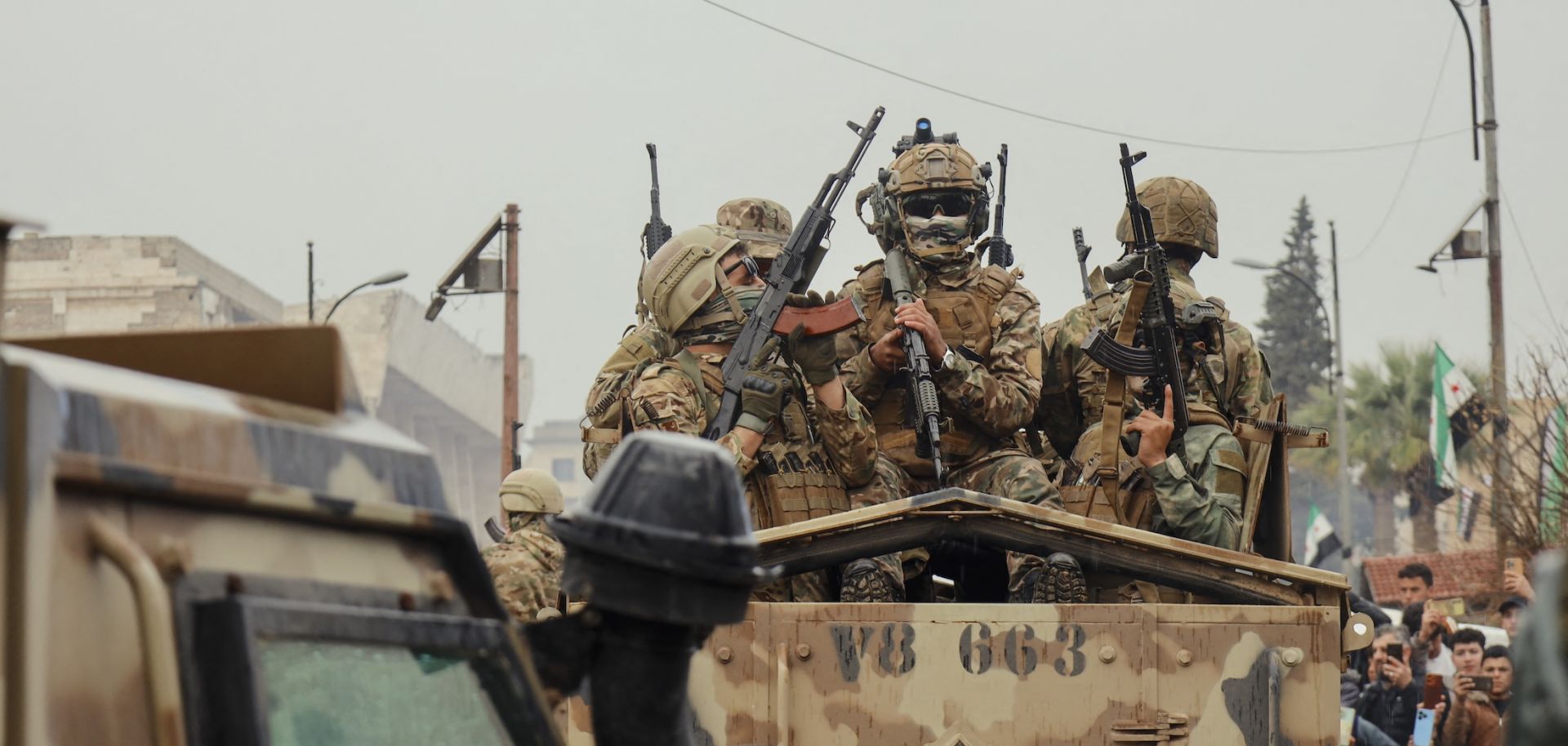
Despite Turkish training and weapons, Syria's military capabilities will remain limited amid the government's reliance on loyalists and efforts to consolidate power, slowing the integration of minority militias into the Defense Ministry and incentivizing the government to reach a comprehensive security agreement with Israel. Over the past several months, the interim Syrian government has taken steps to rebuild its army after President Ahmad al-Sharaa formally dissolved the remnants of the Assad-era military structure in late January 2025, ousting remaining leaders loyal to the former regime and calling for all nonstate armed militias to dissolve and merge under the Ministry of Defense. As of June, the nascent army had reportedly recruited around half of its goal of 200,000 men, mostly from al-Sharaa's Hayat Tahrir al-Sham, or HTS, as well as allied rebel groups that supported the HTS's overthrow of former President Bashar al Assad in December 2024. In late October 2025, the Turkish defense ministry announced that Turkey would allow Syrian soldiers to use its barracks within Turkey and receive training to enhance their military capabilities. Already, an initial cohort of 49 Syrians has enrolled in Turkish military academies to study and eventually become officers in the Syrian army. But even with Turkish efforts to professionalize the Syrian military, a Dec. 11 report in The New York Times indicated that HTS loyalists are being appointed to high-level positions in the army, not for their previous fighting experience or aptitude, but rather their ideological alignment with and personal ties to al-Sharaa.
- In August 2025, Turkey and Syria signed a military cooperation agreement in which Turkey agreed to provide military training, logistical support and weapons to Syria, not only to strengthen the Syrian central government's capabilities but also to expand Turkey's influence in Syria. Furthermore, Turkey and Syria have been in discussions for Turkey to establish military bases in central Syria, where Turkey previously expressed interest in deploying air defense systems and/or drones.
- The same New York Times report noted that a significant portion of Syrian military training includes Islamic religious instruction that has an ideological component but no relevance to improving the military's capabilities.
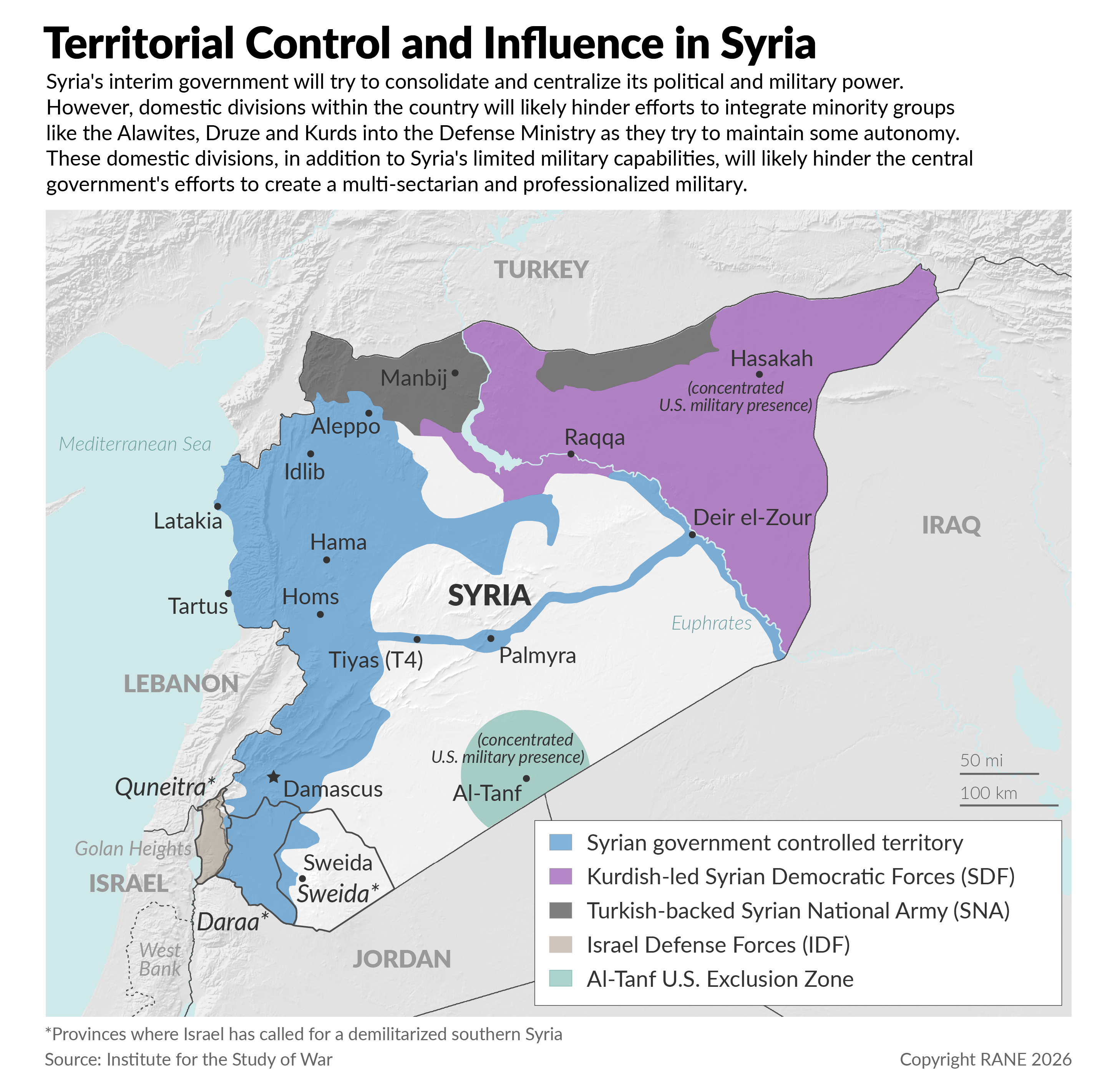
These developments come as al-Sharaa seeks to rebuild Syria's military and centralize power under state institutions. The Syrian military's capabilities were severely degraded from late 2024 to early 2025 by a series of Israeli airstrikes that attacked Assad-era weapons caches, as well as remaining Syrian naval and aerial assets, to minimize the risk that the new Syrian military could use them against Israel. Since then, al-Sharaa has faced challenges in rebuilding Syria's military capabilities and in establishing new state institutions under his interim administration. To this end, al-Sharaa has prioritized efforts to centralize power under his leadership to boost the government's domestic and international legitimacy, and he has also worked to integrate ethnic and religious minorities, as well as non-HTS-aligned militias, into the government to promote domestic stability. As part of these policies, al-Sharaa formally dissolved HTS into the Ministry of Defense and incorporated some smaller allied militias and foreign fighters that supported HTS's takeover. Nonetheless, multiple key minority groups — which comprise around 25% of Syria's population — including the Druze, Alawites and Kurds, have resisted integrating into the state institutions after spates of violent clashes with government forces, which have led them to seek to maintain some autonomy, especially regarding their defense.
- Shortly after the December 2024 collapse of the Assad regime, the Israel Defense Forces estimated that its airstrikes had degraded 70%-80% of Syria's remaining strategic capabilities, which at the time included some fighter jets, naval vessels and air defense systems.
- In May, the U.S.-backed and Kurdish-led Syrian Democratic Forces, or SDF, signed a deal with al-Sharaa to integrate itself and northeastern Kurdish-led institutions into the state, but little concrete progress has been made. A preliminary agreement signed in December 2025 proposed that the SDF would establish three divisions within the federal military controlled by the Ministry of Defense, though key additional details, including the organizational structure and roles of those divisions, remain unresolved.
Al-Sharaa will likely prioritize loyalty among high-ranking military officers over the next several years to shore up his government's stability, slowing the military's professionalization and the integration of ethnic and religious minorities into the Syrian armed forces. The professionalizing impacts of Turkey's military training initiatives will likely be constrained by al-Sharaa's appointment of key allies to important military positions, despite their lack of qualifications; while many of al-Sharaa's more experienced appointees have commanded forces in HTS-controlled Idlib province, they have not previously served in a formal military, and some of his new recruits who did not fight with HTS in Idlib likely have little fighting experience at all. Moreover, many of al-Sharaa's military leadership appointees, including some foreign fighters, are Sunni ideologues, with no representation in the senior command from the ethnic and religious minorities that al-Sharaa intends to integrate. These ideologically homogenous appointments demonstrate al-Sharaa's efforts to exert influence over the military, in part to mitigate the risk of a coup against him amid divisions between the central government and minority militias, as well as between al-Sharaa — who has disavowed his jihadist past and adopted a more moderate approach — and hard-liners within his government. However, the emerging military's Islamist leanings and rules, as well as a lack of minority representation among the commanders, are likely to alienate less religious or secular trainees, not to mention ethnic and religious minorities. This will likely harm efforts to integrate the SDF, Druze and Alawites into the new Syrian military, and at least some trainees may become disenchanted with the military organization and drop out, hindering the Syrian government's ambitions to establish a multi-sectarian, professionalized armed forces.
- The 84th Division of Syria's army includes thousands of foreign fighters, primarily Uyghurs. China, in particular, has raised concerns about the integration of Uyghur militants and potential security threats arising from it. Conversely, in June, U.S. special envoy to Syria Tom Barrack acknowledged the United States' tacit agreement to their inclusion, citing their loyalty to al-Sharaa and security concerns that could arise if they were excluded from the Syrian government.
These internal divisions, as well as constraints on foreign military aid from countries like Turkey, will likely limit the Syrian military's capabilities over the next few years, likely motivating the government to eventually reach a more comprehensive security agreement with Israel and refrain from forcibly integrating militias. Turkish cooperation will likely enable Syria to expand some of its military capabilities, especially regarding radar systems, drones and armed vehicles, but even so, there will likely be a limit to the types of weapons and defense systems that Syria will be able to access. For one, there is still a risk — albeit a low one — that internal divisions will lead to the overthrow of the interim Syrian government, which could result in rival militias or jihadist groups within Syria obtaining sensitive weapons systems. This risk will place an upper limit on the types of weapons foreign suppliers are willing to transfer. Second, even though Turkish-Israeli tensions remain elevated due to Israel's military operations in Gaza and Israel's aggressive regional approach in 2025, Turkey is highly unlikely to provide Syria with advanced weapons systems that could potentially be used against Israel — such as advanced jets or air defense systems — to avoid provoking Israel or causing friction with the United States. As a result, the Syrian army's capabilities will remain limited, which will constrain its ability to implement a more assertive policy against Israel and could even incentivize Syria to reach a more comprehensive security agreement with Israel over the next two to three years, though mistrust remains. Though such an agreement would likely favor Israel, the Syrian government may be able to avoid making certain concessions, such as allowing Israel to retain all of its positions within Syrian territory, since the United States did not condition sanctions relief on a deal. Meanwhile, the Syrian army's limited capabilities will likely also prevent it from attempting to force militias to integrate into the Defense Ministry over the next year, particularly since any major operation against groups like the SDF or the Druze could trigger U.S. or Israeli intervention, respectively. However, U.S. support for the SDF has declined, and the Syrian army could become increasingly likely to attempt to force the SDF to integrate if Turkey signals strong backing and additional military support. Regardless, militias will focus on consolidating their capabilities during Syria's uncertain transition period, making another full-scale domestic conflict unlikely in the immediate wake of the Syrian civil war. Still, sporadic clashes between Syrian troops and armed militias are likely to continue amid persistent divergences between the central government and minority groups.
- Israel and Syria have been negotiating a security agreement to de-escalate bilateral tensions for several months. On Jan. 6, Syrian and Israeli officials agreed to a "fusion mechanism" to share intelligence and enable de-escalation. However, a more comprehensive agreement remains subject to impasses, including al-Sharaa's demands that Israel completely withdraw from Syrian territory gained after the fall of the Assad regime.
